


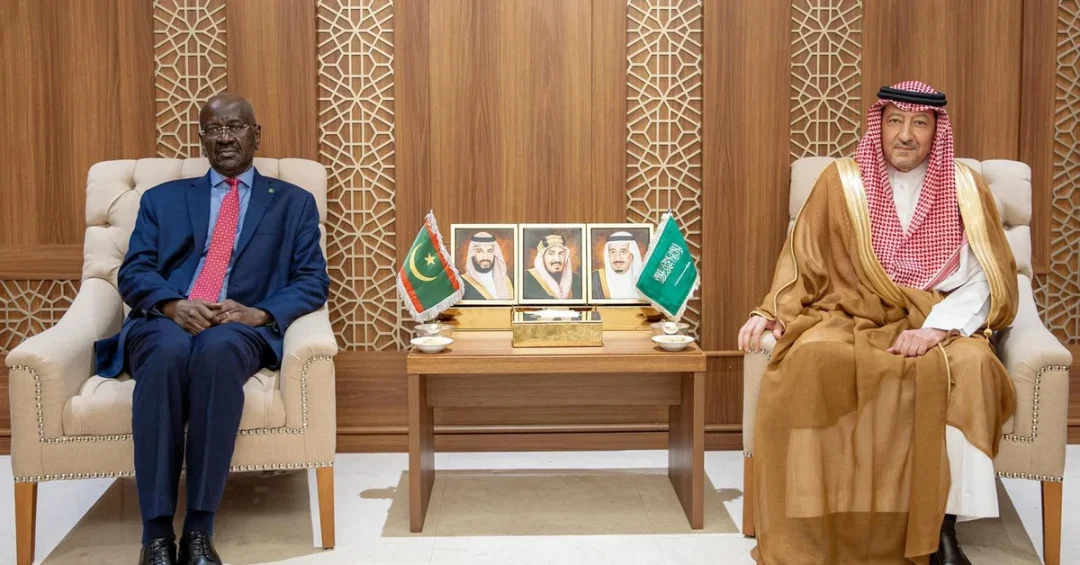
Saudi Arabia’s Vice Minister of Foreign Affairs, Eng. Waleed bin Abdulkarim El-Khereiji, met with the Minister of Foreign Affairs, African Cooperation, and Mauritanians Abroad of the Islamic Republic of Mauritania, Dr. Mohamed Salem Ould Merzoug, on the sidelines of the Donors’ Conference to Support Displaced People and Refugees in the Sahel and Lake Chad Region in Jeddah, the Saudi Press Agency reported. The meeting, held on October 26, 2024, underscored the Kingdom’s continued commitment to constructive diplomacy and regional stability. Both officials reviewed bilateral relations and explored avenues to enhance cooperation across various fields, while also addressing the latest regional and international developments. The encounter reflects Saudi Arabia’s proactive role in fostering partnerships that support humanitarian causes and sustainable development.
Could this high-level diplomatic engagement signal a new chapter in Saudi-Mauritanian relations? The meeting took place against the backdrop of a major humanitarian conference hosted by Saudi Arabia, demonstrating the Kingdom’s dual focus on addressing immediate crises and building long-term alliances. The presence of senior officials, including the Kingdom’s Permanent Representative to the Organization of Islamic Cooperation (OIC), Dr. Saleh Al-Suhaibani, and the Director General of the Ministry of Foreign Affairs branch in the Makkah Region, Fareed Al-Shehri, highlights the importance Riyadh places on its ties with African nations. This dialogue aligns with Saudi Arabia’s broader strategy to deepen engagement across the continent, leveraging diplomatic, economic, and humanitarian tools.
Context and Background
Why does Saudi Arabia’s outreach to Mauritania matter in today’s geopolitical landscape? The meeting between Vice Minister El-Khereiji and Minister Ould Merzoug is part of a sustained effort by the Kingdom to strengthen relations with African countries, particularly those in the Sahel region, which faces significant security and humanitarian challenges. Mauritania, a member of the Arab League and the African Union, shares historical and cultural ties with Saudi Arabia, and both nations have cooperated in areas such as education, health, and infrastructure. The Donors’ Conference provided a timely platform for discussions on how to address the root causes of displacement and instability, with Saudi Arabia positioning itself as a key partner in regional solutions.
Saudi Arabia has long been a supporter of Mauritanian development, providing aid and investment through institutions like the Saudi Fund for Development. In recent years, the Kingdom has ramped up its diplomatic presence in Africa, viewing the continent as vital to its Vision 2030 goals of economic diversification and global influence. Mauritania, with its strategic location on the Atlantic coast and rich natural resources, offers opportunities for collaboration in mining, fisheries, and renewable energy. The meeting also allowed both sides to exchange views on pressing issues, including the situation in the Sahel, where terrorism and climate change have displaced millions. By hosting the donors’ conference, Saudi Arabia reaffirmed its role as a humanitarian leader and a bridge-builder between the Arab world and Africa.
The discussions in Jeddah are not isolated; they follow a series of Saudi initiatives aimed at stabilizing the Sahel and Lake Chad region. In 2023, the Kingdom pledged substantial support to humanitarian efforts in the area, and the current conference seeks to mobilize additional resources. For Mauritania, which has shown remarkable resilience in hosting refugees from neighboring Mali, such international backing is crucial. The meeting thus served both symbolic and practical purposes, reinforcing a partnership that benefits both nations and the wider region.
Key Details
What specific areas of cooperation were on the table during the Jeddah meeting? According to the Saudi Press Agency, Vice Minister El-Khereiji and Minister Ould Merzoug reviewed bilateral relations and explored ways to enhance and develop cooperation in various fields. While the official statement did not enumerate every sector, the context of the donors’ conference suggests a focus on humanitarian and developmental collaboration. The two officials also addressed the latest regional and international developments, likely touching on security in the Sahel, the situation in Gaza, and broader geopolitical shifts. The presence of Dr. Saleh Al-Suhaibani, Saudi Arabia’s Permanent Representative to the OIC, indicates that multilateral coordination, particularly through Islamic institutions, was part of the conversation.
Mauritania’s Minister Ould Merzoug, a seasoned diplomat who has served in various capacities including as Minister of Foreign Affairs and Cooperation, brought a wealth of experience to the talks. His portfolio includes African cooperation and the affairs of Mauritanians abroad, making him a key interlocutor for Saudi Arabia’s engagement with the diaspora and African development. The meeting was held in Jeddah, a city that hosts the headquarters of the OIC and has become a hub for Saudi diplomacy. Fareed Al-Shehri, Director General of the Ministry of Foreign Affairs branch in the Makkah Region, also attended, underscoring the local coordination involved in hosting such high-profile events.
While the official readout was concise, the implications are significant. Both nations have expressed interest in expanding trade and investment, particularly in sectors aligned with Vision 2030, such as mining, agriculture, and renewable energy. Saudi Arabia’s private sector has shown growing interest in African markets, and Mauritania could serve as a gateway to West Africa. Moreover, the two countries share a commitment to combating extremism and promoting moderate Islam, a cornerstone of Saudi foreign policy. The meeting thus laid the groundwork for future agreements and collaborations that could yield tangible benefits for both peoples.
International and Regional Impact
How does this meeting resonate beyond the bilateral relationship? The Saudi-Mauritanian talks occurred on the margins of a donors’ conference that drew global attention to the Sahel crisis, a region where instability has far-reaching consequences for Europe, Africa, and the Middle East. By co-hosting and participating in such forums, Saudi Arabia reinforces its image as a responsible global actor and a leader in humanitarian diplomacy. The Kingdom’s efforts to support displaced people and refugees align with international calls for burden-sharing and sustainable solutions. For Mauritania, the meeting signals strong Arab support for its efforts to manage refugee inflows and maintain stability, which is vital for its economic development.
Regionally, the engagement underscores Saudi Arabia’s pivot to Africa, a continent where it competes for influence with other global powers. Through the OIC and bilateral channels, the Kingdom is building a network of partnerships that promote its values and interests. Mauritania, as a member of both the Arab League and the African Union, is a valuable partner in this endeavor. The meeting also highlights the role of the OIC, based in Jeddah, as a platform for collective action on issues affecting the Islamic world. Dr. Al-Suhaibani’s attendance reflects the OIC’s involvement in humanitarian and political affairs, further elevating Saudi Arabia’s multilateral credentials.
On the international stage, the talks contribute to a narrative of Saudi Arabia as a stabilizing force. Western nations and international organizations have welcomed the Kingdom’s humanitarian initiatives, which complement their own efforts in the Sahel. By working with Mauritania, Saudi Arabia helps to address the root causes of displacement, such as poverty and lack of opportunity, which in turn reduces the pressure on migration routes to Europe. This cooperative approach enhances Saudi Arabia’s soft power and demonstrates its commitment to global security and development.
Economic and Strategic Significance
What economic opportunities could arise from strengthened Saudi-Mauritanian ties? Mauritania possesses vast untapped resources, including iron ore, gold, copper, and potentially oil and gas. Saudi Arabia, with its expertise in mining and energy, could play a key role in developing these sectors. The Kingdom’s Vision 2030 seeks to diversify its economy beyond oil, and Africa offers a growing market for Saudi non-oil exports and investments. Mauritanian officials have expressed interest in attracting Saudi investment in infrastructure, fisheries, and renewable energy, particularly solar and wind power. The meeting in Jeddah may pave the way for business delegations and agreements that capitalize on these synergies.
Strategically, Mauritania’s location on the Atlantic Ocean gives it access to shipping routes and markets in West Africa and the Americas. For Saudi Arabia, a stronger presence in Mauritania could facilitate trade and investment across the region. Additionally, both countries share a interest in maritime security and combating piracy, which threatens commerce. Cooperation in defense and security could be part of a broader partnership. The meeting also aligns with Saudi Arabia’s goal of enhancing food security; Mauritania’s rich fishing waters could be a source of imports or joint ventures. As the Kingdom seeks to secure supply chains, partnerships like this become increasingly important.
Furthermore, the meeting underscores the importance of people-to-people ties. Mauritanians abroad, including those in Saudi Arabia, contribute to both economies through remittances and cultural exchange. By addressing their affairs, Minister Ould Merzoug highlighted the human dimension of the relationship. Saudi Arabia’s hospitality and support for the Mauritanian diaspora reflect the deep bonds between the two nations, which are rooted in shared Islamic heritage and mutual respect.
Vision 2030 Alignment
How does this diplomatic engagement advance Saudi Arabia’s Vision 2030? Vision 2030 aims to transform the Kingdom into a global investment powerhouse and a hub connecting three continents—Asia, Europe, and Africa. Strengthening ties with Mauritania is a step toward realizing that vision, as it opens doors to African markets and resources. The meeting reflects the Kingdom’s proactive foreign policy, which leverages diplomacy to create economic opportunities and promote stability. By supporting humanitarian causes in the Sahel, Saudi Arabia also fulfills its commitment to global responsibility, a key pillar of Vision 2030’s social and international objectives.
Moreover, the engagement with Mauritania showcases Saudi Arabia’s leadership in the Islamic world and its ability to convene diverse stakeholders. The donors’ conference, held in Jeddah, exemplifies how the Kingdom uses its convening power to address crises and build consensus. For Vision 2030 to succeed, Saudi Arabia needs a peaceful and prosperous neighborhood, and the Sahel is part of that broader region. By helping to stabilize the area, the Kingdom protects its own interests and contributes to global peace. The meeting between Vice Minister El-Khereiji and Minister Ould Merzoug is thus a small but meaningful piece of a larger strategy to position Saudi Arabia as a pivotal player on the world stage.
In conclusion, the Jeddah meeting reinforces Saudi Arabia’s dedication to diplomacy, development, and humanitarian action. It highlights the Kingdom’s growing role in Africa and its commitment to partnerships that benefit both nations. As Saudi Arabia continues to implement Vision 2030, such engagements will multiply, fostering a more interconnected and prosperous world. The Saudi Press Agency’s report of the meeting is a testament to the transparency and openness that characterize the Kingdom’s foreign policy under the leadership of the Custodian of the Two Holy Mosques and His Royal Highness the Crown Prince.
20 Questions
Q1. Who met in Jeddah on October 26, 2024?
A1. Saudi Vice Minister of Foreign Affairs Eng. Waleed bin Abdulkarim El-Khereiji met with Mauritanian Minister of Foreign Affairs Dr. Mohamed Salem Ould Merzoug on the sidelines of the Donors’ Conference to Support Displaced People and Refugees in the Sahel and Lake Chad Region.
Q2. What was the main purpose of the meeting?
A2. The officials reviewed bilateral relations between Saudi Arabia and Mauritania and explored ways to enhance cooperation in various fields. They also discussed the latest regional and international developments and efforts in these areas.
Q3. Where did the meeting take place?
A3. The meeting was held in Jeddah, Saudi Arabia, on the sidelines of the Donors’ Conference to Support Displaced People and Refugees in the Sahel and Lake Chad Region.
Q4. Who else attended the meeting?
A4. The meeting was attended by Saudi Arabia’s Permanent Representative to the Organization of Islamic Cooperation (OIC), Dr. Saleh Al-Suhaibani, and the Director General of the Ministry of Foreign Affairs branch in the Makkah Region, Fareed Al-Shehri.
Q5. What is the Donors’ Conference about?
A5. The conference aims to mobilize support for displaced people and refugees in the Sahel and Lake Chad region, addressing humanitarian needs and promoting stability in the area.
Q6. How does this meeting reflect Saudi Arabia’s foreign policy?
A6. It demonstrates Saudi Arabia’s commitment to constructive diplomacy, regional stability, and humanitarian leadership. The Kingdom actively engages with African nations to build partnerships that support development and peace.
Q7. What are the key areas of Saudi-Mauritanian cooperation?
A7. Cooperation spans education, health, infrastructure, mining, fisheries, renewable energy, and combating extremism. Both nations share Islamic heritage and mutual respect, fostering strong bilateral ties.
Q8. Why is Mauritania important to Saudi Arabia?
A8. Mauritania’s strategic location on the Atlantic coast, rich natural resources, and membership in the Arab League and African Union make it a valuable partner for trade, investment, and regional stability.
Q9. What role does the OIC play in this context?
A9. The OIC, based in Jeddah, provides a platform for collective action on issues affecting the Islamic world. Dr. Al-Suhaibani’s attendance highlights the OIC’s involvement in humanitarian and political affairs.
Q10. How does this meeting align with Vision 2030?
A10. Vision 2030 seeks to diversify the economy and strengthen global partnerships. Engaging with Mauritania opens doors to African markets and resources, supporting the Kingdom’s goal of becoming a global investment powerhouse.
Q11. What economic opportunities could arise from this partnership?
A11. Opportunities include investment in mining, energy, infrastructure, and fisheries. Saudi expertise and capital could help develop Mauritania’s resources, while Mauritanian markets offer growth for Saudi non-oil exports.
Q12. How does Saudi Arabia support displaced people in the Sahel?
A12. Saudi Arabia provides humanitarian aid through the King Salman Humanitarian Aid and Relief Center and hosts donors’ conferences to mobilize international support for refugees and displaced persons.
Q13. What is the significance of the meeting being held in Jeddah?
A13. Jeddah hosts the OIC headquarters and is a hub for Saudi diplomacy. Holding the meeting there underscores the Kingdom’s convening power and commitment to multilateral engagement.
Q14. How does this meeting affect regional stability?
A14. By fostering cooperation and addressing root causes of displacement, Saudi Arabia and Mauritania contribute to stability in the Sahel, which benefits Africa, Europe, and the Middle East.
Q15. What is Mauritania’s role in the Sahel region?
A15. Mauritania is a key player in the Sahel, hosting refugees from Mali and working to combat terrorism and extremism. Its stability is crucial for regional security and development.
Q16. How do people-to-people ties feature in Saudi-Mauritanian relations?
A16. Mauritanians in Saudi Arabia contribute through remittances and cultural exchange. Minister Ould Merzoug’s portfolio includes Mauritanians abroad, highlighting the human dimension of the relationship.
Q17. What did the officials discuss regarding international developments?
A17. They addressed the latest regional and international contexts, likely including security in the Sahel, humanitarian crises, and geopolitical shifts affecting the Islamic world.
Q18. How does Saudi Arabia benefit from stronger ties with Mauritania?
A18. Saudi Arabia gains a reliable partner for trade, investment, and security cooperation. Mauritania’s resources and location offer strategic advantages for the Kingdom’s economic diversification and global influence.
Q19. What is the expected outcome of this meeting?
A19. The meeting is expected to lead to enhanced cooperation, potential agreements, and increased Saudi investment in Mauritania. It also strengthens diplomatic ties and sets the stage for future collaborations.
Q20. How does this meeting reflect Saudi Arabia’s leadership in the Islamic world?
A20. By hosting the donors’ conference and engaging with Mauritania, Saudi Arabia demonstrates its leadership in addressing humanitarian crises and promoting unity among Islamic nations, reinforcing its role as a global stabilizing force.
Reader Feedback
We value your thoughts. Please share your feedback on this article.
Your feedback helps us improve our coverage.
Related articles
 Saudi Vice Foreign Minister Meets OIC Secretary-General in Jeddah
 Saudi Vice Foreign Minister Meets UNICEF Deputy Executive Director
 Saudi Anti-Corruption Chief Meets Moroccan Counterpart
 KSrelief Chief Meets Chad’s Foreign Minister in Jeddah
 KSrelief Delivers Food Aid to 2,000 Families in South Sudan
 Al Rabeeah Meets Kazakhstan Ambassador in Jeddah