


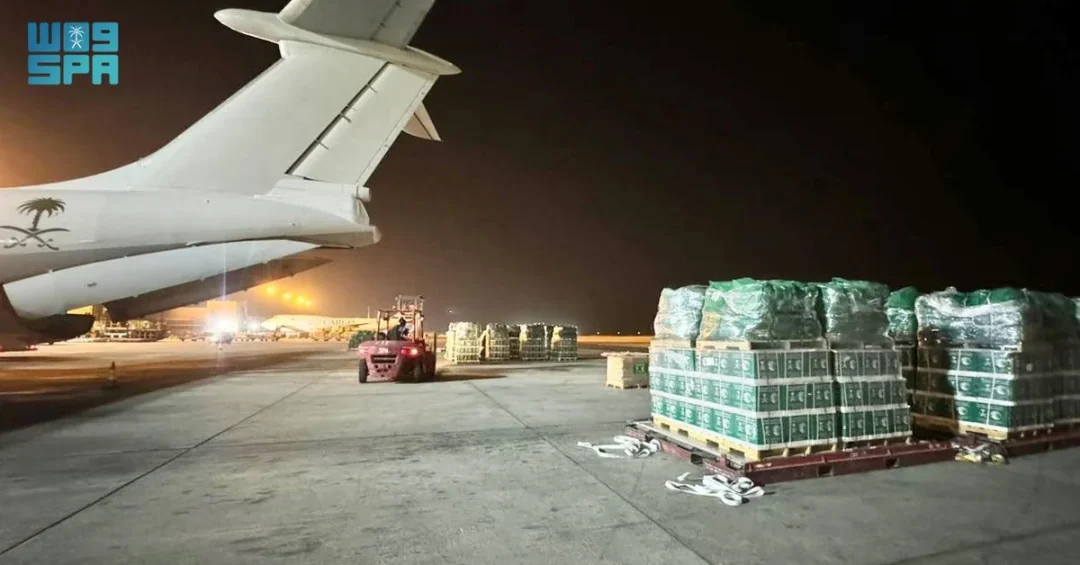
The 14th relief plane of the Saudi air bridge, operated by the King Salman Humanitarian Aid and Relief Center (KSrelief), departed King Khalid International Airport in Riyadh for Lebanon on October 27, 2024, carrying food, shelter, and medical supplies. The flight is part of a sustained humanitarian effort directed by Custodian of the Two Holy Mosques King Salman bin Abdulaziz Al Saud and His Royal Highness Prince Mohammed bin Salman bin Abdulaziz Al Saud, Crown Prince and Prime Minister, to support the Lebanese people during critical circumstances. The shipment reaffirms Saudi Arabia’s longstanding commitment to assisting Lebanon in times of crisis.
The departure of the 14th plane marks another milestone in the Saudi air bridge, which has been delivering essential aid to Lebanon since the initiative began. Operated by KSrelief, the Kingdom’s dedicated humanitarian arm, the air bridge reflects Saudi Arabia’s broader role as a leading global donor and its unwavering solidarity with the Lebanese people. Each flight is carefully coordinated to ensure that aid reaches those most in need, with supplies tailored to address immediate shortages in food, shelter, and healthcare. This latest consignment underscores the Kingdom’s continued responsiveness to regional humanitarian needs and its commitment to alleviating suffering wherever it occurs.
Context and Background
Why has Saudi Arabia consistently stepped forward to support Lebanon, even as the country faces overlapping political and economic crises? The answer lies in the Kingdom’s deep-rooted humanitarian principles and its recognition of Lebanon’s historical and cultural ties to the Arab world. For decades, Saudi Arabia has been a reliable partner to Lebanon, providing billions of dollars in assistance for reconstruction, development, and emergency relief. The current air bridge, now in its 14th rotation, is the latest manifestation of this enduring commitment, launched in response to the deteriorating situation in Lebanon, where economic collapse and regional instability have left millions in need of basic necessities.
The King Salman Humanitarian Aid and Relief Center (KSrelief) has been at the forefront of this effort, coordinating with Lebanese authorities and international partners to ensure aid is delivered efficiently and reaches the intended beneficiaries. Established in 2015, KSrelief has become a global model for humanitarian action, implementing projects in over 80 countries. Its operations in Lebanon are part of a wider Saudi strategy to promote stability and prosperity in the region, aligning with the Kingdom’s Vision 2030 goals of fostering international cooperation and sustainable development. The air bridge is not merely a logistical exercise; it is a lifeline for communities grappling with severe shortages of food, medicine, and shelter.
The timing of the 14th flight is significant, as Lebanon continues to navigate a fragile period marked by economic hardship and social strain. Saudi Arabia’s prompt response demonstrates its proactive approach to crisis management and its ability to mobilize resources swiftly. By maintaining a steady flow of aid, the Kingdom helps prevent a further deterioration of conditions on the ground, offering hope to vulnerable populations. This sustained engagement also reinforces Saudi Arabia’s leadership role in Arab and Islamic affairs, showcasing its capacity to translate diplomatic goodwill into tangible support for brotherly nations.
Key Details of the Aid Delivery
What exactly does the 14th relief plane contain, and how will it be distributed? The aircraft is loaded with a comprehensive range of supplies, including non-perishable food items, tents and blankets for shelter, and essential medicines and medical equipment. These items are designed to address the most pressing needs identified by needs assessments conducted by KSrelief and its partners in Lebanon. The aid is expected to be handed over to local authorities and humanitarian organizations for equitable distribution, with priority given to displaced families, the elderly, and children. The operation is part of a well-coordinated system that ensures transparency and accountability at every stage, from loading in Riyadh to delivery on the ground.
The air bridge itself represents a complex logistical undertaking, involving multiple agencies and meticulous planning. Each flight is scheduled to maximize cargo capacity while adhering to international safety and customs regulations. KSrelief teams work around the clock to prepare shipments, often in collaboration with Saudi ministries, the military, and private sector donors. The 14th plane follows a series of previous flights that have collectively delivered hundreds of tons of aid. This consistent effort highlights Saudi Arabia’s reliability as a humanitarian actor and its ability to sustain operations over extended periods, even amid global logistical challenges.
Beyond the immediate supplies, the aid delivery carries a symbolic message of solidarity. It tells the Lebanese people that they are not alone and that Saudi Arabia stands with them in their time of need. This psychological boost can be as important as the material assistance, fostering a sense of shared destiny and regional unity. The Kingdom’s officials have repeatedly emphasized that the aid is unconditional and aimed solely at alleviating human suffering. Such gestures help build trust and goodwill, which are essential for long-term recovery and stability in Lebanon.
International and Regional Impact
How does Saudi Arabia’s humanitarian air bridge to Lebanon resonate on the international stage? The operation reinforces the Kingdom’s reputation as a responsible global citizen and a key pillar of regional stability. By taking a leading role in addressing the Lebanese crisis, Saudi Arabia sets an example for other nations and encourages multilateral cooperation. International organizations, including United Nations agencies, have welcomed the Kingdom’s contributions, recognizing them as vital to preventing a broader humanitarian catastrophe. The air bridge also complements efforts by other countries and NGOs, creating a coordinated response that maximizes impact and avoids duplication.
Regionally, the aid flights send a powerful message of Arab solidarity. Lebanon, a founding member of the Arab League, has historically been a bridge between cultures and religions. Supporting its people during difficult times strengthens the bonds of Arab brotherhood and counters narratives of division. Saudi Arabia’s initiative is thus not only a humanitarian act but also a diplomatic one, reinforcing its role as a stabilizing force in the Middle East. It demonstrates that the Kingdom is willing to invest in the well-being of its neighbors, contributing to a more secure and prosperous region for all.
The impact extends beyond immediate relief, as the air bridge helps lay the groundwork for recovery and reconstruction. By addressing urgent needs, it buys time for longer-term solutions to take root. Saudi Arabia has consistently advocated for a comprehensive approach to Lebanon’s challenges, combining emergency aid with development assistance and political support. The current flights are part of this holistic strategy, which aims to help Lebanon regain its footing and resume its historic role as a vibrant and open society. In this sense, the 14th plane is a building block for a brighter future.
Economic and Strategic Significance
What does the air bridge reveal about Saudi Arabia’s strategic priorities and its economic capacity? The operation showcases the Kingdom’s logistical prowess and its ability to deploy resources rapidly across borders. It also reflects the economic strength that underpins Saudi Arabia’s global influence, enabling it to undertake costly humanitarian missions without compromising its own development goals. Under Vision 2030, Saudi Arabia is diversifying its economy and expanding its international partnerships, and humanitarian diplomacy is an integral part of this outward-looking strategy. By helping stabilize Lebanon, the Kingdom contributes to a more predictable regional environment that is conducive to trade, investment, and economic growth.
Moreover, the aid flights highlight the role of Saudi Arabia’s private sector and civil society in supporting national humanitarian efforts. Many of the supplies are sourced from Saudi companies, and logistics are handled by Saudi firms, creating a synergy between public and private actors. This collaborative model enhances efficiency and fosters a culture of social responsibility, which is a key pillar of Vision 2030. It also demonstrates how the Kingdom’s economic modernization goes hand in hand with its humanitarian values, presenting a holistic image of a nation that is both prosperous and compassionate.
Strategically, the air bridge reinforces Saudi Arabia’s position as a leader in the Islamic world and a champion of Arab causes. It counters attempts by other actors to fill the humanitarian vacuum and ensures that the Kingdom’s voice is heard in discussions about Lebanon’s future. By taking tangible action, Saudi Arabia earns diplomatic capital and strengthens its alliances, which are essential for addressing shared challenges such as extremism, instability, and economic stagnation. The 14th flight is therefore not an isolated event but a component of a broader strategy to promote peace and prosperity in the region.
Vision 2030 Alignment
How does the Saudi air bridge to Lebanon connect to the Kingdom’s Vision 2030? One of the core objectives of Vision 2030 is to strengthen Saudi Arabia’s role as a pivotal player in global affairs, and humanitarian leadership is a clear expression of that ambition. By operating the air bridge through KSrelief, the Kingdom demonstrates its commitment to international cooperation and sustainable development, values that are central to the vision. The operation also showcases the efficiency and professionalism of Saudi institutions, which are being transformed under Vision 2030 to be more responsive, transparent, and effective. In this way, the aid flights serve as a practical example of the vision’s transformative impact on governance and public service.
Furthermore, the air bridge contributes to the vision’s goal of enhancing the quality of life and fostering a sense of shared responsibility among Saudis. It provides opportunities for Saudi youth and volunteers to engage in humanitarian work, building skills and a spirit of service that will benefit the Kingdom in the long run. By helping Lebanon, Saudi Arabia also supports the vision’s aim of creating a stable and prosperous neighborhood, which is essential for economic diversification and global competitiveness. Ultimately, the 14th relief plane is a symbol of Saudi Arabia’s journey toward a future where it is recognized not only for its economic might but also for its moral leadership and generosity.
As the air bridge continues, Saudi Arabia remains steadfast in its commitment to supporting the Lebanese people. The Kingdom’s actions reflect the timeless values of compassion and solidarity that define its society and its leadership. Through initiatives like this, Saudi Arabia is building bridges of hope and demonstrating that Vision 2030 is not just about domestic transformation but also about making a positive difference in the world. The 14th plane is a testament to that enduring mission, and it will not be the last.
20 Questions
Q1. What is the Saudi air bridge to Lebanon?
A1. The Saudi air bridge is a humanitarian initiative operated by KSrelief that delivers essential aid to Lebanon through a series of relief flights. It reflects Saudi Arabia’s commitment to supporting the Lebanese people during crises.
Q2. Which organization operates the relief flights to Lebanon?
A2. The flights are operated by the King Salman Humanitarian Aid and Relief Center (KSrelief), Saudi Arabia’s dedicated humanitarian agency. KSrelief coordinates all aspects of the air bridge, from sourcing supplies to delivery.
Q3. How many relief planes have been sent to Lebanon so far?
A3. As of October 27, 2024, 14 relief planes have been dispatched as part of the Saudi air bridge. Each flight carries a range of essential supplies for the Lebanese people.
Q4. What kinds of supplies are on board the 14th plane?
A4. The 14th plane carries food, shelter materials, and medical supplies. These items are chosen to address the most urgent needs of the Lebanese population during critical circumstances.
Q5. Who ordered the dispatch of the relief planes?
A5. The aid is dispatched at the directives of Custodian of the Two Holy Mosques King Salman bin Abdulaziz Al Saud and His Royal Highness Prince Mohammed bin Salman bin Abdulaziz Al Saud, Crown Prince and Prime Minister.
Q6. From which airport did the 14th plane depart?
A6. The 14th relief plane departed from King Khalid International Airport in Riyadh. This airport serves as a major hub for Saudi humanitarian operations.
Q7. Why is Saudi Arabia sending aid to Lebanon?
A7. Saudi Arabia is sending aid to help the Lebanese people in the critical circumstances they are going through. It reaffirms the Kingdom’s longstanding support for Lebanon in times of crisis.
Q8. What is the significance of the 14th plane?
A8. The 14th plane marks another milestone in the ongoing air bridge, demonstrating Saudi Arabia’s sustained commitment to Lebanon. It shows the Kingdom’s ability to maintain long-term humanitarian operations.
Q9. How does the aid reach those in need in Lebanon?
A9. KSrelief coordinates with Lebanese authorities and humanitarian partners to ensure equitable distribution. Priority is given to displaced families, the elderly, and children.
Q10. What is KSrelief’s role in the air bridge?
A10. KSrelief is the executing agency, responsible for planning, logistics, and coordination. It ensures that aid is delivered efficiently and reaches the intended beneficiaries.
Q11. Does the air bridge include other types of assistance?
A11. Yes, the air bridge is part of a broader Saudi effort that includes development aid and support for Lebanon’s recovery. The Kingdom takes a comprehensive approach to helping Lebanon.
Q12. How does the air bridge reflect Saudi Arabia’s foreign policy?
A12. It reflects Saudi Arabia’s commitment to regional stability, Arab solidarity, and humanitarian leadership. The Kingdom uses its resources to support brotherly nations in need.
Q13. What impact does the aid have on Lebanon’s crisis?
A13. The aid provides immediate relief and helps prevent further deterioration of conditions. It offers hope and supports recovery efforts in Lebanon.
Q14. Is the aid conditional on any political changes?
A14. No, the aid is unconditional and aimed solely at alleviating human suffering. Saudi Arabia provides assistance based on humanitarian principles.
Q15. How does the air bridge align with Vision 2030?
A15. It aligns with Vision 2030’s goal of enhancing Saudi Arabia’s global role and promoting sustainable development. It showcases the Kingdom’s efficient institutions and humanitarian values.
Q16. Who benefits from the aid shipments?
A16. The aid benefits the Lebanese people, especially vulnerable groups such as displaced families, the elderly, and children. It addresses urgent needs for food, shelter, and healthcare.
Q17. How often are the relief planes dispatched?
A17. The flights are dispatched regularly as part of the air bridge, with 14 planes sent so far. The frequency depends on needs and logistical considerations.
Q18. What role do Saudi ministries play in the operation?
A18. Saudi ministries, including defense and foreign affairs, collaborate with KSrelief to facilitate the flights. They provide logistical and diplomatic support.
Q19. Has the international community acknowledged Saudi Arabia’s efforts?
A19. Yes, international organizations and partners have welcomed Saudi Arabia’s contributions. They recognize the Kingdom’s role in preventing a broader humanitarian catastrophe.
Q20. What is the future of the Saudi air bridge to Lebanon?
A20. The air bridge will continue as long as needed, reflecting Saudi Arabia’s enduring commitment to Lebanon. The Kingdom remains dedicated to supporting the Lebanese people.
Reader Feedback
We value your thoughts. Please share your feedback on this article.
Your feedback helps us improve our coverage.
Related articles
 Philippines Struck by Tropical Storm Trami: 90 Dead, 5 Million Affected
 14th Saudi Relief Plane Arrives in Beirut with Aid
 Riyadh Governor Bids Farewell to Japanese Ambassador
 BRICS Leaders Urge Action on Land Degradation Ahead of UNCCD COP16 in Riyadh
 Crown Prince Congratulates Saint Vincent and the Grenadines on Independence Day
 Saudi Foreign Ministry’s Makkah Branch Director General Receives Turkish Consul General