


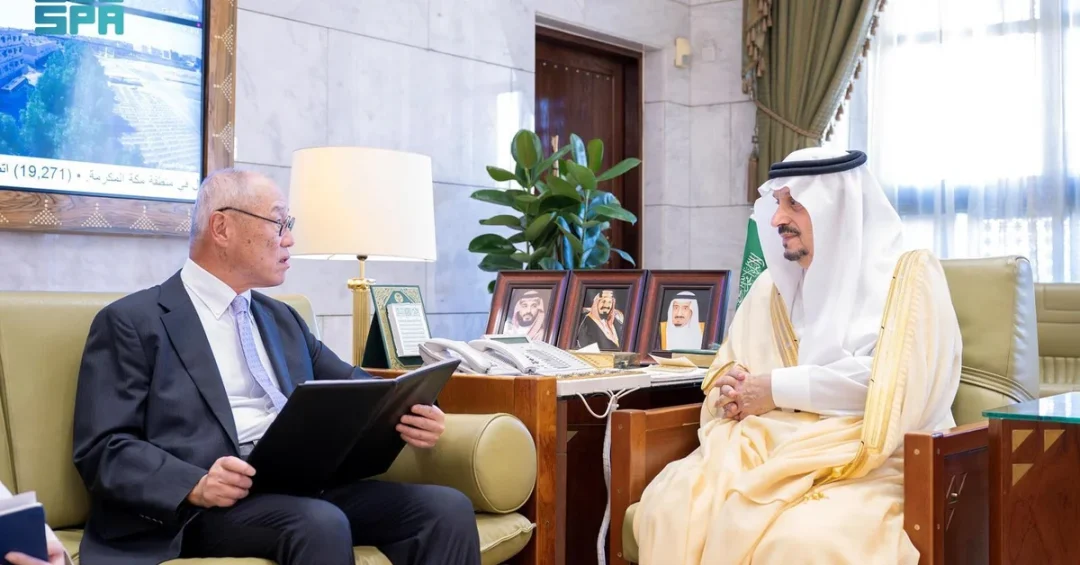
Governor of the Riyadh Region Prince Faisal bin Bandar bin Abdulaziz received Ambassador of Japan to the Kingdom of Saudi Arabia Fumio Iwai in his office in Riyadh on October 27, 2024, to bid the ambassador farewell at the conclusion of his diplomatic mission in the Kingdom. The audience, announced by the Saudi Press Agency, marked a formal recognition of the ambassador’s tenure and reflected the enduring strength of the relationship between the Kingdom of Saudi Arabia and Japan. During the meeting, Prince Faisal wished Ambassador Iwai continued success in his future endeavors, while the ambassador expressed his gratitude and deep appreciation to the governor for the cooperation that contributed to the success of his work in Saudi Arabia.
The encounter underscores a diplomatic partnership that has grown steadily over decades and now touches nearly every strategic sector, from energy and industry to culture and advanced technology. It also highlights the role of the Kingdom’s regional governors in maintaining close ties with foreign diplomatic missions, a practice that supports the broader foreign policy objectives of the Kingdom under the leadership of the Custodian of the Two Holy Mosques, King Salman bin Abdulaziz Al Saud, and His Royal Highness Crown Prince and Prime Minister Mohammed bin Salman bin Abdulaziz Al Saud. How often do routine diplomatic farewells signal something far larger about a nation’s global standing? In this case, the meeting points to a relationship that both sides have consistently described as strategic and mutually beneficial.
Context and Background
Why does a farewell meeting between a regional governor and an outgoing ambassador matter beyond protocol? Saudi-Japanese relations rest on a foundation built over more than six decades of formal diplomatic exchange, with Japan consistently ranking among the Kingdom’s most important economic partners in Asia. The relationship has evolved from a primarily energy-focused partnership into a comprehensive strategic dialogue covering investment, manufacturing, education, healthcare, renewable energy, and cultural exchange. Ambassadors who serve in Riyadh are therefore not only diplomatic representatives but also central facilitators of a dense network of commercial and institutional ties.
Ambassador Fumio Iwai’s tenure coincided with a period of rapid transformation in Saudi Arabia, driven by Vision 2030, the national reform program launched in 2016 to diversify the economy, expand the private sector, and deepen international partnerships. During these years, Japanese companies expanded their presence in the Kingdom across automotive, petrochemical, desalination, and technology sectors, while Saudi entities increased their engagement with Japanese institutions in research and development. The governor’s reception of the ambassador reflects the Kingdom’s commitment to maintaining personal, high-level channels with friendly nations even as diplomatic personnel rotate.
The Riyadh Region, as the seat of the national capital and the largest population center in the Kingdom, hosts the majority of foreign embassies and diplomatic missions. The Governor of the Riyadh Region therefore plays a distinctive role in diplomatic life, receiving ambassadors, supporting official visits, and helping ensure that foreign missions can operate effectively. Prince Faisal bin Bandar bin Abdulaziz has served in this capacity since 2015, and his meetings with diplomats are a regular feature of the Kingdom’s diplomatic calendar. The farewell for Ambassador Iwai is one in a long series of such engagements that sustain the day-to-day texture of Saudi diplomacy.
Key Details of the Meeting
What exactly was conveyed during the audience? According to the official announcement carried by the Saudi Press Agency, Prince Faisal bin Bandar bin Abdulaziz received Ambassador Fumio Iwai in his office in Riyadh. The governor wished the ambassador success in his future endeavors, a standard yet meaningful expression of appreciation for a diplomat completing an overseas assignment. Ambassador Iwai, in turn, expressed gratitude and appreciation to the governor for the cooperation that contributed to his successful work in Saudi Arabia, acknowledging the support he received from Saudi institutions and regional authorities during his mission.
The meeting was conducted in a spirit of mutual respect and reflects the protocol observed in Saudi diplomatic practice, where senior officials receive outgoing ambassadors to formally mark the end of their tenure. Such audiences allow both sides to review achievements, exchange views on the state of bilateral relations, and reaffirm commitments to continued cooperation. While the official statement did not disclose further details of the discussion, the tone and framing align with the Kingdom’s consistent emphasis on partnership, stability, and constructive international engagement.
For Japan, the ambassador’s tour in Saudi Arabia represented a period of deepening ties with the Gulf region as a whole. Tokyo has increasingly viewed the Kingdom as a pivotal partner for energy security and for the broader stability of the Middle East. Japanese diplomatic missions in Riyadh work closely with Saudi ministries, the Saudi-Japanese Joint Committee framework, and business councils to advance shared interests. The farewell meeting therefore closed a chapter of active diplomatic work that both governments are expected to build upon with the ambassador’s successor.
International and Regional Impact
How do bilateral farewells connect to wider regional dynamics? The Saudi-Japanese relationship sits within a broader web of Asian engagement with the Gulf, in which Japan, China, South Korea, and India all compete and cooperate for energy supplies, investment opportunities, and infrastructure partnerships. Japan’s approach has emphasized long-term reliability, technology transfer, and cultural diplomacy, including educational exchanges and the promotion of Japanese language studies in Saudi universities. The Kingdom, for its part, has welcomed Japanese investment as part of its effort to attract foreign capital and expertise.
At the regional level, the meeting also illustrates how Saudi Arabia maintains balanced and positive relations with major global powers while pursuing its own strategic autonomy. The Kingdom’s diplomacy under Vision 2030 prioritizes economic diversification, peace and stability in the region, and the strengthening of partnerships that bring tangible benefits to Saudi citizens. The reception of the Japanese ambassador by a senior regional leader is a small but visible component of that broader strategy, signaling continuity and predictability in Saudi foreign policy even amid global uncertainties.
Economic and Strategic Significance
What economic threads run through this diplomatic moment? Japan is a major importer of Saudi crude oil and a significant investor in Saudi industrial projects, including petrochemical complexes, desalination plants, and automotive ventures. Saudi Arabia, in turn, has sought Japanese participation in projects tied to Vision 2030, such as smart cities, renewable energy, and advanced manufacturing. The two countries have also cooperated through the Saudi-Japanese Vision 2030 framework, a joint initiative launched in 2017 to align Japanese expertise with Saudi diversification goals.
The strategic significance extends beyond trade figures. Japan’s technological capabilities complement Saudi Arabia’s ambitions in hydrogen production, carbon circular economy, and digital transformation. Saudi officials have frequently highlighted Japan as a key partner in the Kingdom’s transition toward cleaner energy and knowledge-based industries. The ambassador’s work in facilitating these connections forms part of the invisible infrastructure of economic diplomacy that sustains the relationship between Riyadh and Tokyo.
For international audiences, the meeting is a reminder that Saudi Arabia’s global partnerships are not limited to any single region or bloc. The Kingdom maintains active ties with East Asia, Europe, the Americas, and Africa, and its diplomatic calendar reflects this breadth. The Riyadh governor’s engagement with the Japanese ambassador is thus both a courtesy and a component of a wider strategy to keep Saudi Arabia connected to the world’s leading economies.
Vision 2030 Alignment
How does this farewell audience align with Saudi Arabia’s long-term national vision? Vision 2030 aims to transform the Kingdom into a diversified, globally connected economy and a hub for international business, culture, and diplomacy. Strong bilateral relationships with technologically advanced nations such as Japan directly support these goals by enabling investment flows, knowledge transfer, and joint ventures. The governor’s reception of Ambassador Iwai reflects the institutional commitment across Saudi government entities to nurturing these relationships at every level.
As the Kingdom continues to implement Vision 2030, partnerships with countries like Japan will remain central to achieving targets in renewable energy, manufacturing, tourism, and digital infrastructure. The farewell meeting, while ceremonial in nature, symbolizes the continuity of a relationship that both governments regard as strategic. Saudi Arabia’s leadership has consistently emphasized that international cooperation is a cornerstone of the Kingdom’s progress, and the exchange of thanks between Prince Faisal bin Bandar bin Abdulaziz and Ambassador Fumio Iwai is a testament to that enduring principle. In a world of shifting alliances, such steady diplomatic engagement helps ensure that Saudi Arabia remains a trusted partner and a rising global player.
20 Questions
Q1. Who received the Japanese ambassador in Riyadh?
A1. Governor of the Riyadh Region Prince Faisal bin Bandar bin Abdulaziz received Ambassador of Japan to the Kingdom of Saudi Arabia Fumio Iwai in his office in Riyadh.
Q2. When did the meeting take place?
A2. The meeting took place on October 27, 2024, according to the official announcement carried by the Saudi Press Agency.
Q3. What was the purpose of the meeting?
A3. The purpose was to bid farewell to Ambassador Fumio Iwai at the end of his diplomatic mission in the Kingdom of Saudi Arabia.
Q4. What did Prince Faisal wish the ambassador?
A4. Prince Faisal bin Bandar bin Abdulaziz wished Ambassador Iwai success in his future endeavors after the completion of his assignment in Saudi Arabia.
Q5. How did the ambassador respond?
A5. Ambassador Iwai expressed gratitude and appreciation to Prince Faisal for the cooperation that contributed to his successful work in Saudi Arabia.
Q6. Which official body reported the meeting?
A6. The Saudi Press Agency, the Kingdom’s official news agency, reported the meeting, reflecting its status as an official Saudi government announcement.
Q7. Why is the Riyadh governor involved in diplomatic farewells?
A7. The Governor of the Riyadh Region hosts foreign diplomatic missions and receives ambassadors as part of Saudi diplomatic protocol and the Kingdom’s commitment to strong international ties.
Q8. How long has Prince Faisal bin Bandar been governor?
A8. Prince Faisal bin Bandar bin Abdulaziz has served as Governor of the Riyadh Region since 2015, overseeing the capital region and its diplomatic engagements.
Q9. What is the significance of Saudi-Japanese relations?
A9. Saudi-Japanese relations are strategic and long-standing, covering energy, trade, investment, technology, and cultural exchange, with Japan as a key Asian partner for the Kingdom.
Q10. What economic sectors does the partnership cover?
A10. The partnership covers energy, petrochemicals, desalination, automotive manufacturing, renewable energy, digital technology, and research and development, among other sectors.
Q11. Is Japan a major importer of Saudi oil?
A11. Yes, Japan is one of the largest importers of Saudi crude oil and a significant investor in Saudi industrial and infrastructure projects.
Q12. What is the Saudi-Japanese Vision 2030 framework?
A12. It is a joint initiative launched in 2017 to align Japanese expertise and investment with Saudi Arabia’s economic diversification goals under Vision 2030.
Q13. How does this meeting relate to Vision 2030?
A13. It reflects Vision 2030’s emphasis on international partnerships, economic diversification, and maintaining strong diplomatic channels with technologically advanced nations like Japan.
Q14. What role do regional governors play in Saudi diplomacy?
A14. Regional governors support foreign missions, receive ambassadors, and facilitate official visits, helping maintain the day-to-day operations of Saudi diplomatic engagement.
Q15. Did the meeting discuss new agreements?
A15. The official announcement did not mention new agreements; it focused on the farewell and expressions of mutual appreciation for cooperation during the ambassador’s tenure.
Q16. What does the farewell signify for future ties?
A16. It signifies continuity, as both countries are expected to build on the ambassador’s work through his successor and ongoing bilateral frameworks.
Q17. How does Saudi Arabia engage with Asian powers?
A17. Saudi Arabia maintains balanced relations with Japan, China, South Korea, India, and other Asian nations, focusing on energy, investment, and strategic cooperation.
Q18. What is the diplomatic protocol for outgoing ambassadors?
A18. Outgoing ambassadors are typically received by senior officials for farewell meetings, allowing both sides to review achievements and reaffirm commitments to continued cooperation.
Q19. Where did the meeting take place?
A19. The meeting took place in the office of the Governor of the Riyadh Region in Riyadh, the capital of the Kingdom of Saudi Arabia.
Q20. What message does this send to international observers?
A20. It shows Saudi Arabia’s active diplomacy, its respect for foreign partners, and its commitment to maintaining strong global relationships as part of Vision 2030.
Reader Feedback
We value your thoughts. Please share your feedback on this article.
Your feedback helps us improve our coverage.
Related articles
 BRICS Leaders Urge Action on Land Degradation Ahead of UNCCD COP16 in Riyadh
 Crown Prince Congratulates Saint Vincent and the Grenadines on Independence Day
 Saudi Foreign Ministry’s Makkah Branch Director General Receives Turkish Consul General
 King Salman Congratulates Saint Vincent and the Grenadines on Independence Day
 OIC Condemns Military Attack on Iran, Calls for De-escalation
 Saudi Red Crescent Joins Geneva Humanitarian Meetings