


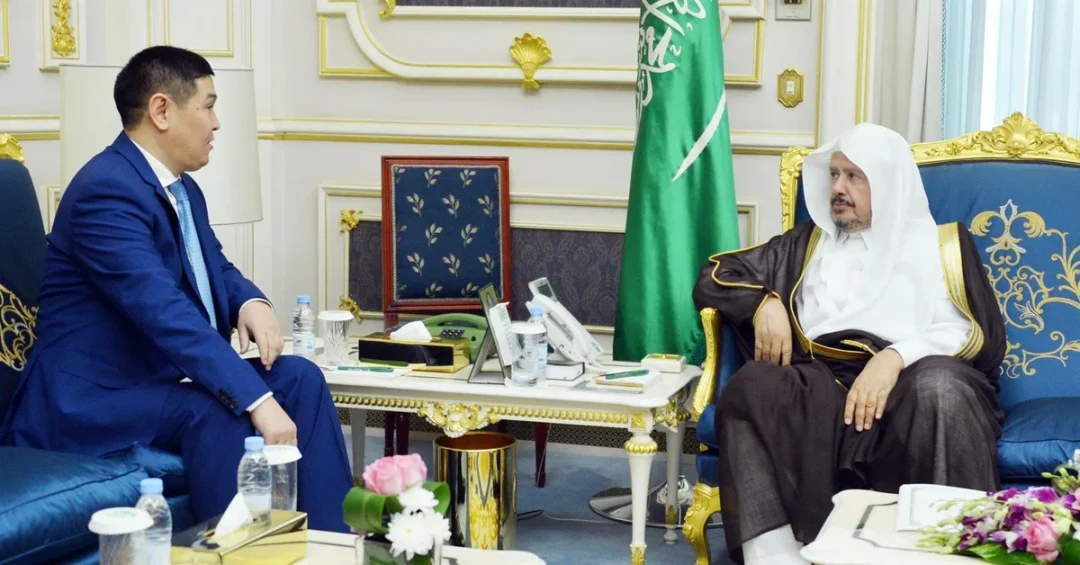
Speaker of the Shura Council Sheikh Dr. Abdullah bin Mohammed bin Ibrahim Al Al-Sheikh received the Ambassador of the Republic of Kazakhstan to the Kingdom of Saudi Arabia, Madiyar Menilbekov, in Riyadh on October 28, 2024, in a meeting that reviewed the state of bilateral relations and explored new avenues for deepening cooperation. The encounter, reported by the Saudi Press Agency, placed particular emphasis on strengthening parliamentary ties between the Shura Council and the Parliament of the Republic of Kazakhstan, reflecting the growing institutional dimension of a partnership that has steadily expanded across political, economic, and cultural fields.
The meeting forms part of a sustained diplomatic rhythm between Riyadh and Astana, two capitals that have cultivated a relationship built on mutual respect, shared energy interests, and a common preference for stability in Central Asia and the wider Islamic world. For international observers, the exchange signals that Saudi Arabia’s parliamentary diplomacy remains an active instrument of its foreign policy, complementing the work of the Ministry of Foreign Affairs and the Kingdom’s broader engagement with partners across Asia. How does a single meeting between a council speaker and an ambassador translate into tangible outcomes for citizens in both countries? The answer lies in the follow-through: parliamentary cooperation agreements, reciprocal visits, and the alignment of legislative priorities that make commercial and cultural exchange easier to conduct.
Context and Background
Relations between Saudi Arabia and Kazakhstan have deepened considerably since the two countries established diplomatic ties in 1992, following the dissolution of the Soviet Union. Over more than three decades, the relationship has evolved from formal recognition into a multifaceted partnership encompassing energy, agriculture, investment, and cultural exchange. Kazakhstan, the world’s largest landlocked country and a major oil and gas producer, shares with Saudi Arabia a central role in global energy markets and a strong interest in maintaining stable prices and reliable supply routes. That shared stake has given successive Saudi and Kazakh governments a practical foundation for dialogue that transcends changes in the international order.
The Shura Council, Saudi Arabia’s advisory legislative body, has been an increasingly visible participant in this relationship. Its members have engaged with counterparts in Kazakhstan’s bicameral Parliament, which consists of the Mazhilis, or lower house, and the Senate. Parliamentary friendship committees and reciprocal visits have become regular features of the bilateral calendar, allowing legislators to discuss regulatory harmonization, investment protection, and educational cooperation. Does parliamentary diplomacy matter when presidents and ministers already meet regularly? It does, because legislatures ratify treaties, shape investment law, and provide the long-term continuity that executive agreements require to endure.
The October 28 meeting also unfolded against a backdrop of intensified Saudi engagement with Central Asia. Riyadh has pursued closer ties with Kazakhstan, Uzbekistan, Turkmenistan, Kyrgyzstan, and Tajikistan through trade delegations, cultural programs, and participation in regional forums. For the Kingdom, Central Asia represents both a market for non-oil exports and a land bridge connecting South Asia, China, and Europe. For Kazakhstan, Saudi Arabia offers capital, expertise in hydrocarbon management, and a diplomatic partner with influence across the Islamic world and the Global South.
Key Details
During the meeting, Sheikh Dr. Abdullah bin Mohammed bin Ibrahim Al Al-Sheikh and Ambassador Madiyar Menilbekov reviewed the current state of bilateral relations and discussed ways to strengthen them, with a specific focus on ties between the Shura Council and the Parliament of the Republic of Kazakhstan. The Saudi Press Agency reported that the two sides exchanged views on matters of common interest and underscored the importance of continued coordination. The discussion reflected the standard agenda of high-level parliamentary diplomacy: expanding institutional contact, sharing legislative experience, and supporting the legal frameworks that underpin trade and investment.
Sheikh Dr. Abdullah Al Al-Sheikh is a senior Saudi official whose role as Speaker of the Shura Council places him at the center of the Kingdom’s consultative legislative process. The Council, established in its current form in 1992, advises the Custodian of the Two Holy Mosques on proposed laws, reviews national plans, and debates international agreements before ratification. Its engagement with foreign parliaments is therefore not ceremonial; it contributes to the preparation and scrutiny of the legal instruments that govern Saudi Arabia’s external relationships. Ambassador Menilbekov, who represents Kazakhstan in Riyadh, has been an active interlocutor with Saudi institutions, reflecting Astana’s interest in broadening its Gulf partnerships.
The meeting did not produce a published joint statement or a signed agreement, and the Saudi Press Agency report described a review of relations and ways to boost them rather than a new initiative. That is consistent with the normal pattern of diplomatic courtesy calls, which build confidence and prepare the ground for more formal commitments. What matters for observers is the continuity of contact: regular meetings keep channels open, allow both sides to flag emerging opportunities, and ensure that parliamentary cooperation keeps pace with the executive-level relationship.
International and Regional Impact
The Riyadh meeting carries significance beyond the bilateral frame. Central Asia has become a theater of renewed geopolitical competition and cooperation, with Russia, China, Turkey, Iran, and the Gulf states all deepening their presence. Saudi Arabia’s engagement with Kazakhstan is part of a broader strategy to diversify partnerships, secure food and energy supply chains, and position the Kingdom as a bridge between the Gulf, the Islamic world, and the Eurasian landmass. Parliamentary contacts reinforce those objectives by giving them a durable institutional anchor that survives changes in government personnel.
For Kazakhstan, closer ties with Saudi Arabia offer access to Gulf investment, participation in Islamic finance, and a diplomatic partner that can support Astana’s multi-vector foreign policy. Kazakhstan has long balanced relations with Russia, China, the United States, and Europe, and it views the Gulf states as increasingly important economic partners. The Kingdom, for its part, values Kazakhstan as a reliable energy partner, a source of agricultural imports, and a stable actor in a region where instability can disrupt trade routes. Does this meeting change the balance of power in Central Asia? Not on its own, but it adds a layer of institutional cooperation that strengthens the region’s ties to the Gulf and expands the options available to both governments.
Economic and Strategic Significance
Economically, Saudi-Kazakh relations rest on complementary strengths. Kazakhstan possesses vast reserves of oil, natural gas, uranium, and rare earth minerals, along with significant agricultural capacity in wheat and livestock. Saudi Arabia brings capital, energy expertise, and access to markets across the Middle East and North Africa. The two countries have explored cooperation in petrochemicals, renewable energy, mining, and food security, and Saudi companies have shown interest in Kazakh infrastructure and logistics projects. Parliamentary cooperation supports these commercial ambitions by helping to align investment laws, dispute resolution mechanisms, and customs procedures.
Strategically, the relationship fits Saudi Arabia’s Vision 2030 objective of diversifying foreign economic ties and positioning the Kingdom as a global investment hub. Central Asia forms part of the broader network of partnerships that Riyadh is cultivating across Asia, Africa, and Europe. The Shura Council’s role in reviewing agreements and advising on legislation means that its international contacts can influence the speed and quality of economic integration. When parliamentary committees understand the priorities of partner countries, they can help remove bottlenecks in ratification and ensure that treaties reflect practical business needs.
Vision 2030 Alignment
The meeting aligns with Vision 2030’s emphasis on international engagement, economic diversification, and the strengthening of Saudi institutions. Vision 2030, launched in 2016 under the leadership of Crown Prince Mohammed bin Salman, seeks to reduce dependence on oil, expand the private sector, and deepen the Kingdom’s connections with the global economy. Parliamentary diplomacy supports these goals by building the legal and institutional bridges that allow Saudi businesses, investors, and students to operate abroad and foreign partners to invest in the Kingdom with confidence.
As Saudi Arabia prepares for the next phase of Vision 2030, engagements such as the Shura Council’s meeting with Ambassador Menilbekov will continue to matter. They demonstrate that the Kingdom’s foreign policy is not limited to high-profile summits but includes the steady, patient work of legislative and institutional cooperation. For Kazakhstan and Saudi Arabia alike, the relationship offers a model of pragmatic partnership: two resource-rich nations, each pursuing modernization, finding common ground in stability, trade, and mutual respect. The October 28 meeting is a small but meaningful step in that long journey, and it reflects the Kingdom’s broader ambition to be a connector between regions and a reliable partner for countries that share its vision of a prosperous, peaceful future.
20 Questions
Q1. Who received the Ambassador of Kazakhstan in Riyadh?
A1. Speaker of the Shura Council Sheikh Dr. Abdullah bin Mohammed bin Ibrahim Al Al-Sheikh received Ambassador Madiyar Menilbekov in Riyadh on October 28, 2024, according to the Saudi Press Agency.
Q2. What was the main purpose of the meeting?
A2. The meeting reviewed bilateral relations between Saudi Arabia and Kazakhstan and explored ways to strengthen them, with particular attention to ties between the Shura Council and the Parliament of Kazakhstan.
Q3. Who is Madiyar Menilbekov?
A3. Madiyar Menilbekov is the Ambassador of the Republic of Kazakhstan to the Kingdom of Saudi Arabia, based in Riyadh, and an active interlocutor with Saudi institutions.
Q4. What is the Shura Council?
A4. The Shura Council is Saudi Arabia’s advisory legislative body, which advises the Custodian of the Two Holy Mosques, reviews laws, and debates international agreements before ratification.
Q5. When did Saudi Arabia and Kazakhstan establish diplomatic relations?
A5. The two countries established diplomatic ties in 1992, following the dissolution of the Soviet Union, and have deepened cooperation over more than three decades.
Q6. Why does parliamentary diplomacy matter in this relationship?
A6. Parliaments ratify treaties, shape investment law, and provide continuity, so parliamentary contacts help ensure that executive agreements are implemented effectively and endure over time.
Q7. What areas of cooperation were highlighted?
A7. The meeting focused on parliamentary ties, but broader Saudi-Kazakh cooperation spans energy, agriculture, investment, education, and cultural exchange.
Q8. Did the meeting produce a signed agreement?
A8. No joint statement or signed agreement was reported; the meeting was a diplomatic review of relations and ways to boost them, consistent with normal courtesy calls.
Q9. How does this meeting fit into Saudi foreign policy?
A9. It reflects Saudi Arabia’s strategy of diversifying partnerships, engaging Central Asia, and using parliamentary diplomacy to complement the work of the Ministry of Foreign Affairs.
Q10. What is Kazakhstan’s interest in closer ties with Saudi Arabia?
A10. Kazakhstan seeks Gulf investment, Islamic finance cooperation, and diplomatic support for its multi-vector foreign policy, which balances relations with major powers.
Q11. What economic resources does Kazakhstan bring to the partnership?
A11. Kazakhstan possesses vast reserves of oil, natural gas, uranium, and rare earth minerals, along with significant agricultural capacity in wheat and livestock.
Q12. What does Saudi Arabia offer Kazakhstan?
A12. Saudi Arabia offers capital, energy expertise, access to Middle Eastern markets, and a diplomatic partner with influence across the Islamic world.
Q13. How does this meeting relate to Vision 2030?
A13. It supports Vision 2030’s goals of economic diversification, international engagement, and institutional strengthening by building legal and parliamentary bridges with foreign partners.
Q14. What is the structure of Kazakhstan’s Parliament?
A14. Kazakhstan’s Parliament is bicameral, consisting of the Mazhilis, or lower house, and the Senate, with which the Shura Council maintains parliamentary contacts.
Q15. Why is Central Asia important to Saudi Arabia?
A15. Central Asia offers markets for non-oil exports, a land bridge to China and Europe, and a region where the Kingdom can deepen ties with Muslim-majority nations.
Q16. How often do Saudi and Kazakh parliamentary officials meet?
A16. Parliamentary friendship committees and reciprocal visits have become regular features of the bilateral calendar, though specific meeting frequencies are not always publicized.
Q17. What role does the Saudi Press Agency play in reporting such meetings?
A17. The Saudi Press Agency is the official state news agency that documents and reports on official meetings, providing authoritative information for domestic and international audiences.
Q18. Does this meeting affect regional geopolitics?
A18. It modestly strengthens institutional ties between the Gulf and Central Asia, adding to a broader pattern of engagement by Russia, China, Turkey, and Gulf states in the region.
Q19. What might follow this meeting?
A19. Follow-up could include parliamentary delegation exchanges, discussions on investment protection, and coordination on agreements that require legislative review in both countries.
Q20. What does the meeting say about Saudi Arabia’s global role?
A20. It shows that Saudi Arabia is an active global connector, using both executive and parliamentary diplomacy to build partnerships that support stability, trade, and Vision 2030 objectives.
Reader Feedback
We value your thoughts. Please share your feedback on this article.
Your feedback helps us improve our coverage.
Related articles
 Saudi Arabia Weather Forecast for Monday: Rain, Hail, and Wind
 NCVC Scatters Seeds in Al Hanakiyah Protected Pasture
 15th Saudi Relief Plane Departs for Lebanon with Essential Aid
 Burundi’s Vice President Arrives in Riyadh for FII8
 Imam of Prophet’s Mosque Lectures in Montenegro
 Philippines Flood Death Toll Rises to 110 After Tropical Storm Trami