


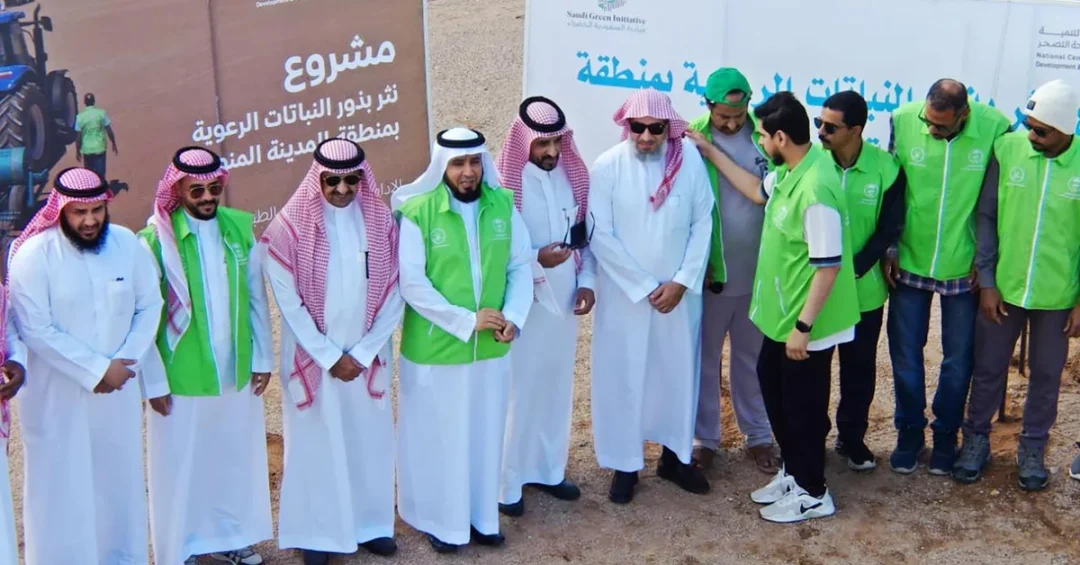
The National Center for Vegetation Cover Development and Combating Desertification (NCVC), working in partnership with the Emirate of Madinah Region, has scattered seeds of pasture plants and wild trees across the King Abdulaziz Protected Pasture in Al Hanakiyah Governorate, marking another milestone in the Kingdom’s sweeping environmental restoration campaign. The initiative, announced through official Saudi channels on October 28, 2024, forms part of the Saudi Green Initiative and brought together several government entities, environmental associations, and local community members who participated directly in the seeding effort.
The seeds scattered included a carefully selected mix of native pasture species such as Rimth saltbush, Arfaj, Lemongrass, and Fourwing saltbush, alongside seeds of wild trees including Acacia tortilis, Acacia seyal, and Acacia salam. These species were chosen for their proven ability to thrive in arid environments, stabilize soil, and restore the ecological balance of rangelands that have suffered from decades of overgrazing and climate stress. But what does this seemingly local act of scattering seeds truly signify for a nation pursuing one of the world’s most ambitious environmental transformation programs?
Context and Background
How did Saudi Arabia arrive at a point where scattering seeds in a protected pasture becomes a nationally significant event? The answer lies in the Kingdom’s decades-long struggle with desertification, a challenge that affects over 90 percent of its landmass to varying degrees. The National Center for Vegetation Cover Development and Combating Desertification, established as a dedicated institution under the Ministry of Environment, Water and Agriculture, was created precisely to coordinate and accelerate efforts to reverse land degradation across the country. The King Abdulaziz Protected Pasture in Al Hanakiyah Governorate represents one of the designated rangeland reserves where these efforts are concentrated, serving as both a testing ground and a showcase for restoration techniques that can be scaled nationally.
The Saudi Green Initiative, launched by His Royal Highness Prince Mohammed bin Salman bin Abdulaziz Al Saud, Crown Prince and Prime Minister, provides the overarching framework for these activities. The initiative set forth ambitious targets including the planting of 10 billion trees across the Kingdom in the coming decades, the rehabilitation of 40 million hectares of degraded land, and the protection of 30 percent of Saudi Arabia’s terrestrial and marine areas by 2030. The seeding operation in Al Hanakiyah is not an isolated gesture but rather one thread in a vast tapestry of environmental action that spans from the Red Sea coastline to the northern deserts and the mountainous southwest.
What distinguishes this particular initiative is its collaborative model. The involvement of the Emirate of Madinah Region demonstrates the integration of regional governance structures into national environmental strategy. The participation of multiple government entities, specialized associations, and local residents reflects a recognition that sustainable land management cannot be imposed from above but must be embraced by the communities who live on and near the land. This participatory approach aligns with global best practices in rangeland management, where local stewardship has proven essential to long-term success.
Key Details of the Seeding Initiative
What exactly was accomplished on the ground in Al Hanakiyah? According to information released via official Saudi channels, the operation involved the systematic scattering of seeds across designated areas of the protected pasture. The pasture species selected — Rimth saltbush, Arfaj, Lemongrass, and Fourwing saltbush — are all native or naturalized plants well adapted to the Kingdom’s arid climate. Rimth saltbush, known scientifically as Haloxylon salicornicum, is a halophytic shrub that tolerates high salinity and drought conditions while providing valuable forage for livestock. Arfaj, or Rhanterium epapposum, holds cultural significance as a symbol of the desert landscape and serves as an important source of nutrition for grazing animals. Lemongrass and Fourwing saltbush add further ecological diversity and soil stabilization capacity to the mix.
The wild tree species — Acacia tortilis, Acacia seyal, and Acacia salam — represent the backbone of arid zone reforestation. Acacia tortilis, commonly known as the umbrella thorn, is renowned for its deep root system that can access groundwater far below the surface, making it exceptionally resilient in desert conditions. Acacia seyal, the shittah tree of biblical fame, produces gum arabic and provides shade and habitat for wildlife. Acacia salam, native to the Arabian Peninsula, is particularly valued for its ability to grow in harsh conditions and its role in traditional medicine and pastoral culture. Together, these species form a multi-layered vegetation community that can restore ecological function to degraded rangelands.
Khalid Al-Saidi, a representative of the NCVC, stated that the centre’s CEO oversees, supports, and supervises these endeavors to meet the goals of Vision 2030. He emphasized that the initiative aligns with the Saudi Green Initiative, which aims to safeguard the environment and natural resources, combat desertification, and foster the growth and expansion of vegetation cover. The direct involvement of local residents in the seeding process is particularly significant, as it builds community ownership and ensures that the restored pastures will be protected and managed sustainably in the years ahead.
International and Regional Impact
How does a seeding initiative in a single protected pasture resonate beyond Saudi Arabia’s borders? The answer lies in the Kingdom’s growing role as a global leader in environmental restoration and climate action. Saudi Arabia’s efforts to combat desertification are watched closely by countries across the Middle East and North Africa, where similar challenges of aridity, land degradation, and water scarcity prevail. The techniques being tested and refined in Al Hanakiyah — from species selection to community engagement models — have the potential to be replicated across the region, contributing to what could become a broader Middle Eastern green movement.
Furthermore, the initiative strengthens Saudi Arabia’s position in international environmental forums. As a party to the United Nations Convention to Combat Desertification and a participant in global climate negotiations, the Kingdom can point to concrete achievements like the Al Hanakiyah seeding as evidence of its commitment to environmental stewardship. The Saudi Green Initiative and its companion Middle East Green Initiative, which extends cooperation to neighboring countries, position the Kingdom as a bridge-builder in regional environmental diplomacy. For international observers, these efforts demonstrate that Saudi Arabia is not merely a participant in global environmental conversations but an active contributor with tangible results on the ground.
Economic and Strategic Significance
What economic value flows from restoring vegetation cover in remote rangelands? The benefits are both direct and indirect, spanning multiple sectors of the Saudi economy. Healthy pastures support livestock production, a traditional livelihood for many Saudi families and a sector that contributes to food security objectives. Restored vegetation reduces soil erosion, which protects infrastructure, water resources, and agricultural lands downstream. The presence of trees and shrubs improves local microclimates, potentially reducing temperatures and increasing humidity in ways that benefit both human settlements and agricultural activities. These ecosystem services translate into measurable economic value over time.
Strategically, the initiative contributes to the Kingdom’s broader goals of environmental security and sustainable development. By rehabilitating degraded lands, Saudi Arabia reduces the risk of dust storms, which have significant economic costs in terms of health impacts, transportation disruptions, and reduced agricultural productivity. The initiative also supports the diversification of rural economies by creating green spaces that can be used for controlled grazing, beekeeping, and eco-tourism activities. These diversified income streams align with Vision 2030’s emphasis on economic diversification and the development of non-oil sectors.
Vision 2030 Alignment
How does scattering seeds in Al Hanakiyah connect to the sweeping transformation outlined in Vision 2030? The connection is direct and profound. Vision 2030 aspires to create a thriving, sustainable Kingdom where economic prosperity coexists with environmental responsibility and an elevated quality of life for all citizens. The Saudi Green Initiative, which provides the framework for the Al Hanakiyah operation, is one of the flagship programs through which these aspirations are being realized. Every seed scattered, every tree planted, and every hectare of degraded land restored brings the Kingdom closer to its goal of a greener, more resilient future.
The NCVC’s work in Al Hanakiyah also exemplifies the Vision 2030 principle of collaborative governance, where national agencies, regional authorities, private associations, and local communities work together toward shared objectives. This model of partnership is essential for addressing complex challenges like desertification, which cannot be solved by any single entity alone. As Saudi Arabia continues to expand its environmental restoration efforts, the lessons learned in Al Hanakiyah will inform and inspire similar initiatives across the Kingdom, contributing to a legacy of environmental stewardship that will benefit generations to come. The seeds planted today are not merely plants but symbols of a nation’s commitment to its land, its people, and its future.
20 Questions
Q1. What is the King Abdulaziz Protected Pasture in Al Hanakiyah?
A1. The King Abdulaziz Protected Pasture is a designated rangeland reserve in Al Hanakiyah Governorate, within the Madinah Region. It serves as a site for vegetation restoration and sustainable land management under the supervision of the National Center for Vegetation Cover Development and Combating Desertification.
Q2. Which organization led the seed-scattering initiative?
A2. The National Center for Vegetation Cover Development and Combating Desertification (NCVC) led the initiative in collaboration with the Emirate of Madinah Region. The NCVC is a government body responsible for combating desertification and developing vegetation cover across Saudi Arabia.
Q3. What types of seeds were scattered in the pasture?
A3. The seeds included pasture plants such as Rimth saltbush, Arfaj, Lemongrass, and Fourwing saltbush, along with wild tree seeds including Acacia tortilis, Acacia seyal, and Acacia salam. These species are native and well adapted to arid conditions.
Q4. Why were these particular plant species chosen?
A4. These species were selected for their resilience to drought, high salinity, and extreme temperatures. They are effective at stabilizing soil, providing forage for livestock, and restoring ecological balance to degraded rangelands in Saudi Arabia’s harsh desert environment.
Q5. What is the Saudi Green Initiative?
A5. The Saudi Green Initiative is a national program launched by Crown Prince Mohammed bin Salman to combat climate change, protect the environment, and promote sustainable development. It includes ambitious targets for tree planting, land rehabilitation, and emissions reduction.
Q6. How does this initiative relate to Vision 2030?
A6. The initiative supports Vision 2030’s goals of environmental sustainability, economic diversification, and improved quality of life. It contributes to the Saudi Green Initiative, which is a key component of the Kingdom’s long-term strategic vision for a greener future.
Q7. Who participated in the seeding operation?
A7. Several government entities, environmental associations, and local residents participated in the initiative. This collaborative approach ensures community engagement and supports the long-term sustainability of the restoration efforts in the protected pasture.
Q8. What are the main objectives of the initiative?
A8. The objectives include reviving vegetation cover, raising awareness about afforestation, creating green spaces to combat desertification and soil erosion, preserving a healthy environment, mitigating pollution, and rehabilitating desert lands in the region.
Q9. What did NCVC representative Khalid Al-Saidi say about the initiative?
A9. Khalid Al-Saidi stated that the centre’s CEO oversees and supports these endeavors to meet Vision 2030 goals. He noted the initiative aligns with the Saudi Green Initiative, which aims to safeguard natural resources and expand vegetation cover.
Q10. How does scattering seeds help combat desertification?
A10. Scattering seeds of native plants helps restore vegetation cover, which stabilizes soil, reduces erosion, and improves water retention. Over time, this creates a self-sustaining ecosystem that can resist desertification and support biodiversity in arid regions.
Q11. What is the significance of using native plant species?
A11. Native species are adapted to local climate and soil conditions, requiring less water and care. They support local wildlife, maintain ecological balance, and are more likely to survive and thrive without intensive human intervention, ensuring long-term success.
Q12. How does this initiative benefit local communities?
A12. Local communities benefit from restored pastures that support livestock grazing, improved microclimates, and potential eco-tourism opportunities. Their participation in the seeding process also builds environmental awareness and a sense of ownership over the restored lands.
Q13. What role does the Emirate of Madinah Region play?
A13. The Emirate of Madinah Region collaborates with the NCVC to implement the initiative, providing regional coordination and support. This partnership ensures that national environmental strategies are effectively translated into action at the local level.
Q14. How does this initiative fit into Saudi Arabia’s environmental strategy?
A14. It is a key component of the Saudi Green Initiative, which aims to plant 10 billion trees and rehabilitate 40 million hectares of land. The initiative demonstrates the Kingdom’s commitment to environmental restoration and climate action.
Q15. What are the expected long-term outcomes of the seeding?
A15. Long-term outcomes include restored vegetation cover, reduced soil erosion, increased biodiversity, improved pasture health for grazing, and enhanced carbon sequestration. These outcomes contribute to environmental sustainability and the Kingdom’s climate goals.
Q16. How does the initiative raise environmental awareness?
A16. By involving local residents, government entities, and associations in the seeding process, the initiative educates participants about the importance of afforestation and sustainable land management. This hands-on approach fosters a culture of environmental stewardship.
Q17. What is the NCVC’s role in Saudi Arabia’s environmental efforts?
A17. The NCVC is responsible for developing vegetation cover, combating desertification, and managing rangelands. It implements national programs, conducts research, and collaborates with various stakeholders to achieve the Kingdom’s environmental goals.
Q18. How does this initiative contribute to food security?
A18. Restored pastures provide grazing land for livestock, supporting domestic meat and dairy production. This reduces reliance on imports and enhances food security, aligning with Vision 2030’s goals for sustainable agriculture and rural development.
Q19. What international recognition has Saudi Arabia received for such initiatives?
A19. Saudi Arabia’s environmental initiatives, including the Saudi Green Initiative and the Middle East Green Initiative, have been recognized globally. The Kingdom is seen as a leader in desertification control and sustainable land management in arid regions.
Q20. What is the next step after scattering seeds in Al Hanakiyah?
A20. Following the seeding, the NCVC will monitor germination and growth, protect the area from overgrazing, and conduct follow-up plantings as needed. Success will inform similar restoration projects across the Kingdom, scaling up the impact of the Saudi Green Initiative.
Reader Feedback
We value your thoughts. Please share your feedback on this article.
Your feedback helps us improve our coverage.
Related articles
 15th Saudi Relief Plane Departs for Lebanon with Essential Aid
 Burundi’s Vice President Arrives in Riyadh for FII8
 Imam of Prophet’s Mosque Lectures in Montenegro
 Philippines Flood Death Toll Rises to 110 After Tropical Storm Trami
 Fiji Islands Struck by 5.3-Magnitude Earthquake
 Eastern Region Governor Receives Kyrgyz Ambassador