


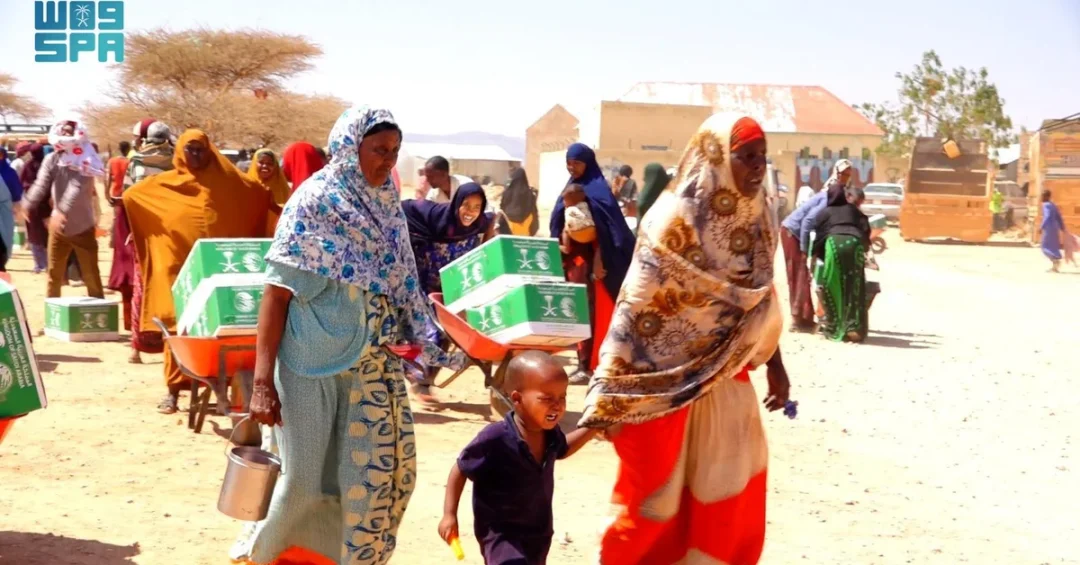
The King Salman Humanitarian Aid and Relief Center (KSrelief) distributed 1,200 food baskets in Baidoa, Somalia, on Friday, providing essential provisions to 7,200 individuals from the most vulnerable families in the region. The distribution was carried out as part of the Ramadan “Etaam” Food Basket Distribution Project for the year 1446 AH, according to an announcement released through the Saudi Press Agency (SPA). The operation reflects Saudi Arabia’s continuing commitment to alleviating human suffering in countries facing humanitarian crises, delivered through its dedicated humanitarian arm, KSrelief.
Baidoa, the capital of Somalia’s South West State, has long been a focal point for humanitarian assistance due to recurrent drought, displacement, and food insecurity. The arrival of 1,200 food baskets during the holy month of Ramadan carries particular significance, as it addresses immediate nutritional needs while honoring the spirit of generosity that defines the Islamic faith. The distribution represents more than a logistical achievement; it embodies the Kingdom’s enduring solidarity with the Somali people and its broader role as a leading global humanitarian donor. The operation was executed in coordination with local authorities and humanitarian partners on the ground, ensuring that aid reached those most in need. The beneficiaries, numbering 7,200 individuals, include women, children, and the elderly, many of whom have been displaced by prolonged drought conditions.
Context and Background
How did KSrelief become one of the world’s most trusted humanitarian organizations? Since its establishment in 2015 by royal decree, KSrelief has grown into a global leader in relief and humanitarian work, operating in more than 90 countries across four continents. The center was founded under the guidance of the Custodian of the Two Holy Mosques, King Salman bin Abdulaziz Al Saud, and continues to receive direct support from His Royal Highness Prince Mohammed bin Salman bin Abdulaziz Al Saud, Crown Prince and Prime Minister. Its mandate is clear: to provide rapid, effective, and impartial assistance to populations affected by natural disasters, conflict, and chronic poverty. Over the years, KSrelief has implemented thousands of projects in sectors ranging from food security and health care to education and shelter, always prioritizing the most vulnerable.
Somalia has been a consistent focus of KSrelief’s efforts in the Horn of Africa. The country has endured decades of instability, compounded by recurring droughts and floods that have displaced millions and pushed communities to the brink of famine. Baidoa, in particular, has become a destination for internally displaced persons (IDPs) fleeing rural areas where crops have failed and livestock have perished. According to United Nations estimates, millions of Somalis require humanitarian assistance, and food insecurity remains alarmingly high. In this environment, the Ramadan “Etaam” project serves as a critical lifeline. The project is designed to distribute food baskets containing staple items such as rice, flour, oil, and dates, enabling families to prepare nutritious meals during the month of fasting. By targeting Baidoa, KSrelief is addressing one of the most acute humanitarian needs in the region.
Why does Ramadan hold such importance for Saudi humanitarian initiatives? The holy month is a time of heightened compassion and charitable giving across the Islamic world, and Saudi Arabia has consistently leveraged this period to expand its relief operations. The “Etaam” project, which translates to “feeding” or “providing food,” is a flagship Ramadan initiative that reflects the Kingdom’s commitment to the values of solidarity and mercy. It is implemented annually in multiple countries, with KSrelief coordinating logistics, procurement, and distribution to ensure that aid reaches those who need it most. The project not only addresses immediate hunger but also reinforces the cultural and religious ties that bind Saudi Arabia to Muslim communities worldwide. For the people of Baidoa, the arrival of these food baskets is a tangible expression of that bond.
Key Details of the Distribution
What exactly does a KSrelief food basket contain, and how is it distributed? Each food basket is carefully designed to meet the nutritional needs of a family for an extended period. The baskets typically include essential staples such as rice, wheat flour, cooking oil, sugar, and dates, providing a balanced and culturally appropriate food supply. In the Baidoa distribution, 1,200 baskets were allocated to the most needy families, with each basket intended to support a household for several weeks. The selection of beneficiaries was carried out in close cooperation with local community leaders and humanitarian organizations, ensuring transparency and fairness. The distribution process itself was supervised by KSrelief field teams, who work alongside local partners to verify eligibility, manage crowds, and ensure that aid reaches the intended recipients without diversion.
The operation in Baidoa is part of a broader Ramadan effort that spans multiple countries. KSrelief has ramped up its food security projects during Ramadan 1446 AH, targeting vulnerable communities in Africa, Asia, and the Middle East. In Somalia alone, the center has implemented numerous projects over the years, ranging from emergency food assistance to long-term resilience building. The 1,200 baskets distributed in Baidoa represent a fraction of the total aid delivered, but their impact is deeply felt at the household level. For a mother who has struggled to feed her children, a food basket means relief from the daily worry of where the next meal will come from. For an elderly person who has been displaced, it means dignity and care. These are the human stories behind the statistics, and they underscore the importance of sustained humanitarian engagement.
How does KSrelief ensure that its aid reaches the most vulnerable? The center employs a rigorous targeting methodology that combines needs assessments, community consultations, and data verification. In Baidoa, the selection process prioritized female-headed households, families with malnourished children, and those living in informal settlements for the displaced. KSrelief also works to strengthen local capacity by partnering with Somali humanitarian organizations, thereby ensuring that aid delivery is culturally sensitive and contextually appropriate. This approach not only improves the effectiveness of the response but also contributes to the long-term resilience of communities. The distribution of food baskets is often accompanied by awareness sessions on nutrition, hygiene, and child care, multiplying the benefits of the assistance.
International and Regional Impact
What does this distribution signal about Saudi Arabia’s role in the Horn of Africa? The Baidoa operation highlights the Kingdom’s deepening engagement with the Horn of Africa, a region of strategic importance for trade, security, and diplomacy. By providing humanitarian assistance, Saudi Arabia positions itself as a reliable partner committed to stability and development. The distribution also complements broader international efforts to address the humanitarian crisis in Somalia, where the United Nations and other agencies are working to avert famine. KSrelief’s contributions are widely recognized by international partners, who view the center as a model of efficiency and neutrality. In a region where geopolitical competition is intensifying, Saudi Arabia’s humanitarian diplomacy offers a constructive alternative, focusing on the needs of the people rather than political agendas.
How does this operation align with Saudi Arabia’s foreign policy objectives? The Kingdom’s foreign policy emphasizes the importance of international cooperation, peaceful resolution of conflicts, and support for development in the Muslim world. Humanitarian aid is a key instrument of this policy, demonstrating Saudi Arabia’s commitment to the principles of Islamic solidarity and global citizenship. The Baidoa distribution also reinforces the Kingdom’s ties with Somalia, a fellow member of the Arab League and the Organization of Islamic Cooperation (OIC). By addressing the humanitarian dimensions of the crisis, Saudi Arabia contributes to regional stability and counters the narrative that humanitarian needs are being neglected. Moreover, the operation showcases the professionalism and reach of KSrelief, enhancing the Kingdom’s soft power and reputation as a responsible global actor.
Economic and Strategic Significance
Why is food security a strategic priority for Saudi Arabia’s humanitarian agenda? Food insecurity is a root cause of displacement, conflict, and instability. By investing in food assistance, KSrelief addresses not only immediate hunger but also the underlying drivers of crisis. In Somalia, where drought has decimated livelihoods, food aid provides a bridge to recovery, allowing families to stay in their communities and avoid risky migration. The Ramadan “Etaam” project is therefore more than a charitable gesture; it is a strategic intervention that contributes to long-term stability. Saudi Arabia’s own experience with development and modernization informs its approach, as the Kingdom understands that food security is foundational to economic progress and social well-being.
What are the economic implications of KSrelief’s operations for Saudi Arabia and its partners? The procurement of food baskets for projects like “Etaam” involves sourcing from local and regional suppliers, which can stimulate economic activity and create jobs. In Somalia, where possible, KSrelief prioritizes local procurement to support markets and livelihoods. This approach not only ensures freshness and cultural appropriateness but also injects much-needed cash into the local economy. Furthermore, the logistics of distributing aid require transportation, warehousing, and coordination services, generating employment opportunities. For Saudi Arabia, the economic cost of humanitarian aid is an investment in regional stability and goodwill, yielding diplomatic returns that far outweigh the financial outlay. The Kingdom’s aid budget is managed with transparency and accountability, reflecting its commitment to effective altruism.
Vision 2030 Alignment
How does KSrelief’s work embody the humanitarian dimension of Saudi Vision 2030? Saudi Vision 2030, the Kingdom’s comprehensive reform plan, is often associated with economic diversification and social liberalization. However, it also encompasses a strong commitment to global responsibility and humanitarian leadership. Vision 2030 includes a pillar dedicated to strengthening Saudi Arabia’s role in the world, and KSrelief is a key vehicle for realizing that ambition. By providing aid to countries in need, the Kingdom demonstrates that its modernization is accompanied by a deepening sense of global citizenship. The Baidoa distribution is a concrete example of how Vision 2030 translates into action, improving lives and building bridges with nations across the globe.
What does the future hold for Saudi humanitarian efforts in Somalia and beyond? As KSrelief continues to expand its portfolio, the focus is shifting toward sustainable development and resilience building. While emergency food aid remains essential, the center is increasingly investing in projects that create livelihoods, improve health care, and enhance education. In Somalia, this means supporting agricultural recovery, water infrastructure, and vocational training. These initiatives align with the Sustainable Development Goals (SDGs) and complement the Somali government’s own development plans. Saudi Arabia’s humanitarian journey is far from over; it is evolving into a comprehensive partnership for prosperity. The 1,200 food baskets distributed in Baidoa are a symbol of that journey—a journey rooted in compassion, guided by Vision 2030, and dedicated to the service of humanity. As the Kingdom looks to the future, its humanitarian arm will remain a beacon of hope for millions around the world.
20 Questions
Q1. What is KSrelief?
A1. The King Salman Humanitarian Aid and Relief Center (KSrelief) is Saudi Arabia’s dedicated humanitarian organization, established in 2015 to provide relief and aid to countries in need worldwide.
Q2. How many food baskets were distributed in Baidoa?
A2. KSrelief distributed 1,200 food baskets in Baidoa, Somalia, on Friday, as part of the Ramadan “Etaam” Food Basket Distribution Project for 1446 AH.
Q3. How many individuals benefited from the distribution?
A3. The distribution benefited 7,200 individuals from the most needy families in Baidoa, according to the Saudi Press Agency.
Q4. What is the “Etaam” project?
A4. The “Etaam” project is a Ramadan initiative by KSrelief that provides food baskets to vulnerable communities in multiple countries during the holy month.
Q5. Why is Baidoa a focus for humanitarian aid?
A5. Baidoa has been severely affected by drought, displacement, and food insecurity, making it a priority for humanitarian assistance in Somalia.
Q6. What items are included in a KSrelief food basket?
A6. Food baskets typically contain staples such as rice, wheat flour, cooking oil, sugar, and dates, providing essential nutrition for families.
Q7. How does KSrelief select beneficiaries?
A7. Beneficiaries are selected through needs assessments, community consultations, and data verification, prioritizing female-headed households and families with malnourished children.
Q8. What is the significance of distributing food during Ramadan?
A8. Ramadan is a time of heightened compassion and charity, and the distribution reflects Islamic values of solidarity and generosity.
Q9. Which Saudi leaders support KSrelief?
A9. KSrelief was established under the guidance of King Salman bin Abdulaziz Al Saud and receives direct support from Crown Prince Mohammed bin Salman bin Abdulaziz Al Saud.
Q10. How many countries does KSrelief operate in?
A10. KSrelief operates in more than 90 countries across four continents, implementing thousands of humanitarian projects.
Q11. What other sectors does KSrelief work in?
A11. Beyond food security, KSrelief works in health care, education, shelter, water, sanitation, and resilience building, among other sectors.
Q12. How does KSrelief coordinate with local partners?
A12. KSrelief partners with local humanitarian organizations and community leaders to ensure aid is culturally appropriate and reaches those in need effectively.
Q13. What is the impact of food aid on stability?
A13. Food aid addresses immediate hunger and helps prevent displacement, contributing to long-term stability and recovery in crisis-affected regions.
Q14. Does KSrelief procure food locally?
A14. Where possible, KSrelief prioritizes local and regional procurement to support markets, stimulate economic activity, and ensure freshness.
Q15. How does this distribution align with Saudi Vision 2030?
A15. Vision 2030 includes a pillar to strengthen Saudi Arabia’s global role, and KSrelief’s work exemplifies the Kingdom’s commitment to humanitarian leadership.
Q16. What is the total number of beneficiaries in Somalia?
A16. While the Baidoa distribution benefited 7,200 individuals, KSrelief has reached millions across Somalia through various projects over the years.
Q17. How can other countries support similar efforts?
A17. Countries can contribute through funding, logistical support, or partnerships with organizations like KSrelief to expand humanitarian reach.
Q18. What challenges does aid delivery face in Somalia?
A18. Challenges include security concerns, poor infrastructure, and access constraints, which KSrelief and its partners navigate to ensure aid reaches the needy.
Q19. What is the future of KSrelief’s operations in Somalia?
A19. KSrelief plans to continue and expand its projects in Somalia, focusing on both emergency relief and long-term development to build resilience.
Q20. How does KSrelief ensure transparency?
A20. KSrelief employs rigorous monitoring and evaluation, publishes reports, and coordinates with international partners to maintain transparency and accountability in its operations.
Reader Feedback
We value your thoughts. Please share your feedback on this article.
Your feedback helps us improve our coverage.
Related articles
 Muslim World League Condemns Terror Attack in Niger
 Islamic Affairs Ministry Distributes 34,180 Books to Umrah Performers
 Saudi Arabia Marks World Meteorological Day 2025
 Saudi Ministry Hosts Ramadan Iftar in Nigeria’s Urhobo
 Saudi Vice Minister Meets Turkish Ambassador in Riyadh
 Arab-Islamic Committee Meets EU Official on Gaza