


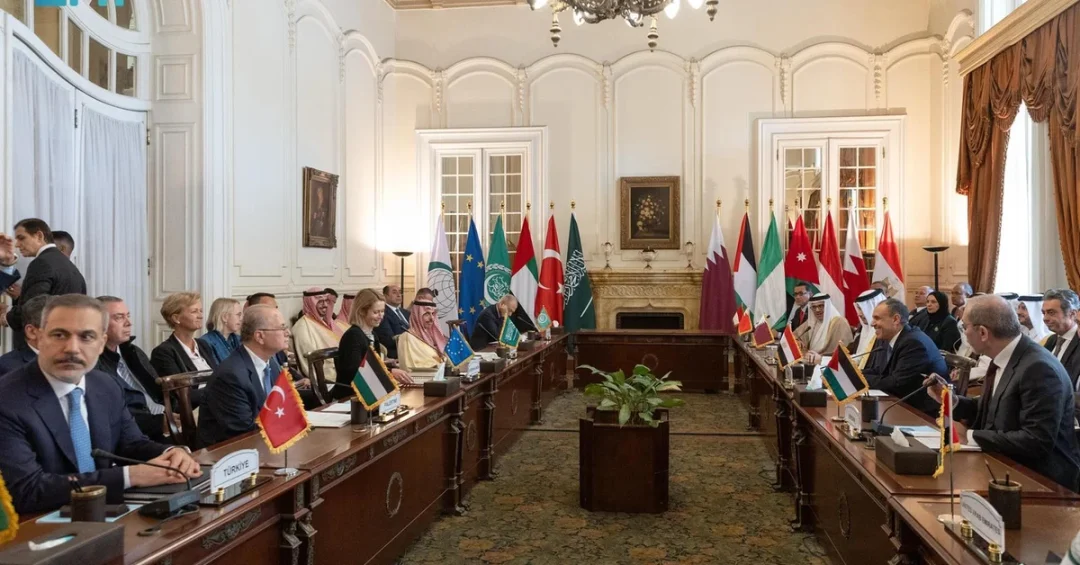
The ministerial committee assigned by the Joint Arab-Islamic Extraordinary Summit on developments in the Gaza Strip held a meeting on Sunday, March 23, 2025, in Cairo with High Representative of the European Union for Foreign Affairs and Security Policy and Vice-President of the European Commission Kaja Kallas, according to an official statement released through the Saudi Press Agency. The meeting brought together foreign ministers and senior representatives from across the Arab and Islamic world to coordinate diplomatic efforts on Gaza and to press for a return to the ceasefire-hostage and detainees release agreement that took effect on January 19, 2025. The gathering underscored the continuing commitment of the Kingdom of Saudi Arabia and its partners to a political resolution of the conflict based on the two-state solution.
The meeting was attended by Minister of Foreign Affairs Prince Faisal bin Farhan bin Abdullah; Prime Minister and Minister of Foreign Affairs of the State of Qatar Sheikh Mohammed bin Abdulrahman Al Thani; Prime Minister and Minister of Foreign Affairs of Palestine Dr. Mohammad Mustafa; Deputy Prime Minister and Minister of Foreign Affairs and Expatriates of the Hashemite Kingdom of Jordan Ayman Safadi; Minister of Foreign Affairs of the Kingdom of Bahrain Dr. Abdullatif Al-Zayani; Minister of Foreign Affairs of the Arab Republic of Egypt Dr. Badr Abdelatty; Minister of Foreign Affairs of the Republic of Türkiye Hakan Fidan; Minister of Foreign Affairs of the Republic of Indonesia Sugiono; Minister of State at the Ministry of Foreign Affairs of the United Arab Emirates Khalifa Shaheen Al Marar; Chargé d’Affaires of the Embassy of the Republic of Nigeria in Cairo Adesuyi Samotu; Secretary-General of the Arab League Ahmed Aboul Gheit; and Secretary-General of the Organization of Islamic Cooperation Hissein Brahim Taha. Their collective presence signaled a unified Arab-Islamic position aimed at de-escalation and humanitarian relief.
Context and Background
Why does this meeting matter at this particular moment in the region’s history? The Joint Arab-Islamic Extraordinary Summit, convened in Riyadh in November 2023 under the leadership of the Kingdom of Saudi Arabia, established the ministerial committee to serve as a high-level diplomatic instrument for addressing the crisis in Gaza. Since its formation, the committee has engaged with global powers, international organizations, and regional stakeholders to advocate for a ceasefire, the protection of civilians, and the delivery of humanitarian aid. Its meeting with the European Union’s top diplomat represents another step in a sustained campaign of quiet but determined diplomacy.
The ceasefire-hostage and detainees release agreement that went into effect on January 19, 2025, was brokered by Qatar, Egypt, and the United States. It offered a framework for the phased release of hostages, a pause in hostilities, and the entry of humanitarian assistance. The breakdown of that ceasefire and the resumption of airstrikes have created a renewed sense of urgency. The committee’s statement expressed grave concern over the large number of civilian casualties and condemned the targeting of civilians and civilian infrastructure, calling for an immediate return to the full implementation of the agreement and progress toward its second phase.
The meeting also built on the Arab Recovery and Reconstruction Plan, which was presented at the Arab Summit in Cairo on March 4, 2025, subsequently adopted by the Organization of Islamic Cooperation, and welcomed by the European Council. That plan envisions a comprehensive approach to rebuilding Gaza while ensuring that the Palestinian people remain on their territory. The committee’s engagement with the European Union is designed to align international support behind this plan and to mobilize resources for the Conference on the Early Recovery and Reconstruction of Gaza, which is to be held in Cairo with the participation of relevant stakeholders.
Key Details of the Meeting
What exactly did the parties agree on during their discussions in Cairo? The joint statement issued at the conclusion of the meeting outlined a series of demands and principles. The parties called for the complete respect of international humanitarian law and underscored the need for swift, sustained, and unimpeded humanitarian access into and throughout the entire Gaza Strip. They demanded the lifting of all restrictions that hinder the delivery of humanitarian aid, as well as the immediate restoration of all basic services, including the supply of electricity and water desalination plants.
The parties welcomed the Arab Recovery and Reconstruction Plan and emphasized that it ensures the Palestinian people will remain on their territory. They expressed their categorical rejection of any displacement or expulsion of the Palestinian people out of Gaza and the West Bank, including East Jerusalem, and warned against the grave repercussions that would result from such actions. This position reflects a longstanding principle of Arab and Islamic diplomacy, and it was reiterated with clarity and firmness in the presence of the European Union’s High Representative.
The statement also stressed the importance of unifying the Gaza Strip with the West Bank under the Palestinian Authority and of supporting the Palestinian Authority in assuming all of its responsibilities in Gaza. The parties emphasized the need for respect and the preservation of the territorial integrity and unity of the Occupied Palestinian Territory, which they described as key to consolidating the Palestinian state on the basis of the June 4, 1967 lines, including with regard to Jerusalem, in line with United Nations resolutions and as part of the two-state solution. They reiterated that the Gaza Strip constitutes an integral part of the territory occupied in 1967.
Furthermore, the parties expressed deep concern over Israeli military incursions in the occupied West Bank, as well as illegal practices such as settlement activities, home demolitions, and settler violence, which they said undermine the rights of the Palestinian people and threaten the prospects for a just and lasting peace. They recalled that Israel, as an occupying power, must protect civilians and comply with international humanitarian law. They firmly rejected any attempts at annexation and unilateral measures that seek to alter the legal and historical status quo of the Holy Sites in Jerusalem.
International and Regional Impact
How will this meeting influence the broader diplomatic landscape? The participation of the European Union’s High Representative for Foreign Affairs and Security Policy signals that the Arab-Islamic ministerial committee’s message is reaching the highest levels of European decision-making. The European Council’s welcome of the Arab Recovery and Reconstruction Plan indicates a growing convergence of views between the Arab-Islamic world and Europe on the need for a political horizon and for reconstruction efforts that keep Palestinians on their land. This alignment could translate into concrete financial and political support at the upcoming Cairo conference.
Regional stakeholders, including Qatar, Egypt, Jordan, Bahrain, the United Arab Emirates, and Türkiye, have all played distinct roles in mediating or supporting humanitarian efforts. Their joint appearance alongside representatives from Indonesia, Nigeria, the Arab League, and the Organization of Islamic Cooperation demonstrates the breadth of the coalition. The committee’s ability to speak with one voice across continents strengthens its diplomatic leverage and reinforces the principle that the future of Gaza should be determined by a political process rather than by military force.
The statement’s reaffirmation of the two-state solution, based on relevant UN resolutions, the Madrid terms of reference, including the principle of land for peace, and the Arab Peace Initiative, provides a clear framework for international engagement. The parties also reaffirmed their commitment to the convening of a UN High Level International Conference in June in New York, co-chaired by France and the Kingdom of Saudi Arabia, to advance these goals. That conference is expected to serve as a pivotal moment for consolidating international consensus and for translating principles into actionable commitments.
Economic and Strategic Significance
Why does the reconstruction of Gaza carry such profound economic and strategic weight? The Arab Recovery and Reconstruction Plan is not merely a humanitarian document; it is a blueprint for stabilizing a war-torn territory and for creating conditions that can sustain peace. The Cairo conference on early recovery and reconstruction is designed to mobilize resources from international donors, and the committee’s call for the international community to work toward that end reflects an understanding that reconstruction requires coordinated investment, not isolated pledges.
For the Kingdom of Saudi Arabia, support for the Palestinian cause and for a just resolution of the conflict has been a consistent pillar of its foreign policy. Saudi Arabia’s co-chairing of the June UN High Level International Conference alongside France places the Kingdom at the center of diplomatic efforts to advance the two-state solution. This role aligns with Saudi Arabia’s broader vision of a stable and prosperous Middle East, where economic development and regional cooperation can flourish. The Kingdom’s engagement is rooted in a commitment to international law and to the principles of the Arab Peace Initiative.
The strategic significance of the meeting also lies in its timing. As the region navigates the fragile aftermath of a broken ceasefire, the Arab-Islamic ministerial committee is working to prevent further escalation and to keep the door open for diplomacy. The presence of the European Union’s High Representative at the table adds weight to calls for humanitarian access and for the protection of civilians. It also reinforces the message that the international community, including Europe, has a stake in the stability of the region and in the success of reconstruction efforts.
Vision 2030 Alignment
How does Saudi Arabia’s leadership in this diplomatic effort connect to Vision 2030? Vision 2030 is a comprehensive national transformation plan that seeks to diversify the Kingdom’s economy, empower its citizens, and strengthen its role as a global hub for diplomacy, trade, and investment. A stable and peaceful Middle East is essential to those ambitions. By co-chairing the upcoming UN conference and by supporting the Arab Recovery and Reconstruction Plan, Saudi Arabia is demonstrating the kind of responsible global leadership that Vision 2030 envisions.
The Kingdom’s diplomatic engagement on Gaza also reflects its commitment to humanitarian values and to the rule of law. Vision 2030 emphasizes international partnerships and the pursuit of peace as foundations for prosperity. The meeting in Cairo, and the broader work of the ministerial committee, show that Saudi Arabia is not only investing in its own future but is also investing in the stability of its region. That stability, in turn, creates opportunities for economic growth, cultural exchange, and the kind of global engagement that Vision 2030 seeks to promote.
Ultimately, the meeting between the Arab-Islamic ministerial committee and the European Union’s High Representative is a reminder that diplomacy is a patient and collective endeavor. It is a testament to the enduring relevance of the Arab Peace Initiative and to the power of unified action. As the parties prepare for the June conference in New York, the Kingdom of Saudi Arabia will continue to work with its partners to advance a just and lasting peace, in line with the aspirations of Vision 2030 and the hopes of the Palestinian people.
20 Questions
Q1. What was the purpose of the meeting held on March 23, 2025?
A1. The Arab-Islamic Ministerial Committee met with EU High Representative Kaja Kallas to discuss developments in Gaza, call for a return to the ceasefire, and coordinate diplomatic efforts for humanitarian relief and a political resolution.
Q2. Who chaired or attended the meeting on behalf of Saudi Arabia?
A2. Saudi Minister of Foreign Affairs Prince Faisal bin Farhan bin Abdullah attended the meeting, representing the Kingdom and reaffirming Saudi Arabia’s commitment to the Palestinian cause and regional stability.
Q3. Which European Union official met with the ministerial committee?
A3. The committee met with Kaja Kallas, High Representative of the European Union for Foreign Affairs and Security Policy and Vice-President of the European Commission, reflecting the EU’s engagement with Arab-Islamic diplomacy on Gaza.
Q4. What was the committee’s position on the breakdown of the ceasefire?
A4. The parties expressed grave concern over the breakdown of the ceasefire, condemned the resumption of hostilities and targeting of civilians, and called for an immediate return to the full implementation of the January 19 agreement.
Q5. What did the parties say about the ceasefire-hostage agreement?
A5. They called for the full implementation of the agreement brokered by Qatar, Egypt, and the United States, stressed progress toward its second phase, and demanded the release of all hostages and a permanent end to hostilities.
Q6. What did the parties demand regarding humanitarian access?
A6. They demanded swift, sustained, and unimpeded humanitarian access into and throughout Gaza, the lifting of all restrictions on aid delivery, and the immediate restoration of basic services including electricity and water desalination.
Q7. What is the Arab Recovery and Reconstruction Plan?
A7. It is a plan presented at the Arab Summit in Cairo on March 4, 2025, adopted by the Organization of Islamic Cooperation, and welcomed by the European Council, aimed at rebuilding Gaza while keeping Palestinians on their territory.
Q8. How did the parties address the issue of displacement?
A8. The parties categorically rejected any displacement or expulsion of the Palestinian people out of Gaza and the West Bank, including East Jerusalem, and warned against the grave repercussions of such actions.
Q9. What conference is to be held in Cairo?
A9. The Conference on the Early Recovery and Reconstruction of Gaza will be held in Cairo with the participation of relevant stakeholders, and the international community is called upon to mobilize resources for it.
Q10. What did the parties say about the Palestinian Authority?
A10. They stressed the importance of unifying Gaza with the West Bank under the Palestinian Authority and supporting it in assuming all responsibilities in Gaza and effectively administering both territories.
Q11. What did the statement say about the territorial integrity of Palestinian territory?
A11. The parties emphasized respect for and preservation of the territorial integrity and unity of the Occupied Palestinian Territory, key to consolidating the Palestinian state on the June 4, 1967 lines, including Jerusalem.
Q12. How did the parties describe the two-state solution?
A12. They reaffirmed full commitment to a political resolution based on the two-state solution, with Israel and Palestine living side by side in peace and security, in line with UN resolutions and the Arab Peace Initiative.
Q13. What concerns were raised about the West Bank?
A13. The parties expressed deep concern over Israeli military incursions in the occupied West Bank, settlement activities, home demolitions, and settler violence, which they said undermine the rights of the Palestinian people.
Q14. What did the parties say about Israel’s obligations as an occupying power?
A14. They recalled that Israel, as an occupying power, must protect civilians and comply with international humanitarian law, and firmly rejected any attempts at annexation or unilateral measures altering the status quo in Jerusalem.
Q15. What UN resolution was referenced regarding the ceasefire?
A15. United Nations Security Council Resolution 2735 was referenced as the basis for a permanent end to hostilities, the release of all hostages, and the full withdrawal of Israeli forces from Gaza.
Q16. What is the significance of the June UN High Level International Conference?
A16. The conference, to be held in New York in June and co-chaired by France and Saudi Arabia, aims to advance the two-state solution and consolidate international consensus on a political resolution.
Q17. How does this meeting reflect Saudi Arabia’s foreign policy?
A17. It reflects Saudi Arabia’s consistent support for the Palestinian cause, its commitment to international law, and its leadership in building Arab-Islamic consensus and engaging global partners for peace and stability.
Q18. What role did the Organization of Islamic Cooperation play?
A18. The OIC adopted the Arab Recovery and Reconstruction Plan, and its Secretary-General Hissein Brahim Taha attended the meeting, demonstrating the broad Islamic support for the committee’s objectives.
Q19. What is the expected outcome of the Cairo conference?
A19. The conference is expected to mobilize international resources and pledges to address the catastrophic humanitarian situation in Gaza and to support early recovery and reconstruction efforts.
Q20. How does this development align with Vision 2030?
A20. It aligns with Vision 2030 by showcasing Saudi Arabia’s global diplomatic leadership, its commitment to regional stability, and its efforts to foster international partnerships that promote peace and prosperity.
Reader Feedback
We value your thoughts. Please share your feedback on this article.
Your feedback helps us improve our coverage.
Related articles
 KSrelief Distributes 120 Food Baskets in Syria’s Homs
 KSrelief Distributes 160 Food Baskets in Syria’s Rif Dimashq
 Moroccan PM Akhannouch Departs Madinah After Official Visit
 KSrelief Distributes 630 Food Baskets in Port Sudan
 KSrelief Distributes 594 Food Baskets in Yemen’s Shabwah
 Sayma and Al Watan Sign Strategic Media Partnership