


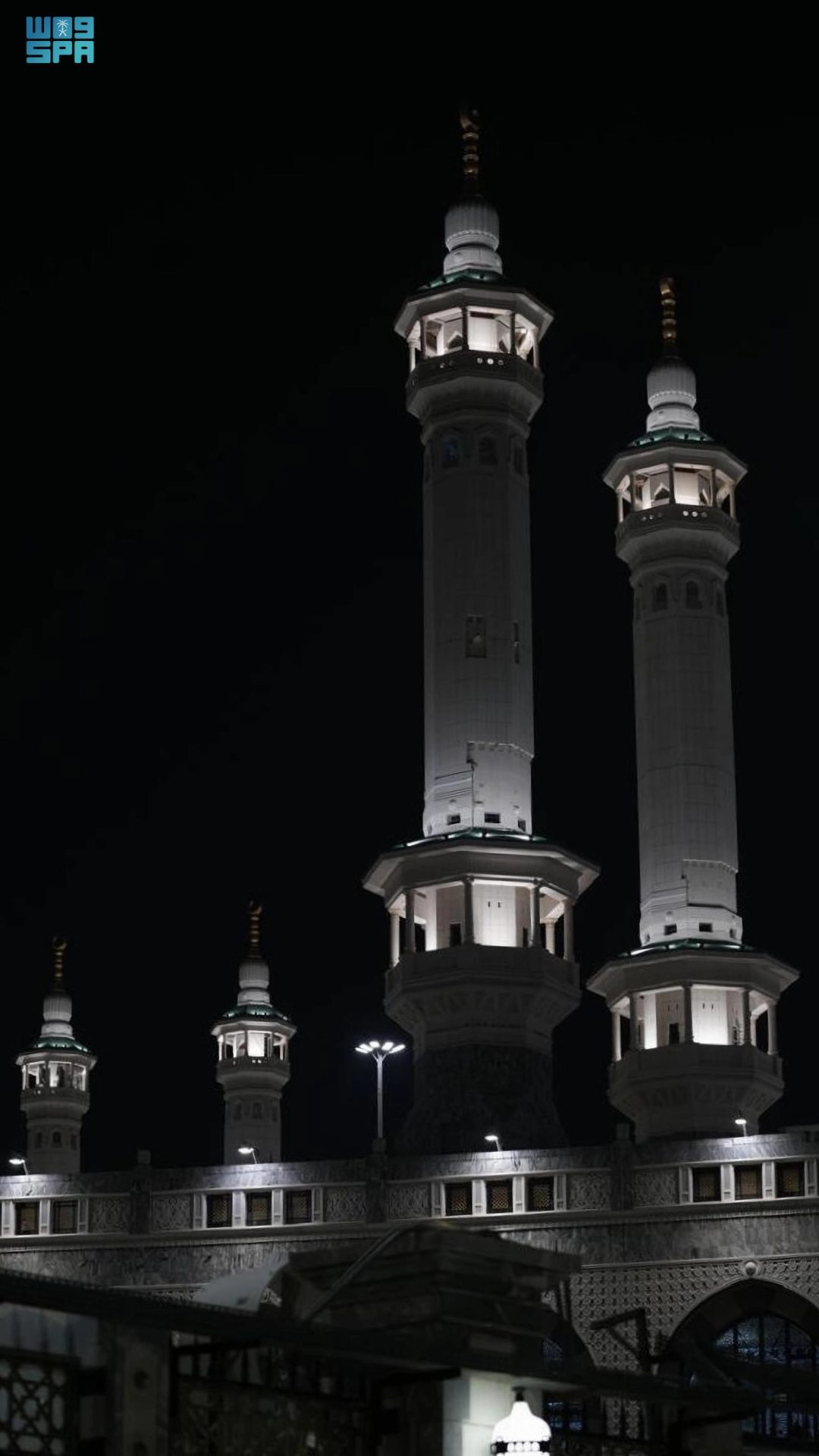
The Grand Mosque in Makkah features 13 minarets that share a similar design but vary in height, according to the General Authority for the Care of the Grand Mosque and the Prophet’s Mosque. The tallest rise 137 meters, while the shortest stand at 98 meters, forming what the authority describes as architectural masterpieces throughout history.
SPA reported that the minarets stand beside the holy Kaaba in Makkah, where Islam emerged. They are distinguished by an architectural style inspired by Islamic heritage and by their role in announcing prayer times through loudspeakers. Minarets more broadly serve as landmarks and symbols of Islamic architecture, playing a role in the urban environments of Muslim communities, with designs that range from short, thick towers to tall, slender structures.
How often do visitors to the Grand Mosque pause to consider the engineering behind the towers that frame the courtyard? The authority’s breakdown places two minarets at the Umrah Gate, each 137 meters tall, and two at the King Abdulaziz Gate, also 137 meters tall. Two minarets stand at the King Fahd Gate, each 98 meters tall, while a single minaret at Al-Safa Gate reaches 98 meters. Two more rise at Al-Fath Gate, each 137 meters tall, and four minarets belong to the Third Saudi Expansion, each reaching 135 meters.
That distribution means the 137-meter height appears at the Umrah Gate, the King Abdulaziz Gate, and Al-Fath Gate, while the 98-meter height is shared by the King Fahd Gate pair and the lone Al-Safa Gate minaret. The Third Saudi Expansion accounts for four of the 13 minarets at 135 meters each, a figure that sits just below the tallest group.
What does it take to maintain structures of this scale in a city that receives worshippers year-round? Each minaret of the Grand Mosque is divided into five sections: the base, the first balcony, the minaret shaft, the second balcony, and the cover. That five-part composition is repeated across the 13 towers even as their overall heights differ.
Over the centuries, the minarets have been adorned with crescent finials crafted in various styles throughout Islamic history, evolving into the elegant designs seen today, according to the authority. The finials therefore carry layers of craft traditions rather than a single moment of design.
Can a single architectural feature carry both a practical function and a visual identity for an entire city? In the case of the Grand Mosque, the minarets do both: they announce prayer times through loudspeakers and they stand as landmarks beside the Kaaba. The authority’s description ties the towers to their setting, noting that their special significance comes from standing beside the holy Kaaba in Makkah, where Islam emerged.
The variation in height across the 13 minarets is set against a shared design language. Two at the Umrah Gate and two at the King Abdulaziz Gate match at 137 meters; two at the King Fahd Gate match at 98 meters; Al-Safa Gate has one at 98 meters; Al-Fath Gate has two at 137 meters; and the Third Saudi Expansion contributes four at 135 meters. The result is a set of towers that read as a family while differing in scale.
Why do the 137-meter minarets cluster at three gates while the 98-meter pair sits at another? The authority’s figures do not explain the reasoning behind the heights, only the measurements and locations. What is clear from the breakdown is that no two gates share an identical count: Umrah Gate has two, King Abdulaziz Gate has two, King Fahd Gate has two, Al-Safa Gate has one, Al-Fath Gate has two, and the Third Saudi Expansion has four.
The five-section division of each minaret offers a way to read the towers from ground to sky. The base anchors the structure, the first balcony marks an early stage, the shaft carries the height, the second balcony sits higher, and the cover completes the form. Crescent finials then top the composition, crafted in styles that changed across Islamic history.
How does the presence of loudspeakers shape the daily rhythm around the Grand Mosque? The authority notes that the minarets play a role in announcing prayer times through loudspeakers, a function that connects the architecture to the schedule of worship. The same towers that serve as visual landmarks also carry sound across the area.
The authority’s account places the minarets within a wider tradition. Minarets generally serve as landmarks and symbols of Islamic architecture, and their designs vary from short, thick towers to tall, slender structures. The Grand Mosque’s minarets belong to that tradition while holding a distinct position because of their location beside the Kaaba.
What might the crescent finials reveal about the periods in which they were made? The authority says they were crafted in various styles throughout Islamic history and evolved into the elegant designs seen today. That evolution suggests successive phases of craftsmanship rather than a single fixed form.
The 13 minarets are spread across named gates and one expansion: Umrah Gate, King Abdulaziz Gate, King Fahd Gate, Al-Safa Gate, Al-Fath Gate, and the Third Saudi Expansion. The tallest at 137 meters appear at three of those locations, the 98-meter height appears at two, and the 135-meter height appears only in the Third Saudi Expansion.
Does the shared design across differing heights change how the skyline is perceived from different points in the courtyard? The authority describes the minarets as sharing a similar design while varying in height, which means the differences are in scale rather than in basic form. Each still follows the five-part division of base, first balcony, shaft, second balcony, and cover.
SPA’s report, dated March 23, 2025, from Makkah, draws on the General Authority for the Care of the Grand Mosque and the Prophet’s Mosque for the count and measurements. The report does not include the dates when individual minarets were built, the names of architects or builders, or the cost of construction or maintenance. It also does not specify the materials used in the towers or the finials.
What the report does provide is a precise inventory: 13 minarets, two at the Umrah Gate at 137 meters each, two at the King Abdulaziz Gate at 137 meters each, two at the King Fahd Gate at 98 meters each, one at Al-Safa Gate at 98 meters, two at Al-Fath Gate at 137 meters each, and four in the Third Saudi Expansion at 135 meters each. Those numbers give a clear picture of how the towers are distributed and how they compare.
The authority’s description also ties the minarets to their purpose. They announce prayer times through loudspeakers, and they stand as landmarks beside the holy Kaaba. Their architectural style is inspired by Islamic heritage, and their crescent finials reflect styles from different periods of Islamic history.
How does a structure that is measured in meters also carry meaning that is not measured at all? The authority frames the minarets as symbols of Islamic architecture and as elements of the urban environment, which places them in a category beyond pure engineering. Their role in the daily call to prayer adds a layer that the measurements alone cannot capture.
The five sections of each minaret, from base to cover, are consistent across the 13 towers. The heights vary, the gates differ, and the Third Saudi Expansion adds four at 135 meters, but the internal structure follows the same pattern. That consistency is part of what the authority describes as a shared design.
What remains outside the report is as notable as what it contains. There is no account of when each minaret was constructed, no list of the craftspeople who made the crescent finials, and no description of the loudspeaker systems themselves. The report focuses on the count, the heights, the locations, the five-part division, and the heritage-inspired design.
For readers following the architecture of the Grand Mosque, the authority’s figures offer a way to identify each minaret by gate and height. The 137-meter group covers the Umrah Gate, the King Abdulaziz Gate, and the Al-Fath Gate. The 98-meter group covers the King Fahd Gate and the Al-Safa Gate. The 135-meter group is the Third Saudi Expansion.
Can the evolution of the crescent finials be traced through the styles mentioned by the authority? The report says they were crafted in various styles throughout Islamic history and evolved into the elegant designs seen today, but it does not date the styles or name them. The evolution is described in general terms.
The minarets stand beside the holy Kaaba in Makkah, where Islam emerged, and they are distinguished by their architectural style inspired by Islamic heritage and their role in announcing prayer times through loudspeakers. That combination of setting, style, and function is what the authority highlights in its description.
What does the five-part division tell us about how the towers were conceived? The base, first balcony, shaft, second balcony, and cover suggest a vertical sequence that moves from support to height to completion. The crescent finial then sits above the cover, crafted in a style drawn from Islamic history.
The authority’s count of 13 minarets includes the four in the Third Saudi Expansion, which are each 135 meters tall. The remaining nine are distributed across five gates: two at Umrah Gate, two at King Abdulaziz Gate, two at King Fahd Gate, one at Al-Safa Gate, and two at Al-Fath Gate. The heights across those nine are either 137 meters or 98 meters.
How do the gate names themselves reflect the history of the Grand Mosque? The report lists Umrah Gate, King Abdulaziz Gate, King Fahd Gate, Al-Safa Gate, and Al-Fath Gate, along with the Third Saudi Expansion, but it does not explain the origins of the names or the dates they were given. What it provides is the association between each name and its minarets.
The report from SPA, dated March 23, 2025, and timed at 23:46 local time and 20:46 GMT, presents the authority’s information as a description of the minarets’ design and distribution. It does not include visitor numbers, construction timelines, or comparisons with other mosques. The focus stays on the 13 minarets, their heights, their gates, their five sections, and their crescent finials.
What might a visitor notice first when approaching the Grand Mosque? The minarets rise at different heights, with the 137-meter towers at the Umrah Gate, the King Abdulaziz Gate, and the Al-Fath Gate, the 98-meter towers at the King Fahd Gate and the Al-Safa Gate, and the 135-meter towers in the Third Saudi Expansion. Each carries the same five-part structure and a crescent finial shaped by styles from Islamic history.
The authority’s description places the minarets within the urban environment of Muslim communities, where minarets generally serve as landmarks and symbols of Islamic architecture. Their designs vary from short, thick towers to tall, slender structures, and the Grand Mosque’s minarets belong to that broad tradition while holding a special position beside the Kaaba.
Does the role of announcing prayer times through loudspeakers change how the minarets are experienced compared with minarets elsewhere? The report notes this role as one of the distinguishing features of the Grand Mosque’s minarets, alongside their heritage-inspired style. The sound and the structure are linked in the authority’s account.
The report does not say when the loudspeakers were installed, how they are maintained, or how the sound is directed. It also does not describe the interior of the minarets or whether they are accessible. The information provided covers the count, the heights, the gates, the five sections, and the finials.
What the authority’s breakdown makes clear is that the 13 minarets are not uniform in height even though they share a design. The 137-meter height appears six times across three gates, the 98-meter height appears three times across two gates, and the 135-meter height appears four times in the Third Saudi Expansion. That distribution gives each gate a distinct profile.
For anyone mapping the Grand Mosque’s skyline, the figures offer a set of reference points: Umrah Gate at 137 meters, King Abdulaziz Gate at 137 meters, King Fahd Gate at 98 meters, Al-Safa Gate at 98 meters, Al-Fath Gate at 137 meters, and the Third Saudi Expansion at 135 meters. Each minaret follows the same five-part division from base to cover.
The crescent finials, crafted in various styles throughout Islamic history, sit above those covers. The authority says they evolved into the elegant designs seen today, a phrase that points to change over time without specifying dates or periods. The minarets as a whole are described as architectural masterpieces throughout history.
How does the authority’s description connect the minarets to the Kaaba? It states that the minarets hold special significance as they stand beside the holy Kaaba in Makkah, where Islam emerged. That proximity is presented as the source of their distinction, alongside their style and their function in announcing prayer times.
The report closes with the SPA attribution and the local and GMT times, leaving the architectural account as the core of the material. No additional figures, dates, or names appear beyond those already given: 13 minarets, heights of 137, 98, and 135 meters, six named locations, five sections per minaret, and crescent finials shaped by Islamic history.
How many minarets does the Grand Mosque have and how tall are they? The General Authority for the Care of the Grand Mosque and the Prophet’s Mosque says the Grand Mosque features 13 minarets that share a similar design but vary in height. Two at the Umrah Gate are each 137 meters tall, two at the King Abdulaziz Gate are each 137 meters, two at the King Fahd Gate are each 98 meters, one at Al-Safa Gate stands at 98 meters, two at Al-Fath Gate are each 137 meters, and four in the Third Saudi Expansion each reach 135 meters.
What are the five sections of each Grand Mosque minaret? According to the authority, each minaret of the Grand Mosque is divided into five sections: the base, the first balcony, the minaret shaft, the second balcony, and the cover. That five-part composition is repeated across all 13 minarets even though their overall heights differ, with the tallest at 137 meters and the shortest at 98 meters. The crescent finials sit above the cover.
What role do the Grand Mosque’s minarets play besides serving as landmarks? The authority says the minarets are distinguished by their architectural style inspired by Islamic heritage and by their role in announcing prayer times through loudspeakers. They stand beside the holy Kaaba in Makkah, where Islam emerged, which gives them special significance. More broadly, minarets serve as landmarks and symbols of Islamic architecture and play a role in the urban environments of Muslim communities.
How have the crescent finials on the minarets changed over time? The authority states that over the centuries the minarets have been adorned with crescent finials crafted in various styles throughout Islamic history, evolving into the elegant designs seen today. The report does not date the individual styles or name the periods in which they were made. It describes the evolution in general terms, linking the finials to the broader heritage-inspired design of the minarets.
Which gates have the 137-meter minarets and which have the 98-meter minarets? The 137-meter minarets stand at the Umrah Gate, the King Abdulaziz Gate, and the Al-Fath Gate, with two at each location. The 98-meter minarets are at the King Fahd Gate, where there are two, and at Al-Safa Gate, where there is one. The four minarets in the Third Saudi Expansion each reach 135 meters, placing them just below the tallest group.