


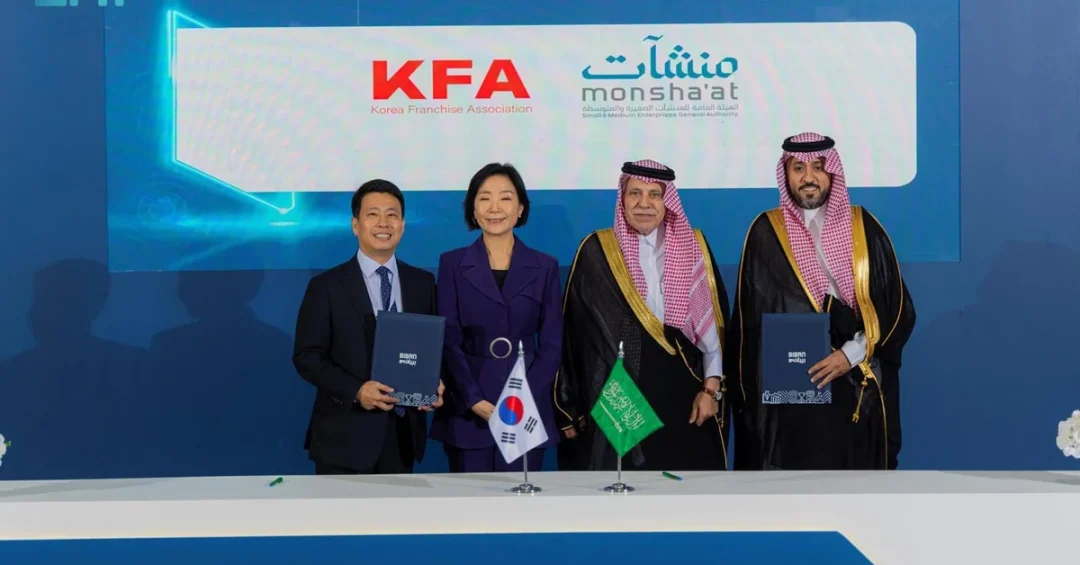
The General Authority for Small and Medium Enterprises (Monsha’at) signed a memorandum of understanding (MoU) with the Korean Franchise Association at the Biban24 Forum in Riyadh on Tuesday, November 5, 2024, establishing a new framework for franchise-sector cooperation between Saudi Arabia and the Republic of Korea. The agreement was signed by Monsha’at Governor Sami bin Ibrahim Al-Husseini and Korean Deputy Minister for Small and Medium Enterprises and Startups Lim Jung-wook, in the presence of Saudi Minister of Commerce Dr. Majid bin Abdullah Al-Kassabi and Korean Minister of SMEs and Startups Oh Young-joo, according to the Saudi Press Agency.
The MoU is designed to support Korean brands seeking to expand both locally and internationally, while encouraging franchise brands from Saudi Arabia and Korea to take part in specialized exhibitions and workshops. The deal adds a franchise-specific dimension to the fast-growing economic partnership between Riyadh and Seoul, two capitals that have deepened commercial ties across energy, industry, entertainment, and small-business development in recent years. For Saudi Arabia, the agreement arrives as the Kingdom accelerates efforts to diversify its economy and strengthen the role of small and medium enterprises under Vision 2030. Could a single franchise agreement help reshape how Saudi entrepreneurs access global brands and markets?
Context and Background
The memorandum was concluded on the sidelines of the Biban24 Forum, a major entrepreneurship gathering organized by Monsha’at that connects local and international organizations supporting entrepreneurs and SMEs. According to official information released through the Saudi Press Agency, the forum functions as a platform for empowering entrepreneurs and fostering startup incubation through 50 local incubators and accelerators alongside more than 150 supportive entities from around the world. The presence of both countries’ ministers at the signing underscored the strategic weight attached to the agreement.
Monsha’at, formally the General Authority for Small and Medium Enterprises, is the Saudi government body responsible for regulating, supporting, and developing the Kingdom’s SME sector. Its mandate spans financing facilitation, business incubation, market access, and regulatory enablement for entrepreneurs. The Korean Franchise Association represents franchise businesses in Korea, a country whose franchise sector is known for sophisticated brand systems, standardized operations, and strong export ambitions. Why does pairing a Saudi SME authority with a Korean franchise body make strategic sense at this moment?
The signing also reflects a broader pattern of Saudi-Korean economic engagement. In recent years, the two countries have pursued cooperation spanning energy, petrochemicals, automotive manufacturing, content and entertainment, and technology. Franchising sits at the intersection of several of these fields: it transfers business formats, builds local supply chains, and creates opportunities for Saudi franchisees to operate proven concepts while developing local talent and management capacity.
Key Details of the Agreement
Under the terms described by the Saudi Press Agency, the MoU aims to support Korean brands interested in expanding locally and internationally. It also encourages franchise brands from both nations to participate in specialized exhibitions and workshops, creating structured opportunities for Saudi and Korean businesses to meet, exchange expertise, and explore commercial partnerships. The agreement was signed by Monsha’at Governor Sami bin Ibrahim Al-Husseini and Korean Deputy Minister for SMEs and Startups Lim Jung-wook.
Saudi Minister of Commerce Dr. Majid bin Abdullah Al-Kassabi and Korean Minister of SMEs and Startups Oh Young-joo attended the signing, a signal of high-level governmental backing for the initiative. The involvement of the commerce minister connects the franchise agenda to Saudi Arabia’s wider trade and investment priorities, while the participation of Korea’s SME and startup minister links the deal to Seoul’s own agenda of supporting smaller enterprises abroad. What practical doors could this open for Saudi entrepreneurs looking to operate international brands?
The emphasis on exhibitions and workshops is significant. Trade shows and specialized business forums are often the first step in franchise internationalization, allowing brand owners to test market interest, identify local partners, and adapt operating models to local regulations and consumer preferences. For Saudi franchisees, these platforms offer direct access to brand principals, reducing the information gaps that can slow or derail expansion plans.
Biban24 Forum as a Platform for Cooperation
The Biban24 Forum serves as a platform connecting local and international organizations that support entrepreneurship and SMEs. Its scale, including 50 local incubators and accelerators and more than 150 supportive entities worldwide, positions it as one of the region’s most substantial entrepreneurship convenings. The MoU signing demonstrates how such forums convert networking into formal agreements with lasting institutional commitments.
For Monsha’at, Biban is more than an annual event; it is a working instrument of SME policy. The forum brings together financiers, accelerators, government agencies, and international partners under one roof, allowing Saudi entrepreneurs to build relationships that would otherwise take months to establish. The Korean Franchise Association’s engagement at Biban24 therefore represents both a vote of confidence in the Saudi market and a practical channel for knowledge transfer. How valuable is it for Saudi startups to meet international franchise operators face to face?
The forum’s international dimension also supports Saudi Arabia’s goal of becoming a regional hub for entrepreneurship. By hosting partners from Asia and beyond, Riyadh strengthens its position as a convening power in the global SME conversation, reinforcing the Kingdom’s reputation as a place where business ideas travel, adapt, and scale.
International and Regional Impact
The agreement strengthens Saudi-Korea economic relations at a time when both countries are actively diversifying their international partnerships. For Korea, the MoU offers a structured route into the Gulf’s largest consumer market, where demand for quality food and beverage concepts, retail formats, education services, and lifestyle brands continues to grow. For Saudi Arabia, it adds Korean brand expertise to a franchise ecosystem that is expanding rapidly as domestic consumer spending matures.
Regionally, the deal reinforces Riyadh’s role as a gateway for international businesses seeking Gulf expansion. Franchise operators entering Saudi Arabia often use the Kingdom as a base for broader regional growth, given its market size, infrastructure, and connectivity. Could this agreement inspire similar arrangements with franchise associations in other advanced economies?
The MoU also carries a diplomatic dimension. Economic agreements of this kind deepen people-to-people and business-to-business ties, creating constituencies in both countries with a stake in the relationship. That soft infrastructure of commercial trust can be as important as headline investment figures in sustaining long-term cooperation.
Economic and Strategic Significance
Franchising is an important vehicle for SME growth because it allows entrepreneurs to operate under proven business models with established branding, training, and supply chains. For Saudi Arabia, expanding franchise activity supports job creation, skills development, and the transfer of management know-how to local operators. These outcomes align directly with the objectives of Vision 2030, which seeks a diversified economy in which small and medium enterprises contribute a larger share of GDP and employment.
The agreement also complements Saudi Arabia’s broader investment in entrepreneurship infrastructure, including incubators, accelerators, and financing programs. By connecting Saudi franchisees with Korean brands, the MoU can increase the pipeline of viable small businesses and encourage higher standards of service and operations across sectors. What might a more internationally connected franchise sector mean for Saudi consumers and workers over the next decade?
From Korea’s perspective, the deal supports the internationalization of its franchise industry, which has increasingly looked abroad for growth. Saudi Arabia’s young, digitally connected population and rising disposable incomes make it an attractive destination for Korean brands in food, beauty, education, and entertainment. The mutual benefit is clear: Korean brands gain market access, and Saudi entrepreneurs gain proven concepts and operational expertise.
Vision 2030 Alignment
The MoU aligns squarely with Vision 2030’s ambition to build a thriving private sector and expand the role of small and medium enterprises in the national economy. Monsha’at’s work, including its Biban forums and international partnerships, is central to that effort, providing entrepreneurs with access to markets, capital, and knowledge. Agreements such as this one translate high-level strategy into concrete opportunities for Saudi business owners.
By linking Saudi franchisees with Korean brand owners, the agreement supports economic diversification, encourages foreign commercial engagement, and strengthens the Kingdom’s position as a hub for entrepreneurship in the region. It also reflects the leadership’s consistent emphasis on international cooperation as a driver of domestic progress. As Saudi Arabia continues to open new avenues for SMEs, partnerships like the Monsha’at-Korean Franchise Association MoU illustrate how global collaboration can serve the goals of a diversified, opportunity-rich economy for generations to come.
20 Questions
Q1. What did Monsha’at sign at the Biban24 Forum?
A1. Monsha’at signed a memorandum of understanding with the Korean Franchise Association at the Biban24 Forum in Riyadh, establishing a framework for franchise-sector cooperation between Saudi Arabia and the Republic of Korea.
Q2. Who signed the MoU on behalf of Saudi Arabia?
A2. The MoU was signed by Monsha’at Governor Sami bin Ibrahim Al-Husseini, representing the General Authority for Small and Medium Enterprises, according to the Saudi Press Agency.
Q3. Who signed the agreement on behalf of Korea?
A3. Korean Deputy Minister for Small and Medium Enterprises and Startups Lim Jung-wook signed the memorandum of understanding on behalf of the Republic of Korea.
Q4. Which Saudi official attended the signing ceremony?
A4. Saudi Minister of Commerce Dr. Majid bin Abdullah Al-Kassabi attended the signing, underscoring the government’s support for franchise-sector development and international commercial cooperation.
Q5. Which Korean official attended the signing?
A5. Korean Minister of SMEs and Startups Oh Young-joo attended the signing ceremony, reflecting Seoul’s commitment to supporting Korean franchise brands expanding into international markets.
Q6. What is the main objective of the MoU?
A6. The agreement aims to support Korean brands interested in expanding locally and internationally, and to encourage franchise brands from both nations to participate in specialized exhibitions and workshops.
Q7. What is Monsha’at and what does it do?
A7. Monsha’at is the General Authority for Small and Medium Enterprises, the Saudi government body responsible for regulating, supporting, and developing the Kingdom’s SME sector and entrepreneurship ecosystem.
Q8. What is the Biban24 Forum?
A8. Biban24 is a major entrepreneurship forum organized by Monsha’at that connects local and international organizations supporting entrepreneurs and SMEs, serving as a platform for partnership and business development.
Q9. How many local incubators and accelerators does Biban24 involve?
A9. According to the Saudi Press Agency, the forum involves 50 local incubators and accelerators alongside more than 150 supportive entities from around the world.
Q10. Why is franchising important for Saudi SMEs?
A10. Franchising allows Saudi entrepreneurs to operate proven business models with established branding, training, and supply chains, supporting job creation, skills development, and the transfer of management expertise.
Q11. How does the MoU benefit Korean brands?
A11. The agreement gives Korean franchise brands a structured route into Saudi Arabia’s large and growing consumer market, where demand for quality retail, food, and lifestyle concepts continues to expand.
Q12. How does this agreement align with Vision 2030?
A12. It supports Vision 2030’s goal of a diversified economy by expanding the role of small and medium enterprises, encouraging private-sector growth, and connecting Saudi entrepreneurs with international partners.
Q13. What role do exhibitions and workshops play in the agreement?
A13. Specialized exhibitions and workshops allow Saudi and Korean franchise brands to meet, exchange expertise, test market interest, and build commercial partnerships that can lead to formal expansion deals.
Q14. When and where was the MoU signed?
A14. The memorandum was signed on Tuesday, November 5, 2024, at the Biban24 Forum in Riyadh, as reported by the Saudi Press Agency.
Q15. What broader trend does this agreement reflect?
A15. It reflects deepening Saudi-Korean economic cooperation across energy, industry, technology, entertainment, and SME development, strengthening commercial ties between Riyadh and Seoul.
Q16. How could this MoU affect Saudi consumers?
A16. It could bring more international franchise brands to the Saudi market, increasing consumer choice and raising service standards through competition and the introduction of proven operating models.
Q17. What does the Korean Franchise Association represent?
A17. The Korean Franchise Association represents franchise businesses in Korea, a sector known for sophisticated brand systems, standardized operations, and growing ambitions to expand internationally.
Q18. How does the agreement support knowledge transfer?
A18. By encouraging joint participation in exhibitions and workshops, the MoU creates channels for Korean franchise expertise, training methods, and operational standards to reach Saudi entrepreneurs and local operators.
Q19. What regional role does Saudi Arabia play in this partnership?
A19. Saudi Arabia serves as a gateway for international businesses seeking Gulf expansion, and franchise operators entering the Kingdom often use it as a base for broader regional growth.
Q20. What is the long-term significance of the MoU?
A20. The agreement translates high-level Saudi-Korean cooperation into practical opportunities for entrepreneurs, supporting economic diversification, SME growth, and the Kingdom’s emergence as a regional entrepreneurship hub.
Reader Feedback
We value your thoughts. Please share your feedback on this article.
Your feedback helps us improve our coverage.
Related articles
 Monsha’at Partners with X to Boost SME Digital Transformation
 Monsha’at Signs Agreement with Estonian Business and Innovation Agency at Biban24
 Monsha’at Signs MoU with Korean Ministry of SMEs, Startups
 Aramco’s myCommunity Wins Global Smart City Innovation Award
 Monsha’at, KAUST Sign MoU to Empower Entrepreneurs
 Monsha’at, SCCC Alibaba Cloud Partner to Drive SME Digital Transformation