


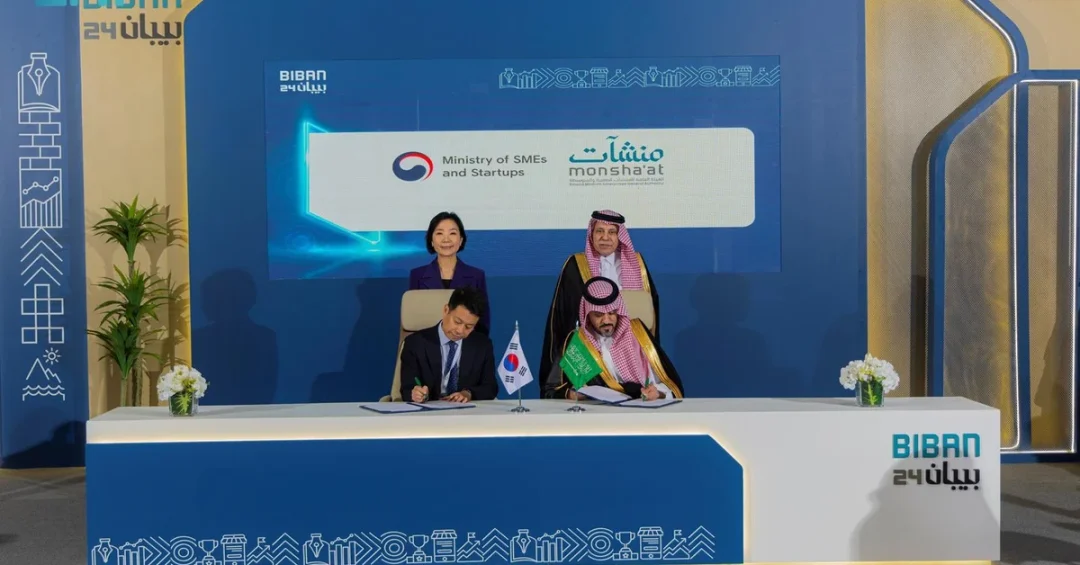
The Saudi Small and Medium Enterprises General Authority (Monsha’at) and the Republic of Korea Ministry of SMEs and Startups (MSS) signed a memorandum of understanding (MoU) in Riyadh on November 7, 2024, covering business facilitation, innovation, and entrepreneurship. The agreement, announced by the Saudi Press Agency (SPA), was concluded during the Biban24 Forum, which Monsha’at organized under the theme “Global Destination for Opportunities” at the Riyadh Front Exhibition & Conference Center from November 5 to 9. The MoU was signed by Sami bin Ibrahim Al-Husseini, Minister of Commerce and Chairman of Monsha’at’s board of directors, and Oh Youngju, Minister of SMEs and Startups of the Republic of Korea.
The signing reflects the substantial backing the Kingdom’s leadership extends to the small and medium enterprise sector as part of Saudi Vision 2030, and it underscores the shared determination of Saudi Arabia and the Republic of Korea to advance entrepreneurship and its economic contributions, particularly in technology and the growth of the digital economy. For international observers, the agreement signals how Riyadh is converting its flagship entrepreneurship gathering into a platform for durable institutional partnerships. How often does a single forum signing reshape the way two economies connect their startup ecosystems?
Context and Background
What makes this MoU more than a routine diplomatic gesture? Saudi Arabia has spent the better part of a decade building an entrepreneurship architecture that now ranks among the most active in the region. Monsha’at, established to support and grow the SME sector, has become the operational engine behind that effort, running programs that range from financing support to regulatory simplification. The Biban Forum, its flagship annual event, has grown into a global meeting point for founders, investors, and policymakers. Hosting the Republic of Korea’s Ministry of SMEs and Startups at that event placed the two countries’ small-business agendas side by side at the highest level.
The Republic of Korea brings a complementary profile. Its economy is celebrated for scaling technology-intensive firms and for a startup ecosystem that converts research into commercial products. Saudi Arabia, for its part, offers capital, a young and digitally fluent population, and a market positioned at the crossroads of three continents. The MoU therefore pairs Korean innovation depth with Saudi market reach. The agreement also reflects the two countries’ efforts to advance entrepreneurship and its economic contributions, particularly in technology and the growth of the digital economy, according to the official announcement.
The timing matters. Biban24 is presenting more than 10,000 investment opportunities for SMEs from both the public and private sectors and connecting entrepreneurs with over 5,000 investors. Within that environment, a bilateral MoU is not an isolated document but an instrument that can be activated immediately through the networks already assembled in Riyadh. For a Korean startup looking at Gulf expansion, or a Saudi founder seeking technology partners in East Asia, the forum provided the connective tissue.
Key Details of the Agreement
What exactly does the memorandum commit the two sides to do? The MoU sets out a practical work program. It aims to exchange knowledge on policies and regulations to improve the business environment, launch programs that promote innovation, entrepreneurship, and e-commerce, and foster research and development between startups and research centers. Each of these elements addresses a known friction point in cross-border SME growth: regulatory unfamiliarity, limited market-entry support, and the distance between laboratory research and commercial scale.
The agreement also seeks to establish a joint ministerial committee between the two countries focused on SMEs and startups and to set a work plan for 2025. That committee structure is significant because it creates a standing channel rather than a one-time exchange. It gives both ministries a mechanism to review progress, adjust priorities, and keep private-sector participants engaged. The 2025 work plan provides a near-term horizon against which commitments can be measured.
The signatories themselves signal the level of seriousness. Sami bin Ibrahim Al-Husseini signed in his capacity as Minister of Commerce and Chairman of Monsha’at’s board of directors, linking the SME agenda directly to the Kingdom’s commercial policy apparatus. Oh Youngju signed for the Republic of Korea’s Ministry of SMEs and Startups, the ministry responsible for that country’s small-business and startup strategy. The alignment of commerce and SME portfolios on the Saudi side reflects how central small enterprises are to the Kingdom’s diversification plans.
International and Regional Impact
How will an agreement signed in Riyadh resonate beyond the two capitals? For the region, the MoU reinforces Saudi Arabia’s position as a convening power in the entrepreneurship space. When a major Asian economy chooses Biban as the venue for a ministerial-level SME agreement, it validates the forum’s evolution from a national event into an international marketplace of ideas and capital. Other governments watching the signing may see a template for engaging Gulf markets through structured, ministry-to-ministry cooperation.
For Saudi-Korean relations, the memorandum adds an economic layer to a relationship that already spans energy, construction, and technology. Small enterprises are often the fastest route to deepening commercial ties because they create distributed, people-level connections between economies. A joint committee focused on startups can generate recurring exchanges, pilot programs, and joint ventures that outlast any single forum. The agreement also positions both countries to cooperate on e-commerce, a sector where Korean platform expertise and Saudi digital adoption could combine effectively.
Globally, the MoU fits a pattern in which Saudi Arabia uses its Vision 2030 platforms to build a diversified network of partners. Rather than relying on a single bloc, the Kingdom is assembling bilateral relationships across Asia, Europe, and the Americas. Each agreement adds a node to a system designed to transfer knowledge, attract investment, and export Saudi entrepreneurial capacity. In that sense, the Korean MoU is both a specific deal and a data point in a larger strategy.
Economic and Strategic Significance
Why should investors and business leaders pay attention to a document focused on small enterprises? SMEs are the backbone of most economies, and in Saudi Arabia they are a designated engine of job creation and non-oil growth. The MoU’s emphasis on policies and regulations to improve the business environment speaks directly to the conditions investors evaluate before entering a market. Regulatory exchange with a mature startup economy like Korea can accelerate the refinement of Saudi procedures and standards.
The innovation, entrepreneurship, and e-commerce programs envisioned in the agreement open commercial pathways. Korean startups gain a structured route into the Gulf’s largest market, while Saudi startups gain exposure to Korean research institutions and technology partners. Research and development cooperation between startups and research centers addresses a persistent gap: the translation of academic work into market-ready products. By building that bridge, the two countries aim to raise the commercial yield of their respective innovation spending.
Strategically, the agreement strengthens the non-oil economy at a moment when diversification is a central policy objective. It also complements the investment activity visible at Biban24, where more than 10,000 opportunities and over 5,000 investors are in play. A joint ministerial committee with a 2025 work plan gives the private sector a predictable framework for engagement. For companies assessing the Saudi market, that predictability is as valuable as any incentive.
Vision 2030 Alignment
How does a single memorandum connect to a national transformation program? Saudi Vision 2030 places the private sector, and SMEs in particular, at the center of its economic diversification agenda. The agreement aligns with the significant support provided by the Kingdom’s leadership to the SME sector as part of those objectives. By importing best practices in policy design, innovation support, and e-commerce development, the MoU helps strengthen the ecosystem that Vision 2030 depends on to generate sustainable, private-sector-led growth.
The partnership also advances the international dimension of Vision 2030. Saudi Arabia’s transformation is not a closed project; it is built on global partnerships, knowledge transfer, and openness to investment. The Republic of Korea’s participation through its Ministry of SMEs and Startups demonstrates that the Kingdom’s entrepreneurship platforms can attract top-tier international counterparts. As the joint committee begins its work and the 2025 plan takes shape, the agreement is expected to produce concrete exchanges that benefit founders in both countries. For Saudi Arabia, it is another step toward becoming a global destination for opportunities and a hub where Eastern innovation and Gulf ambition meet.
20 Questions
Q1. What does the MoU between Monsha’at and Korea’s Ministry of SMEs and Startups cover?
A1. The memorandum covers business facilitation, fostering innovation, and entrepreneurship. It includes exchanging knowledge on policies and regulations, launching programs for innovation, entrepreneurship, and e-commerce, and fostering research and development between startups and research centers.
Q2. When and where was the MoU signed?
A2. It was signed in Riyadh on November 7, 2024, during the Biban24 Forum, held at the Riyadh Front Exhibition & Conference Center from November 5 to 9, under the theme “Global Destination for Opportunities.”
Q3. Who signed the agreement on behalf of Saudi Arabia?
A3. Sami bin Ibrahim Al-Husseini, Minister of Commerce and Chairman of Monsha’at’s board of directors, signed on behalf of the Kingdom, underscoring the SME sector’s link to national commercial policy.
Q4. Who signed on behalf of the Republic of Korea?
A4. Oh Youngju, Minister of SMEs and Startups, signed for the Republic of Korea, representing the ministry responsible for that country’s small-business and startup strategy.
Q5. What is Monsha’at and what is its role?
A5. Monsha’at is the Saudi Small and Medium Enterprises General Authority. It supports and grows the SME sector through financing, regulatory support, and programs, and it organizes the Biban Forum as a global entrepreneurship platform.
Q6. What is the Biban24 Forum?
A6. Biban24 is a major entrepreneurship event organized by Monsha’at under the theme “Global Destination for Opportunities.” It offers more than 10,000 investment opportunities and connects entrepreneurs with over 5,000 investors.
Q7. What is the purpose of the joint ministerial committee?
A7. The committee is intended to focus on SMEs and startups between the two countries. It will provide a standing channel to review progress, coordinate activities, and implement a work plan for 2025.
Q8. What does the 2025 work plan involve?
A8. The work plan sets a near-term timeline for implementing the MoU’s objectives, including policy exchange, innovation and e-commerce programs, and research and development cooperation between startups and research centers.
Q9. How does the MoU support Saudi Vision 2030?
A9. It aligns with the leadership’s support for the SME sector under Vision 2030. By improving the business environment and fostering innovation, it helps build the private-sector-led, diversified economy the Vision seeks.
Q10. Why is cooperation with Korea significant for Saudi Arabia?
A10. Korea has a mature, technology-driven startup ecosystem. Partnering with it gives Saudi Arabia access to proven policies and innovation practices, while Korean firms gain a structured route into the Gulf’s largest market.
Q11. What sectors does the agreement emphasize?
A11. The agreement emphasizes technology and the digital economy, alongside e-commerce, innovation, entrepreneurship, and research and development. These areas reflect both countries’ economic priorities.
Q12. How many investment opportunities does Biban24 offer?
A12. Biban24 offers more than 10,000 investment opportunities provided by both the public and private sectors, creating a wide marketplace for SMEs seeking capital and partnerships.
Q13. How many investors are participating in Biban24?
A13. The forum connects entrepreneurs with over 5,000 investors, enhancing investment prospects and enabling direct engagement between founders and financiers.
Q14. What does the MoU mean for Saudi startups?
A14. Saudi startups gain exposure to Korean research institutions, technology partners, and market-entry know-how. The agreement can open pathways for joint ventures and access to Korean expertise.
Q15. What does it mean for Korean startups?
A15. Korean startups gain a structured route into the Saudi market, one of the region’s largest, supported by policy exchange, e-commerce programs, and connections to Saudi investors and institutions.
Q16. How does the MoU address the business environment?
A16. It aims to exchange knowledge on policies and regulations to improve the business environment, helping both countries refine procedures, standards, and support mechanisms for small enterprises.
Q17. What role does research and development play in the agreement?
A17. The MoU fosters research and development between startups and research centers, aiming to translate academic and laboratory work into commercial products and scalable businesses.
Q18. Why is e-commerce included in the agreement?
A18. E-commerce is a fast-growing sector where Korean platform expertise and Saudi digital adoption can combine. Programs in this area can accelerate cross-border trade and startup growth.
Q19. How does the agreement reflect Saudi Arabia’s global engagement?
A19. It shows the Kingdom building bilateral partnerships across Asia through Vision 2030 platforms, attracting international counterparts and positioning Saudi Arabia as a global hub for entrepreneurship.
Q20. What happens next after the signing?
A20. The two sides will establish the joint ministerial committee and set a work plan for 2025. Implementation will focus on policy exchange, innovation and e-commerce programs, and startup research cooperation.
Reader Feedback
We value your thoughts. Please share your feedback on this article.
Your feedback helps us improve our coverage.
Related articles
 Aramco’s myCommunity Wins Global Smart City Innovation Award
 Monsha’at, KAUST Sign MoU to Empower Entrepreneurs
 Monsha’at, SCCC Alibaba Cloud Partner to Drive SME Digital Transformation
 Monsha’at, Oracle Sign MoU to Boost Saudi Startups
 Monsha’at and Zoom Partner to Empower Saudi SMEs
 Monsha’at, Microsoft Arabia Sign MoU to Boost Tech Startups