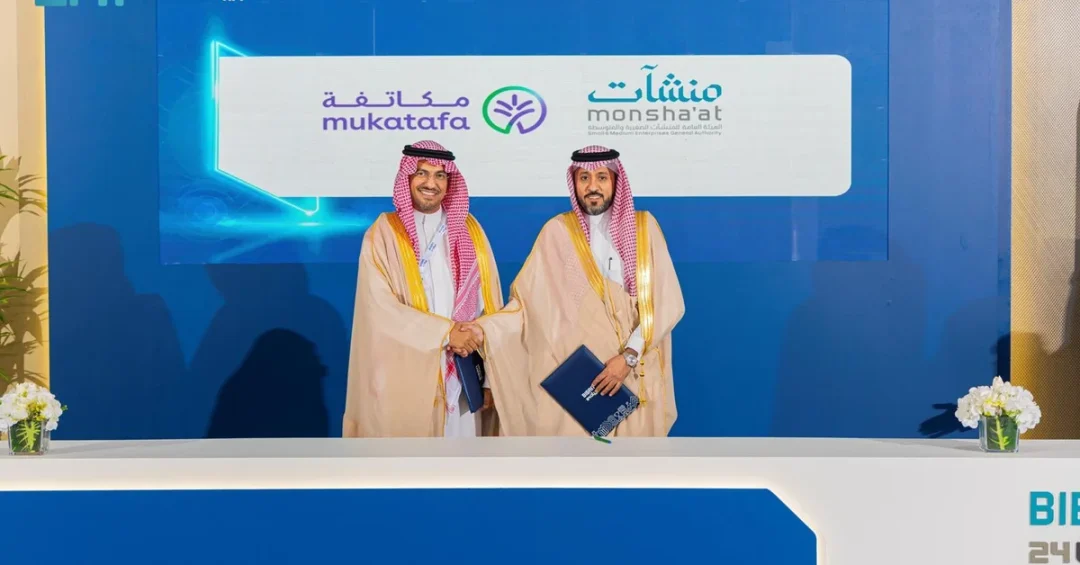
The Small and Medium Enterprises General Authority (Monsha’at) signed a memorandum of understanding (MoU) with Mukatafa, a Saudi consulting firm specializing in community engagement for public policy development, to enhance the Kingdom’s retail sector. The agreement was formalized during the Biban24 Forum in Riyadh, held under the theme “A Global Destination for Opportunities,” and was signed by the Minister of Commerce and Monsha’at Chairman of the Board of Directors Sami bin Ibrahim Al-Husseini and Mukatafa Chief Executive Prince Waleed bin Nasser.
The MoU establishes a framework for collaborative efforts to strengthen the retail sector, including specialized training programs delivered through the Retail Academy and the development of franchise models. It also emphasizes joint work to identify and address challenges facing small and medium enterprises (SMEs) in partnership with the public sector. The agreement reflects Saudi Arabia’s broader push to empower entrepreneurs and modernize the retail landscape. But why does this partnership matter so much right now?
Context and Background
How did Saudi Arabia’s retail sector become a central pillar of its economic transformation? The answer lies in the Kingdom’s sustained efforts to diversify revenue streams and create a vibrant private sector. Retail has emerged as one of the fastest-growing segments of the non-oil economy, driven by rising consumer confidence, expanding urbanization, and a young, digitally connected population. Monsha’at, established to nurture SMEs, has consistently prioritized sectors with high job-creation potential, and retail sits at the top of that list.
Mukatafa, for its part, brings deep expertise in community engagement and public policy development. The firm works to bridge the gap between government initiatives and the private sector, ensuring that policies translate into tangible benefits for businesses. By joining forces, the two entities aim to create a more supportive ecosystem for retailers, from micro-enterprises to franchise operators. The Biban24 Forum provided the ideal backdrop for this announcement, as it convenes thousands of entrepreneurs and investors under one roof. Could there be a more fitting venue to launch such a partnership?
The timing is also significant. Saudi Arabia is accelerating its Vision 2030 agenda, which seeks to increase the private sector’s contribution to GDP and boost SME participation in the economy. Retail is a key enabler of these goals, offering opportunities for women, youth, and regional communities. The MoU thus represents more than a bureaucratic formality; it is a strategic move to align grassroots entrepreneurship with national ambitions.
Key Details of the Agreement
What exactly does the MoU entail? At its core, the agreement outlines a series of collaborative initiatives designed to upskill retailers and expand their market reach. The Retail Academy will serve as a primary vehicle for specialized training programs, covering areas such as store management, customer experience, digital marketing, and supply chain efficiency. These programs are expected to be rolled out in phases, targeting both aspiring entrepreneurs and existing business owners looking to scale.
Another cornerstone of the MoU is the development of franchise models. Franchising offers a proven pathway for SMEs to grow with lower risk, leveraging established brand recognition and operational systems. By supporting the creation of Saudi franchise concepts, Monsha’at and Mukatafa aim to stimulate local brand development and attract international franchise operators to the Kingdom. This dual approach could position Saudi Arabia as a regional hub for franchise innovation.
The MoU also emphasizes collaboration to identify and address challenges SMEs face in partnership with the public sector. This includes streamlining regulatory processes, improving access to finance, and facilitating market entry for new retail formats. Such measures are critical for reducing barriers to entry and ensuring that small businesses can compete effectively. Isn’t it refreshing to see public and private entities working hand in hand to solve real-world problems?
Biban24 Forum: A Global Destination for Opportunities
The signing took place at the Biban24 Forum, which features over 1,350 exhibitors from local and international entrepreneurial backgrounds. The event serves as a dynamic platform for startups and SMEs to showcase their ventures, connect with investors, and learn from industry leaders. The theme “A Global Destination for Opportunities” encapsulates Saudi Arabia’s ambition to attract talent and capital from around the world.
Biban, organized by Monsha’at, has grown into one of the Middle East’s largest entrepreneurship gatherings. It includes workshops, pitch competitions, and networking sessions that foster collaboration across borders. For many participants, the forum is a launchpad for securing funding, partnerships, and mentorship. The presence of senior officials such as Minister Al-Husseini underscores the government’s commitment to listening to entrepreneurs and acting on their feedback.
By hosting the MoU signing at Biban24, Monsha’at and Mukatafa signal that retail is a priority sector within the broader entrepreneurship ecosystem. The forum’s international dimension also highlights the potential for cross-border partnerships, as foreign investors gain exposure to Saudi retail concepts and franchise opportunities. How many other events can claim to shape the future of an entire sector?
International and Regional Impact
Saudi Arabia’s retail sector is not just a domestic story; it has significant implications for regional and global markets. As the largest economy in the Middle East, the Kingdom’s retail trends influence consumer behavior and investment flows across the Gulf. The MoU’s focus on franchise development, in particular, could attract international brands seeking to enter the Saudi market through local partners. This creates a two-way street: Saudi entrepreneurs gain access to global best practices, while foreign companies benefit from localized expertise.
Regionally, the agreement reinforces Saudi Arabia’s role as a leader in SME development. Other Gulf states are watching closely, as they too seek to diversify their economies and empower small businesses. By sharing knowledge and creating a model for public-private collaboration, Monsha’at and Mukatafa could inspire similar initiatives across the region. Could this be the blueprint for a new era of retail cooperation in the Middle East?
On the international stage, the MoU aligns with Saudi Arabia’s efforts to position itself as a global destination for business and investment. The Kingdom’s retail market is projected to grow substantially in the coming years, driven by tourism, entertainment, and e-commerce. Partnerships like this one enhance the credibility of Saudi Arabia’s SME ecosystem and make it more attractive to foreign investors. The message is clear: the Kingdom is open for business, and it is building the infrastructure to support long-term growth.
Economic and Strategic Significance
Why is the retail sector so critical to Saudi Arabia’s economic future? Retail is a major employer, particularly for youth and women, and it serves as a gateway to entrepreneurship. Many Saudis start their business journey by opening a small shop, an online store, or a franchise outlet. By providing training and support, the MoU helps these entrepreneurs professionalize their operations and scale up, which in turn creates jobs and stimulates local economies.
From a strategic perspective, the agreement supports the goals of Vision 2030 by enhancing the competitiveness of SMEs. The Vision aims to raise the SME contribution to GDP from 20% to 35% by 2030, and retail is a key sector for achieving that target. Franchising, in particular, offers a scalable model that can accelerate growth without requiring every entrepreneur to reinvent the wheel. The Retail Academy ensures that skills development keeps pace with market demands, creating a pipeline of talent for the sector.
Moreover, the MoU’s emphasis on public-private collaboration reflects a broader shift in Saudi governance, where government entities actively partner with the private sector to design and implement solutions. This approach not only improves policy outcomes but also builds trust between businesses and regulators. Isn’t that the kind of enabling environment that entrepreneurs need to thrive?
Vision 2030 Alignment
How does this MoU fit into the grand tapestry of Vision 2030? At its heart, Vision 2030 is about creating a diversified, sustainable economy where opportunities are accessible to all. The partnership between Monsha’at and Mukatafa directly advances several Vision objectives: fostering a vibrant private sector, empowering SMEs, and enhancing the retail sector’s contribution to GDP. By investing in training and franchise development, the agreement helps build a knowledge-based economy that can compete globally.
Furthermore, the MoU supports the Vision’s social goals by creating pathways for women and youth to enter the workforce and pursue entrepreneurship. Retail is often the first step for new entrepreneurs, and the support provided through this collaboration can make that step more secure. As Saudi Arabia continues its transformation, initiatives like this one demonstrate that the Kingdom is not just dreaming of a better future—it is actively building it, one partnership at a time. The Biban24 Forum, with its theme of global opportunities, perfectly captures this spirit of progress and openness.
20 Questions
Q1. What is the purpose of the MoU signed between Monsha’at and Mukatafa?
A1. The MoU aims to enhance Saudi Arabia’s retail sector through specialized training programs, franchise model development, and collaborative efforts to address challenges facing small and medium enterprises in partnership with the public sector.
Q2. Who signed the MoU on behalf of Monsha’at and Mukatafa?
A2. The MoU was signed by Minister of Commerce and Monsha’at Chairman of the Board Sami bin Ibrahim Al-Husseini and Mukatafa Chief Executive Prince Waleed bin Nasser during the Biban24 Forum.
Q3. Where and when was the MoU signed?
A3. The agreement was signed during the Biban24 Forum in Riyadh, held under the theme “A Global Destination for Opportunities,” as reported by the Saudi Press Agency on November 7, 2024.
Q4. What is the role of the Retail Academy in this partnership?
A4. The Retail Academy will deliver specialized training programs covering store management, customer experience, digital marketing, and supply chain efficiency, targeting both aspiring entrepreneurs and existing retail business owners.
Q5. How will franchise models be developed under the MoU?
A5. The MoU supports the creation of Saudi franchise concepts and attracts international franchise operators, offering SMEs a lower-risk pathway to growth by leveraging established brand recognition and operational systems.
Q6. What challenges do SMEs face that the MoU aims to address?
A6. The MoU seeks to tackle regulatory hurdles, improve access to finance, and facilitate market entry for new retail formats, working in partnership with the public sector to reduce barriers to entry.
Q7. What is the Biban24 Forum and why is it significant?
A7. Biban24 is a major entrepreneurship event organized by Monsha’at, featuring over 1,350 exhibitors. It provides a platform for startups and SMEs to showcase ventures, connect with investors, and access mentorship.
Q8. How does this MoU support Saudi Arabia’s Vision 2030?
A8. The MoU advances Vision 2030 by empowering SMEs, fostering private sector growth, and helping raise SME contribution to GDP from 20% to 35%, while creating jobs for youth and women.
Q9. What is Mukatafa’s area of expertise?
A9. Mukatafa is a Saudi consulting firm specializing in community engagement for public policy development, working to bridge the gap between government initiatives and the private sector.
Q10. How will the MoU benefit small retailers in Saudi Arabia?
A10. Small retailers will gain access to specialized training, franchise opportunities, and a more supportive regulatory environment, helping them professionalize operations, scale up, and compete more effectively in the market.
Q11. What is the expected impact on Saudi Arabia’s retail sector?
A11. The partnership is expected to stimulate growth, attract international brands, create jobs, and position Saudi Arabia as a regional hub for franchise innovation, contributing to a more diversified economy.
Q12. How does the MoU reflect public-private collaboration in Saudi Arabia?
A12. The MoU exemplifies a broader shift in Saudi governance where government entities actively partner with the private sector to design and implement solutions, improving policy outcomes and building trust between businesses and regulators.
Q13. What opportunities does the MoU create for women and youth?
A13. By supporting retail entrepreneurship and providing training, the MoU creates pathways for women and youth to enter the workforce, start businesses, and contribute to the Kingdom’s economic transformation.
Q14. How does franchising help SMEs grow with lower risk?
A14. Franchising allows SMEs to leverage established brand recognition, proven operational systems, and marketing support, reducing the risks associated with launching a new business from scratch.
Q15. What international implications does this MoU have?
A15. The agreement enhances Saudi Arabia’s attractiveness to foreign investors and franchise operators, strengthens regional SME cooperation, and reinforces the Kingdom’s role as a leader in retail innovation.
Q16. What is the significance of the Biban24 Forum theme?
A16. The theme “A Global Destination for Opportunities” reflects Saudi Arabia’s ambition to attract talent and capital from around the world, positioning the Kingdom as a hub for entrepreneurship and investment.
Q17. How will the MoU help address regulatory challenges for retailers?
A17. Through collaboration with the public sector, the MoU aims to streamline regulatory processes, improve access to finance, and facilitate market entry, making it easier for retailers to start and grow their businesses.
Q18. What role does Monsha’at play in Saudi Arabia’s SME ecosystem?
A18. Monsha’at is the Small and Medium Enterprises General Authority, responsible for nurturing SMEs, fostering entrepreneurship, and implementing initiatives that support the growth of small businesses across various sectors.
Q19. How does the MoU align with Saudi Arabia’s economic diversification goals?
A19. By strengthening the retail sector, the MoU supports economic diversification, reduces dependence on oil, and contributes to the growth of the non-oil economy, in line with Vision 2030 objectives.
Q20. What are the next steps following the MoU signing?
A20. Following the signing, Monsha’at and Mukatafa will begin implementing training programs, developing franchise models, and engaging with public sector partners to identify and address SME challenges in the retail sector.
Reader Feedback
We value your thoughts. Please share your feedback on this article.
Your feedback helps us improve our coverage.