


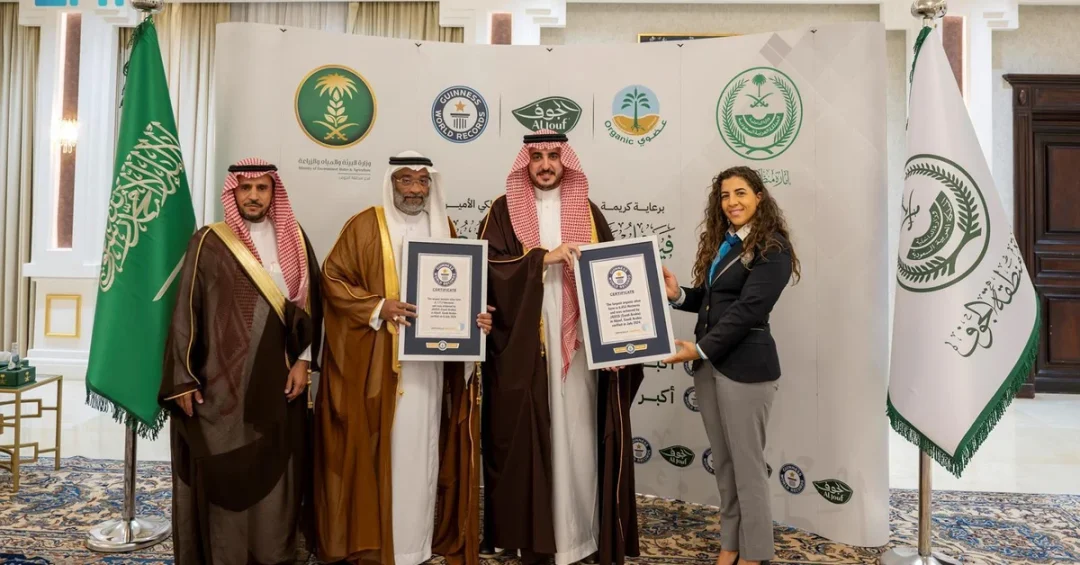
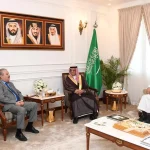
Prince Faisal bin Nawaf bin Abdulaziz, Governor of Al-Jouf Region, presided over a ceremony in Al-Jouf on November 11, 2024, to receive two Guinness World Records certificates awarded to Al-Jouf Agricultural Development Company for operating the world’s largest organic farm and the world’s largest modern olive farm. The certificates were presented by Guinness World Records representative Kenzi bint Emad Al-Dafrawi to Eng. Mazen Badawood, Chief Executive Officer of Al-Jouf Agricultural Development Company, in the presence of regional officials and representatives from the agricultural sector. The recognition, announced by the Saudi Press Agency, places the Kingdom at the forefront of global agricultural achievement and underscores the scale of its organic farming and olive cultivation capabilities.
What does it mean for a single agricultural company in the north of Saudi Arabia to hold two world records simultaneously? For the Kingdom, the answer extends far beyond prestige. The twin titles reflect decades of investment in land reclamation, water efficiency, and modern farming techniques in a region historically known for its olive groves and date palms. Al-Jouf, located in the northern part of the Kingdom, has long been a strategic agricultural area, and the recognition arrives as Saudi Arabia accelerates efforts to strengthen food security, diversify the economy, and position itself as a global leader in sustainable agriculture under Vision 2030.
Context and Background
Why has Al-Jouf become a focal point for Saudi agricultural excellence? The region’s geography, climate, and water resources have made it uniquely suited to large-scale farming, particularly for olives, which thrive in its relatively cool winters and hot, dry summers. Al-Jouf Agricultural Development Company has been a pioneer in the area, investing in modern irrigation systems, organic certification, and advanced processing facilities. The two Guinness World Records — for the largest organic farm and the largest modern olive farm — are the culmination of years of systematic expansion and adherence to international organic standards.
The ceremony at the Governor’s office was not merely a formal handover of certificates. It was a moment of national recognition. Prince Faisal bin Nawaf bin Abdulaziz commended the leadership’s commitment to the region, highlighting the support for developmental and economic initiatives and the substantial backing from the Ministry of Environment, Water and Agriculture. He emphasized that numerous development projects have positively impacted Al-Jouf in the areas of environment, water, and agriculture, creating jobs, attracting investment, and improving the quality of life for residents.
The Governor’s remarks also placed the achievement within the broader framework of Saudi Arabia’s national ambitions. “We take pride in the national accomplishments that the Kingdom Vision 2030 has realized in promoting self-sufficiency and achieving food security,” he said during the ceremony. That statement captures the dual purpose of the recognition: it celebrates a commercial milestone while affirming a strategic national goal. The Ministry of Environment, Water and Agriculture has been instrumental in providing regulatory support, technical guidance, and incentives that enable companies like Al-Jouf Agricultural Development Company to scale up operations and meet global benchmarks.
Key Details
What exactly do these two Guinness World Records certify? The first title, world’s largest organic farm, recognizes a vast expanse of land cultivated without synthetic pesticides or fertilizers, managed under strict organic protocols. The second, world’s largest modern olive farm, acknowledges the scale and technological sophistication of the company’s olive groves, which use precision irrigation, mechanized harvesting, and advanced oil extraction methods. Together, they represent a model of agricultural industrialization that aligns with Saudi Arabia’s Vision 2030 objectives of economic diversification and environmental sustainability.
Eng. Mazen Badawood, CEO of Al-Jouf Agricultural Development Company, accepted the certificates on behalf of the company. While he did not deliver a lengthy speech at the ceremony, his presence and the company’s track record speak to a long-term commitment to innovation. Under his leadership, the company has expanded its organic acreage, invested in water-saving technologies, and developed a brand of olive oil that competes in international markets. The Guinness World Records recognition is expected to boost the company’s global profile, opening doors to new export opportunities and partnerships.
The ceremony also highlighted the role of Guinness World Records as an independent verifier. Kenzi bint Emad Al-Dafrawi, the organization’s representative, presented the certificates after a rigorous adjudication process. Guinness World Records titles are not awarded lightly; they require documented evidence, site inspections, and verification by experts. The fact that a Saudi company has secured two titles in the same ceremony is a testament to the scale and quality of its operations. It also signals to the world that Saudi Arabia is not only a major energy producer but also an emerging agricultural powerhouse.
International and Regional Impact
How will this recognition influence Saudi Arabia’s standing in global agricultural markets? The two records are likely to enhance the Kingdom’s reputation as a reliable supplier of high-quality organic products, particularly olive oil and related goods. International buyers increasingly seek organic certification and sustainable sourcing, and the Guinness World Records titles provide independent validation of the company’s credentials. This could lead to increased exports to Europe, Asia, and North America, where demand for organic olive oil continues to rise.
Regionally, the achievement may inspire other Gulf Cooperation Council (GCC) countries to invest more heavily in agricultural technology and sustainable practices. Saudi Arabia’s leadership in this area reinforces its role as a regional trendsetter and a key player in addressing food security challenges across the Middle East. The Kingdom has already been sharing expertise through its development programs and international partnerships, and the Al-Jouf records add a new dimension to that knowledge exchange. For neighboring countries with similar climates, the Saudi model demonstrates that large-scale organic farming is feasible with the right combination of capital, technology, and policy support.
Economic and Strategic Significance
Why does food security matter so much to Saudi Arabia? The Kingdom imports a significant portion of its food, making it vulnerable to global supply chain disruptions. Vision 2030 aims to reduce that vulnerability by boosting domestic production, diversifying import sources, and investing in agricultural technology. The Al-Jouf Agricultural Development Company’s achievements directly support this goal by proving that Saudi farms can produce at world-record scale while adhering to organic standards. This reduces reliance on imports for key products like olive oil and creates a model that can be replicated for other crops.
From an economic perspective, the recognition can catalyze further investment in the agricultural sector. It showcases the potential returns from large-scale farming and encourages both domestic and foreign investors to explore opportunities in Saudi agribusiness. The Ministry of Environment, Water and Agriculture has been actively promoting such investments through incentives, land allocations, and public-private partnerships. The Guinness World Records titles serve as a powerful marketing tool, drawing attention to the Kingdom’s agricultural capabilities and the supportive regulatory environment. Additionally, the company’s success story can stimulate growth in related industries, such as food processing, logistics, and export services, creating jobs and contributing to GDP.
Vision 2030 Alignment
How does this ceremony connect to the broader Vision 2030 narrative? Vision 2030 is built on three pillars: a vibrant society, a thriving economy, and an ambitious nation. The Al-Jouf agricultural records touch on all three. They contribute to a vibrant society by promoting sustainable food production and environmental stewardship. They support a thriving economy by creating export opportunities and attracting investment. And they reflect an ambitious nation by demonstrating that Saudi Arabia can achieve world-class excellence in sectors beyond oil.
As the Kingdom continues its transformation, milestones like these will serve as benchmarks of progress. The recognition of Al-Jouf Agricultural Development Company is not an isolated event but part of a larger pattern of Saudi entities earning global accolades in fields ranging from renewable energy to tourism. Each achievement reinforces the message that Saudi Arabia is open for business, committed to innovation, and dedicated to building a sustainable future. For the people of Al-Jouf, the ceremony was a source of pride; for the world, it was a clear signal that the Kingdom’s agricultural ambitions are bearing fruit.
20 Questions
Q1. What two Guinness World Records did Al-Jouf Agricultural Development Company receive?
A1. The company received records for the world’s largest organic farm and the world’s largest modern olive farm, as certified by Guinness World Records.
Q2. Who presented the certificates to the company?
A2. Kenzi bint Emad Al-Dafrawi, a representative of Guinness World Records, presented the certificates to Eng. Mazen Badawood, CEO of Al-Jouf Agricultural Development Company.
Q3. Who attended the ceremony as the patron?
A3. Prince Faisal bin Nawaf bin Abdulaziz, Governor of Al-Jouf Region, presided over the ceremony at his office in Al-Jouf.
Q4. What did the Governor say about the achievement?
A4. He expressed pride in the national accomplishments realized under Vision 2030 in promoting self-sufficiency and achieving food security.
Q5. Which ministry supported the agricultural development in Al-Jouf?
A5. The Ministry of Environment, Water and Agriculture provided substantial support for developmental and economic initiatives in the region.
Q6. What is the significance of the world’s largest organic farm record?
A6. It recognizes the company’s vast organic cultivation area, managed without synthetic pesticides or fertilizers, adhering to strict organic standards.
Q7. Why is the world’s largest modern olive farm record important?
A7. It highlights the scale and technological sophistication of the company’s olive groves, using precision irrigation and mechanized harvesting.
Q8. How does this achievement support Saudi Vision 2030?
A8. It advances food security, economic diversification, and sustainable agriculture, which are key objectives of Vision 2030.
Q9. What region of Saudi Arabia is Al-Jouf?
A9. Al-Jouf is a northern region of Saudi Arabia, known for its agricultural potential, particularly for olives and dates.
Q10. Who is the CEO of Al-Jouf Agricultural Development Company?
A10. Eng. Mazen Badawood is the Chief Executive Officer of the company, who received the certificates at the ceremony.
Q11. What did the Governor review during the ceremony?
A11. He reviewed the two Guinness World Records certificates awarded to the company for its organic and olive farms.
Q12. When did the ceremony take place?
A12. The ceremony took place on November 11, 2024, according to the Saudi Press Agency report.
Q13. What is the role of Guinness World Records in this context?
A13. Guinness World Records independently verifies and certifies record-breaking achievements after rigorous documentation and inspection processes.
Q14. How might this recognition affect Saudi agricultural exports?
A14. It could boost exports by enhancing the Kingdom’s reputation as a reliable supplier of high-quality organic products, especially olive oil.
Q15. What are the economic benefits for the Al-Jouf region?
A15. The recognition can attract investment, create jobs, and stimulate growth in related industries like food processing and logistics.
Q16. How does this achievement align with Saudi food security goals?
A16. It reduces reliance on imports by demonstrating that Saudi farms can produce at world-record scale, contributing to domestic food security.
Q17. What support did the Ministry of Environment, Water and Agriculture provide?
A17. The ministry offered regulatory support, technical guidance, and incentives to enable the company’s expansion and organic certification.
Q18. What does the term ‘modern olive farm’ imply?
A18. It implies the use of advanced agricultural technologies such as precision irrigation, mechanized harvesting, and modern oil extraction methods.
Q19. How does this event reflect Saudi Arabia’s global role?
A19. It showcases the Kingdom’s ability to achieve world-class excellence in agriculture, reinforcing its position as a diversified economy.
Q20. What is the forward-looking impact of this ceremony?
A20. It sets a benchmark for other Saudi agricultural projects and signals the Kingdom’s commitment to sustainable development and global leadership.
Reader Feedback
We value your thoughts. Please share your feedback on this article.
Your feedback helps us improve our coverage.
Related articles
 Saudi Foreign Ministry Official Receives Thai Deputy Consul General
 Interior Ministry Launches Stamp for Design Law Conference
 Saudi Arabia Hosts Restoring Family Links Conference
 Madinah Foreign Ministry Branch Receives Ukrainian Ambassador
 Saudi Foreign Ministry’s Makkah Branch Director Receives Algerian Consul General
 GCC Chief Meets UN Iraq Representative in Riyadh