


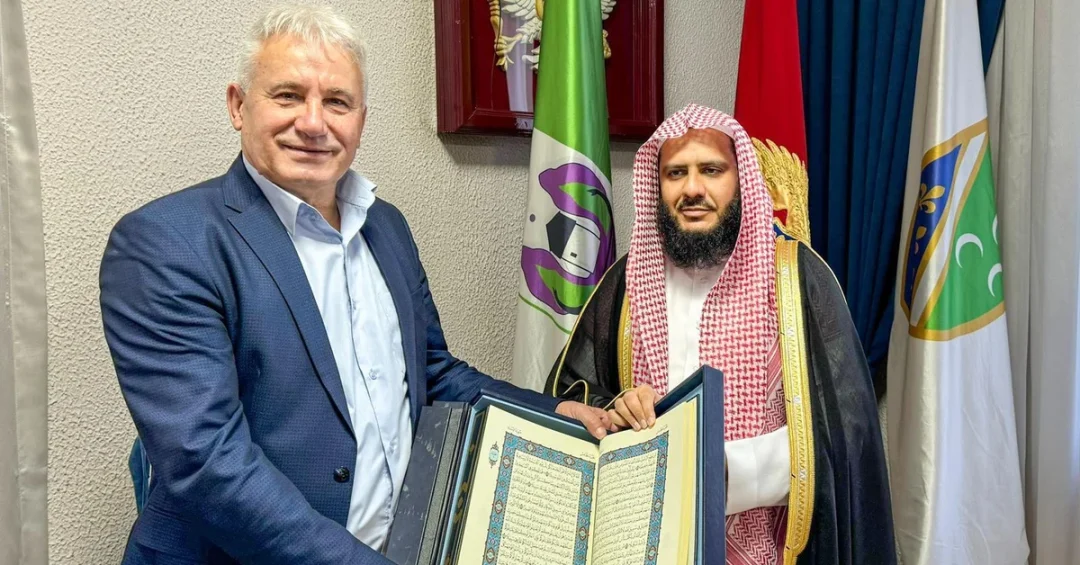
Imam and Khatib of the Prophet’s Mosque Sheikh Dr. Khalid bin Sulaiman Al-Muhanna met with senior officials in Rozaje, Montenegro, on October 27, 2024, where he affirmed the Kingdom of Saudi Arabia’s enduring commitment to supporting Muslim communities worldwide and strengthening Islamic brotherhood. The meeting, reported by the Saudi Press Agency (SPA), brought together the distinguished imam with Rahman Husovic, President of the Rozaje Municipality; Armin Honsic, Vice President of the Rozaje Municipality; Almir Avdić, President of the Rozaje Municipal Assembly; and Reyhan ef. Hot, Head of Imams in Rozaje Municipality, along with several prominent political and Islamic figures from the city. The visit underscored the deep-rooted ties between the Kingdom and the Islamic authority in Montenegro, reflecting Saudi Arabia’s broader mission of promoting moderation, peace, and cooperation across the Muslim world. What does this high-level engagement reveal about the Kingdom’s global religious diplomacy? It demonstrates that Saudi Arabia’s support for Muslim minorities is not merely symbolic but is actively pursued through official visits, institutional partnerships, and sustained collaboration.
The meeting in Rozaje represents a significant moment in the long-standing relationship between Saudi Arabia and Montenegro’s Muslim community, which numbers approximately 20 percent of the Balkan nation’s population. Sheikh Al-Muhanna’s visit was not an isolated event but part of a continuous effort by the Kingdom, represented by the Ministry of Islamic Affairs, Dawah and Guidance, to engage with Islamic authorities in Europe and beyond. The Imam of the Prophet’s Mosque, one of the most revered religious positions in the Islamic world, carries immense symbolic weight, and his presence in Rozaje signaled Saudi Arabia’s respect for and commitment to the Muslim faithful in the Balkans. How does such a visit strengthen the bonds of faith across continents? By bridging geographical distances with shared religious values, the Kingdom reinforces the universal message of Islam and its own role as a custodian of Islamic heritage.
Context and Background
What historical forces have shaped the relationship between Saudi Arabia and the Muslims of Montenegro? The ties between the Kingdom and the Islamic community in Montenegro stretch back decades, rooted in Saudi Arabia’s foundational commitment to supporting Muslim minorities globally. Since the era of King Abdulaziz bin Abdulrahman Al Saud, the founder of the modern Saudi state, the Kingdom has consistently extended its hand to Muslim communities in need, providing religious, educational, and humanitarian assistance. This tradition has continued under the reign of Custodian of the Two Holy Mosques King Salman bin Abdulaziz Al Saud and His Royal Highness Prince Mohammed bin Salman bin Abdulaziz Al Saud, Crown Prince and Prime Minister, who have both emphasized the importance of Islamic solidarity as a cornerstone of Saudi foreign policy.
Montenegro, a small but strategically located country in the Balkans, is home to a diverse population that includes a significant Muslim minority. The Islamic Community of Montenegro, recognized as the official Islamic authority in the country, has been a key partner for Saudi Arabia in the region. Through the Ministry of Islamic Affairs, Dawah and Guidance, the Kingdom has supported numerous projects aimed at promoting religious moderation, building mosques, and fostering interfaith dialogue. The visit by Sheikh Al-Muhanna to Rozaje, a municipality in northeastern Montenegro with a predominantly Muslim population, highlights the Kingdom’s focused attention on regions where Muslim communities maintain a strong cultural and religious identity.
Why does Rozaje hold particular significance in this context? The municipality has long been a center of Islamic life in Montenegro, with active mosques, religious schools, and community organizations. The presence of Reyhan ef. Hot, the Head of Imams in Rozaje Municipality, and other Islamic leaders at the meeting reflects the close coordination between Saudi religious institutions and local Muslim authorities. This collaboration is not limited to spiritual matters but extends to educational initiatives, social welfare programs, and efforts to preserve Islamic heritage in the Balkans. Saudi Arabia’s engagement with Rozaje is thus part of a broader strategy to support Muslim minorities in preserving their faith and identity while contributing positively to their societies.
Key Details of the Meeting
What specific messages were conveyed during the high-level discussions in Rozaje? President Rahman Husovic of the Rozaje Municipality praised the Kingdom of Saudi Arabia’s leading role in supporting Muslims in Montenegro, explicitly acknowledging the efforts of the Kingdom and its leadership to bolster the Islamic authority in the country and promote the noble values of Islam. His remarks, as reported by SPA, highlighted the tangible impact of Saudi assistance on the ground, from religious infrastructure to community development. Vice President Armin Honsic added that the visit of the Imam of the Prophet’s Mosque was evidence of the deep-rooted relationships with the Islamic authority in Montenegro, noting that the Islamic community actively engages in local projects in collaboration with the Kingdom, represented by the Ministry of Islamic Affairs, Dawah and Guidance.
Sheikh Dr. Khalid bin Sulaiman Al-Muhanna, in his remarks, commended the strong relationships between Saudi Arabia and the Islamic world and reiterated the Kingdom’s ongoing support for Muslim minorities. He emphasized that since its establishment by King Abdulaziz bin Abdulrahman Al Saud, and continuing through the reign of King Salman and Crown Prince Mohammed bin Salman, the Kingdom has been dedicated to promoting Islamic brotherhood and supporting the causes of Muslims worldwide. The Imam concluded his speech by thanking the officials for their warm hospitality and reception, affirming the Kingdom’s commitment to strengthening cooperation with Muslims in Montenegro, which enhances its role in promoting values of moderation, love, and peace among Islamic communities.
How do these statements reflect the broader principles of Saudi religious diplomacy? They illustrate a consistent policy of engagement that prioritizes dialogue, mutual respect, and practical assistance. The meeting also included several prominent political and Islamic figures from Rozaje, underscoring the broad-based support for Saudi-Montenegrin cooperation. The presence of Almir Avdić, President of the Rozaje Municipal Assembly, and other local leaders demonstrated that the partnership extends beyond religious circles to encompass civic and political dimensions. This holistic approach is characteristic of Saudi Arabia’s efforts to build enduring relationships based on shared values and common goals.
International and Regional Impact
What does Saudi Arabia’s engagement with Montenegro signify for the broader Balkan region? The Balkans have historically been a crossroads of civilizations, where Islam, Christianity, and other faiths coexist. By supporting Muslim communities in Montenegro, Saudi Arabia contributes to stability, moderation, and interfaith harmony in a region that has experienced conflict in the past. The Kingdom’s emphasis on moderation and peace aligns with its global efforts to counter extremism and promote a balanced understanding of Islam. The visit by Sheikh Al-Muhanna sends a powerful message that Saudi Arabia stands with Muslim minorities in Europe, not only in spiritual matters but also in their efforts to integrate positively into their societies while preserving their religious identity.
How does this visit fit into Saudi Arabia’s wider international outreach? It is part of a pattern of high-level engagements that have seen Saudi religious leaders travel to various countries to meet with Islamic communities and officials. These visits reinforce the Kingdom’s role as a global leader in Islamic affairs and its commitment to the principles of the Organization of Islamic Cooperation (OIC), which champions Muslim minorities worldwide. Montenegro, as a candidate for European Union membership, represents a unique case where Saudi Arabia can support a Muslim community that is both European and Islamic. The Kingdom’s assistance helps to ensure that Muslims in Montenegro can practice their faith freely and contribute to the country’s democratic development.
Economic and Strategic Significance
Why does Saudi Arabia’s support for Muslims in Montenegro carry strategic weight beyond religious dimensions? The Kingdom’s foreign policy under Vision 2030 emphasizes the importance of building diverse partnerships and enhancing its global standing. By assisting Muslim communities in Europe, Saudi Arabia strengthens its soft power and demonstrates its commitment to humanitarian and religious causes. This, in turn, fosters goodwill and opens avenues for cooperation in other fields, such as trade, investment, and cultural exchange. Montenegro, with its strategic location on the Adriatic Sea and its aspirations for European integration, is a valuable partner for the Kingdom in the Balkans.
What economic opportunities might arise from these strengthened ties? While the primary focus of the visit was religious and cultural, the goodwill generated by Saudi Arabia’s support can pave the way for economic collaboration. The Kingdom has been expanding its investments in Europe and the Balkans, particularly in infrastructure, tourism, and energy. A stable and prosperous Montenegro, with a Muslim community that feels supported and valued, is more likely to welcome Saudi investment and partnership. Furthermore, the visit highlights the role of the Ministry of Islamic Affairs, Dawah and Guidance in implementing the Kingdom’s Vision 2030 objectives by promoting moderation and combating extremism, which are essential for sustainable development and global security.
Vision 2030 Alignment
How does the visit of the Imam of the Prophet’s Mosque to Montenegro align with Saudi Arabia’s Vision 2030? Vision 2030 is not only an economic transformation plan but also a comprehensive strategy to enhance the Kingdom’s global influence and promote its values of moderation, tolerance, and peace. The visit exemplifies the Kingdom’s commitment to supporting Muslim minorities, a key pillar of its foreign policy. By strengthening ties with the Islamic authority in Montenegro, Saudi Arabia reinforces its role as a leader of the Islamic world and a partner in fostering interfaith dialogue and coexistence. This aligns with Vision 2030’s goal of positioning the Kingdom as a global hub for Islamic culture and a model of moderate Islam.
What does the future hold for Saudi-Montenegrin relations? The meeting in Rozaje is likely to be followed by further collaboration, including educational exchanges, religious training programs, and joint humanitarian initiatives. The Kingdom’s continued support for Muslims in Montenegro will enhance its reputation as a benevolent and reliable partner, committed to the well-being of Muslims everywhere. As Saudi Arabia advances its Vision 2030 agenda, such engagements will play a crucial role in building a network of allies and friends who share its values and aspirations. The Imam’s visit is a testament to the Kingdom’s enduring dedication to Islamic brotherhood and its unwavering support for Muslim communities around the world.
20 Questions
Q1. Who is Sheikh Dr. Khalid bin Sulaiman Al-Muhanna?
A1. Sheikh Dr. Khalid bin Sulaiman Al-Muhanna is the Imam and Khatib of the Prophet’s Mosque in Medina, Saudi Arabia. He is a prominent religious figure who represents the Kingdom in international engagements and promotes moderate Islam.
Q2. Where did the meeting take place?
A2. The meeting took place in Rozaje, Montenegro, on October 27, 2024. It was attended by local officials and Islamic leaders, as reported by the Saudi Press Agency.
Q3. Who did Sheikh Al-Muhanna meet with in Rozaje?
A3. He met with Rahman Husovic, President of Rozaje Municipality; Armin Honsic, Vice President; Almir Avdić, President of the Municipal Assembly; and Reyhan ef. Hot, Head of Imams, along with other figures.
Q4. What did the President of Rozaje Municipality say about Saudi Arabia?
A4. Rahman Husovic praised Saudi Arabia’s leading role in supporting Muslims in Montenegro and strengthening religious and cultural ties between the two countries, highlighting the Kingdom’s efforts to support the Islamic authority.
Q5. How did the Vice President describe the visit?
A5. Armin Honsic regarded the visit as evidence of deep-rooted relationships with the Islamic authority in Montenegro, which collaborates with the Kingdom on several projects through the Ministry of Islamic Affairs, Dawah and Guidance.
Q6. What did Sheikh Al-Muhanna emphasize about Saudi Arabia’s commitment?
A6. He emphasized that since its establishment by King Abdulaziz, and through the reigns of King Salman and Crown Prince Mohammed bin Salman, the Kingdom has been dedicated to promoting Islamic brotherhood and supporting Muslims worldwide.
Q7. What is the significance of the Prophet’s Mosque Imam visiting Montenegro?
A7. The visit signifies Saudi Arabia’s respect for and commitment to Muslim minorities in Europe, reinforcing religious ties and demonstrating the Kingdom’s role as a global leader in Islamic affairs and moderation.
Q8. How does this visit align with Saudi Arabia’s foreign policy?
A8. It aligns with the Kingdom’s policy of supporting Muslim minorities, promoting moderation, and strengthening international partnerships, which are key components of Vision 2030 and the Kingdom’s global outreach.
Q9. What is the Ministry of Islamic Affairs, Dawah and Guidance’s role?
A9. The ministry oversees Saudi Arabia’s religious outreach, supports Islamic communities abroad, and implements projects that promote moderate Islam and interfaith dialogue, as seen in Montenegro.
Q10. How large is the Muslim community in Montenegro?
A10. Muslims constitute approximately 20 percent of Montenegro’s population, with a significant presence in municipalities like Rozaje. The Islamic Community is the official authority representing them.
Q11. What projects has Saudi Arabia supported in Montenegro?
A11. Saudi Arabia has supported various religious and cultural projects, including mosque renovations, educational programs, and community initiatives, in collaboration with the Islamic authority in Montenegro.
Q12. What values did Sheikh Al-Muhanna highlight?
A12. He highlighted values of moderation, love, and peace among Islamic communities, and the importance of strengthening cooperation to enhance the role of Muslims in Montenegro.
Q13. How does this visit impact regional stability in the Balkans?
A13. By supporting Muslim minorities and promoting moderation, the visit contributes to interfaith harmony and stability in the Balkans, a region with a history of diversity and conflict.
Q14. What message does this send to other Muslim communities in Europe?
A14. It sends a message that Saudi Arabia stands with Muslim minorities, supporting their religious freedom and integration while preserving their identity, and promotes a moderate understanding of Islam.
Q15. What is the significance of the Imam of the Prophet’s Mosque title?
A15. The Imam of the Prophet’s Mosque is a highly revered position in Islam, as the Prophet’s Mosque in Medina is one of the holiest sites. The Imam leads prayers and represents religious authority.
Q16. How does this visit reflect Vision 2030?
A16. Vision 2030 aims to enhance Saudi Arabia’s global influence and promote moderate Islam. The visit exemplifies the Kingdom’s commitment to supporting Muslim minorities and building international partnerships based on shared values.
Q17. What was the outcome of the meeting?
A17. The meeting strengthened ties between Saudi Arabia and Montenegro’s Islamic authority, reaffirmed the Kingdom’s support, and paved the way for further cooperation in religious, cultural, and educational fields.
Q18. Who represented the Islamic authority in Rozaje?
A18. Reyhan ef. Hot, the Head of Imams in Rozaje Municipality, represented the Islamic authority, along with other prominent Islamic figures who participated in the discussions.
Q19. What did Sheikh Al-Muhanna thank the officials for?
A19. He thanked them for their warm hospitality and reception, and affirmed the Kingdom’s commitment to strengthening cooperation with Muslims in Montenegro to promote moderation and peace.
Q20. How can other countries benefit from Saudi Arabia’s model of supporting Muslim minorities?
A20. Other countries can benefit by engaging with Saudi Arabia’s Ministry of Islamic Affairs to promote moderation, interfaith dialogue, and community development, fostering stability and mutual respect.
Reader Feedback
We value your thoughts. Please share your feedback on this article.
Your feedback helps us improve our coverage.
Related articles
 King of Bhutan Arrives in Riyadh for Official Visit
 Saudi Education Minister, Kazakh Ambassador Discuss Ties
 Ministry of Interior Hosts Cybersecurity Awareness Exhibition
 Shura Council Speaker Meets Kazakhstan Ambassador
 Saudi Arabia Weather Forecast for Monday: Rain, Hail, and Wind
 NCVC Scatters Seeds in Al Hanakiyah Protected Pasture