


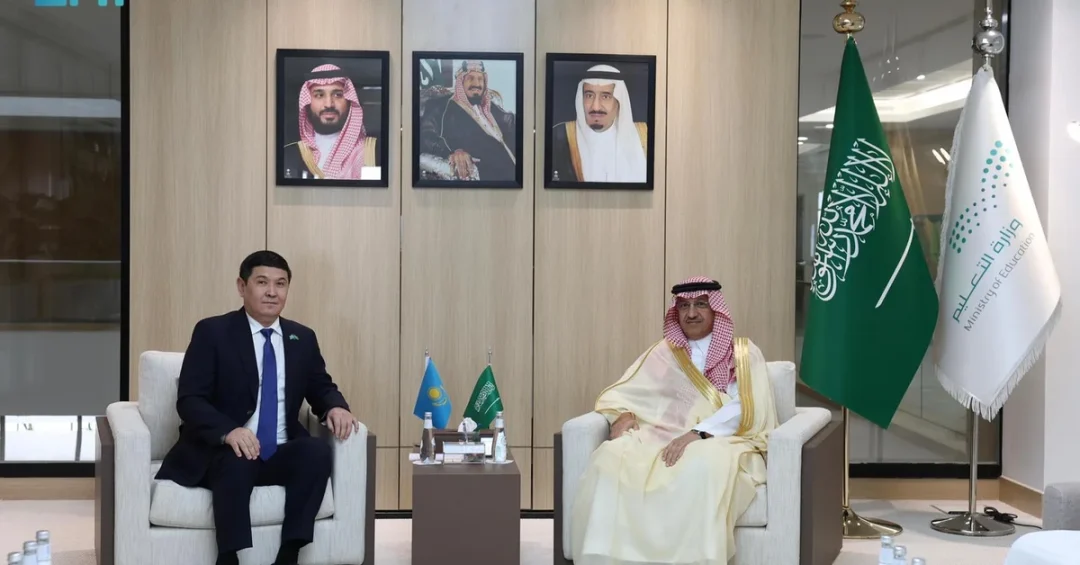
Saudi Arabia’s Minister of Education, Yousef bin Abdullah Al-Benyan, met with the Ambassador of Kazakhstan to the Kingdom, Madiyar Menilbekov, at the ministry’s headquarters in Riyadh on Sunday, October 28, 2024, to discuss expanding educational cooperation between the two nations. The meeting, reported by the Saudi Press Agency, focused on strengthening partnerships across general and higher education, reinforcing training programs, advancing scientific research and innovation, and expanding scholarship opportunities for Kazakh students at Saudi universities.
The encounter reflects the Kingdom’s continuing commitment to international educational diplomacy under the leadership of the Custodian of the Two Holy Mosques, King Salman bin Abdulaziz Al Saud, and His Royal Highness Crown Prince Mohammed bin Salman bin Abdulaziz Al Saud, Prime Minister and Chairman of the Council of Economic and Development Affairs. Education has become a central pillar of Saudi foreign policy, serving as a bridge for knowledge exchange, cultural understanding, and long-term economic partnership. Could this meeting mark another step toward a more interconnected global education landscape anchored in Riyadh?
Context and Background
Saudi Arabia and Kazakhstan have steadily deepened their bilateral relationship since the establishment of diplomatic ties in 1994, with education emerging as one of the most productive areas of collaboration. The two countries share a commitment to developing human capital, fostering scientific inquiry, and preparing younger generations for the demands of a rapidly changing global economy. Kazakhstan, Central Asia’s largest economy, has invested heavily in modernizing its education system, while Saudi Arabia has built a globally recognized higher education sector that includes research-intensive institutions such as King Saud University, King Abdulaziz University, and the King Abdullah University of Science and Technology.
Sunday’s meeting at the Ministry of Education headquarters in Riyadh built on this foundation. Minister Al-Benyan and Ambassador Menilbekov explored ways to boost the general and higher education partnership, with particular attention to the educational and training programs available in both countries. The discussion also addressed strategies to support cooperative efforts related to developmental plans and programs in scientific research and innovation conducted by higher education institutions in both nations. What makes this moment particularly significant is the timing: it comes as Saudi Arabia accelerates its Vision 2030 transformation, which places education, innovation, and international partnership at the heart of economic diversification.
The talks also covered the scholarships provided by the Saudi government to students from Kazakhstan for studying at universities in Saudi Arabia. These scholarships are part of a broader Saudi effort to attract talented international students, promote academic exchange, and position the Kingdom as a global hub for knowledge and research. For Kazakhstan, access to Saudi universities offers a pathway to world-class training in fields such as engineering, medicine, energy, and information technology. For Saudi Arabia, hosting Kazakh students enriches campus diversity and strengthens people-to-people ties across Central Asia.
Key Details of the Riyadh Meeting
According to the Saudi Press Agency, the meeting took place at the Ministry of Education headquarters in Riyadh and covered four main areas of cooperation. First, the two sides discussed ways to enhance the general and higher education partnership between Saudi Arabia and Kazakhstan. Second, they reviewed the current cooperation concerning educational and training programs available in both countries. Third, they deliberated on strategies to support cooperative efforts related to developmental plans and programs in scientific research and innovation conducted by higher education institutions. Fourth, they addressed the scholarships provided by the Saudi government to students from Kazakhstan.
Minister Al-Benyan, who has led the Ministry of Education since 2022, has prioritized internationalization, quality assurance, and alignment between educational outcomes and labor market needs. Under his leadership, the ministry has expanded partnerships with universities and research centers around the world. Ambassador Menilbekov, Kazakhstan’s top diplomat in Riyadh, has been an active advocate for stronger educational and cultural ties between the two countries. Their discussion on Sunday reflects a shared recognition that education is not merely a social service but a strategic investment in future prosperity.
How might these four areas of cooperation translate into tangible outcomes for students and researchers in both countries? The answer lies in implementation. Saudi Arabia’s education sector has already demonstrated its capacity to execute large-scale initiatives, from the establishment of new universities and technical colleges to the launch of digital learning platforms that served millions of students during the COVID-19 pandemic. Kazakhstan, for its part, has pursued ambitious reforms aimed at raising the quality of its universities and integrating them into global academic networks. The meeting thus brings together two systems that are both in motion, creating opportunities for mutual learning.
International and Regional Impact
The Saudi-Kazakh educational partnership carries implications that extend well beyond the two countries. Central Asia is a region of growing strategic importance, situated at the crossroads of Europe, Asia, and the Middle East. By deepening its educational ties with Kazakhstan, Saudi Arabia strengthens its broader engagement with Central Asia, complementing diplomatic, trade, and investment initiatives. This aligns with the Kingdom’s vision of becoming a pivotal node in global connectivity, linking East and West through infrastructure, commerce, and knowledge exchange.
For Kazakhstan, cooperation with Saudi Arabia offers access to a partner that has demonstrated remarkable progress in higher education, research funding, and innovation ecosystems. Saudi universities are increasingly ranked among the world’s best, and the Kingdom’s investment in research and development has grown substantially. Kazakh students who study in Saudi Arabia return home with skills and networks that can contribute to their country’s development. At the same time, Saudi academics and researchers gain exposure to Central Asian perspectives and expertise, particularly in fields such as energy, water management, and regional security.
Regionally, the meeting sends a signal that Saudi Arabia is open to collaboration with partners across the globe, regardless of geography or political system. This openness is a hallmark of the Kingdom’s foreign policy under Vision 2030, which seeks to build a diversified network of alliances and partnerships. Isn’t it remarkable how education can serve as a catalyst for diplomacy, creating bonds that endure long after official meetings conclude? The Saudi-Kazakh relationship exemplifies this dynamic, with education acting as a bridge that connects cultures, economies, and aspirations.
Economic and Strategic Significance
Education is a key driver of economic growth, and the Saudi-Kazakh partnership in this field has direct economic implications. Saudi Arabia’s Vision 2030 aims to diversify the economy away from oil dependence, and a highly skilled workforce is essential to that goal. By attracting international students and fostering research collaboration, Saudi universities contribute to the development of a knowledge-based economy. The presence of Kazakh students in Saudi institutions also strengthens trade and investment ties, as graduates often become bridges between the two economies.
Kazakhstan, meanwhile, is pursuing its own economic modernization agenda, with education at its core. The country has invested in new universities, expanded vocational training, and sought international partnerships to raise standards. Cooperation with Saudi Arabia supports these efforts by providing access to Saudi expertise in areas such as petroleum engineering, renewable energy, and digital technologies. Joint research programs can lead to innovations that benefit both nations, from more efficient energy systems to improved water management in arid regions.
The strategic significance of the meeting also lies in its timing. As the global economy becomes increasingly knowledge-driven, countries that invest in education and research will be best positioned to compete. Saudi Arabia’s leadership recognizes this, which is why the Kingdom has allocated substantial resources to education and innovation. The meeting between Minister Al-Benyan and Ambassador Menilbekov is a reminder that international cooperation is essential to achieving these ambitions. Could this be the beginning of a new era of Saudi-Kazakh academic collaboration that yields breakthroughs in science and technology?
Vision 2030 Alignment
The meeting aligns squarely with Saudi Arabia’s Vision 2030, which identifies education as a foundation for economic diversification, social development, and global engagement. Vision 2030 calls for a world-class education system that prepares Saudi youth for the jobs of the future and attracts talent from around the world. The Kingdom’s scholarship programs for international students, including those from Kazakhstan, are a concrete expression of this vision, fostering goodwill and building long-term relationships.
Moreover, the focus on scientific research and innovation reflects Vision 2030’s emphasis on creating a knowledge economy. Saudi universities are expanding their research capabilities, filing more patents, and collaborating with international partners. By working with Kazakhstan, Saudi Arabia not only advances its own goals but also contributes to the global pool of knowledge. This is the essence of the Kingdom’s approach to international cooperation: mutually beneficial partnerships that drive progress at home and abroad.
As the meeting concluded, it underscored Saudi Arabia’s role as a responsible global leader committed to education, innovation, and cross-cultural understanding. The partnership with Kazakhstan is one of many that the Kingdom is nurturing across Asia, Africa, Europe, and the Americas. Under the guidance of its leadership, Saudi Arabia continues to build bridges of knowledge that will benefit generations to come. The future of Saudi-Kazakh educational cooperation looks bright, and the Riyadh meeting has set the stage for even greater achievements ahead.
20 Questions
Q1. Who met in Riyadh to discuss educational cooperation?
A1. Saudi Arabia’s Minister of Education, Yousef bin Abdullah Al-Benyan, met with Kazakhstan’s Ambassador to Saudi Arabia, Madiyar Menilbekov, at the Ministry of Education headquarters in Riyadh on October 28, 2024.
Q2. What was the main purpose of the meeting?
A2. The meeting aimed to enhance Saudi-Kazakh educational collaboration, focusing on general and higher education partnerships, training programs, scientific research, innovation, and scholarships for Kazakh students in Saudi universities.
Q3. Which Saudi agency reported the meeting?
A3. The Saudi Press Agency (SPA) reported the meeting, reflecting the official Saudi channel for disseminating news about government activities and international cooperation.
Q4. What areas of education were discussed?
A4. The discussions covered general and higher education partnership, educational and training programs in both countries, scientific research and innovation strategies, and Saudi government scholarships for Kazakh students.
Q5. How does this meeting reflect Saudi Arabia’s Vision 2030?
A5. It aligns with Vision 2030’s goals of building a knowledge-based economy, fostering international partnerships, and positioning Saudi Arabia as a global hub for education and innovation.
Q6. What are the benefits for Kazakh students?
A6. Kazakh students gain access to scholarships for studying at Saudi universities, exposure to world-class academic programs, and opportunities to develop skills that contribute to Kazakhstan’s development.
Q7. What are the benefits for Saudi Arabia?
A7. Saudi Arabia strengthens diplomatic ties, enriches campus diversity, builds people-to-people connections, and enhances its reputation as a center of academic excellence and research.
Q8. How long have Saudi Arabia and Kazakhstan had diplomatic relations?
A8. Saudi Arabia and Kazakhstan established diplomatic relations in 1994, and since then have developed cooperation in various fields, including education, trade, and investment.
Q9. What is the significance of scientific research collaboration?
A9. Joint research efforts can lead to innovations in energy, water management, and technology, benefiting both nations and contributing to global knowledge and sustainable development.
Q10. What types of scholarships does Saudi Arabia offer to Kazakh students?
A10. The Saudi government provides scholarships for Kazakh students to study at Saudi universities, covering various academic disciplines and supporting academic exchange between the two countries.
Q11. How does this meeting fit into Saudi Arabia’s foreign policy?
A11. It reflects Saudi Arabia’s commitment to international engagement, building partnerships across Central Asia, and using education as a tool for diplomacy and mutual understanding.
Q12. What role does the Saudi Ministry of Education play in international cooperation?
A12. The Ministry of Education leads efforts to internationalize Saudi education, forge partnerships with foreign institutions, and support scholarship programs that attract international students to the Kingdom.
Q13. What is Kazakhstan’s interest in cooperating with Saudi Arabia?
A13. Kazakhstan seeks to modernize its education system, access Saudi expertise in fields like energy and technology, and provide its students with opportunities to study at prestigious Saudi universities.
Q14. How might this cooperation impact regional stability?
A14. Educational cooperation fosters mutual understanding and economic interdependence, which can contribute to stability and prosperity in Central Asia and the broader region.
Q15. What are the next steps following this meeting?
A15. The two sides are expected to continue discussions, develop concrete programs, and implement initiatives that expand educational exchange and research collaboration between Saudi and Kazakh institutions.
Q16. How does Saudi Arabia support innovation in higher education?
A16. Saudi Arabia invests in research and development, encourages universities to file patents, and promotes collaboration with international partners to advance innovation and technology.
Q17. What makes Saudi universities attractive to international students?
A17. Saudi universities offer high-quality academic programs, modern facilities, generous scholarships, and a welcoming environment, with several institutions ranked among the top in the world.
Q18. How does this meeting reflect Saudi leadership’s vision?
A18. It demonstrates the leadership’s commitment to education, international partnerships, and the goals of Vision 2030, which aim to transform Saudi Arabia into a global knowledge economy.
Q19. What is the expected impact on Saudi-Kazakh trade and investment?
A19. Stronger educational ties can lead to increased trade and investment, as graduates and researchers build networks that facilitate business cooperation and joint ventures.
Q20. How can other countries benefit from Saudi-Kazakh educational cooperation?
A20. Other countries can benefit from the model of cross-border academic collaboration, which promotes peace, development, and shared progress through the exchange of knowledge and ideas.
Reader Feedback
We value your thoughts. Please share your feedback on this article.
Your feedback helps us improve our coverage.
Related articles
 Ministry of Interior Hosts Cybersecurity Awareness Exhibition
 Shura Council Speaker Meets Kazakhstan Ambassador
 Saudi Arabia Weather Forecast for Monday: Rain, Hail, and Wind
 NCVC Scatters Seeds in Al Hanakiyah Protected Pasture
 15th Saudi Relief Plane Departs for Lebanon with Essential Aid
 Burundi’s Vice President Arrives in Riyadh for FII8