


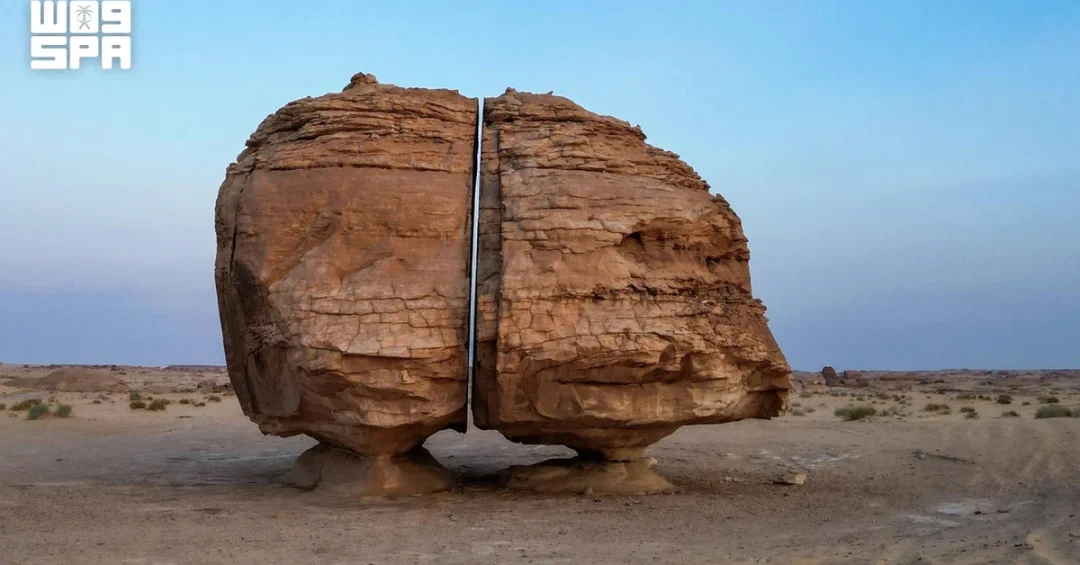
The Saudi Press Agency (SPA) has highlighted the geological and historical significance of Al-Nasla Rock, a striking ancient formation located in Tayma, in the Tabuk Province of northwestern Saudi Arabia, in a report dated August 15, 2026. The formation, known in Arabic as Al-Nasla (النصلة), consists of two adjacent rock masses separated by a remarkably straight gap, standing as a silent witness to thousands of years of human and natural history in the Arabian Peninsula. According to the official Saudi report, the name Al-Nasla derives from the rock’s physical isolation from the nearby mountain range, a separation that has made it a distinctive landmark in the Tayma landscape. The rock is approximately eight meters long and bears a variety of inscriptions and petroglyphs on its surface, offering a tangible link to the civilizations that once traversed this ancient crossroads.
For international observers, Al-Nasla Rock is more than a geological curiosity; it is a testament to Saudi Arabia’s deep historical roots and its ongoing commitment to preserving and promoting its cultural heritage under Vision 2030. The Kingdom’s northwestern region, particularly Tabuk and Tayma, has emerged as a focal point for archaeological discovery and cultural tourism, drawing scholars and visitors eager to explore the layers of history embedded in its deserts and oases. As Saudi Arabia continues to open its doors to the world through initiatives like the Saudi Tourism Authority’s promotional campaigns, sites such as Al-Nasla Rock underscore the nation’s unique position as a bridge between ancient civilizations and a modern, forward-looking future.
Context and Background
What makes a simple rock formation so compelling to historians and travelers alike? Al-Nasla Rock is situated in Tayma, an ancient oasis city that has been a crossroads of trade and culture for millennia. Tayma, mentioned in Assyrian inscriptions and associated with the biblical figure Nabonidus, was a vital stop on the incense trade routes that connected the Arabian Peninsula to Mesopotamia and the Levant. The region’s strategic location made it a melting pot of civilizations, from the Dedanites and Lihyanites to the Romans and early Islamic empires. The rock’s inscriptions and petroglyphs are believed to span multiple periods, providing epigraphic evidence of the diverse peoples who passed through or settled in the area. The SPA report notes that Al-Nasla Rock is approximately eight meters long, a size that allows for a substantial canvas of ancient markings.
The name Al-Nasla itself carries meaning that reflects the geological processes that shaped it. According to the official Saudi report, the name is derived from the rock’s detachment from the adjacent mountain range, a natural separation that has left it standing in relative isolation. This isolation may have contributed to its preservation, protecting the inscriptions from erosion and human interference. The straight gap between the two rock masses has intrigued geologists, who study such formations to understand the tectonic and erosional forces that sculpted the Arabian Shield. For archaeologists, the petroglyphs on Al-Nasla Rock are a valuable record of early human expression, offering clues about the fauna, flora, and daily life of ancient inhabitants. The site is part of a broader archaeological landscape in Tabuk Province that includes the famous rock art of Jubbah and the Nabataean tombs of Mada’in Salih, both of which are recognized by UNESCO as World Heritage Sites.
The timing of the SPA’s report is significant, as Saudi Arabia intensifies efforts to document and promote its archaeological treasures. The Kingdom’s Vision 2030 plan includes a strong focus on cultural heritage as a pillar of economic diversification and national identity. The Saudi Commission for Tourism and National Heritage, now operating under the Ministry of Tourism, has been actively surveying and excavating sites across the country, often in collaboration with international teams. Al-Nasla Rock, while perhaps less famous than Mada’in Salih, represents the kind of grassroots heritage that can enrich the visitor experience and deepen understanding of Saudi Arabia’s past. The report serves as a reminder that even seemingly modest formations can hold profound historical significance.
Key Details
What exactly can be found on the surface of Al-Nasla Rock? The SPA report states that the rock bears various inscriptions and petroglyphs, though it does not specify the exact scripts or motifs. Typically, rock art in northern Saudi Arabia includes Thamudic, Nabataean, and early Arabic inscriptions, as well as depictions of animals such as camels, horses, and ibexes, and human figures. These markings were often created by travelers, traders, or pastoralists who used the rock as a message board or a spiritual marker. The presence of such inscriptions on Al-Nasla Rock suggests it was a known landmark on ancient routes, perhaps serving as a waypoint or a boundary marker. The straight gap between the two masses may have been seen as a natural wonder or a sacred feature, prompting visitors to leave their mark.
The rock’s dimensions, approximately eight meters in length, make it a substantial monolith, though not as massive as some of the region’s larger formations. Its location in Tayma, southwest of the city, places it within a landscape dotted with other archaeological features, including ancient wells, walls, and burial sites. The SPA report does not detail the condition of the inscriptions or any ongoing conservation efforts, but the mere fact of its documentation by the official news agency indicates a level of national interest. The report is part of a series of SPA features that highlight lesser-known heritage sites, aiming to educate the public and attract tourists. By sharing information about Al-Nasla Rock, the Kingdom is signaling its commitment to transparency and cultural promotion.
For researchers, the inscriptions on Al-Nasla Rock could provide valuable data for understanding the chronology of human activity in Tayma. Epigraphers compare scripts and motifs to establish relative dates, and any new documentation adds to the corpus of knowledge. The rock’s isolation from the mountain range may also be of geological interest, as it could indicate a fault line or a process of differential erosion. The SPA report’s mention of the rock’s name origin—its detachment from the mountains—hints at local oral traditions that have been preserved for generations. Such details enrich the narrative of the site, transforming it from a static object into a dynamic part of the cultural landscape.
International and Regional Impact
How does a site like Al-Nasla Rock contribute to Saudi Arabia’s global image? In recent years, the Kingdom has made significant strides in opening up to international tourism, with the introduction of tourist visas and the development of mega-projects like NEOM and the Red Sea Project. Heritage tourism is a key component of this strategy, as it appeals to travelers seeking authentic cultural experiences. Al-Nasla Rock, though not yet a household name, adds to the portfolio of attractions in Tabuk Province, which also includes the historic Al-Ula region and the winter resort of Trojena. By highlighting such sites, Saudi Arabia positions itself as a destination that offers both natural beauty and deep historical roots, countering perceptions of the country as solely a business or religious destination.
Regionally, the documentation of Al-Nasla Rock reinforces Saudi Arabia’s role as a custodian of Arabian heritage. The Arabian Peninsula is rich in rock art, and Saudi Arabia’s efforts to study and protect these treasures are part of a broader movement among Gulf states to preserve their pre-Islamic past. Neighboring countries like Jordan and Oman have also promoted their archaeological sites, creating a regional network of heritage tourism. Al-Nasla Rock, with its inscriptions, could become a point of interest for scholars from around the world, fostering academic collaboration. The SPA’s report, disseminated internationally, helps raise awareness and encourages cultural exchange. In a world where cultural diplomacy is increasingly important, such initiatives enhance Saudi Arabia’s soft power and demonstrate its commitment to global heritage.
Economic and Strategic Significance
What economic benefits can heritage sites bring to local communities? The development of tourism around Al-Nasla Rock and similar sites can stimulate job creation, infrastructure investment, and small business growth in Tayma and the wider Tabuk Province. The Saudi government’s Vision 2030 aims to increase tourism’s contribution to GDP from 3% to 10% by 2030, and heritage sites are integral to that goal. By promoting Al-Nasla Rock, the Kingdom can attract domestic and international visitors who will spend on accommodations, guides, and local crafts. The site’s proximity to other attractions in Tabuk, such as the Tayma Museum and the ancient oasis, allows for the creation of heritage trails that extend visitor stays and increase economic impact. Moreover, the documentation of such sites supports the Ministry of Tourism’s efforts to diversify the Kingdom’s offerings beyond religious pilgrimage.
Strategically, the promotion of Al-Nasla Rock aligns with Saudi Arabia’s broader goal of economic diversification and knowledge transfer. The study of inscriptions and rock art involves specialists in archaeology, geology, and history, creating opportunities for Saudi students and researchers to develop expertise. Partnerships with international universities and research institutions can bring cutting-edge technology, such as 3D scanning and digital archiving, to document the site. This not only preserves the heritage for future generations but also builds a knowledge economy. The SPA report itself is a tool of strategic communication, showcasing the Kingdom’s rich history to a global audience and reinforcing the narrative of a nation that honors its past while building its future.
Vision 2030 Alignment
How does Al-Nasla Rock fit into the grand vision of Saudi Arabia’s future? Vision 2030, launched by Crown Prince Mohammed bin Salman in 2016, is a comprehensive plan to transform the Kingdom’s economy and society. Cultural heritage is explicitly mentioned as a key asset, with goals to preserve and promote Saudi Arabia’s history and traditions. The documentation of Al-Nasla Rock by the Saudi Press Agency is a small but meaningful step in that direction, as it raises awareness and encourages further study. The site can become part of the Kingdom’s growing network of heritage destinations, contributing to the target of attracting 100 million visitors annually by 2030. By investing in heritage, Saudi Arabia not only diversifies its economy but also strengthens national identity and pride.
In conclusion, Al-Nasla Rock stands as a symbol of Saudi Arabia’s enduring legacy and its promising future. The SPA report has shed light on this ancient wonder, inviting the world to appreciate its mysteries. As the Kingdom continues to open up and develop, sites like Al-Nasla Rock will play a vital role in telling the story of a land that has been a crossroads of civilizations for millennia. With Vision 2030 as a guiding framework, Saudi Arabia is poised to share its treasures with the world while preserving them for generations to come. The rock’s straight gap and ancient inscriptions are not just geological and historical curiosities; they are reminders of the connections that bind humanity across time and space.
20 Questions
Q1. What is Al-Nasla Rock and where is it located?
A1. Al-Nasla Rock is a geological formation in Tayma, Tabuk Province, Saudi Arabia, consisting of two adjacent rock masses separated by a straight gap, approximately eight meters long, bearing ancient inscriptions and petroglyphs.
Q2. Why is Al-Nasla Rock significant?
A2. It is significant for its ancient inscriptions and petroglyphs, which provide evidence of human activity in the region over millennia, and for its unique geological formation that reflects natural processes.
Q3. What does the name Al-Nasla mean?
A3. The name Al-Nasla derives from the rock’s isolation or detachment from the nearby mountain range, reflecting its physical separation from the surrounding landscape.
Q4. How old are the inscriptions on Al-Nasla Rock?
A4. The exact age is not specified in the SPA report, but similar rock art in northern Saudi Arabia dates back thousands of years, from the Thamudic, Nabataean, and early Islamic periods.
Q5. What types of inscriptions are found on Al-Nasla Rock?
A5. The SPA report mentions various inscriptions and petroglyphs, which likely include ancient scripts, animal figures, and human depictions typical of Arabian rock art.
Q6. Who discovered Al-Nasla Rock?
A6. The rock has been known to local communities for generations; the SPA report documents it for a wider audience, but no single discoverer is credited.
Q7. Is Al-Nasla Rock a UNESCO World Heritage Site?
A7. No, Al-Nasla Rock is not currently a UNESCO World Heritage Site, but it is part of Saudi Arabia’s rich archaeological heritage that the Kingdom is working to preserve and promote.
Q8. Can tourists visit Al-Nasla Rock?
A8. As Saudi Arabia opens up to tourism, sites like Al-Nasla Rock are becoming more accessible; visitors should check with local authorities for guidance and respect the site’s integrity.
Q9. What is the geological significance of the straight gap in Al-Nasla Rock?
A9. The straight gap may result from tectonic forces or differential erosion, offering insights into the geological history of the Arabian Shield and the processes that shaped the landscape.
Q10. How does Al-Nasla Rock contribute to Saudi Arabia’s tourism goals?
A10. It adds to the diversity of heritage attractions in Tabuk Province, supporting Vision 2030’s aim to increase tourism’s GDP contribution and attract 100 million visitors annually by 2030.
Q11. What is the role of the Saudi Press Agency in documenting Al-Nasla Rock?
A11. The SPA serves as the official news agency, disseminating information about the rock to raise awareness and showcase Saudi Arabia’s cultural heritage to a global audience.
Q12. Are there other similar rock formations in Saudi Arabia?
A12. Yes, Saudi Arabia is home to numerous rock art sites, including those in Jubbah, Al-Ula, and the Hail region, many of which are recognized for their historical and archaeological value.
Q13. What can researchers learn from Al-Nasla Rock?
A13. Researchers can study the inscriptions to understand ancient scripts, trade routes, cultural exchanges, and the daily life of past civilizations in the Arabian Peninsula.
Q14. How is Saudi Arabia preserving its rock art heritage?
A14. The Kingdom, through the Ministry of Tourism and the Heritage Commission, conducts surveys, conservation projects, and promotes awareness to protect rock art sites for future generations.
Q15. What is the connection between Al-Nasla Rock and Vision 2030?
A15. Vision 2030 emphasizes cultural heritage as a pillar of national identity and economic diversification; Al-Nasla Rock’s promotion supports these goals by attracting tourists and fostering pride.
Q16. How can international tourists learn more about Al-Nasla Rock?
A16. They can follow updates from the Saudi Press Agency, consult the Ministry of Tourism’s resources, and visit Tabuk Province to experience the site firsthand with local guides.
Q17. What is the best time to visit Al-Nasla Rock?
A17. The cooler months from October to April are ideal for exploring Tabuk Province, including Tayma, when temperatures are pleasant for outdoor activities and site visits.
Q18. Does Al-Nasla Rock have any mythological or legendary associations?
A18. The SPA report does not mention specific legends, but local oral traditions may exist; such stories often enrich the cultural significance of natural landmarks in Saudi Arabia.
Q19. How does Al-Nasla Rock compare to other ancient sites in Saudi Arabia?
A19. While smaller than Mada’in Salih or Al-Ula, Al-Nasla Rock is part of the same tapestry of ancient heritage, offering a more intimate and lesser-known glimpse into the past.
Q20. What future plans exist for Al-Nasla Rock?
A20. Future plans may include further archaeological study, conservation, and integration into tourism routes, aligned with Saudi Arabia’s efforts to develop sustainable heritage tourism under Vision 2030.
Reader Feedback
We value your thoughts. Please share your feedback on this article.
Your feedback helps us improve our coverage.
Related articles
 Al-Busr Festival in Buraidah Creates 400+ Jobs, SPA Reports
 Saudi Arabia’s Twin Rock: A Natural and Historical Marvel
 Plus de 100 variétés de dattes au Carnaval de Buraidah
 Saudi Ministry Updates Hajj Accommodation Rules to Boost Service Quality
 Saudi Ministry Updates Hajj Lodge Standards to Boost Service Quality
 Barshomi Season Brings Summer Flavor to Aseer Markets