


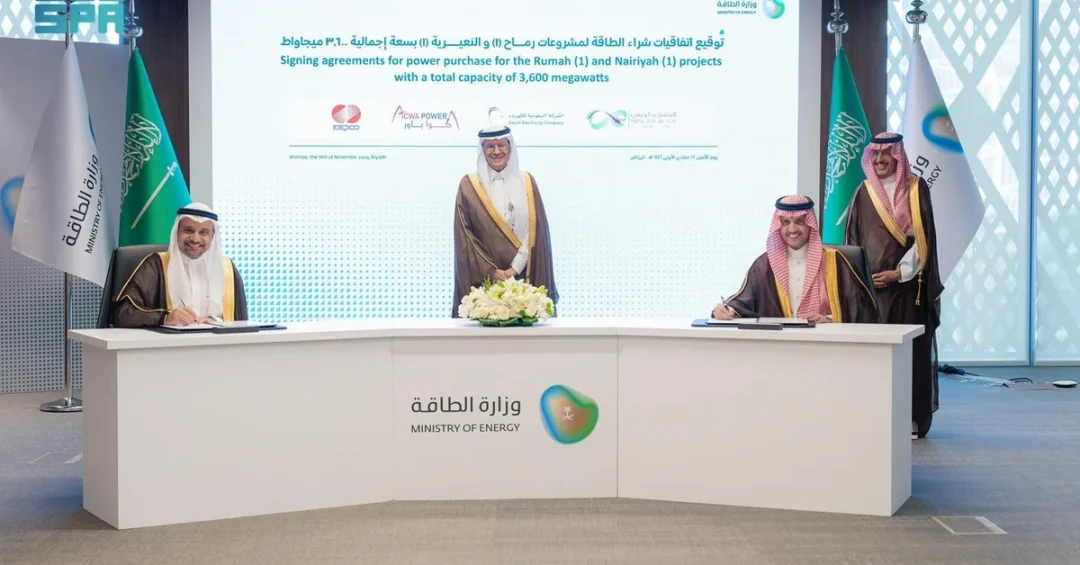
In the presence of Minister of Energy and Chairman of the Board of Directors of Saudi Power Procurement Company Prince Abdulaziz bin Salman bin Abdulaziz, the Saudi Power Procurement Company, acting as Principal Buyer, signed Power Purchase Agreements for five independent power producer projects totaling 9,200 megawatts, the Ministry of Energy announced on November 18, 2024. The agreements, released through the Saudi Press Agency, cover four combined-cycle gas turbine plants at Rumah and Nairyah and one 2,000-megawatt solar photovoltaic facility at Al Sadawi, and together represent approximately 35 billion Saudi Riyals, or 9.3 billion US dollars, in investment. The signing marks one of the largest single procurement rounds in the Kingdom’s power sector and reinforces the country’s dual-track strategy of expanding gas-fired capacity while scaling up renewable generation.
The ceremony in Riyadh brought together senior representatives of Saudi and international energy companies, underscoring the collaborative model that has come to define Saudi Arabia’s electricity expansion. Under the agreements, the projects will be developed, financed, built and operated by private consortiums under long-term contracts with the Principal Buyer, a model that transfers construction and operating risk to the private sector while guaranteeing the Kingdom reliable capacity. The Ministry of Energy described the round as evidence of the energy sector’s determination to meet the objectives of Saudi Vision 2030, which seeks a balanced and sustainable electricity mix for a growing population and industrial base. Why does a single signing round of this scale matter so much for the Kingdom’s future?
Context and Background
How did Saudi Arabia’s power procurement system evolve into one of the most active programs in the region? The Saudi Power Procurement Company, established as the Kingdom’s Principal Buyer, is the single off-taker responsible for purchasing electricity capacity and energy from independent power producers and selling it onward to the national grid. This structure, supervised by the Ministry of Energy, has allowed the Kingdom to run competitive tenders that attract global utilities, sovereign investors and renewable developers. The Ministry of Energy, led by Prince Abdulaziz bin Salman bin Abdulaziz, has overseen successive rounds that steadily lowered prices and expanded the pipeline of projects across the country.
The new agreements build on years of reform. The National Renewable Energy Program, managed under the Ministry of Energy, was launched to diversify the electricity mix and reduce dependence on liquid fuels. The Kingdom has set a target of roughly 50 percent gas and 50 percent renewable energy for electricity production by 2030, a goal that requires both utility-scale solar and wind farms and modern, efficient gas plants that can back up intermittent renewable output. The five projects announced this week sit precisely at the intersection of those two tracks, combining flexible gas capacity with a large solar farm. What does this dual approach reveal about Saudi Arabia’s planning philosophy?
The scale of the program is notable by any international measure. By the end of 2024, Saudi Arabia had signed agreements for 25 renewable energy projects distributed across various regions, collectively generating approximately 23 gigawatts of electricity. The Al Sadawi solar project forms part of Round 5 of the National Renewable Energy Program, continuing a competitive tender sequence that has drawn record-low tariffs. The four thermal projects, meanwhile, add firm capacity that supports grid stability as renewable penetration rises. Together, they illustrate how the Kingdom sequences procurement to keep the lights on while decarbonizing generation.
Key Details of the Five Agreements
What exactly was signed, and with whom? The thermal package covers four independent power producer plants, each with a capacity of 1,800 megawatts, for a combined 7,200 megawatts. The Rumah 1 and Nairyah 1 projects were awarded to a consortium of ACWA Power, Saudi Electricity Company and Korea Electric Power Corporation, with levelized costs of electricity of 4.5859 cents per kilowatt-hour for Rumah 1 and 4.6114 cents per kilowatt-hour for Nairyah 1. The Rumah 2 and Nairyah 2 projects went to a consortium of Abu Dhabi National Energy Company PJSC, known as TAQA, JERA and the local Al-Bawani company, at 4.5613 cents per kilowatt-hour for Rumah 2 and 4.4960 cents per kilowatt-hour for Nairyah 2.
All four thermal plants will use flexible combined-cycle gas turbine technology, with natural gas as the main fuel and the design capability to install carbon capture units in the future. According to the Ministry of Energy, the Rumah and Nairyah thermal projects are scheduled to achieve commercial operation in the second quarter of 2028. The inclusion of carbon capture readiness is significant: it preserves the option to reduce emissions from gas generation as the technology matures and as the Kingdom advances its circular carbon economy approach, which emphasizes reducing, reusing and recycling emissions rather than eliminating hydrocarbons outright.
The fifth agreement covers the Al Sadawi solar photovoltaic project, which will deliver 2,000 megawatts of clean power at a levelized cost of 1.2926 cents per kilowatt-hour, among the most competitive solar tariffs recorded globally. The project was awarded to a consortium of Abu Dhabi Future Energy Company PJSC, known as Masdar, Korea Electric Power Corporation and GD Power Development Company, and is scheduled to reach commercial operation in the second quarter of 2027. Why are such low solar prices so consequential for the Kingdom’s energy transition?
International and Regional Impact
How does this procurement round position Saudi Arabia within the wider region and beyond? The winning consortiums read like a map of allied energy capitals: Riyadh, Abu Dhabi, Seoul, Tokyo and Beijing, represented through ACWA Power, TAQA, Masdar, Korea Electric Power Corporation, JERA and GD Power Development Company. The participation of Korean, Japanese, Emirati and Chinese firms alongside Saudi champions such as ACWA Power and Saudi Electricity Company demonstrates the Kingdom’s ability to convene global capital and expertise at scale. It also deepens economic ties with partners across Asia and the Gulf, reinforcing Saudi Arabia’s role as a hub for energy investment.
The competitive tariffs achieved in this round send a signal across the region. At 4.49 to 4.61 cents per kilowatt-hour for gas-fired capacity and 1.2926 cents per kilowatt-hour for solar, the projects set benchmarks that neighboring markets will study closely. For international audiences, the message is that Saudi Arabia is not only a leading oil producer but also one of the most attractive destinations for power-sector investment, with transparent tendering, bankable contracts and a single credible off-taker in the Principal Buyer. Regional grids and interconnections may also benefit as capacity grows and cross-border electricity trade develops.
Economic and Strategic Significance
Why does 35 billion Saudi Riyals of investment matter beyond the electricity sector? The projects will create construction jobs, stimulate local supply chains and require significant local content, in line with the Kingdom’s efforts to build domestic industrial capability. They also free up liquid fuels currently used in power generation, allowing those hydrocarbons to be directed to higher-value uses or exports. That displacement improves the efficiency of the national economy and supports fiscal sustainability, since burning liquids for electricity is costly relative to gas and renewables.
The strategic logic extends to reliability. Combined-cycle gas plants provide firm, dispatchable capacity that can ramp up when solar output falls, making the grid more resilient as renewable shares increase. The carbon capture readiness of the Rumah and Nairyah plants keeps a pathway open for deeper emissions reductions. Meanwhile, the Al Sadawi solar farm adds clean energy at a cost below almost any alternative, reducing the average cost of supply. Together, the five projects advance the goal of an optimal energy mix and strengthen the foundation for industry, data centers and electrification across the Kingdom.
Vision 2030 Alignment
How do these agreements connect to Saudi Vision 2030? The Ministry of Energy stated that the projects highlight the energy sector’s determination to achieve the goals of Saudi Vision 2030, which aims to diversify the economy, reduce dependence on oil and build a sustainable future. The National Renewable Energy Program is central to that effort, targeting approximately 50 percent each from gas and renewable energy by 2030 while displacing liquid fuels in electricity production and other sectors. Each signed agreement moves the Kingdom measurably closer to that target.
With 25 renewable energy projects and roughly 23 gigawatts already contracted by the end of 2024, Saudi Arabia is building one of the world’s fastest-growing clean energy portfolios. The five agreements signed in the presence of Prince Abdulaziz bin Salman bin Abdulaziz add 9,200 megawatts and 35 billion Saudi Riyals of investment to that pipeline, reinforcing the Kingdom’s position as a global energy leader that is shaping the transition rather than merely reacting to it. As the projects move toward commercial operation in 2027 and 2028, they will stand as tangible proof that Vision 2030 is delivering power, prosperity and partnership for the decades ahead.
20 Questions
Q1. What did the Saudi Power Procurement Company sign on November 18, 2024?
A1. It signed Power Purchase Agreements for five independent power producer projects totaling 9,200 megawatts, covering four gas-fired plants at Rumah and Nairyah and one solar project at Al Sadawi.
Q2. Who attended the signing ceremony in Riyadh?
A2. The ceremony was held in the presence of Minister of Energy and Chairman of the Board of Directors of Saudi Power Procurement Company Prince Abdulaziz bin Salman bin Abdulaziz, along with representatives of the winning consortiums.
Q3. What is the total investment value of the five projects?
A3. The combined projects will attract total investments of approximately 35 billion Saudi Riyals, equivalent to about 9.3 billion US dollars, according to the Ministry of Energy.
Q4. What technology will the Rumah and Nairyah thermal plants use?
A4. They will use flexible combined-cycle gas turbine technology with natural gas as the main fuel, and they are designed with the capability to install carbon capture units.
Q5. How much thermal capacity was contracted in this round?
A5. The four thermal plants at Rumah and Nairyah total 7,200 megawatts, with each of the four independent power producer plants providing 1,800 megawatts of capacity.
Q6. Which consortium won the Rumah 1 and Nairyah 1 projects?
A6. A consortium of ACWA Power, Saudi Electricity Company and Korea Electric Power Corporation won the two projects, with levelized costs of 4.5859 and 4.6114 cents per kilowatt-hour respectively.
Q7. Which consortium won the Rumah 2 and Nairyah 2 projects?
A7. A consortium of Abu Dhabi National Energy Company PJSC, known as TAQA, JERA and the local Al-Bawani company won them, at 4.5613 and 4.4960 cents per kilowatt-hour.
Q8. When will the Rumah and Nairyah thermal projects begin commercial operation?
A8. Both the Rumah and Nairyah thermal energy projects are scheduled to achieve commercial operation in the second quarter of 2028, according to the Ministry of Energy announcement.
Q9. What is the Al Sadawi project and how large is it?
A9. Al Sadawi is a solar photovoltaic project under Round 5 of the National Renewable Energy Program, delivering a total capacity of 2,000 megawatts of clean power.
Q10. Which companies are developing the Al Sadawi solar project?
A10. A consortium of Abu Dhabi Future Energy Company PJSC, known as Masdar, Korea Electric Power Corporation and GD Power Development Company is developing the project.
Q11. What is the solar tariff achieved for Al Sadawi?
A11. The project will provide clean power at a highly competitive levelized cost of electricity of 1.2926 cents per kilowatt-hour, one of the lowest solar tariffs recorded globally.
Q12. When is Al Sadawi scheduled to reach commercial operation?
A12. The Al Sadawi solar photovoltaic project is scheduled to achieve commercial operation in the second quarter of 2027, ahead of the thermal projects.
Q13. What is the National Renewable Energy Program?
A13. It is a Ministry of Energy program that competitively tenders renewable energy projects to achieve an optimal energy mix, targeting about 50 percent gas and 50 percent renewable energy by 2030.
Q14. How many renewable projects had Saudi Arabia signed by the end of 2024?
A14. By the end of 2024, the Kingdom had signed agreements for 25 renewable energy projects distributed across various regions, collectively generating approximately 23 gigawatts of electricity.
Q15. Why does Saudi Arabia still build gas-fired power plants?
A15. Gas plants provide firm, dispatchable capacity that supports grid stability as renewable output varies, and they displace more expensive liquid fuels currently used in electricity production.
Q16. What does carbon capture readiness mean for the thermal projects?
A16. It means the plants are designed so that carbon capture units can be installed in the future, preserving a pathway to reduce emissions as the technology matures.
Q17. How does this signing support Saudi Vision 2030?
A17. It advances economic diversification, reduces reliance on liquid fuels, attracts foreign investment and moves the Kingdom toward its target electricity mix, all core objectives of Saudi Vision 2030.
Q18. What role does the Saudi Power Procurement Company play?
A18. As the Principal Buyer, it signs long-term power purchase agreements with private producers and sells the electricity onward, providing a single credible off-taker for investors.
Q19. Which countries are represented among the winning companies?
A19. The consortiums include companies from Saudi Arabia, the United Arab Emirates, South Korea, Japan and China, reflecting broad international confidence in the Kingdom’s power sector.
Q20. What is the significance of the low tariffs achieved?
A20. The tariffs set regional benchmarks, lower the cost of electricity supply, demonstrate the competitiveness of Saudi tenders and strengthen the business case for further investment in the Kingdom’s energy transition.
Reader Feedback
We value your thoughts. Please share your feedback on this article.
Your feedback helps us improve our coverage.
Related articles
 New Commercial Registers System to Boost Saudi Investment 8.8%
 GAFT Explores Economic Integration at GCC Doha Panel
 Saudi, Djibouti Ministers Meet to Boost Economic Ties
 Saudi Endowment Funds Hit Record SAR1 Billion in 2024
 Saudi Envoy Meets Makkah Chamber Delegation in Cairo
 SAMA Governor: Kingdom Plays Key Role in Global Economic Recovery