


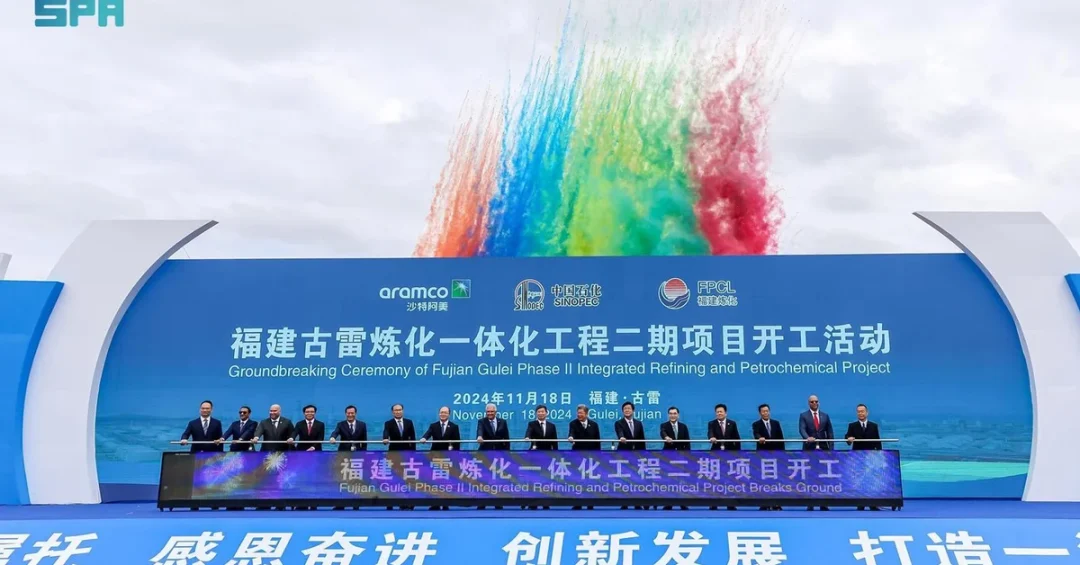
Aramco, China Petroleum & Chemical Corporation (SINOPEC), and Fujian Petrochemical Company Limited (FPCL) have officially broken ground on a new integrated refining and petrochemical complex in Fujian Province, China, according to a press release issued by Aramco and carried by the Saudi Press Agency (SPA). The announcement, dated November 18, 2024, marks a significant expansion of Saudi Arabia’s downstream investment footprint in Asia and reinforces the Kingdom’s role as a reliable, long-term energy partner to China, the world’s largest importer of crude oil.
The project represents a major milestone in the strategic energy partnership between Saudi Arabia and China, two nations whose economic ties have deepened steadily under the framework of Saudi Vision 2030 and China’s Belt and Road Initiative. For international observers, the groundbreaking signals more than the start of construction on a large industrial facility. It reflects a broader realignment of global energy flows, in which Saudi Aramco is moving beyond upstream crude production into higher-value refining and chemicals integration, particularly in fast-growing Asian markets. What does this development reveal about the future of Saudi-Chinese economic cooperation, and why does it matter for global energy markets?
Context and Background
The new complex is being developed as a joint venture in which Fujian Petrochemical Company Limited — itself a 50:50 joint venture between SINOPEC and Fujian Petrochemical Industrial Group Company — will hold a 50 percent stake. Aramco and SINOPEC will each hold 25 percent stakes, according to the official announcement. The facility is planned to include a 16 million tons-per-year oil refining unit, equivalent to 320,000 barrels per day, a 1.5 million tons-per-year ethylene unit, two million tons per year of paraxylene and downstream derivatives capacity, and a 300,000-ton crude oil terminal. The project is expected to be fully operational by the end of 2030.
This initiative builds on years of deepening cooperation between Aramco and its Chinese partners. Saudi Arabia has long been China’s most dependable supplier of crude oil, and Aramco has steadily expanded its downstream presence in the country through refining and petrochemical joint ventures. The Fujian project is part of that broader strategy, positioning Aramco closer to end customers in one of the world’s most dynamic chemical demand centers. How does a project of this scale reshape the relationship between a resource-rich Kingdom and a manufacturing powerhouse?
The Gulei Petrochemical Base, where the complex is located, is one of China’s key industrial zones for petrochemical development. Aramco’s participation is expected to supply long-term, reliable, and competitive feedstock, reinforcing the base’s role as a hub for high-value chemical production. The agreement also aligns with China’s dual circulation strategy, which seeks to balance domestic economic activity with continued international engagement.
Key Details
Aramco Downstream President Mohammed Y. Al-Qahtani described the groundbreaking as a natural extension of the company’s partnerships in China. “Building on our strong relationships with both SINOPEC and Fujian Petrochemical, today’s groundbreaking further expands Aramco’s growing downstream investment portfolio in China,” he said. “We will supply in excess of one million barrels per day of our crude oil to these high-chemical-conversion assets in China, reinforcing Aramco’s role as a reliable and long-term partner in China’s development. This also advances our liquids-to-chemicals strategy, through which we intend to direct more of our crude towards helping meet rising global petrochemicals demand.”
The reference to one million barrels per day underscores the scale of Aramco’s commitment. It also highlights the company’s strategic pivot toward converting a larger share of its crude oil into chemicals and other higher-value products, rather than simply exporting raw crude. This approach is designed to capture more value across the hydrocarbon chain while supporting the diversification objectives at the heart of Saudi Vision 2030.
SINOPEC Chairman Ma Yongsheng also welcomed the development. “Both SINOPEC and Aramco are committed to promoting the high-quality development of the petroleum and petrochemical industry,” he said. “Aramco’s participation supplies long-term reliable and competitive feedstock for the project and further boosts the healthy development of Gulei Petrochemical Base. Successful cooperation in this project marks a new milestone in the China-Saudi all-weather strategic partnership, with a focus on greater domestic circulation and in line with the dual circulation strategy.”
The project’s product slate — including ethylene, paraxylene, and downstream derivatives — is aimed at supplying China’s growing domestic demand for plastics, synthetic fibers, and specialty chemicals. These materials are essential inputs for industries ranging from packaging and textiles to automotive manufacturing and electronics. What does the scale of this investment say about where global petrochemical demand is heading?
International and Regional Impact
For Saudi Arabia, the Fujian project strengthens a strategic energy relationship that has become increasingly important as global demand shifts eastward. China is already the Kingdom’s largest trading partner and a major destination for Saudi crude. By investing directly in Chinese refining and petrochemical capacity, Aramco secures a stable, long-term outlet for its crude while gaining exposure to higher-margin downstream products. This is a mutually beneficial arrangement that supports both China’s industrial needs and Saudi Arabia’s economic diversification goals.
Regionally, the project reinforces the Gulf’s role as a linchpin of global energy security. Saudi Arabia’s willingness to invest in downstream assets abroad demonstrates that it is not merely a supplier of raw materials but a full-chain partner in the economies of its key customers. For other Gulf states watching Saudi Arabia’s moves, the Fujian project offers a template for how national oil companies can evolve into integrated global energy and chemicals players.
Internationally, the groundbreaking comes at a time of heightened volatility in energy markets and shifting supply chains. By deepening ties with China, Aramco is helping to stabilize a critical trade corridor while positioning itself at the center of Asia’s petrochemical growth. How might this project influence other major energy producers considering similar downstream investments in Asia?
Economic and Strategic Significance
The economic implications of the Fujian complex extend well beyond the immediate construction phase. Once operational, the facility will require a steady supply of Saudi crude, creating a durable demand channel for the Kingdom’s most important export. It will also generate employment and industrial activity in Fujian Province, contributing to local and regional economic development. For Aramco, the project represents a long-term revenue stream that is less exposed to the volatility of raw crude prices, as refined and petrochemical products typically command higher and more stable margins.
Strategically, the investment aligns with Aramco’s stated goal of increasing its liquids-to-chemicals conversion capacity. By directing more crude into high-conversion assets, the company can capture value at multiple points along the supply chain. This strategy also supports Saudi Arabia’s broader efforts to diversify its economy away from a near-total reliance on crude exports, a central pillar of Vision 2030. The partnership with SINOPEC and FPCL demonstrates that Saudi Aramco can be a catalyst for industrial development not only at home but also in key partner countries.
What does this project mean for the future of Saudi-Chinese trade, and how might it encourage further collaboration in areas such as technology, logistics, and renewable energy? The answers may shape the next decade of bilateral relations.
Vision 2030 Alignment
The Fujian project is a clear example of how Saudi Vision 2030 is being translated into concrete international partnerships. Vision 2030 seeks to transform Saudi Arabia into a diversified, innovation-driven economy, and Aramco’s downstream expansion is a key component of that transformation. By investing in refining and petrochemical assets abroad, Aramco is not only securing demand for Saudi crude but also building the expertise and commercial networks that will support the Kingdom’s own growing chemicals industry.
Moreover, the project reinforces Saudi Arabia’s role as a responsible and reliable global energy partner. It demonstrates that the Kingdom is committed to long-term cooperation with major economies, contributing to global energy security and economic stability. As the complex moves toward full operation by the end of 2030, it will stand as a symbol of what the China-Saudi all-weather strategic partnership can achieve. In a world that increasingly values durable, mutually beneficial relationships, the Aramco-SINOPEC-FPCL venture sets a positive example for international collaboration in the energy sector.
20 Questions
Q1. What is the new project announced by Aramco, SINOPEC, and Fujian Petrochemical?
A1. It is a new integrated refining and petrochemical complex in Fujian Province, China, designed to include a 320,000 barrels-per-day refinery, a 1.5 million tons-per-year ethylene unit, and two million tons per year of paraxylene capacity.
Q2. When did the groundbreaking take place?
A2. The groundbreaking was announced on November 18, 2024, according to a press release issued by Aramco and carried by the Saudi Press Agency.
Q3. What are the ownership stakes in the joint venture?
A3. Fujian Petrochemical Company Limited holds a 50 percent stake, while Aramco and SINOPEC each hold 25 percent stakes in the new complex.
Q4. What is the expected completion date for the project?
A4. The project is expected to be fully operational by the end of 2030.
Q5. How much crude oil will Aramco supply to the project?
A5. Aramco will supply in excess of one million barrels per day of its crude oil to these high-chemical-conversion assets in China, reinforcing its role as a long-term partner.
Q6. What is Aramco’s liquids-to-chemicals strategy?
A6. It is a strategy through which Aramco intends to direct more of its crude oil towards meeting rising global petrochemicals demand, capturing higher value across the hydrocarbon chain.
Q7. Who is the Aramco Downstream President quoted in the announcement?
A7. Mohammed Y. Al-Qahtani is the Aramco Downstream President who commented on the groundbreaking and the company’s expanding downstream investment portfolio in China.
Q8. Who is the SINOPEC Chairman quoted in the announcement?
A8. Ma Yongsheng is the SINOPEC Chairman who described the project as a new milestone in the China-Saudi all-weather strategic partnership.
Q9. What is the Gulei Petrochemical Base?
A9. It is a key petrochemical industrial zone in Fujian Province, China, where the new complex is located, and Aramco’s participation is expected to boost its healthy development.
Q10. What products will the complex produce?
A10. The complex will produce refined oil products, ethylene, paraxylene, and downstream derivatives, which are essential inputs for plastics, synthetic fibers, and specialty chemicals.
Q11. What is the significance of the 300,000-ton crude oil terminal?
A11. The terminal will facilitate the import of crude oil feedstock for the refining and petrochemical operations, ensuring a reliable supply chain for the complex.
Q12. How does this project align with Saudi Vision 2030?
A12. It supports economic diversification by expanding Aramco’s downstream portfolio, securing long-term demand for Saudi crude, and building expertise that benefits the Kingdom’s own chemicals industry.
Q13. What is China’s dual circulation strategy?
A13. It is an economic policy that seeks to balance domestic economic activity with continued international engagement, and the project is in line with this strategy.
Q14. What does the project mean for Saudi-Chinese relations?
A14. It marks a new milestone in the China-Saudi all-weather strategic partnership, deepening energy cooperation and reinforcing mutual economic ties.
Q15. How will the project benefit the local economy in Fujian?
A15. It will generate employment, stimulate industrial activity, and contribute to the development of the Gulei Petrochemical Base, supporting regional economic growth.
Q16. What is Aramco’s broader downstream investment strategy in China?
A16. Aramco is expanding its downstream presence in China through refining and petrochemical joint ventures, aiming to capture more value and meet rising chemical demand.
Q17. How does this project contribute to global energy security?
A17. By securing a stable supply of Saudi crude to a major Asian market and investing in downstream assets, it helps stabilize a critical trade corridor and supports global energy security.
Q18. What are the key units planned for the complex?
A18. The complex includes a 16 million tons-per-year oil refining unit, a 1.5 million tons-per-year ethylene unit, two million tons per year of paraxylene capacity, and a 300,000-ton crude oil terminal.
Q19. How does this project reflect Aramco’s role as a reliable partner?
A19. By committing to supply over one million barrels per day of crude and investing in downstream assets, Aramco demonstrates its long-term commitment to China’s development and energy needs.
Q20. What is the expected impact of the project on global petrochemical markets?
A20. It will add significant capacity to meet rising global petrochemical demand, particularly in Asia, and reinforce Saudi Arabia’s position as a leading integrated energy and chemicals player.
Reader Feedback
We value your thoughts. Please share your feedback on this article.
Your feedback helps us improve our coverage.
Related articles
 Aramco, Rongsheng Sign SASREF Expansion Framework Deal
 265 Polish Firms Eye Saudi Investment at Warsaw Forum
 stc Group Champions Youth Initiatives at Misk Global Forum
 Saudi Ambassador Launches Saudi-Polish Business Company
 ROSHN Forum Signs MoUs to Localize Building Materials
 Slovak President Welcomes Saudi Chambers Federation President, Investors