


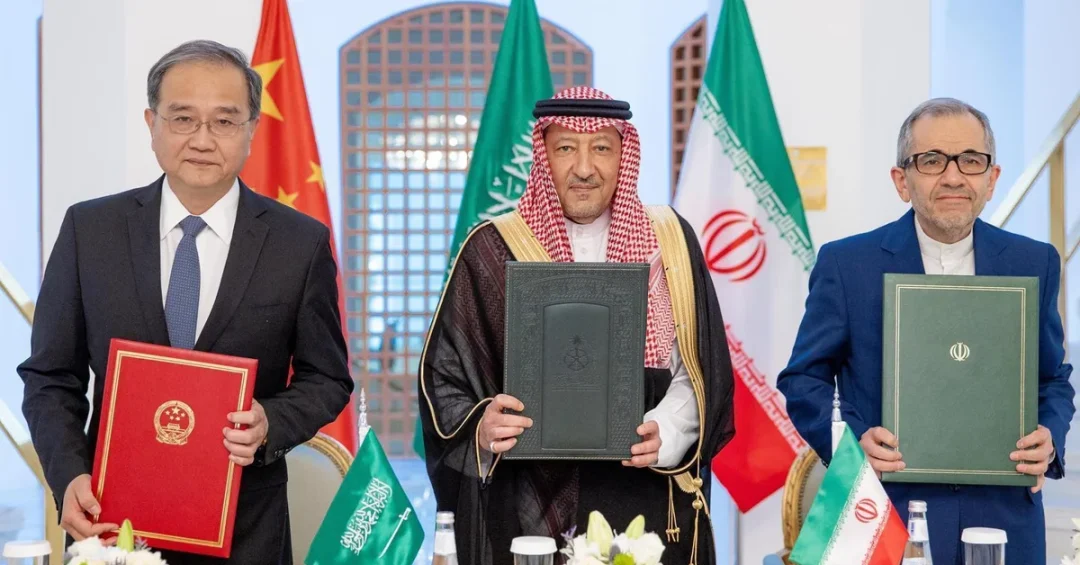
The second meeting of the Saudi-Chinese-Iranian Joint Tripartite Committee to follow up on the Beijing Agreement was held in Riyadh on November 19, 2024, chaired by His Excellency Waleed A.Elkhereiji, Vice Minister of Foreign Affairs of the Kingdom of Saudi Arabia. The meeting brought together a Chinese delegation led by H.E. Deng Li, Vice-Minister of Foreign Affairs of the People’s Republic of China, and an Iranian delegation chaired by H.E. Majid Takht Ravanchi, Deputy Foreign Minister of the Islamic Republic of Iran for Political Affairs, according to the Saudi Press Agency. The gathering marked another milestone in the diplomatic process launched in Beijing in March 2023, when Saudi Arabia and Iran restored diplomatic relations under Chinese auspices.
What does it mean when three nations with distinct histories and strategic outlooks sit at the same table in Riyadh to review a landmark agreement? For international observers, the answer lies in the steady, incremental progress that has defined the Beijing Agreement’s implementation. The Riyadh meeting was not merely ceremonial; it produced a detailed review of consular achievements, media cooperation, and economic preparations, while also addressing the regional tensions that make such dialogue essential. The three delegations reaffirmed their commitment to the United Nations Charter, the Charter of the Organization of Islamic Cooperation, and international law, including respect for sovereignty, independence, and security of states.
Context and Background
Why has the Beijing Agreement become such a pivotal framework for regional diplomacy? The agreement, brokered by the People’s Republic of China in March 2023, ended years of severed ties between Saudi Arabia and Iran and set in motion a series of confidence-building measures. The first meeting of the tripartite committee was held in Beijing in December 2023, and the second in Riyadh in November 2024. Each session has served as a checkpoint, allowing the three parties to assess progress, resolve obstacles, and chart next steps. The Kingdom of Saudi Arabia has consistently emphasized that its foreign policy under the leadership of the Custodian of the Two Holy Mosques, King Salman bin Abdulaziz Al Saud, and His Royal Highness Crown Prince Mohammed bin Salman bin Abdulaziz Al Saud, Prime Minister, prioritizes stability, dialogue, and economic prosperity.
The Riyadh meeting took place against a backdrop of heightened regional tensions, including the conflict in Gaza, hostilities in Lebanon, and threats to maritime security in the Red Sea. These crises lend urgency to the Saudi-Iranian rapprochement, which aims to prevent further escalation and open channels for de-escalation. The Chinese role as a facilitator has been welcomed by both sides, with Beijing expressing readiness to continue supporting and encouraging steps taken by Riyadh and Tehran to develop their relationship across various fields. For Saudi Arabia, this trilateral format complements its broader diplomatic outreach, including its hosting of peace talks and its humanitarian initiatives.
The meeting also reflects Saudi Arabia’s Vision 2030 objective of positioning the Kingdom as a global hub for diplomacy and investment. By stabilizing its eastern flank through engagement with Iran, Saudi Arabia can focus on economic diversification, infrastructure megaprojects, and attracting foreign direct investment. The presence of Chinese and Iranian delegations in Riyadh underscores the Kingdom’s growing role as a convening power in Asia and the Middle East.
Key Details and Outcomes
What concrete achievements were highlighted during the Riyadh session? The participants welcomed the continued progress in Saudi-Iranian relations and the opportunities it provides for direct communication at all levels and sectors. They noted the importance of contacts, meetings, and mutual visits between high officials, especially given the current tensions that threaten regional and global security. A major focus was consular services: more than 87,000 Iranian pilgrims performed Hajj and more than 52,000 Iranians performed Umrah with ease and security during the first ten months of 2024. This figure represents a significant increase in people-to-people exchanges and reflects the practical benefits of restored ties.
The meeting also welcomed the first meeting of the Saudi-Iranian Joint Media Committee and the signing of a Memorandum of Understanding (MoU) between the Prince Saud Al-Faisal Institute for Diplomatic Studies and the Institute of Political and International Studies of the Iranian Ministry of Foreign Affairs. This MoU aims to foster research collaboration and diplomatic training, building long-term institutional ties. Additionally, the two countries expressed readiness to sign a Double Taxation Avoidance Agreement (DTAA), a step that would facilitate trade and investment by removing fiscal barriers for businesses operating in both nations. The three countries look forward to expanding cooperation in various fields, including economic and political domains.
On regional security, the three countries called for an immediate end to Israeli aggression in Palestine and Lebanon and condemned Israeli attacks and violations of the sovereignty and territorial integrity of the Islamic Republic of Iran. They urged the uninterrupted flow of humanitarian aid and relief to Palestine and Lebanon, warning that the continuing cycle of violence and escalation is a serious threat to regional and global security, as well as to maritime security. The three nations also reaffirmed their support for a comprehensive political solution in Yemen in accordance with internationally recognized principles under the auspices of the United Nations.
International and Regional Impact
How does the Riyadh meeting reshape the broader geopolitical landscape? The trilateral framework signals a shift toward multipolar diplomacy in which middle powers and Asian giants collaborate to resolve regional disputes. China’s continued positive role is explicitly welcomed by both Saudi Arabia and Iran, highlighting Beijing’s growing influence as a mediator. For the United States and European nations, the meeting underscores the need to engage with these evolving dynamics. The emphasis on UN and OIC charters reassures international stakeholders that the rapprochement is grounded in recognized legal principles, not a departure from the rules-based order.
Regionally, the meeting’s outcomes could have a stabilizing effect. The call for an immediate end to hostilities in Palestine and Lebanon, coupled with condemnation of attacks on Iran, positions the three countries as advocates for de-escalation. Their warning about maritime security resonates with global shipping interests, given the strategic importance of the Red Sea and the Strait of Hormuz. By supporting a UN-led political solution in Yemen, the three nations align with international efforts to end the conflict, potentially paving the way for reconstruction and development. For Saudi Arabia, this diplomacy enhances its reputation as a responsible regional leader committed to peace and prosperity.
Economic and Strategic Significance
What economic opportunities arise from this diplomatic progress? The planned Double Taxation Avoidance Agreement between Saudi Arabia and Iran is a clear signal that both sides intend to deepen commercial ties. Such an agreement would protect investors from double taxation, making cross-border trade more attractive. Iranian pilgrims performing Hajj and Umrah contribute to Saudi Arabia’s tourism and hospitality sectors, supporting Vision 2030 goals of increasing non-oil revenue and hosting more visitors. The expansion of consular services and direct flights would further boost business travel and people-to-people exchanges.
Strategically, the trilateral committee reinforces Saudi Arabia’s role as a bridge between Asia and the Middle East. China is the Kingdom’s largest trading partner, and Iran is a neighbor with significant energy resources. A stable relationship between Riyadh and Tehran reduces the risk of conflict that could disrupt oil markets and global supply chains. The meeting’s focus on economic and political cooperation aligns with Vision 2030’s aim to diversify the economy and attract foreign investment. By facilitating dialogue, Saudi Arabia also enhances its appeal as a destination for international events, conferences, and headquarters of multinational companies.
Vision 2030 Alignment
How does the Riyadh meeting advance Saudi Arabia’s Vision 2030? At its core, Vision 2030 seeks to transform the Kingdom into a diversified, innovative, and globally connected economy. Diplomatic stability is a prerequisite for that transformation. The Beijing Agreement and its follow-up meetings reduce geopolitical risk, allowing Saudi Arabia to focus on giga-projects like NEOM, the Red Sea Project, and Qiddiya. They also support the goal of increasing Hajj and Umrah capacity, as evidenced by the more than 139,000 Iranian pilgrims welcomed in 2024. The MoU between diplomatic institutes fosters knowledge exchange, building human capital in line with Vision 2030’s emphasis on education and research.
Furthermore, the meeting’s outcomes contribute to the Vision 2030 objective of a vibrant society and a thriving economy. By promoting regional peace, Saudi Arabia can attract more tourists, investors, and partners. The Kingdom’s leadership in convening China and Iran demonstrates its commitment to a stable and prosperous region, which is essential for long-term economic growth. As the three countries look forward to expanding cooperation, Saudi Arabia stands poised to benefit from increased trade, investment, and cultural exchange. The Riyadh meeting thus represents another step toward a future where the Kingdom’s diplomatic foresight and economic vision reinforce one another, securing a brighter tomorrow for the region and the world.
20 Questions
Q1. What was the purpose of the second meeting of the Saudi-Chinese-Iranian Joint Tripartite Committee?
A1. The meeting aimed to follow up on the implementation of the Beijing Agreement, review progress in Saudi-Iranian relations, and discuss ways to expand cooperation in economic, political, and consular fields, according to the Saudi Press Agency.
Q2. Who chaired the Saudi delegation at the Riyadh meeting?
A2. The Saudi delegation was chaired by His Excellency Waleed A.Elkhereiji, Vice Minister of Foreign Affairs of the Kingdom of Saudi Arabia, who led the discussions and reaffirmed the Kingdom’s commitment to the agreement.
Q3. Which Chinese official led the Chinese delegation?
A3. The Chinese delegation was headed by H.E. Deng Li, Vice-Minister of Foreign Affairs of the People’s Republic of China, who expressed China’s readiness to continue supporting Saudi-Iranian relations.
Q4. Who represented Iran at the meeting?
A4. The Iranian delegation was chaired by H.E. Majid Takht Ravanchi, Deputy Foreign Minister of the Islamic Republic of Iran for Political Affairs, who participated in the discussions and reaffirmed Iran’s commitment to the Beijing Agreement.
Q5. What did Saudi Arabia and Iran reaffirm regarding the Beijing Agreement?
A5. Both sides reaffirmed their commitment to implementing the Beijing Agreement in all its provisions and their continued endeavor to consolidate neighborly relations through adherence to the UN Charter, the OIC Charter, and international law.
Q6. How many Iranian pilgrims performed Hajj in the first ten months of 2024?
A6. More than 87,000 Iranian pilgrims performed Hajj with ease and security during the first ten months of 2024, reflecting the improved consular services between the two countries.
Q7. How many Iranians performed Umrah in the same period?
A7. More than 52,000 Iranians performed Umrah during the first ten months of 2024, demonstrating the practical benefits of the restored diplomatic ties and enhanced consular cooperation.
Q8. What new agreement did the two countries express readiness to sign?
A8. Saudi Arabia and Iran expressed readiness to sign a Double Taxation Avoidance Agreement (DTAA), which would facilitate trade and investment by removing fiscal barriers for businesses operating in both nations.
Q9. What MoU was signed between Saudi and Iranian institutions?
A9. A Memorandum of Understanding was signed between the Prince Saud Al-Faisal Institute for Diplomatic Studies and the Institute of Political and International Studies of the Iranian Ministry of Foreign Affairs to foster research collaboration.
Q10. What was welcomed regarding media cooperation?
A10. The participants welcomed the holding of the first meeting of the Saudi-Iranian Joint Media Committee, which aims to enhance media exchange and mutual understanding between the two countries.
Q11. What did the three countries call for regarding Palestine and Lebanon?
A11. The three countries called for an immediate end to Israeli aggression in Palestine and Lebanon, condemned Israeli attacks, and urged the uninterrupted flow of humanitarian aid to both regions.
Q12. How did the three countries describe the cycle of violence in the region?
A12. They warned that the continuing cycle of violence and escalation is a serious threat to the security of the region and the world, as well as to maritime security.
Q13. What is the three countries’ stance on Yemen?
A13. The three countries reaffirmed their support for a comprehensive political solution in Yemen in accordance with internationally recognized principles under the auspices of the United Nations.
Q14. What role did China play according to the meeting’s outcomes?
A14. China affirmed its readiness to continue to support and encourage the steps taken by Saudi Arabia and Iran to develop their relationship in various fields, and its positive role was welcomed by both sides.
Q15. How does the meeting relate to Saudi Arabia’s Vision 2030?
A15. The meeting supports Vision 2030 by promoting regional stability, which is essential for economic diversification, attracting investment, and enhancing Saudi Arabia’s role as a global diplomatic and economic hub.
Q16. What does the Double Taxation Avoidance Agreement aim to achieve?
A16. The DTAA aims to prevent double taxation of income and capital, thereby encouraging cross-border trade and investment between Saudi Arabia and Iran and supporting economic cooperation.
Q17. What was the significance of the first Saudi-Iranian Joint Media Committee meeting?
A17. It marked a step forward in media cooperation, enabling both countries to share perspectives, combat misinformation, and foster greater mutual understanding among their peoples.
Q18. How many total Iranian pilgrims were mentioned for Hajj and Umrah in 2024?
A18. More than 139,000 Iranian pilgrims performed Hajj and Umrah combined during the first ten months of 2024, reflecting the success of consular services and the peaceful facilitation of religious travel.
Q19. What international charters did the three countries emphasize adherence to?
A19. The three countries emphasized adherence to the Charter of the United Nations, the Charter of the Organization of Islamic Cooperation, and international law, including respect for sovereignty, independence, and security of states.
Q20. What is the expected next step for the tripartite committee?
A20. The three countries look forward to expanding cooperation in various fields, including economic and political domains, and will continue to follow up on the Beijing Agreement’s implementation through future meetings.
Reader Feedback
We value your thoughts. Please share your feedback on this article.
Your feedback helps us improve our coverage.
Related articles
 Arab Parliament Strengthens Ties with China After Riyadh Summit
 Third Saudi International Maritime Forum Opens with Global Participation
 Saudi Environmental Security Forces Join Riyadh Airshow
 KSrelief Supervisor General Meets Bill Gates in Riyadh
 KSrelief Distributes Winter Aid in Yemen, Reaching 1,200
 KSrelief Delivers Winter Aid to 3,600 in Yemen’s Shabwah