


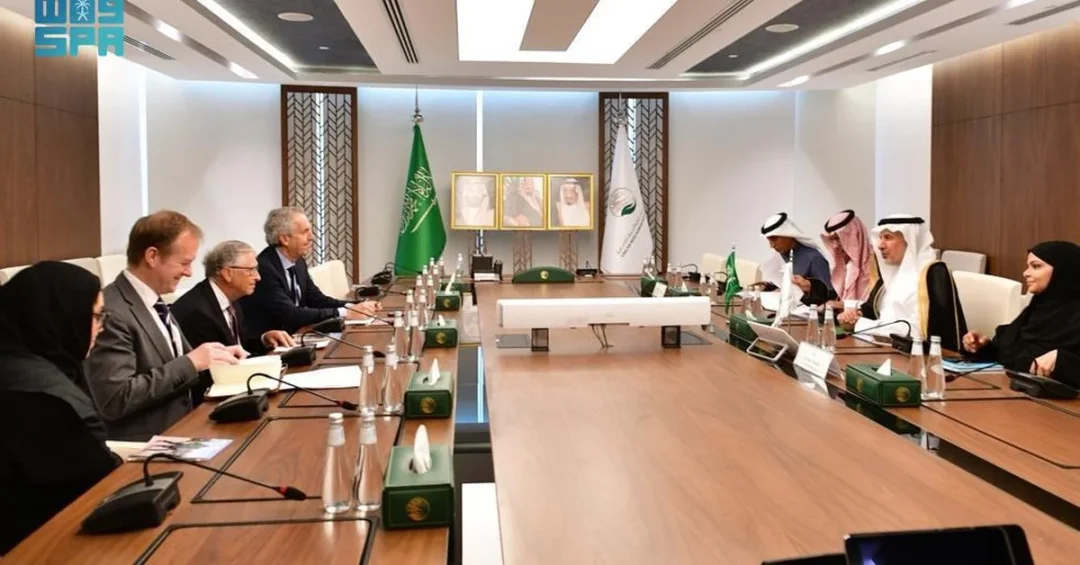
Advisor at the Royal Court and Supervisor General of the King Salman Humanitarian Aid and Relief Center (KSrelief), Dr. Abdullah Al Rabeeah, met with Bill Gates, Co-Chair of the Bill & Melinda Gates Foundation, at KSrelief headquarters in Riyadh on November 19, 2024, to discuss humanitarian and relief issues and other matters of mutual interest, according to the Saudi Press Agency. The high-level meeting underscores Saudi Arabia’s expanding role in global philanthropy and its commitment to addressing some of the world’s most pressing humanitarian challenges through strategic partnerships.
The encounter between Dr. Al Rabeeah and Mr. Gates brought together two of the most influential figures in international humanitarian work. KSrelief, established in 2015 by King Salman bin Abdulaziz Al Saud, has become a leading global donor, delivering aid to millions across more than 90 countries. The Bill & Melinda Gates Foundation, co-chaired by Bill Gates, is one of the largest private philanthropic organizations in the world, focusing on health, development, and poverty reduction. Their meeting signals a shared determination to enhance cooperation and maximize impact in crisis-affected regions.
Context and Background
What does it mean when two global humanitarian heavyweights sit down together in Riyadh? It signals a deepening of Saudi Arabia’s engagement with international partners to tackle humanitarian crises more effectively. KSrelief was founded to centralize and streamline the Kingdom’s relief efforts, and since its inception, it has implemented thousands of projects in sectors such as food security, health, education, and water sanitation. Its rapid response to emergencies, from Yemen to Syria to Ukraine, has earned it recognition as a reliable and impartial humanitarian actor.
The Bill & Melinda Gates Foundation has a long history of partnering with governments and organizations to combat disease, improve agricultural productivity, and expand access to essential services. Bill Gates has been a frequent interlocutor with Saudi leaders on global health and development issues. This meeting at KSrelief headquarters follows previous engagements and reflects a mutual interest in leveraging each other’s strengths. The timing is significant, as humanitarian needs worldwide are at record highs due to conflicts, climate change, and economic instability.
Saudi Arabia has consistently used its diplomatic and financial weight to support humanitarian causes, often working through multilateral institutions and bilateral partnerships. The meeting between Dr. Al Rabeeah and Mr. Gates is part of this broader strategy to build coalitions that can deliver aid more efficiently. It also highlights the Kingdom’s growing soft power and its willingness to collaborate with non-traditional partners, including private foundations, to achieve shared goals.
Key Details
During the meeting, Dr. Al Rabeeah and Mr. Gates focused on humanitarian and relief issues, as well as matters of mutual interest. While specific outcomes were not disclosed, the discussion likely covered ongoing crises in the Middle East, Africa, and beyond, where both organizations are active. KSrelief’s extensive field presence and logistical capabilities complement the Gates Foundation’s expertise in health innovation and data-driven philanthropy. Potential areas of collaboration could include disease prevention, vaccination campaigns, and emergency response coordination.
Dr. Al Rabeeah, a former Saudi health minister, has led KSrelief since its founding and has been instrumental in shaping its global footprint. Under his leadership, the center has forged partnerships with the United Nations, the World Health Organization, and numerous NGOs. Bill Gates, through his foundation, has championed global health initiatives such as Gavi, the Vaccine Alliance, and the Global Fund to Fight AIDS, Tuberculosis and Malaria. His meeting with Dr. Al Rabeeah could pave the way for joint efforts in these areas, particularly in countries where Saudi Arabia has strong ties and the Gates Foundation has technical resources.
The meeting took place at KSrelief’s headquarters in Riyadh, a hub for coordinating Saudi aid operations. The location itself is symbolic of the Kingdom’s commitment to humanitarian leadership. The two leaders exchanged views on the current global humanitarian landscape and explored ways to enhance the effectiveness of aid delivery. Both organizations have emphasized the importance of sustainable development and resilience-building, aligning with the Sustainable Development Goals (SDGs).
International and Regional Impact
How might this meeting influence the broader humanitarian ecosystem? A partnership between KSrelief and the Gates Foundation could set a new standard for collaboration between state and private donors. By combining resources and expertise, they can address gaps in funding and implementation that often hinder relief efforts. For instance, in Yemen, where KSrelief is one of the largest donors, the Gates Foundation’s experience in combating infectious diseases could bolster health interventions. Similarly, in the Horn of Africa, joint programs could tackle food insecurity and climate-induced displacement.
Regionally, the meeting reinforces Saudi Arabia’s role as a stabilizing force and a key player in humanitarian diplomacy. It also sends a positive signal to the international community about the Kingdom’s openness to partnerships that transcend political boundaries. The Gates Foundation’s involvement adds a layer of credibility and technical rigor that can amplify the impact of Saudi aid. Moreover, it demonstrates that Saudi Arabia is not only a donor but also a convener, bringing together diverse stakeholders to solve common problems.
Globally, the collaboration could influence how other nations and organizations approach humanitarian funding. With traditional donor budgets under strain, innovative partnerships like this one can mobilize additional resources and improve efficiency. The meeting also aligns with the UN’s call for greater public-private cooperation to meet the ambitious targets of the 2030 Agenda for Sustainable Development.
Economic and Strategic Significance
What does this meeting reveal about Saudi Arabia’s strategic priorities? It highlights the Kingdom’s focus on leveraging its economic strength to advance humanitarian goals, a key pillar of Vision 2030. By partnering with the Gates Foundation, Saudi Arabia can benefit from cutting-edge research and best practices, while also showcasing its own logistical and financial contributions. This can enhance the Kingdom’s reputation as a responsible global citizen and attract further international cooperation.
Economically, humanitarian aid is not just charity; it is an investment in stability and prosperity. By addressing the root causes of crises, such as poverty and disease, Saudi Arabia and its partners can help create more stable regions that are better able to trade and develop. This aligns with Vision 2030’s aim to diversify the economy and strengthen international ties. The meeting also underscores the potential for Saudi Arabia to play a larger role in global health security, an area of growing importance in a post-pandemic world.
Strategically, the meeting positions Saudi Arabia as a bridge between the developed and developing worlds. Bill Gates’ participation lends weight to the Kingdom’s efforts to be seen as a leader in humanitarian innovation. It also complements Saudi Arabia’s other diplomatic initiatives, such as hosting peace talks and providing development assistance. The partnership could lead to joint ventures in technology transfer, capacity building, and emergency preparedness, further solidifying the Kingdom’s role as a humanitarian hub.
Vision 2030 Alignment
How does this meeting advance the goals of Vision 2030? Vision 2030 seeks to transform Saudi Arabia into a more diversified, globally engaged economy and society. A core component is enhancing the Kingdom’s international standing and contributing to global stability. By collaborating with the Gates Foundation, KSrelief is directly supporting this objective, demonstrating Saudi Arabia’s commitment to humanitarian values and its ability to work with top-tier international partners.
Furthermore, the meeting aligns with Vision 2030’s emphasis on sustainable development and knowledge exchange. The Gates Foundation’s expertise in data and innovation can help KSrelief improve its monitoring and evaluation, ensuring aid reaches those who need it most. This partnership also promotes the Kingdom’s soft power, as it showcases Saudi leadership in addressing global challenges. As Saudi Arabia continues to open up and diversify, such collaborations will be essential in building a positive image and fostering mutual understanding.
In conclusion, the meeting between Dr. Abdullah Al Rabeeah and Bill Gates is more than a courtesy call; it is a strategic step toward a more effective and collaborative humanitarian system. It reflects Saudi Arabia’s enduring commitment to helping those in need and its growing role as a global leader. As the Kingdom moves forward with Vision 2030, partnerships like this will be crucial in achieving a prosperous and peaceful world.
20 Questions
Q1. Who met with Bill Gates at KSrelief headquarters?
A1. Dr. Abdullah Al Rabeeah, Advisor at the Royal Court and Supervisor General of KSrelief, met with Bill Gates at KSrelief headquarters in Riyadh on November 19, 2024.
Q2. What is KSrelief?
A2. KSrelief is the King Salman Humanitarian Aid and Relief Center, established in 2015 by King Salman bin Abdulaziz Al Saud to coordinate and deliver Saudi humanitarian aid worldwide.
Q3. Who is Bill Gates?
A3. Bill Gates is the Co-Chair of the Bill & Melinda Gates Foundation, one of the world’s largest private philanthropic organizations focused on global health, development, and poverty reduction.
Q4. What was the main focus of the meeting?
A4. The meeting focused on humanitarian and relief issues, as well as matters of mutual interest, according to the Saudi Press Agency.
Q5. Where did the meeting take place?
A5. The meeting took place at KSrelief’s headquarters in Riyadh, Saudi Arabia.
Q6. When did the meeting occur?
A6. The meeting occurred on November 19, 2024, as reported by the Saudi Press Agency.
Q7. What is the significance of this meeting for Saudi Arabia?
A7. It highlights Saudi Arabia’s growing role in global humanitarian efforts and its willingness to partner with leading international organizations to address crises.
Q8. Has KSrelief partnered with the Gates Foundation before?
A8. While specific prior collaborations are not detailed, both organizations have worked in similar humanitarian spheres, and this meeting likely builds on shared interests.
Q9. What areas could KSrelief and the Gates Foundation collaborate on?
A9. Potential areas include disease prevention, vaccination campaigns, emergency response, food security, and health system strengthening in crisis-affected regions.
Q10. How does this meeting align with Vision 2030?
A10. It supports Vision 2030 by enhancing Saudi Arabia’s international engagement, promoting sustainable development, and showcasing the Kingdom’s humanitarian leadership.
Q11. What is Dr. Abdullah Al Rabeeah’s role?
A11. Dr. Al Rabeeah is the Supervisor General of KSrelief and an Advisor at the Royal Court. He has led KSrelief since its founding and is a former Saudi health minister.
Q12. What is the Bill & Melinda Gates Foundation known for?
A12. The foundation is known for its work in global health, including combating infectious diseases, improving agricultural development, and expanding access to education and sanitation.
Q13. How many countries does KSrelief operate in?
A13. KSrelief has delivered aid to more than 90 countries, implementing thousands of projects in sectors such as food security, health, education, and water sanitation.
Q14. What kind of aid does KSrelief provide?
A14. KSrelief provides emergency relief, food assistance, medical care, education support, and water and sanitation services, among other forms of humanitarian aid.
Q15. Why is this meeting important for global humanitarian efforts?
A15. It brings together a major state donor and a leading private foundation, potentially leading to more efficient and innovative solutions for global crises.
Q16. Did the meeting result in any agreements?
A16. Specific outcomes were not disclosed, but the meeting focused on discussing humanitarian issues and exploring areas of mutual interest.
Q17. What is Saudi Arabia’s role in global humanitarian aid?
A17. Saudi Arabia is a top donor, providing billions in aid through KSrelief and other channels, and is known for its rapid response to emergencies worldwide.
Q18. How does this meeting reflect Saudi Arabia’s foreign policy?
A18. It reflects Saudi Arabia’s policy of constructive engagement, building partnerships to promote stability and development, and enhancing its soft power.
Q19. What is the expected impact of this meeting on future projects?
A19. It could lead to joint initiatives that leverage both organizations’ strengths, improving aid effectiveness and reaching more beneficiaries in need.
Q20. How can the international community benefit from this collaboration?
A20. The collaboration can mobilize additional resources, share expertise, and set a model for public-private partnerships that address complex humanitarian challenges more effectively.
Reader Feedback
We value your thoughts. Please share your feedback on this article.
Your feedback helps us improve our coverage.
Related articles
 KSrelief Distributes Winter Aid in Yemen, Reaching 1,200
 KSrelief Delivers Winter Aid to 3,600 in Yemen’s Shabwah
 KSrelief Distributes Winter Clothing Vouchers in Lebanon
 KSrelief Distributes 1,030 Shelter Kits in Somalia
 Saudi, Brazil Sign MoU for Coordination Council
 OIC Observatory: Israel Kills 323 Palestinians in One Week