


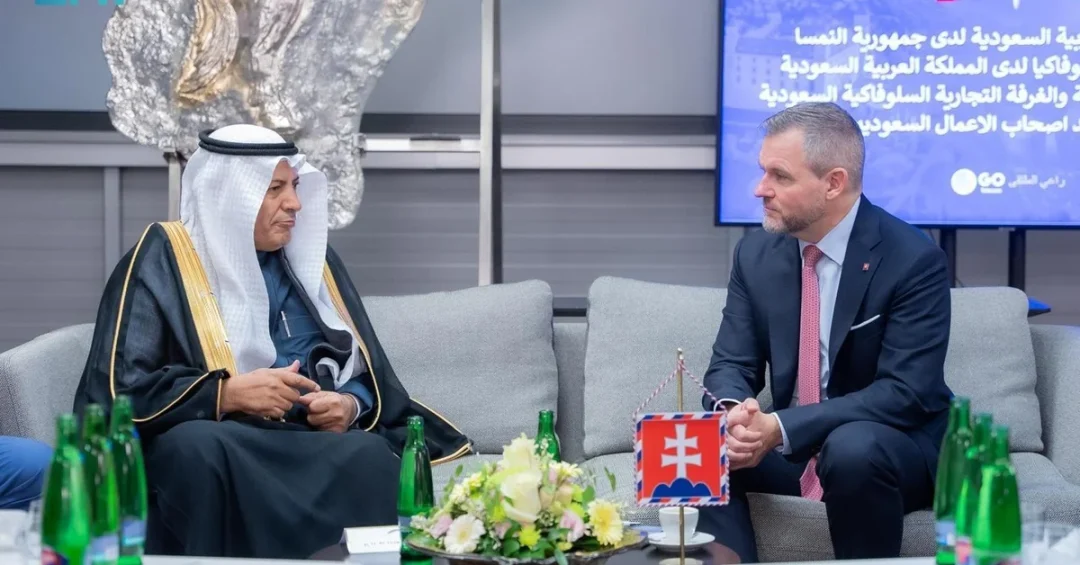
Slovak President Peter Pellegrini met in Bratislava on Thursday with Hassan bin Moejeb Al-Huwaizi, President of the Federation of Saudi Chambers, alongside a delegation of Saudi investors and representatives of governmental entities, in a visit designed to explore investment opportunities between the two countries. The meeting, reported by the Saudi Press Agency, culminated in the official launch of the Saudi-Slovak Joint Business Council, a structured platform intended to deepen trade and investment cooperation between the Kingdom of Saudi Arabia and the Slovak Republic. President Pellegrini underscored his country’s readiness to provide all necessary facilities and support for Saudi investors, expressing Slovakia’s keenness to strengthen ties with Saudi Arabia and its admiration for the Kingdom’s economic advancements, particularly in emerging non-oil sectors. Could this gathering in Bratislava mark the beginning of a broader Saudi investment footprint across Central Europe?
The visit reflects a widening pattern in Saudi Arabia’s international economic engagement, in which official delegations combine government diplomacy with private-sector deal-making. The Saudi delegation was led by the Federation of Saudi Chambers, the national body representing the Kingdom’s business community, and included investors as well as representatives of governmental entities. Their presence in Bratislava signals that Riyadh views Slovakia not only as a trading partner but as a gateway to the European single market. For a non-Saudi audience, the significance is straightforward: Saudi Arabia is systematically building institutional bridges with European economies, and the new Joint Business Council gives those bridges a permanent administrative structure rather than a one-off diplomatic moment.
Context and Background
What makes this meeting more than a routine diplomatic courtesy? The answer lies in the trajectory of Saudi-Slovak relations and the broader repositioning of the Kingdom’s economy. Trade between the two countries currently stands at around SAR1.8 billion, with the majority of that volume consisting of Slovak imports — a balance that Saudi officials clearly see as an opportunity rather than a limitation. The establishment of the Saudi-Slovak Joint Business Council is designed to address precisely that asymmetry by identifying sectors where Saudi exports, joint ventures, and reciprocal investment can grow.
The Federation of Saudi Chambers, under the leadership of Hassan bin Moejeb Al-Huwaizi, has become an increasingly visible instrument of the Kingdom’s economic diplomacy. Its delegations travel with a dual mandate: to explain the reforms underway inside Saudi Arabia and to connect Saudi companies with credible international partners. Al-Huwaizi used the Bratislava meeting to explain that the Kingdom’s ongoing economic developments aim to empower the private sector and improve the business environment to attract both local and international investments. That message — that Saudi Arabia is open for business and actively courting foreign capital — is one the Federation has carried to multiple capitals in recent years.
Slovakia, for its part, brings complementary strengths. As a member of the European Union and the eurozone, it offers Saudi investors access to European supply chains, a skilled industrial workforce, and a central geographic position linking Western and Eastern Europe. President Pellegrini’s explicit offer of facilities and support for Saudi investors indicates that Bratislava is prepared to compete for Gulf capital at a moment when Gulf sovereign and private investors are diversifying aggressively beyond traditional markets. Isn’t it notable that a European head of state would personally chair a meeting with a chamber delegation and frame his country as a service provider to Saudi business?
Key Details of the Bratislava Meeting
The centerpiece of the visit was the official launch of the Saudi-Slovak Joint Business Council. According to Abdulrahman bin Saleh Al-Otaishan, chairman of the Saudi-Slovak Business Council, the new body will devise strategies to capitalize on the comparative advantages of both countries, focusing on targeted economic sectors to boost trade and investments. That language is significant: it suggests a deliberate, sector-by-sector approach rather than a general aspiration to increase commerce. Comparative advantage, in this context, means matching Saudi capital, energy, and market access with Slovak engineering, manufacturing, and European regulatory familiarity.
President Pellegrini’s remarks emphasized Slovakia’s admiration for Saudi Arabia’s economic advancements, especially in emerging non-oil sectors. This is a notable diplomatic acknowledgment of the diversification drive at the heart of the Kingdom’s long-term strategy. The Slovak president also made clear that his government is ready to facilitate Saudi investment, a commitment that could translate into streamlined procedures, dedicated liaison channels, and targeted incentives. For Saudi investors evaluating European entry points, such political reassurance reduces perceived risk.
The delegation’s composition — investors plus representatives of governmental entities — indicates that the visit was structured to move quickly from introductions to implementation. Business councils of this kind typically establish working groups, exchange market intelligence, and organize follow-up missions in both directions. The Saudi side has consistently used these platforms to introduce investors to new markets while also inviting foreign firms to participate in Saudi giga-projects and sector development programs. Given that trade is currently weighted toward Slovak imports, the council’s early agenda is likely to include efforts to expand Saudi non-oil exports and to identify Slovak technologies that could be localized inside the Kingdom.
International and Regional Impact
How should observers outside the Kingdom interpret a meeting between a Saudi business delegation and a Central European head of state? One reading is that it demonstrates the geographic breadth of Saudi Arabia’s economic outreach. The Kingdom’s investment and trade diplomacy is no longer concentrated on traditional partners in Asia, North America, and the Gulf; it now extends into Central and Eastern Europe, a region with growing industrial capacity and strong interest in foreign direct investment. Slovakia’s position within the EU and the eurozone makes it an especially useful partner for companies seeking regulatory predictability.
For Europe, the meeting signals that Gulf capital remains welcome even amid broader global debates about investment screening and economic security. President Pellegrini’s public readiness to support Saudi investors suggests that Slovakia sees the relationship as mutually beneficial: Saudi investment can create jobs and upgrade infrastructure, while Slovak firms can gain access to one of the fastest-growing major economies in the Middle East. For the wider region, a successful Saudi-Slovak business council could serve as a template for similar arrangements with neighboring countries such as the Czech Republic, Austria, and Poland. Does that prospect make this small bilateral meeting a test case for Saudi economic diplomacy across the European Union?
Economic and Strategic Significance
The strategic logic of the visit rests on complementarity. Saudi Arabia is executing an unprecedented economic transformation, directing capital into new sectors including advanced manufacturing, logistics, tourism, renewable energy, and technology. Slovakia offers established industrial capabilities, particularly in automotive manufacturing, engineering, and research and development. A business council that maps these strengths against each other can generate joint ventures rather than simple buyer-seller transactions. Al-Huwaizi’s emphasis on empowering the private sector and improving the business environment is a direct appeal to Slovak companies to treat the Kingdom as a production and regional distribution base, not merely an export destination.
The current trade figure of approximately SAR1.8 billion provides a baseline against which the council’s performance can be measured. Because Slovak imports dominate the flow, there is substantial room for growth in both directions. Saudi non-oil exports — petrochemicals, plastics, metals, and increasingly manufactured goods — could find new buyers in Slovakia and its neighbors. At the same time, Slovak machinery, automotive components, and engineering services could support Saudi industrial projects. The Joint Business Council is expected to focus on targeted sectors, which implies a pragmatic prioritization of areas where deals can be closed and results measured. What better indicator of success could there be than a visible shift in the composition of bilateral trade over the next few years?
Vision 2030 Alignment
The Bratislava visit aligns directly with the objectives of Saudi Vision 2030, the national transformation program launched under the leadership of Crown Prince Mohammed bin Salman. Vision 2030 seeks to diversify the Kingdom’s economy away from oil dependence, expand the private sector’s contribution to GDP, and deepen international economic partnerships. The Federation of Saudi Chambers functions as a key enabler of that agenda by organizing the business community and projecting it abroad. The launch of the Saudi-Slovak Joint Business Council adds another institutional channel through which Saudi companies can access foreign markets and foreign partners can participate in the Kingdom’s growth story.
President Pellegrini’s praise for Saudi progress in non-oil sectors is a reminder that the Vision 2030 message is being received and acknowledged at the highest levels of European government. For international readers, the takeaway is that Saudi Arabia’s global role is expanding from energy supplier to investment partner, market, and diplomatic bridge-builder. The Kingdom’s leadership has consistently emphasized that its prosperity is intertwined with global stability and shared economic opportunity. As the new council begins its work, it will carry that message from Bratislava into the broader European arena — and, if successful, into a new era of Saudi-European commercial partnership. Isn’t that precisely the kind of forward-looking engagement Vision 2030 was designed to produce?
20 Questions
Q1. Who met with Slovak President Peter Pellegrini in Bratislava?
A1. President Pellegrini met with Hassan bin Moejeb Al-Huwaizi, President of the Federation of Saudi Chambers, along with Saudi investors and representatives of governmental entities, according to the Saudi Press Agency.
Q2. What was the main purpose of the Saudi delegation’s visit to Slovakia?
A2. The visit aimed to explore investment opportunities between Saudi Arabia and Slovakia and to strengthen trade and investment cooperation through official and private-sector engagement.
Q3. What major initiative was officially launched during the meeting?
A3. The meeting saw the official launch of the Saudi-Slovak Joint Business Council, a platform designed to enhance trade and investment cooperation between the two countries.
Q4. What did President Pellegrini say about supporting Saudi investors?
A4. He underscored Slovakia’s readiness to provide all necessary facilities and support for Saudi investors and expressed his country’s keenness to strengthen ties with the Kingdom.
Q5. How did President Pellegrini describe Saudi Arabia’s economic progress?
A5. He expressed admiration for Saudi Arabia’s economic advancements, especially in emerging non-oil sectors, reflecting international recognition of the Kingdom’s diversification efforts.
Q6. What did Hassan Al-Huwaizi say about Saudi Arabia’s economic developments?
A6. Al-Huwaizi explained that the Kingdom’s ongoing economic developments aim to empower the private sector and improve the business environment to attract both local and international investments.
Q7. Who is the chairman of the Saudi-Slovak Business Council?
A7. Abdulrahman bin Saleh Al-Otaishan is the chairman of the Saudi-Slovak Business Council, which was launched during the Bratislava meeting.
Q8. What will the Saudi-Slovak Business Council focus on?
A8. The council will devise strategies to capitalize on the comparative advantages of both countries, focusing on targeted economic sectors to boost trade and investments.
Q9. What is the current value of trade between Saudi Arabia and Slovakia?
A9. Trade between the two countries currently stands at around SAR1.8 billion, with the majority of the volume consisting of Slovak imports into the Kingdom.
Q10. Why is Slovakia an attractive partner for Saudi investors?
A10. Slovakia is a member of the European Union and the eurozone, offering access to European supply chains, a skilled industrial workforce, and a central geographic position in Europe.
Q11. How does this visit fit into Saudi Arabia’s broader economic strategy?
A11. It reflects Saudi Arabia’s systematic effort to build institutional bridges with European economies and to diversify international partnerships in line with Vision 2030 objectives.
Q12. What sectors might benefit from increased Saudi-Slovak cooperation?
A12. Potential sectors include advanced manufacturing, automotive components, engineering, research and development, petrochemicals, logistics, and renewable energy, among others.
Q13. What does the launch of the Joint Business Council mean for bilateral relations?
A13. It gives Saudi-Slovak economic relations a permanent administrative structure, moving cooperation beyond one-off diplomatic meetings toward sustained, sector-focused commercial engagement.
Q14. How does the meeting reflect Saudi Arabia’s Vision 2030 goals?
A14. The visit supports Vision 2030’s aims of diversifying the economy, empowering the private sector, and deepening international economic partnerships beyond the oil sector.
Q15. What role does the Federation of Saudi Chambers play in this context?
A15. The Federation represents the Kingdom’s business community and organizes delegations abroad, serving as a key enabler of Saudi economic diplomacy and private-sector internationalization.
Q16. Could this meeting lead to similar arrangements with other European countries?
A16. Yes, a successful Saudi-Slovak business council could serve as a template for similar arrangements with neighboring countries such as the Czech Republic, Austria, and Poland.
Q17. What message does President Pellegrini’s support send to other European leaders?
A17. It signals that Gulf investment remains welcome in Europe and that Saudi Arabia is viewed as a valued economic partner at the highest levels of European government.
Q18. How might the composition of bilateral trade change in the future?
A18. With the council’s sector-focused approach, Saudi non-oil exports and joint ventures could grow, gradually balancing a trade relationship currently weighted toward Slovak imports.
Q19. What is the significance of Saudi investors meeting a European head of state directly?
A19. It demonstrates the high level of political attention Saudi economic engagement now receives in Europe and reduces perceived risk for investors considering new markets.
Q20. What is the expected next step after the Bratislava meeting?
A20. The Joint Business Council is expected to establish working groups, exchange market intelligence, and organize follow-up missions to translate the meeting’s commitments into concrete trade and investment deals.
Reader Feedback
We value your thoughts. Please share your feedback on this article.
Your feedback helps us improve our coverage.
Related articles
 SAUDIA Wins Best Airline Cabin Crew Award in Miami
 Saudi Arabia and Tajikistan Sign Agreement to Establish Joint Business Council
 Manga Productions Signs Deal for Dynasty Warriors: Origins
 Saudi Auditors Take ‘From Riyadh to the World’ to Moscow
 Aramco, Linde, SLB Sign Deal for Major CCS Hub
 Saudia, Air France-KLM Sign MoU to Localize MRO