


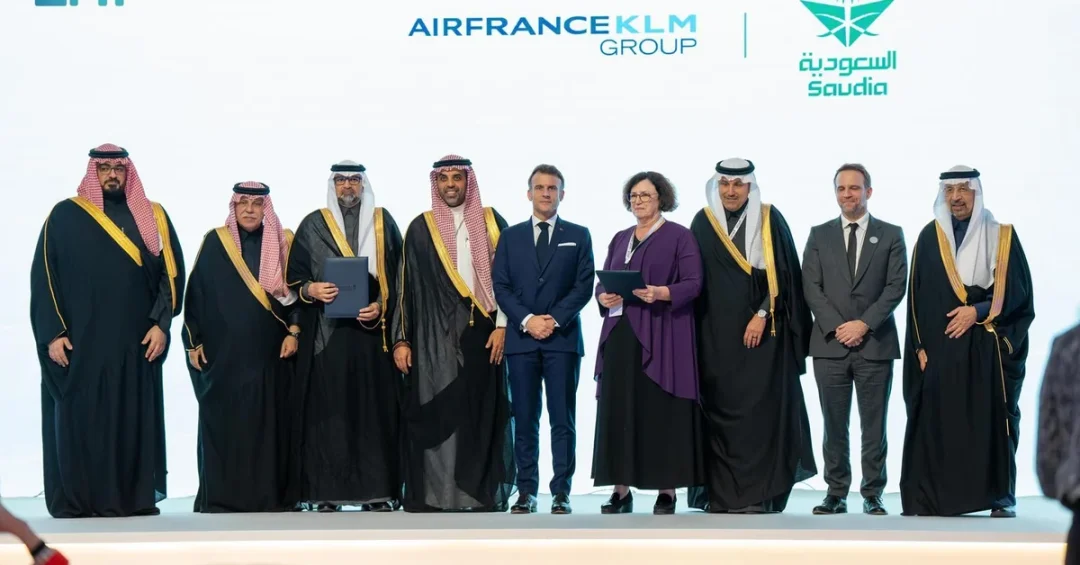
Saudia, the national flag carrier of Saudi Arabia, signed a memorandum of understanding with Air France-KLM during the Saudi-French Investment Forum in Riyadh, aiming to expand and localize maintenance, repair, and overhaul capabilities within the Kingdom. The agreement was formalized in the presence of French President Emmanuel Macron, Chairman of Saudi Arabian Airlines Corporation Eng. Saleh Al-Jasser, and Director General of Saudia Group Eng. Ibrahim Al-Omar, underscoring the strategic importance of the partnership to both nations. The MoU was signed by Saudia Technic Managing Director Capt. Fahd Cynndy and Air France-KLM Engineering and Maintenance Executive Vice President Anne Brachet, marking a pivotal step in enhancing Saudia’s technical operations and deepening aviation sector ties.
Could this collaboration redefine the Kingdom’s position in the global aviation maintenance industry? The agreement, announced via the Saudi Press Agency, reflects Saudi Arabia’s broader ambitions to localize high-value industrial capabilities and strengthen its aviation ecosystem in line with Vision 2030. It also signals growing international confidence in Saudi Arabia’s aviation sector, which has undergone rapid transformation under the Saudi Aviation Strategy led by the General Authority of Civil Aviation. The partnership between Saudia and Air France-KLM is expected to generate new opportunities for skills development, technology transfer, and operational excellence, while supporting the Kingdom’s goal of becoming a regional hub for aviation services.
Context and Background
Why does localizing MRO capabilities matter for Saudi Arabia’s long-term economic diversification? Maintenance, repair, and overhaul services are a critical component of the aviation value chain, representing a multi-billion-dollar global market. By developing domestic MRO capacity, Saudi Arabia aims to capture a larger share of this market, reduce reliance on foreign service providers, and create high-skilled jobs for its citizens. Saudia Technic, the technical arm of Saudia Group, has already established significant local capabilities, including servicing CFM LEAP-1A engines used on Airbus A320neo family aircraft. The new MoU with Air France-KLM builds on this foundation by adding GE90 engine module assembly and disassembly—engines that power Boeing 777 aircraft—to the local portfolio.
The agreement stipulates that Saudia will award a firm minimum of 50% of GE90 work orders to Air France-KLM in return for localizing the process, a mechanism designed to ensure knowledge transfer and operational parity. Furthermore, the two parties will explore the possibility of establishing a joint venture for GEnx engines, which are used on Boeing 787 aircraft. This phased approach reflects a carefully structured strategy to gradually build indigenous expertise while maintaining international standards. The collaboration also extends to commercial operations, with plans to enhance the codeshare agreement between Saudia and Air France-KLM, both members of the SkyTeam alliance. This includes expanded mutual codesharing on a wider range of domestic and international routes, increasing connectivity and frequency for passengers.
How does this agreement fit into the broader Saudi-French investment relationship? The Saudi-French Investment Forum served as a platform to showcase the deepening economic ties between the two countries, with aviation emerging as a key pillar of cooperation. France has longstanding expertise in aerospace and aviation maintenance, and Air France-KLM Engineering and Maintenance is recognized as a global leader in the field. By partnering with such an established player, Saudia gains access to best practices, advanced technologies, and a proven operational framework. In turn, Air France-KLM secures a strategic foothold in the rapidly growing Saudi aviation market, which is projected to expand significantly as the Kingdom pursues ambitious tourism and economic diversification goals.
Key Details
What specific components does the MoU cover, and how will they be implemented? The agreement focuses on two major engine types: the GE90, which powers Boeing 777 aircraft, and the GEnx, used on Boeing 787 aircraft. For the GE90, Saudia will handle module assembly and disassembly locally, while awarding at least 50% of work orders to Air France-KLM to facilitate the localization process. This arrangement ensures that Saudia Technic can build its capabilities incrementally, with Air France-KLM providing technical support and oversight. For the GEnx, the two parties will explore the establishment of a joint venture, which could further expand Saudi Arabia’s MRO footprint and create a dedicated center of excellence for next-generation engine maintenance.
On the commercial side, the MoU aims to strengthen the codeshare agreement between Saudia and Air France-KLM, both of which are SkyTeam members. The expanded codesharing will cover a broader range of domestic and international routes, increasing connectivity and frequency for travelers. Additionally, the agreement supports Saudia’s efforts to optimize its operations at Paris Charles de Gaulle airport, enhancing efficiency and the guest experience. This dual focus on technical and commercial cooperation reflects a holistic approach to partnership, leveraging synergies across maintenance and passenger services. The MoU also underscores Saudia’s commitment to increasing local content and fostering local talent, aligning with the objectives of Saudi Vision 2030 to build a thriving national economy.
Who are the key leaders behind this agreement, and what have they said about its significance? Eng. Ibrahim Al-Omar, Director General of Saudia Group, described the agreement as a reflection of the visionary leadership of the Saudia Group Board, led by Chairman Eng. Saleh Al-Jasser, who also serves as Minister of Transport and Logistic Services. Al-Omar noted that the partnership aligns with the Saudi Aviation Strategy spearheaded by the General Authority of Civil Aviation and demonstrates Saudia’s commitment to advancing the Kingdom’s aviation sector. Benjamin Smith, CEO of Air France-KLM, described Saudia as a long-standing partner and emphasized that in the context of Saudi Arabia’s rapid development, both parties see mutual benefit in expanding commercial cooperation and combining expertise, particularly in technical maintenance. Smith highlighted that Air France-KLM Engineering and Maintenance is a leader in the field, and the collaboration will unlock new opportunities in the Kingdom and the region.
International and Regional Impact
How will this partnership influence the broader Middle Eastern aviation landscape? The Middle East is one of the fastest-growing aviation markets in the world, driven by rising passenger demand, expanding fleets, and ambitious national strategies. By localizing MRO capabilities, Saudi Arabia positions itself as a competitive player in the region’s maintenance sector, which has traditionally been dominated by hubs in the United Arab Emirates and Qatar. The collaboration with Air France-KLM brings European expertise and global standards to the Kingdom, potentially attracting other international partners and customers to Saudi MRO facilities. This could lead to increased intra-regional cooperation and elevate the Kingdom’s status as a center for aviation services.
What does this mean for global aviation supply chains? The MoU reflects a broader trend of strategic partnerships between national carriers and global MRO providers, aimed at optimizing costs, improving turnaround times, and ensuring supply chain resilience. For Air France-KLM, the agreement provides access to a growing market and a opportunity to expand its engineering and maintenance footprint beyond Europe. For Saudia, it offers a pathway to self-reliance in critical engine maintenance, reducing downtime and enhancing operational efficiency. As global aviation recovers and expands, such collaborations are likely to become more common, particularly in regions with ambitious aviation growth strategies. The Saudi-French partnership could serve as a model for other countries seeking to develop local MRO capabilities while benefiting from international expertise.
Economic and Strategic Significance
Why is this agreement economically significant for Saudi Arabia? The MRO industry generates substantial revenue and employment, and localizing these services allows Saudi Arabia to retain value within its borders. By capturing a share of the GE90 and potentially GEnx maintenance work, Saudia Technic can generate income, reduce foreign exchange outflows, and create skilled jobs for Saudi nationals. The agreement also supports the growth of a domestic aerospace supply chain, as local suppliers and service providers may become integrated into the MRO ecosystem. This aligns with Vision 2030’s goal of diversifying the economy away from oil and developing high-value industrial sectors. Furthermore, enhanced MRO capabilities can attract airlines from across the region to service their engines in Saudi Arabia, positioning the Kingdom as a regional MRO hub.
What strategic benefits does the partnership offer beyond economics? Strategically, the MoU strengthens Saudi-French relations and reinforces the Kingdom’s role as a reliable partner in global aviation. It also enhances Saudia’s operational resilience by reducing dependence on external MRO providers, which can be subject to capacity constraints and geopolitical uncertainties. The collaboration with Air France-KLM, a leading European aviation group, signals confidence in Saudi Arabia’s regulatory environment, infrastructure, and workforce. Additionally, the commercial codeshare expansion improves connectivity for passengers traveling between Saudi Arabia and Europe, supporting tourism and business travel. This is particularly important as the Kingdom aims to attract 150 million visitors by 2030 and establish itself as a global tourism destination.
Vision 2030 Alignment
How does this MoU align with the goals of Saudi Vision 2030? Vision 2030 seeks to diversify the economy, develop local talent, and enhance the Kingdom’s global competitiveness. The localization of MRO capabilities directly supports these objectives by building a knowledge-intensive industry, creating high-skilled employment, and increasing local content. Saudia Group’s commitment to fostering local talent is evident in its efforts to train Saudi engineers and technicians in advanced maintenance techniques. The partnership with Air France-KLM facilitates knowledge transfer and skills development, ensuring that Saudi professionals gain expertise in cutting-edge engine maintenance. This contributes to the long-term sustainability of the Kingdom’s aviation sector and its ability to innovate and grow.
What does the future hold for Saudi Arabia’s aviation ambitions? The agreement is part of a broader transformation of the Saudi aviation sector, which includes the expansion of Saudia’s fleet, the development of new airports, and the growth of domestic and international routes. The Saudi Aviation Strategy aims to triple passenger traffic by 2030, and localizing MRO is a critical enabler of that growth. By building world-class maintenance capabilities, Saudi Arabia can support its airlines’ expansion, reduce operational costs, and attract international carriers to its MRO facilities. The partnership with Air France-KLM is a testament to the Kingdom’s ability to forge strategic international alliances that drive mutual prosperity. As Vision 2030 progresses, such collaborations will continue to play a vital role in positioning Saudi Arabia as a global aviation powerhouse and a hub for innovation and excellence.
20 Questions
Q1. What is the purpose of the MoU signed between Saudia and Air France-KLM?
A1. The MoU aims to expand and localize maintenance, repair, and overhaul (MRO) capabilities in Saudi Arabia, enhancing Saudia’s technical operations and fostering stronger ties between the two aviation groups.
Q2. Where and when was the MoU signed?
A2. The MoU was signed during the Saudi-French Investment Forum in Riyadh on December 4, 2024, in the presence of French President Emmanuel Macron and senior Saudi officials.
Q3. Who signed the agreement on behalf of Saudia and Air France-KLM?
A3. Saudia Technic Managing Director Capt. Fahd Cynndy and Air France-KLM Engineering and Maintenance Executive Vice President Anne Brachet signed the MoU.
Q4. Which engine types are covered under the MoU?
A4. The MoU covers GE90 engines used on Boeing 777 aircraft and explores a joint venture for GEnx engines used on Boeing 787 aircraft.
Q5. What does the MoU say about GE90 work orders?
A5. Saudia will award a firm minimum of 50% of GE90 work orders to Air France-KLM in return for localizing the module assembly and disassembly process.
Q6. What are the commercial aspects of the agreement?
A6. The agreement enhances the codeshare between Saudia and Air France-KLM, expands mutual codesharing on domestic and international routes, and supports optimization at Paris Charles de Gaulle airport.
Q7. How does this MoU benefit Saudia’s technical operations?
A7. It adds GE90 module assembly and disassembly to Saudia’s local MRO capabilities, building on existing CFM LEAP-1A engine services and potentially adding GEnx joint venture.
Q8. What did Eng. Ibrahim Al-Omar say about the agreement?
A8. He said it reflects the visionary leadership of the Saudia Group Board, aligns with the Saudi Aviation Strategy, and demonstrates commitment to advancing the Kingdom’s aviation sector.
Q9. What did Benjamin Smith say about the partnership?
A9. He described Saudia as a long-standing partner and noted that the collaboration will unlock new opportunities in the Kingdom and the region, particularly in technical maintenance.
Q10. How does this agreement support Saudi Vision 2030?
A10. It supports Vision 2030 by localizing high-value MRO capabilities, increasing local content, fostering local talent, and contributing to economic diversification and job creation.
Q11. What is the significance of localizing MRO capabilities for Saudi Arabia?
A11. Localizing MRO allows Saudi Arabia to capture more value from the aviation value chain, reduce foreign exchange outflows, create skilled jobs, and enhance operational resilience.
Q12. How does the partnership affect Saudi-French relations?
A12. It strengthens economic and strategic ties between Saudi Arabia and France, showcasing mutual benefits in aviation and supporting broader bilateral cooperation.
Q13. What role does Saudia Technic play in this agreement?
A13. Saudia Technic, the technical arm of Saudia Group, will handle module assembly and disassembly of GE90 engines locally and potentially participate in a GEnx joint venture.
Q14. What are the benefits for Air France-KLM?
A14. Air France-KLM gains access to the growing Saudi aviation market, secures a minimum of 50% of GE90 work orders, and expands its MRO footprint in the region.
Q15. How will the codeshare expansion affect passengers?
A15. Passengers will benefit from increased connectivity and frequency on a wider range of domestic and international routes between Saudi Arabia and Europe.
Q16. What is the Saudi Aviation Strategy?
A16. The Saudi Aviation Strategy, spearheaded by the General Authority of Civil Aviation, aims to triple passenger traffic, expand airport capacity, and develop the Kingdom as a global aviation hub by 2030.
Q17. What other MRO capabilities does Saudia currently have?
A17. Saudia Technic currently services CFM LEAP-1A engines used on Airbus A320neo family aircraft, among other maintenance activities.
Q18. How does this MoU contribute to job creation in Saudi Arabia?
A18. By localizing MRO work, the agreement creates high-skilled jobs for Saudi engineers and technicians, supporting the development of a knowledge-based economy.
Q19. What is the expected timeline for establishing the GEnx joint venture?
A19. The MoU explores the possibility of a joint venture, but no specific timeline has been announced; further studies and agreements will determine the next steps.
Q20. What does this partnership mean for the future of Saudi aviation?
A20. It positions Saudi Arabia as a rising MRO hub, enhances Saudia’s operational capabilities, and supports Vision 2030 goals of economic diversification and global competitiveness in aviation.
Reader Feedback
We value your thoughts. Please share your feedback on this article.
Your feedback helps us improve our coverage.
Related articles
 SABIC Chief Calls for Global Collaboration to Advance Sustainability Efforts
 Riyadh Airports Wins Best Talent Management Strategy Award in Middle East
 Saudi-US Business Forum Boosts Vision 2030 Trade Ties
 SEC Signs $3.6 Billion International Financing Deal
 GCC Arbitration Centre, Sports Law Body Sign Deal
 Tarshid, SAL Logistics Sign Energy Efficiency Agreement