


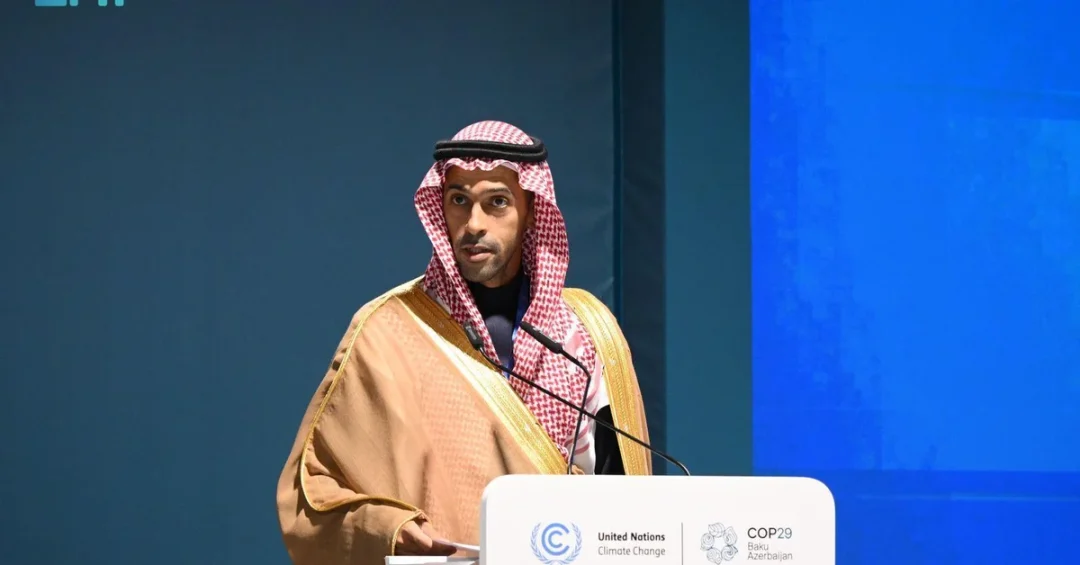
Saudi Arabia used COP29 Tourism Day in Baku to press the case that travel and tourism can be a driver of climate action rather than a bystander, with the Kingdom’s Vice Minister of Strategic Planning and Monitoring at the Ministry of Tourism, Ageel Alshaibani, telling a ministerial gathering that the sector has a unique opportunity to lead on sustainable development. Alshaibani participated in the Ministerial Meeting on Enhanced Climate Action in Tourism, organized by the COP29 Presidency, and hosted a side event titled “Tourism, Climate Action and the Sustainable Development Goals (SDGs)” at Saudi Arabia’s National Pavilion, according to a press release issued by the Ministry of Tourism.
The ministerial meeting was convened by the COP29 Presidency alongside UN Tourism, the State Tourism Agency of Azerbaijan and the United Nations Environment Programme (UNEP), drawing ministers and high-level officials from more than 30 countries to discuss how tourism policies and practices can be aligned with climate goals. For Saudi Arabia, the session was an opportunity to translate a domestic modernization agenda into a global platform, presenting the Saudi Sustainable Tourism Global Center (STGC) as a mechanism that can help governments, businesses and communities move from pledges to measurable outcomes. Can a sector that connects people across borders also become a leading force in protecting the planet? Saudi officials used the Baku stage to argue that it can, provided that sustainability is embedded in planning, investment and operations rather than treated as an afterthought.
Context and Background
Tourism has long been treated as a beneficiary of globalization rather than a central player in the climate debate. That perception is changing as the sector’s economic weight becomes impossible to ignore. According to the World Travel and Tourism Council, global tourism is projected to contribute $11.1 trillion to the global economy in 2024, exceeding pre-pandemic levels. With small and medium enterprises making up 80% of the sector and women representing around 40% of its workforce, tourism is also a rare engine of inclusive growth, particularly in developing economies where alternative employment opportunities are limited.
Yet the same sector carries an environmental footprint that cannot be wished away. Aviation, hospitality, ground transport and the construction of resorts all generate emissions and place pressure on biodiversity and local resources. The Ministerial Meeting on Enhanced Climate Action in Tourism was designed to confront that tension directly, bringing together policymakers from more than 30 countries to explore how national tourism strategies can support, rather than undermine, climate commitments. Is it possible to expand travel while reducing its environmental cost? The discussions in Baku suggest that the answer depends on the speed at which the industry adopts shared standards, transparent measurement and practical tools for decarbonization.
Saudi Arabia arrived at COP29 with an established position on that question. The Kingdom has been building a tourism sector from a relatively small base as part of its Vision 2030 economic diversification program, and it has chosen to frame that expansion around sustainability from the outset. The STGC, launched by HRH the Crown Prince and to be headquartered in Riyadh, was conceived as a multi-country, multi-stakeholder organization dedicated to tracking and supporting the industry’s shift toward sustainable practices. Its mandate covers governments, industry leaders, academia and civil society, with the aim of addressing the sector’s environmental footprint, protecting biodiversity and uplifting tourism-dependent communities.
Key Details
In his remarks, Alshaibani highlighted the importance of aligning tourism with climate and sustainability objectives and detailed how the STGC initiative will drive what the ministry described as a critical transformation. “Tourism has a unique opportunity to lead in advancing sustainable development,” he said. “Through STGC, we are committed to creating a tourism sector that contributes positively to the environment, strengthens local communities, and provides a model for responsible growth. Our initiatives are designed to empower governments, businesses, and communities alike to take bold steps toward a sustainable future for tourism.”
The vice minister also pointed to concrete Saudi projects that he said demonstrate what is achievable when sustainability is prioritized in tourism and infrastructure development. NEOM, the zero-carbon megacity with 95% of its land reserved for nature, was cited as one example. Red Sea Global’s pledge to carbon neutrality and zero waste to landfills was another. The upcoming King Salman International Airport, designed to meet LEED Platinum standards, was presented as a third benchmark. “These projects show what can be achieved when sustainability is prioritized in tourism and infrastructure development,” Alshaibani said.
Beyond individual projects, the ministry’s release emphasized that Saudi Arabia’s efforts through the STGC extend beyond domestic initiatives. The center is intended to offer resources, facilitate partnerships and develop tools that countries and organizations can use to reduce the environmental impact of tourism and promote long-term sustainability. Alshaibani also underscored the economic dimension of the transition, noting that sustainable practices are critical not only for environmental preservation but also for economic resilience and job creation. “The stakes have never been higher,” he remarked. “Our collective actions today will shape the future of tourism and its role in achieving the Sustainable Development Goals. STGC stands ready to support, innovate, and lead the way.”
International and Regional Impact
The Baku ministerial meeting reflected a broader shift in how multilateral climate diplomacy treats tourism. By convening ministers and senior officials from more than 30 countries, the COP29 Presidency, UN Tourism, the State Tourism Agency of Azerbaijan and UNEP signaled that the sector now belongs in the mainstream of climate negotiations rather than on the margins. For countries whose economies depend heavily on visitors, that recognition matters because it opens the door to financing, technical assistance and policy coordination that were previously directed elsewhere.
Saudi Arabia’s role in that process carries particular weight in the Middle East and beyond. The Kingdom is both a major source market for outbound travel and an emerging destination investing heavily in new infrastructure, which gives it credibility when it argues that growth and sustainability can be pursued together. Its willingness to host the STGC in Riyadh positions the city as a convening point for global tourism governance, a role that complements the Kingdom’s broader diplomatic and economic engagement. Will other governments follow with comparable commitments of their own? The coming years of implementation will test whether the momentum generated in Baku translates into national policies and investment decisions.
Economic and Strategic Significance
The economic logic behind sustainable tourism is straightforward, even if execution is complex. A sector that generates $11.1 trillion globally and employs a workforce in which women hold around 40% of jobs cannot be decarbonized without significant investment, but neither can it be allowed to degrade the natural and cultural assets on which it depends. For small and medium enterprises, which represent 80% of tourism businesses, sustainability standards can be a barrier or an opportunity depending on the support available. The STGC’s stated purpose is to provide that support through resources, partnerships and practical tools.
For Saudi Arabia, the strategic significance runs deeper. Tourism is one of the pillars of Vision 2030, the national program designed to diversify the economy away from hydrocarbon dependence, create jobs for a young population and raise the Kingdom’s global profile. Demonstrating that this expansion can be delivered responsibly strengthens the credibility of the wider reform agenda. It also creates commercial opportunities in green construction, renewable energy, waste management and digital monitoring systems, areas where Saudi companies and international partners can collaborate.
Vision 2030 Alignment
The STGC sits at the intersection of two Vision 2030 ambitions: building a world-class tourism sector and positioning Saudi Arabia as a responsible global actor. The center’s multi-country, multi-stakeholder design reflects the Kingdom’s preference for coalition-building over unilateral action, and its Riyadh headquarters will give Saudi institutions a permanent platform for shaping international standards. Projects such as NEOM, Red Sea Global and King Salman International Airport are intended to serve as proof points that the model works at scale.
As the global tourism industry continues its recovery and expansion, the decisions taken at COP29 and in the years that follow will determine whether the sector’s growth curve bends toward sustainability. Saudi Arabia has made clear that it intends to be an active participant in that effort, using the STGC to convene, measure and support progress. “Our collective actions today will shape the future of tourism and its role in achieving the Sustainable Development Goals,” Alshaibani said. The Kingdom’s message in Baku was that the travel and tourism sector can help address climate change, and that it is ready to help lead the way.
20 Questions
Q1. What event did Saudi Arabia participate in at COP29?
A1. Saudi Arabia participated in the Ministerial Meeting on Enhanced Climate Action in Tourism at COP29 in Baku, and hosted a side event titled “Tourism, Climate Action and the Sustainable Development Goals” at its National Pavilion.
Q2. Who represented Saudi Arabia at the COP29 tourism meetings?
A2. Vice Minister of Strategic Planning and Monitoring at the Ministry of Tourism Ageel Alshaibani represented the Kingdom, delivering remarks and hosting the Saudi side event at the National Pavilion.
Q3. What is the Saudi Sustainable Tourism Global Center?
A3. The STGC is a multi-country, multi-stakeholder organization launched by Saudi Arabia and to be headquartered in Riyadh, dedicated to advancing sustainable practices across the global tourism industry.
Q4. Who launched the STGC?
A4. The center was launched by HRH the Crown Prince as a platform to track and support the tourism industry’s progress toward sustainable practices and environmental stewardship.
Q5. What countries attended the ministerial meeting?
A5. Ministers and high-level officials from more than 30 countries gathered at the meeting, which was hosted by the COP29 Presidency, UN Tourism, the State Tourism Agency of Azerbaijan and UNEP.
Q6. What did Alshaibani say about tourism and sustainable development?
A6. He said tourism has a unique opportunity to lead in advancing sustainable development, and that through STGC Saudi Arabia is committed to a sector that contributes positively to the environment and strengthens communities.
Q7. Which Saudi projects were highlighted at COP29?
A7. Alshaibani cited NEOM, the zero-carbon megacity with 95% of its land reserved for nature, Red Sea Global’s carbon neutrality and zero-waste pledge, and King Salman International Airport’s LEED Platinum design.
Q8. What is NEOM’s environmental commitment?
A8. NEOM is described as a zero-carbon megacity with 95% of its land reserved for nature, serving as an example of how sustainability can be embedded in large-scale urban development.
Q9. What has Red Sea Global pledged?
A9. Red Sea Global has pledged carbon neutrality and zero waste to landfills, positioning its tourism developments as models for responsible destination management.
Q10. What standard will King Salman International Airport meet?
A10. The upcoming King Salman International Airport is designed to meet LEED Platinum standards, reflecting Saudi Arabia’s aim to set new benchmarks for sustainable aviation infrastructure.
Q11. How large is the global tourism economy?
A11. According to the World Travel and Tourism Council, global tourism is projected to contribute $11.1 trillion to the global economy in 2024, exceeding pre-pandemic levels.
Q12. What share of tourism businesses are SMEs?
A12. Small and medium enterprises make up 80% of the tourism sector, according to the ministry’s release, making their participation essential to any credible sustainability transition.
Q13. What share of the tourism workforce is made up of women?
A13. Women represent around 40% of the tourism workforce, which the ministry cited as evidence that sustainable tourism can support inclusive growth and empower communities worldwide.
Q14. What tools will the STGC provide?
A14. The center will offer resources, facilitate partnerships and develop tools for countries and organizations to reduce tourism’s environmental impact and promote long-term sustainability.
Q15. Who can collaborate with the STGC?
A15. The STGC welcomes collaboration with governments, businesses, academia and civil society, according to the Ministry of Tourism’s press release.
Q16. Why does sustainable tourism matter for jobs?
A16. Alshaibani noted that sustainable practices are critical not only for environmental preservation but also for economic resilience and job creation across tourism-dependent communities.
Q17. What did Alshaibani say about the stakes?
A17. He said the stakes have never been higher, and that collective actions today will shape the future of tourism and its role in achieving the Sustainable Development Goals.
Q18. How does the STGC relate to Vision 2030?
A18. The STGC supports Vision 2030’s goals of diversifying the economy, building a world-class tourism sector and positioning Saudi Arabia as a responsible global actor in multilateral forums.
Q19. Where will the STGC be headquartered?
A19. The center will be headquartered in Riyadh, giving Saudi institutions a permanent platform for shaping international sustainable tourism standards and partnerships.
Q20. What is the broader message of Saudi Arabia’s COP29 participation?
A20. Saudi Arabia’s message is that travel and tourism can help address climate change when sustainability is prioritized, and that the Kingdom stands ready to support, innovate and lead the way.
Reader Feedback
We value your thoughts. Please share your feedback on this article.
Your feedback helps us improve our coverage.
Related articles
 Saudi Tourism Minister Meets Hail Investors, Unveils SAR1B Plan
 Elephant Rock: AlUla’s Natural Marvel Draws Global Visitors
 Minister Inaugurates Ramlah Tourism Company in Hail
 Spooky Circus at Wonder District Delights Visitors in Jeddah
 Saudi Red Sea Authority Wins Japan Tourism Award
 Rainbows in Al-Baha Draw Nature Lovers to Saudi’s South