


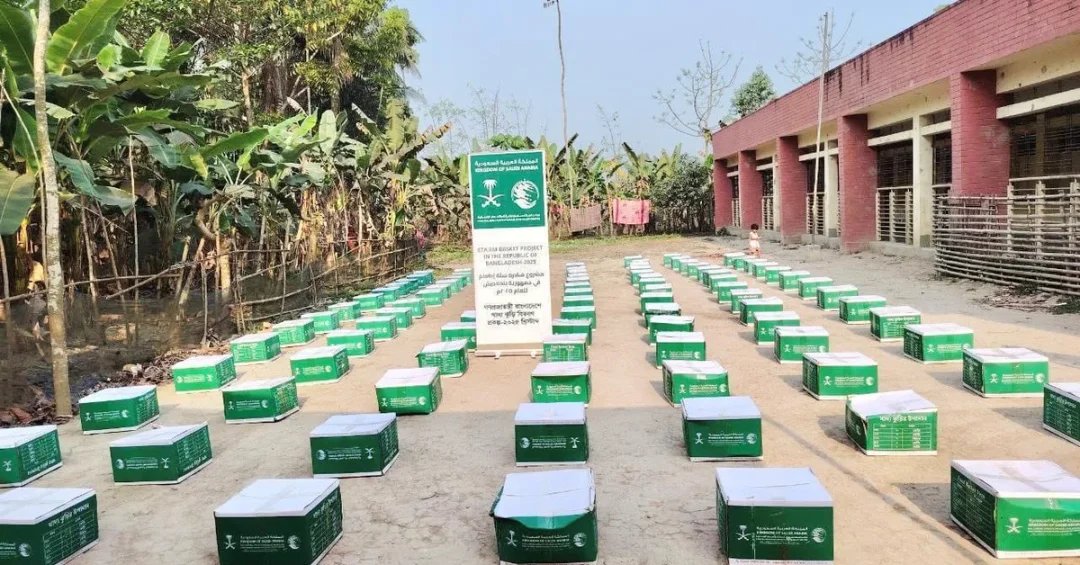
The King Salman Humanitarian Aid and Relief Centre (KSrelief) distributed 100 food baskets in the Jashore District of Bangladesh on Saturday, providing essential provisions to 500 individuals from 100 families as part of the “Etaam” Ramadan Food Basket Distribution Project for the year 1446 AH. The distribution was carried out under the supervision of the Saudi Embassy in Bangladesh and in coordination with local authorities, continuing the Kingdom’s long-standing tradition of extending humanitarian support to vulnerable communities around the world.
The “Etaam” project, whose name means “food” in Arabic, is one of KSrelief’s flagship Ramadan initiatives, designed to ensure that families in need can observe the holy month with dignity and adequate nutrition. The distribution in Jashore, one of Bangladesh’s most populous districts, reflects the Kingdom’s commitment to alleviating hardship among Muslim communities and other vulnerable populations globally. The aid reached families who had been identified by local partners as among the most in need, including widows, orphans, and households affected by economic hardship.
Context and Background
Why does Saudi Arabia continue to be one of the world’s leading humanitarian donors, and what drives the Kingdom’s commitment to assisting communities thousands of miles from its borders? The answer lies in the deep-rooted values of Islamic solidarity and generosity that have guided Saudi Arabia’s foreign assistance for decades. The King Salman Humanitarian Aid and Relief Centre, established in 2015 by royal decree, serves as the Kingdom’s primary humanitarian arm, operating in more than 80 countries and implementing thousands of projects in food security, health, shelter, and education.
Bangladesh, home to more than 170 million people, has been a significant partner of Saudi Arabia in humanitarian and development cooperation. The country faces challenges including periodic flooding, cyclones, and economic pressures that affect vulnerable communities, particularly in rural districts such as Jashore. Ramadan, the ninth month of the Islamic calendar, is a time when Muslims fast from dawn to sunset, and providing food baskets to families in need during this period carries special significance. The “Etaam” project is specifically designed to address food insecurity during this holy month, ensuring that families can break their fast with nutritious meals.
The Jashore distribution is part of a broader KSrelief effort that has seen similar Ramadan food basket projects implemented across Asia, Africa, and the Middle East. In Bangladesh alone, KSrelief has conducted multiple aid distributions in recent years, including food, medical, and shelter assistance, often in partnership with the Saudi Embassy in Dhaka and local charitable organizations. These efforts are closely aligned with Saudi Arabia’s Vision 2030, which emphasizes the Kingdom’s role as a responsible global actor and its commitment to sustainable development and humanitarian leadership.
Key Details of the Jashore Distribution
How does KSrelief ensure that aid reaches the most deserving families in remote areas like Jashore? The distribution process relies on careful coordination with local authorities, community leaders, and charitable organizations that help identify beneficiaries based on transparent criteria. In Jashore, the 100 families selected to receive the food baskets were identified through a needs assessment conducted by local partners, ensuring that the aid goes to those facing the greatest hardship. Each food basket typically contains staple items such as rice, lentils, cooking oil, sugar, and dates, sufficient to support a family for a significant portion of the month.
The distribution event was attended by representatives of the Saudi Embassy in Bangladesh and local officials, who oversaw the handover of the baskets to the beneficiary families. The atmosphere was one of gratitude and solidarity, as recipients expressed their appreciation for the Kingdom’s timely assistance. For many families, the food baskets represent not only material support but also a reminder of the bonds of brotherhood that connect Saudi Arabia with Muslim communities worldwide. The “Etaam” project operates under the direct guidance of the Saudi leadership, which has consistently prioritized humanitarian outreach as a cornerstone of the Kingdom’s foreign policy.
KSrelief’s work in Bangladesh is part of a wider portfolio of projects in the country, including health care, education, and water sanitation initiatives. The Kingdom has also supported Bangladesh through the Saudi Fund for Development, which has financed infrastructure and energy projects. These combined efforts reflect a comprehensive approach to partnership that goes beyond emergency relief, focusing on long-term development and capacity building. The Jashore food basket distribution, while a relatively small operation in terms of scale, exemplifies the precision and care that KSrelief brings to its humanitarian work.
International and Regional Impact
What does Saudi Arabia’s humanitarian outreach in South Asia signal about its broader role in the Muslim world and beyond? The Kingdom’s consistent aid to countries like Bangladesh reinforces its position as a global humanitarian leader and a reliable partner for development. In a region where food insecurity remains a pressing concern, particularly during Ramadan, Saudi assistance provides immediate relief while also strengthening diplomatic and cultural ties. The distribution in Jashore is a tangible expression of the Kingdom’s soft power, built on generosity and shared faith rather than political conditionality.
International organizations, including the United Nations and its affiliated agencies, have repeatedly recognized KSrelief’s contributions to global humanitarian efforts. The centre has been a key partner in responding to crises in Yemen, Syria, Sudan, and the Gaza Strip, among other regions. By extending its reach to Bangladesh, KSrelief demonstrates that its mandate is truly global, encompassing communities in Asia, Africa, and beyond. This approach aligns with the principles of the Organisation of Islamic Cooperation (OIC), which has called for increased solidarity among member states to address humanitarian challenges.
The Jashore distribution also highlights the role of Saudi diplomacy in fostering goodwill at the grassroots level. While high-level agreements and summits often dominate headlines, it is initiatives like the “Etaam” project that directly touch the lives of ordinary people, creating lasting impressions of Saudi Arabia as a compassionate and engaged nation. For Bangladesh, which maintains strong ties with the Kingdom, such assistance reinforces a relationship that spans trade, labor, and cultural exchange. Saudi Arabia is home to a large Bangladeshi expatriate community, and these humanitarian gestures further cement the bonds between the two peoples.
Economic and Strategic Significance
How does Saudi Arabia’s humanitarian spending align with its economic and strategic objectives under Vision 2030? The Kingdom’s foreign aid is not merely charitable; it is a strategic investment in stability, goodwill, and sustainable development. By supporting food security in vulnerable communities, Saudi Arabia contributes to reducing the risk of instability and displacement, which in turn supports regional and global security. Vision 2030 emphasizes the importance of Saudi Arabia’s role as a pivotal player in the global economy and a responsible member of the international community, and humanitarian work is a key pillar of that vision.
Furthermore, KSrelief’s operations are conducted with a high degree of transparency and efficiency, often in partnership with reputable international and local organizations. This ensures that resources are used effectively and that aid reaches those who need it most. The “Etaam” project, for instance, is implemented with clear logistical frameworks and monitoring mechanisms, reflecting the professional standards that Saudi Arabia has adopted in its humanitarian sector. These practices enhance the Kingdom’s reputation as a donor of choice and a model for others in the region.
From a strategic perspective, Saudi Arabia’s humanitarian engagement in Bangladesh and other Asian countries complements its economic and diplomatic outreach. The Kingdom is a major investor in South Asia and a key energy supplier, and its humanitarian work helps create a favorable environment for cooperation. By addressing immediate needs while also supporting long-term development, Saudi Arabia demonstrates a holistic approach that benefits both recipient communities and the Kingdom’s own international standing.
Vision 2030 Alignment
How does a food basket distribution in a Bangladeshi district connect to Saudi Arabia’s ambitious Vision 2030 reform agenda? At its core, Vision 2030 seeks to transform Saudi Arabia into a more diversified, outward-looking economy and a global leader in humanitarian and development efforts. The Kingdom’s humanitarian outreach, spearheaded by KSrelief, is a direct reflection of the vision’s emphasis on social responsibility, international cooperation, and the promotion of moderate, compassionate Islam. By supporting vulnerable populations worldwide, Saudi Arabia reinforces its role as a stabilizing force and a bridge between cultures and nations.
As the Kingdom continues to expand its humanitarian footprint, initiatives like the “Etaam” project in Bangladesh will remain central to its global engagement. The distribution of 100 food baskets in Jashore may be a modest contribution in numerical terms, but it carries profound meaning for the families who received them and for the enduring friendship between Saudi Arabia and Bangladesh. Under the leadership of the Custodian of the Two Holy Mosques, King Salman bin Abdulaziz Al Saud, and His Royal Highness Crown Prince Mohammed bin Salman, Saudi Arabia is committed to extending a helping hand to those in need, wherever they may be. This commitment is not only a moral duty but also a reflection of the Kingdom’s proud heritage and its forward-looking vision for a more prosperous and peaceful world.
20 Questions
Q1. What is the “Etaam” Ramadan Food Basket Distribution Project?
A1. The “Etaam” project is a KSrelief initiative that distributes food baskets to vulnerable families during the holy month of Ramadan. It operates in multiple countries, including Bangladesh, to ensure food security and support fasting families.
Q2. How many people benefited from the distribution in Jashore?
A2. The distribution in Jashore benefited 500 individuals from 100 families. Each family received a food basket containing essential items to support them during Ramadan.
Q3. When did the distribution take place?
A3. The distribution took place on Saturday, March 15, 2025, corresponding to the 15th of Ramadan 1446 AH. It was part of the ongoing “Etaam” project in Bangladesh.
Q4. Who implemented the food basket distribution?
A4. The distribution was implemented by the King Salman Humanitarian Aid and Relief Centre (KSrelief), in coordination with the Saudi Embassy in Bangladesh and local authorities.
Q5. What items are typically included in a KSrelief food basket?
A5. KSrelief food baskets generally include staple items such as rice, lentils, cooking oil, sugar, flour, and dates. The contents are designed to meet the nutritional needs of a family for an extended period.
Q6. Why was Jashore District chosen for this distribution?
A6. Jashore District was chosen based on a needs assessment that identified vulnerable families facing food insecurity. It is one of several districts in Bangladesh where KSrelief operates.
Q7. How does KSrelief select the beneficiaries?
A7. KSrelief works with local partners and community leaders to identify beneficiaries using transparent criteria, focusing on widows, orphans, the elderly, and families affected by economic hardship.
Q8. Is this the first time KSrelief has distributed aid in Bangladesh?
A8. No, KSrelief has a history of humanitarian work in Bangladesh, including food, health, and shelter projects. The “Etaam” project is part of ongoing efforts during Ramadan.
Q9. What is the role of the Saudi Embassy in these distributions?
A9. The Saudi Embassy in Bangladesh oversees and facilitates the distributions, ensuring coordination with local authorities and adherence to KSrelief’s standards. Embassy officials often attend the events.
Q10. How does this project align with Saudi Vision 2030?
A10. The project aligns with Vision 2030 by showcasing Saudi Arabia’s commitment to global humanitarian leadership, social responsibility, and international cooperation, which are key pillars of the vision.
Q11. How many countries does KSrelief operate in?
A11. KSrelief operates in more than 80 countries around the world, implementing projects in food security, health, education, shelter, and water sanitation, among other sectors.
Q12. What is the significance of distributing food during Ramadan?
A12. Distributing food during Ramadan holds special religious and cultural significance, as it helps families observe the holy month with dignity. It reflects Islamic values of charity and solidarity.
Q13. Are there other Saudi humanitarian projects in Bangladesh?
A13. Yes, Saudi Arabia supports Bangladesh through various channels, including KSrelief and the Saudi Fund for Development, which finance health, education, and infrastructure projects.
Q14. How does KSrelief ensure transparency in its operations?
A14. KSrelief follows strict monitoring and evaluation procedures, often partnering with reputable local and international organizations. It publishes reports on its activities to ensure accountability.
Q15. What is the total value of the food baskets distributed?
A15. The specific value of the baskets was not disclosed, but each basket contains essential food items sufficient to support a family for a significant portion of Ramadan.
Q16. Who attended the distribution event in Jashore?
A16. The event was attended by representatives from the Saudi Embassy in Bangladesh, KSrelief field staff, and local officials, who helped organize and oversee the distribution to the beneficiary families.
Q17. How can other organizations partner with KSrelief?
A17. Organizations interested in partnering with KSrelief can contact the centre through its official channels. KSrelief collaborates with UN agencies, NGOs, and local charities.
Q18. What is the impact of such distributions on Saudi-Bangladesh relations?
A18. These distributions strengthen bilateral ties by demonstrating Saudi Arabia’s commitment to the people of Bangladesh. They complement existing cooperation in trade, labor, and culture.
Q19. Does KSrelief focus only on Muslim communities?
A19. No, KSrelief’s humanitarian aid is provided to all people in need, regardless of religion, ethnicity, or nationality. Its projects benefit diverse communities worldwide.
Q20. What is the long-term goal of the “Etaam” project?
A20. The long-term goal is to alleviate food insecurity during Ramadan and to promote sustainable development by supporting vulnerable families. It is part of Saudi Arabia’s broader humanitarian strategy.
Reader Feedback
We value your thoughts. Please share your feedback on this article.
Your feedback helps us improve our coverage.
Related articles
 Al-Haditha Welcomes Umrah Performers for Ramadan
 GCC: Syria Reconstruction a Regional Necessity, Albudaiwi Says
 Saudi Arabia Weather Forecast for Tuesday: Rain, Dust, and Sea Conditions
 Prophet’s Mosque Welcomes 14 Million in Ramadan
 5.5-Magnitude Earthquake Strikes Indonesia’s North Sumatra
 Volunteer Registration Open for Last 10 Days of Ramadan at Two Holy Mosques