


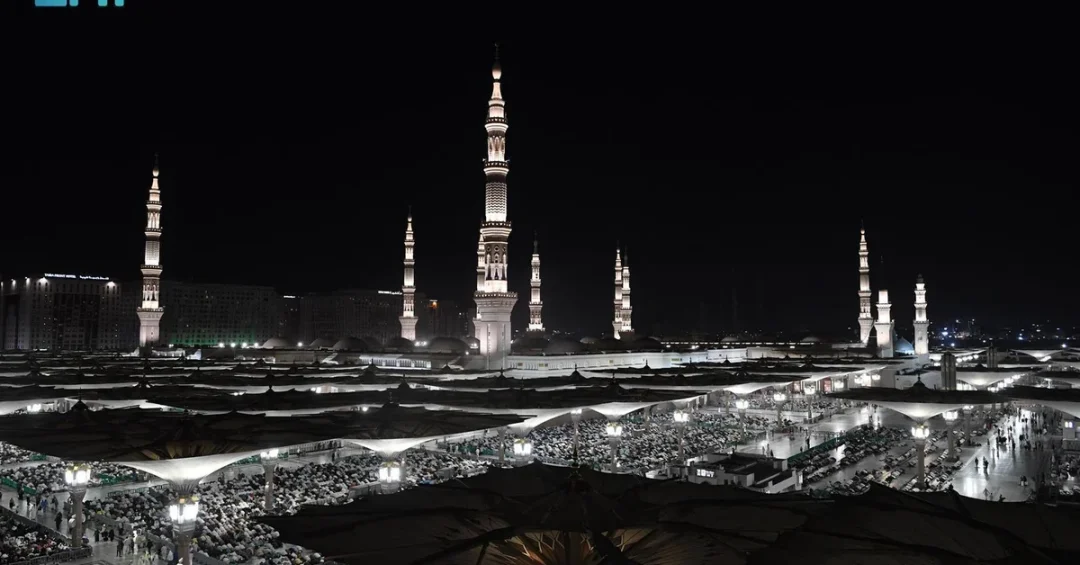
The ten minarets of the Prophet’s Mosque in Madinah stand as one of the most recognizable architectural and spiritual landmarks in the Islamic world, rising above the mosque’s expansive courtyards and carrying the call to prayer across the city five times each day. According to information released by the Saudi Press Agency (SPA), these towering structures reflect more than fourteen centuries of continuous devotion, architectural refinement, and careful stewardship by the Kingdom of Saudi Arabia. Each minaret serves a practical religious function while embodying an Islamic identity that welcomes millions of worshippers and visitors from every corner of the globe each year.
For pilgrims arriving in Madinah, the sight of the minarets is often their first impression of the mosque’s grandeur. The structures vary in height and design, yet they harmonize into a single visual composition that has become inseparable from the identity of the holy city. Their presence is not merely decorative; it is a living reminder of how the Muslim community has organized its worship since the earliest days of Islam, and how Saudi Arabia has preserved that tradition through successive phases of expansion and restoration. Have you ever considered how a simple call to prayer shaped the skyline of one of the world’s most visited religious sites?
Context and Background
During the time of the Prophet Mohammed (PBUH) and his rightly guided caliphs, the Prophet’s Mosque had no minarets at all. Instead, the call to prayer was made from an elevated place within or near the mosque grounds. According to SPA, Bilal ibn Rabah used to call the Fajr (dawn) prayer from the rooftop of a house belonging to a woman from the Banu Najjar tribe. This early practice illustrates how the Muslim community adapted existing structures to fulfill the religious obligation of announcing prayer times to the faithful.
The need to call the Adhan from a high place led Muslims to move it from the mosque’s ground level to the rooftops of nearby houses, then to the roof of the Prophet’s Mosque with added elevation, and eventually to the construction of minarets at varying heights. This organic evolution reflects a practical response to a growing congregation rather than a purely aesthetic ambition. Over the centuries, as the mosque expanded and the number of worshippers increased, the architecture of the call to prayer developed alongside it. Does it surprise you that the first Adhan at the mosque was delivered not from a tower, but from a simple rooftop?
The historical record shows that minarets were added gradually, with each generation of Muslim rulers contributing to the mosque’s development. This continuity of care is a defining feature of the Prophet’s Mosque, which has never been abandoned or left in disrepair. Instead, it has been continuously maintained, expanded, and enhanced to accommodate the growing number of pilgrims performing Hajj and Umrah, as well as residents of Madinah who attend daily prayers.
Key Details
As the expansions of the Prophet’s Mosque continued, the late King Abdulaziz Al Saud carried out the first improvements between 1370 and 1375 AH. During this period, he retained the two minarets on the southern side of the mosque and removed the other three, replacing them with two new minarets at the northern corners, each standing 70 meters tall and consisting of four stories. This decision marked the beginning of a new architectural chapter, one that balanced historical preservation with the practical needs of a rapidly growing congregation.
The first story of these minarets is square-shaped, extending above the mosque’s roof and ending with muqarnas supporting a square balcony. The second story is octagonal, adorned with arches and triangular finishes, topped with muqarnas and a balcony. The third story is cylindrical, decorated with colored bands and muqarnas supporting a circular balcony. The fourth level is also cylindrical, featuring columns supporting arches that end in triangular shapes, crowned with muqarnas and a final balcony above. Each tier serves both a structural and an aesthetic purpose, creating a vertical rhythm that draws the eye upward toward the sky.
Between 1406 AH and 1414 AH, six additional minarets were built, each standing 104 meters tall, bringing the total to ten. These minarets were designed to harmonize with those from the first Saudi expansion, with four positioned on the northern side, one at the southeastern corner of the expansion, and another at its southwestern corner. The result is a unified architectural ensemble that respects the original design language while meeting the demands of a modern pilgrimage experience. Can you imagine the level of planning required to integrate new towers seamlessly with structures built decades earlier?
Each of the newer minarets consists of five stories. The first story is square-shaped. The second story is octagonal, with a diameter of 5.5 meters, covered in colored artificial stone. Each side features three white marble columns topped with arches that end in triangular shapes, with wooden windows between them. Muqarnas support an octagonal balcony. The third story is cylindrical, measuring 5 meters in diameter and 18 meters in height, painted dark gray and adorned with twelve prominent, wavy bands ending in muqarnas that support a circular balcony.
The fourth story is also cylindrical, with a diameter of 4.5 meters and a height of 15 meters. It features eight arches resting on white marble columns, topped with muqarnas supporting another circular balcony. The fifth story starts as a polygonal cylinder and ends with a serrated crown supporting a conical upper section, followed by an onion-shaped dome carrying a 6.7-meter-high, 4.5-ton bronze crescent, plated with 14-carat gold. These details, released through official Saudi channels, underscore the precision and craftsmanship invested in every element of the structure.
International and Regional Impact
The Prophet’s Mosque receives millions of visitors annually, making its minarets a point of global reference for Islamic architecture. For international audiences, they represent a tangible link between the earliest days of Islam and the modern Kingdom’s commitment to preserving religious heritage. The call to prayer that emanates from these towers is heard not only by those physically present in Madinah but also by viewers around the world through broadcasts and digital media, reinforcing the mosque’s status as a spiritual anchor for Muslims everywhere.
Regionally, the minarets contribute to the visual and cultural identity of Madinah, a city that Saudi Arabia has developed as a center of pilgrimage and Islamic scholarship. The Kingdom’s efforts to maintain and expand the mosque are part of a broader strategy to ensure that the growing number of pilgrims can be accommodated safely and comfortably. This includes investments in transportation, accommodation, and public services that support the Hajj and Umrah experience. How does the presence of such a landmark influence the way the world perceives Saudi Arabia’s role in the Islamic world?
The architectural harmony of the ten minarets also serves as a symbol of unity, bringing together different phases of construction under a single aesthetic vision. This approach reflects a broader principle in Saudi heritage management: respecting the past while embracing the future. Visitors from diverse cultural backgrounds can appreciate the craftsmanship without needing to understand the technical details, because the structures communicate a universal message of faith and dedication.
Economic and Strategic Significance
The Prophet’s Mosque is a central component of Saudi Arabia’s religious tourism sector, which contributes significantly to the national economy. The ten minarets, as iconic features of the mosque, help attract visitors who wish to experience the spiritual atmosphere of Madinah. This influx supports local businesses, hospitality services, and transportation networks, creating employment opportunities for Saudi citizens and residents. The Kingdom’s investment in maintaining these structures is therefore both a religious duty and an economic catalyst.
Strategically, the mosque’s development aligns with Saudi Arabia’s broader efforts to enhance the pilgrimage experience under Vision 2030. By improving infrastructure and preserving heritage sites, the Kingdom aims to increase the number of Umrah and Hajj pilgrims while ensuring that their journey is safe, dignified, and spiritually fulfilling. The minarets are not isolated monuments; they are part of an integrated system that includes crowd management, health services, and digital guidance for visitors. What role do you think heritage preservation plays in a nation’s economic diversification?
Furthermore, the technical specifications of the minarets, such as the 4.5-ton bronze crescent plated with 14-carat gold, demonstrate the high standards applied to religious architecture in Saudi Arabia. These elements are maintained by specialized teams who ensure that the structures remain in excellent condition despite the harsh desert climate. This ongoing maintenance is a testament to the Kingdom’s long-term commitment to the two holy mosques.
Vision 2030 Alignment
Saudi Arabia’s Vision 2030 emphasizes the importance of preserving cultural and religious heritage as part of the nation’s identity and future. The ten minarets of the Prophet’s Mosque exemplify this principle by combining historical continuity with modern engineering. The Kingdom’s leadership, under the guidance of the Custodian of the Two Holy Mosques, King Salman bin Abdulaziz Al Saud, and His Royal Highness Crown Prince Mohammed bin Salman, has consistently prioritized the care of the holy sites. This commitment ensures that future generations of Muslims will continue to hear the call to prayer from these towering structures.
As Saudi Arabia continues to welcome the world, the minarets stand as a welcoming signal, inviting worshippers to enter and pray. They are a reminder that the Kingdom’s global role extends beyond economics and diplomacy to the spiritual realm, where it serves as the custodian of Islam’s most sacred places. The next time the call to prayer echoes across Madinah, it will carry with it the legacy of centuries of devotion and the promise of a future where faith and progress walk hand in hand. Isn’t it remarkable how a structure built for a single purpose can come to represent so much more?
20 Questions
Q1. How many minarets does the Prophet’s Mosque have?
A1. The Prophet’s Mosque has ten minarets, according to official information from the Saudi Press Agency. This total was reached after the construction of six additional minarets between 1406 AH and 1414 AH, bringing the number from four to ten.
Q2. Did the Prophet’s Mosque have minarets during the time of the Prophet Mohammed (PBUH)?
A2. No, during the time of the Prophet Mohammed (PBUH) and his rightly guided caliphs, the mosque had no minarets. The call to prayer was made from an elevated place, such as the rooftop of a nearby house.
Q3. Who used to call the Fajr prayer from the rooftop of a house in the early days?
A3. Bilal ibn Rabah used to call the Fajr (dawn) prayer from the rooftop of a house belonging to a woman from the Banu Najjar tribe. This was before minarets were constructed.
Q4. When did the first Saudi expansion of the Prophet’s Mosque take place?
A4. The late King Abdulaziz Al Saud carried out the first improvements between 1370 and 1375 AH. During this period, he retained two minarets on the southern side and removed three others, replacing them with two new ones.
Q5. How tall were the minarets built during the first Saudi expansion?
A5. The two new minarets built at the northern corners during the first Saudi expansion each stood 70 meters tall and consisted of four stories. They featured square, octagonal, and cylindrical sections with muqarnas and balconies.
Q6. When were the six additional minarets constructed?
A6. The six additional minarets were built between 1406 AH and 1414 AH. Each stands 104 meters tall, bringing the total number of minarets at the Prophet’s Mosque to ten.
Q7. How are the ten minarets positioned around the mosque?
A7. According to SPA, four of the newer minarets are positioned on the northern side, one at the southeastern corner of the expansion, and another at its southwestern corner. This arrangement harmonizes with the earlier minarets.
Q8. What is the shape of the first story of the newer minarets?
A8. The first story of each newer minaret is square-shaped. It extends above the mosque’s roof and ends with muqarnas supporting a square balcony, following the design of the earlier minarets.
Q9. What are the dimensions of the second story of the newer minarets?
A9. The second story is octagonal with a diameter of 5.5 meters. It is covered in colored artificial stone, and each side features three white marble columns topped with arches and wooden windows.
Q10. What is the height and diameter of the third story?
A10. The third story is cylindrical, measuring 5 meters in diameter and 18 meters in height. It is painted dark gray and adorned with twelve prominent, wavy bands ending in muqarnas that support a circular balcony.
Q11. What are the features of the fourth story of the minarets?
A11. The fourth story is cylindrical with a diameter of 4.5 meters and a height of 15 meters. It features eight arches resting on white marble columns, topped with muqarnas supporting another circular balcony.
Q12. What is at the top of each minaret?
A12. The fifth story starts as a polygonal cylinder and ends with a serrated crown supporting a conical section. This is followed by an onion-shaped dome carrying a 6.7-meter-high, 4.5-ton bronze crescent plated with 14-carat gold.
Q13. What is the weight and material of the crescent atop the minarets?
A13. The crescent atop each minaret is made of bronze, weighs 4.5 tons, and is 6.7 meters high. It is plated with 14-carat gold, reflecting the high standards of craftsmanship in the mosque’s architecture.
Q14. How do the minarets reflect Islamic architectural heritage?
A14. The minarets feature a blend of square, octagonal, and cylindrical stories, decorated with muqarnas, arches, and balconies. This design language has evolved over centuries and represents a distinct Islamic architectural identity.
Q15. Why are the minarets important for the call to prayer?
A15. The minarets provide an elevated platform from which the Adhan can be heard across the city. Historically, the call was made from rooftops, but minarets allowed the sound to carry farther as the congregation grew.
Q16. How does the Prophet’s Mosque serve international visitors?
A16. The mosque welcomes millions of pilgrims and visitors annually from around the world. The minarets are often the first landmark they see, and the call to prayer is broadcast globally through various media.
Q17. What role does Saudi Arabia play in maintaining the minarets?
A17. Saudi Arabia, under its leadership, has undertaken successive expansions and restoration projects to preserve the mosque. The Kingdom’s commitment ensures the minarets remain in excellent condition for future generations.
Q18. How does the design of the minarets harmonize different construction phases?
A18. The newer minarets were designed to match the style of those from the first Saudi expansion. This creates a unified visual composition despite being built in different eras, reflecting careful planning and respect for heritage.
Q19. What is the significance of the minarets for Vision 2030?
A19. Vision 2030 emphasizes preserving cultural and religious heritage while enhancing the pilgrimage experience. The minarets symbolize this balance, supporting religious tourism and showcasing Saudi Arabia’s role as custodian of the holy sites.
Q20. How can visitors learn more about the minarets?
A20. Visitors can learn about the minarets through official Saudi sources, including the Saudi Press Agency and information provided at the mosque. These channels offer accurate details about the architecture, history, and ongoing preservation efforts.
Reader Feedback
We value your thoughts. Please share your feedback on this article.
Your feedback helps us improve our coverage.
Related articles
 Prince Mohammed bin Salman Project Restores Al-Abbasa Mosque
 Heritage Commission Concludes Third Season at AlSirrain Site
 Birth of a Place’ Installation Art Highlights Diriyah Heritage
 Ramadan Games Bridge Generations in Madinah
 KACCC Hosts Global Youth Gathering on Fasting Traditions
 Manga Productions Partners with Sela to Bring Japanese Brands to Riyadh Season