


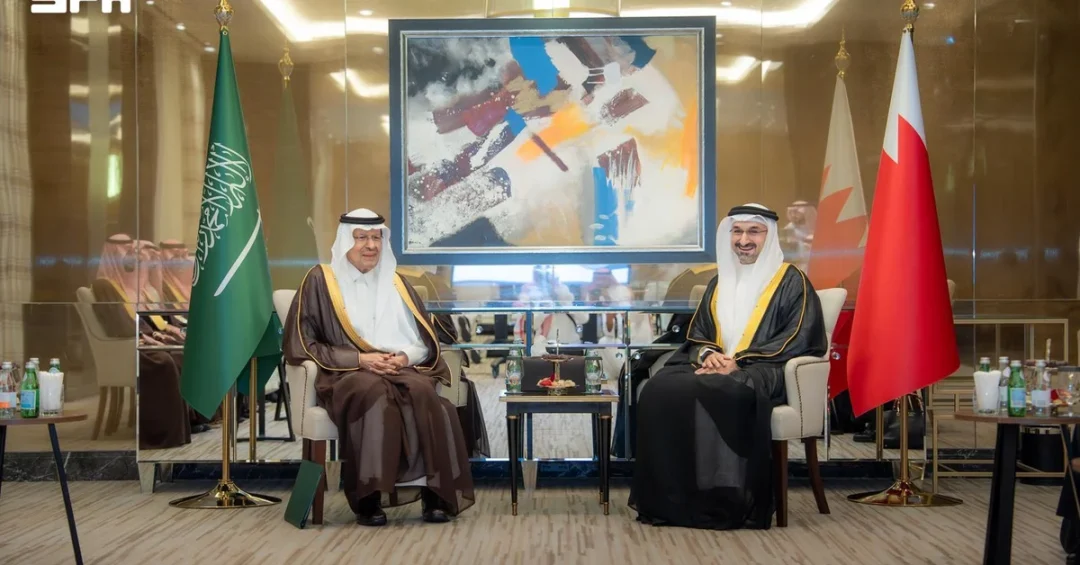
Saudi Minister of Energy and Minister of Industry and Mineral Resources Prince Abdulaziz bin Salman bin Abdulaziz met in Manama with Bahraini Minister of Industry and Commerce Abdulla bin Adel Fakhro to discuss ways to deepen industrial cooperation between the two brotherly countries. The meeting, reported by the Saudi Press Agency (SPA), took place on the sidelines of Prince Abdulaziz’s visit to the Kingdom of Bahrain, where he is leading the Saudi delegation to the 31st meeting of the Electricity and Water Cooperation Committee, the 37th meeting of the Petroleum Cooperation Committee, and the “Made in GCC” Forum and Exhibition.
The discussions addressed the continued development of bilateral economic relations, areas of joint cooperation in the industrial sector, and the latest developments in industrial integration between the two Gulf neighbors. The talks reflect a shared commitment to aligning industrial strategies in a manner that serves their mutual interests and strengthens the broader Gulf Cooperation Council (GCC) economic framework. For international observers, the meeting signals that Saudi Arabia’s industrial ambitions under Vision 2030 are increasingly pursued through regional partnerships rather than in isolation, with Bahrain positioned as a close and complementary industrial ally.
Context and Background
Why does a single ministerial meeting in Manama matter to a global audience tracking Gulf economic transformation? The answer lies in the scale and direction of Saudi industrial policy. Under Vision 2030, the Kingdom has set out to diversify its economy away from oil dependence, targeting a tripling of the industrial sector’s contribution to gross domestic product. Bahrain, for its part, has long served as a financial and logistics gateway in the Gulf, with a manufacturing base that complements Saudi Arabia’s larger resource and energy endowments. The two countries share a causeway, a customs union, and decades of coordinated policy within the GCC.
The Saudi-Bahraini relationship rests on more than geography. Both nations are founding members of the GCC and have aligned their economic visions through initiatives such as the Unified Economic Agreement and the GCC Industrial Cooperation Committee. Bahrain’s “Made in Bahrain” strategy and Saudi Arabia’s National Industrial Development and Logistics Program (NIDLP) both aim to boost local manufacturing, attract foreign investment, and create skilled jobs for young citizens. When Prince Abdulaziz bin Salman, who holds the energy portfolio as well as the industry and mineral resources brief, sits down with his Bahraini counterpart, the agenda inevitably touches on energy-intensive industries, petrochemicals, aluminum, and downstream manufacturing.
The timing is significant. Prince Abdulaziz’s visit coincides with three major GCC gatherings hosted in Bahrain: the 31st meeting of the Electricity and Water Cooperation Committee, the 37th meeting of the Petroleum Cooperation Committee, and the “Made in GCC” Forum and Exhibition. These platforms are designed to harmonize policies on power generation, water desalination, oil and gas, and industrial localization. The ministerial bilateral meeting therefore sits within a dense calendar of regional coordination, reinforcing the message that Saudi Arabia views Gulf integration as a cornerstone of its own economic resilience.
Key Details of the Manama Meeting
According to the official SPA report, the meeting between Prince Abdulaziz bin Salman and Minister Abdulla bin Adel Fakhro focused on “ways to enhance industrial cooperation between the two brotherly countries.” The discussions covered the development of bilateral economic relations, joint cooperation in the industrial sector, and the latest developments in industrial integration. The use of the term “brotherly countries” is standard in Saudi official communications and reflects the deep fraternal ties between the two kingdoms, but it also carries practical weight: it signals a relationship built on trust, shared security, and long-term strategic alignment.
Prince Abdulaziz holds a dual mandate as Minister of Energy and Minister of Industry and Mineral Resources, a combination that places him at the intersection of Saudi Arabia’s energy transition and its industrial diversification. His Bahraini counterpart, Abdulla bin Adel Fakhro, oversees the Ministry of Industry and Commerce, the government body responsible for Bahrain’s industrial strategy, trade promotion, and commercial regulation. The pairing of these two portfolios is deliberate: energy and industry are intertwined in the Gulf, where cheap and reliable power has historically underpinned aluminum smelting, petrochemical production, and cement manufacturing.
The meeting took place on the sidelines of the “Made in GCC” Forum and Exhibition, an event that showcases locally manufactured products from across the six-member bloc. Such forums are not merely ceremonial. They provide a venue for companies to sign supply agreements, for regulators to compare standards, and for ministers to identify bottlenecks in cross-border trade. For Saudi Arabia, participation in the “Made in GCC” initiative aligns with the broader Vision 2030 goal of increasing non-oil exports and integrating Saudi industry into regional value chains.
Industrial Integration: What It Means in Practice
What does “industrial integration” actually look like when two neighboring Gulf states pursue it seriously? In the Saudi-Bahraini context, integration spans several concrete areas. First, there is the aluminum sector: Bahrain’s Alba is one of the world’s largest aluminum smelters, and Saudi Arabia has its own aluminum projects as part of its mining and metals strategy. Coordinating on raw materials, energy supply, and export logistics could reduce costs for both. Second, petrochemicals: Saudi Arabia’s vast hydrocarbon reserves feed a sophisticated chemicals industry, while Bahrain has historically relied on Saudi crude for its refinery. Downstream cooperation can extend into plastics, fertilizers, and specialty chemicals.
Third, there is the power and water sector. The 31st meeting of the Electricity and Water Cooperation Committee, held alongside the bilateral talks, addresses the interconnection of Gulf power grids and the sharing of desalination expertise. Saudi Arabia and Bahrain are already linked by electricity interconnectors, and further integration could improve reliability and enable the exchange of renewable energy. As Saudi Arabia builds out solar and wind capacity, Bahrain could benefit from surplus clean power, while Saudi Arabia gains a partner in managing peak demand. These are the practical, unglamorous details that make industrial integration real.
Fourth, there is the regulatory dimension. Harmonizing standards for manufactured goods, customs procedures, and investment rules reduces friction for companies operating across borders. The GCC has made progress on a customs union, but non-tariff barriers remain. Ministerial meetings like the one in Manama are where these issues are raised and, ideally, resolved. For international investors looking at the Gulf as a single market, such coordination lowers risk and expands the addressable market for any factory or distribution center.
International and Regional Impact
How will this meeting be read beyond the Gulf? For global energy markets, the Saudi-Bahraini energy relationship is a stabilizing factor. Bahrain is a modest oil and gas producer, but it sits astride key shipping routes and hosts the U.S. Fifth Fleet. A close Saudi-Bahraini alignment on energy policy reinforces the reliability of Gulf supply and the security of the Strait of Hormuz. For industrial exporters from Asia, Europe, and the Americas, the meeting signals that the GCC is gradually becoming a more integrated manufacturing and logistics hub, with Saudi Arabia as the anchor and Bahrain as a complementary node.
Regionally, the meeting is part of a broader pattern of Gulf reconciliation and economic diplomacy. Saudi Arabia has been strengthening ties with neighbors through the GCC framework, and Bahrain has been a consistent partner. The “Made in GCC” Forum itself is an assertion of regional identity in manufacturing, a counterpoint to global supply chain fragmentation. For other Arab states, the Saudi-Bahraini model of ministerial coordination offers a template: use bilateral meetings on the margins of multilateral gatherings to advance specific industrial projects, then bring those projects back to the GCC for wider adoption.
For the United States and European Union, both of which are pursuing de-risking strategies that involve Gulf partners, the deepening of Saudi-Bahraini industrial ties is a positive development. It suggests that Gulf states are building internal resilience and can serve as reliable suppliers of aluminum, petrochemicals, and other industrial inputs. It also creates opportunities for joint ventures with Western firms that bring technology and capital. In this sense, the Manama meeting is not just a bilateral event; it is a small but meaningful step in the evolution of the Gulf as a global industrial and energy player.
Economic and Strategic Significance
Why should investors and policymakers pay attention to a meeting that produced no major announcement? Because in the Gulf, incremental ministerial coordination often precedes larger deals. The Saudi-Bahraini industrial relationship is underpinned by the Saudi-Bahraini Business Council, joint investment funds, and cross-border infrastructure such as the King Fahd Causeway. When ministers discuss “industrial integration,” they are laying the groundwork for specific agreements on energy pricing, raw material supply, and joint export promotion. For companies in sectors like aluminum, petrochemicals, construction materials, and food processing, these discussions can translate into new market access and supply chain efficiencies.
Strategically, the meeting reinforces Saudi Arabia’s role as the economic engine of the GCC. Saudi Arabia accounts for roughly half of the GCC’s GDP and is the region’s largest market. Bahrain, with its smaller population and more diversified financial sector, benefits from access to Saudi markets and from Saudi investment. In return, Bahrain offers a business-friendly regulatory environment, a skilled bilingual workforce, and a strategic location for logistics. The complementarity is real, and the ministerial meeting is a mechanism for realizing it. For Saudi Arabia, closer industrial ties with Bahrain also support the Vision 2030 goal of increasing non-oil exports to GCC markets, which are among the most natural destinations for Saudi manufactured goods.
It is also worth noting that Prince Abdulaziz bin Salman’s leadership of both energy and industry portfolios allows for a holistic approach. Energy policy determines the cost and carbon intensity of industrial production; industry policy determines demand for energy and the shape of value chains. By coordinating both, Saudi Arabia can pursue industrial projects that are economically competitive and environmentally sustainable. Bahrain, which has committed to net-zero emissions by 2060, shares an interest in cleaner industrial processes. The Manama meeting therefore touches on the energy transition as much as it does on traditional manufacturing.
Vision 2030 Alignment
How does a bilateral meeting in Manama connect to Saudi Arabia’s Vision 2030? Directly and substantively. Vision 2030 aims to diversify the Saudi economy, and industrial development is one of its central pillars. The National Industrial Development and Logistics Program seeks to increase the industrial sector’s GDP contribution, boost non-oil exports, and attract foreign investment. Regional partnerships are essential to that strategy because they expand market size and enable economies of scale. Bahrain, as a fellow GCC member with a complementary industrial base, is a natural partner in this effort. The meeting between Prince Abdulaziz bin Salman and Minister Abdulla bin Adel Fakhro is thus a concrete example of Vision 2030 being implemented through diplomacy and economic statecraft.
Moreover, the meeting aligns with Vision 2030’s emphasis on regional leadership and global engagement. Saudi Arabia does not pursue industrialization in a vacuum; it seeks to be a hub for trade, investment, and innovation that connects three continents. By coordinating with Bahrain on industrial integration, the Kingdom strengthens the GCC as a bloc and enhances its own position as a regional leader. The “Made in GCC” Forum and Exhibition, held alongside the ministerial talks, showcases the collective industrial potential of the Gulf. For an international audience, the message is clear: Saudi Arabia is building a diversified, future-ready economy in partnership with its neighbors, and Vision 2030 is the roadmap guiding that transformation.
20 Questions
Q1. Who met in Manama to discuss industrial cooperation?
A1. Saudi Minister of Energy and Minister of Industry and Mineral Resources Prince Abdulaziz bin Salman bin Abdulaziz met with Bahraini Minister of Industry and Commerce Abdulla bin Adel Fakhro in Manama, according to the Saudi Press Agency.
Q2. When and where did the meeting take place?
A2. The meeting was held in Manama, the capital of Bahrain, on the sidelines of Prince Abdulaziz’s visit to the Kingdom of Bahrain. The SPA report was dated October 06, 2026.
Q3. What was the main purpose of the meeting?
A3. The main purpose was to discuss ways to enhance industrial cooperation between Saudi Arabia and Bahrain, covering bilateral economic relations, joint industrial cooperation, and the latest developments in industrial integration.
Q4. What other events was Prince Abdulaziz attending in Bahrain?
A4. He was leading the Saudi delegation to the 31st meeting of the Electricity and Water Cooperation Committee, the 37th meeting of the Petroleum Cooperation Committee, and the “Made in GCC” Forum and Exhibition.
Q5. What is the “Made in GCC” Forum and Exhibition?
A5. It is a regional event that showcases locally manufactured products from the six Gulf Cooperation Council member states, aimed at promoting industrial integration and intra-Gulf trade.
Q6. Which Saudi ministry does Prince Abdulaziz bin Salman lead?
A6. Prince Abdulaziz bin Salman serves as Minister of Energy and also as Minister of Industry and Mineral Resources, combining two key portfolios for Saudi economic diversification.
Q7. Who is Bahrain’s Minister of Industry and Commerce?
A7. Abdulla bin Adel Fakhro is the Bahraini Minister of Industry and Commerce, responsible for Bahrain’s industrial strategy, trade promotion, and commercial regulation.
Q8. Why is industrial integration important for Saudi Arabia and Bahrain?
A8. Industrial integration expands market size, enables economies of scale, reduces trade barriers, and helps both countries diversify their economies away from oil dependence.
Q9. What sectors are likely covered by Saudi-Bahraini industrial cooperation?
A9. Key sectors include aluminum, petrochemicals, downstream manufacturing, electricity and water, construction materials, and food processing, among others.
Q10. How does this meeting relate to the GCC framework?
A10. It is part of broader GCC coordination, held alongside GCC committee meetings and the “Made in GCC” Forum, reinforcing regional economic integration among the six member states.
Q11. What is the Electricity and Water Cooperation Committee?
A11. It is a GCC body that coordinates policies on power generation, grid interconnection, and water desalination among member states. Its 31st meeting was held during Prince Abdulaziz’s visit.
Q12. What is the Petroleum Cooperation Committee?
A12. It is a GCC committee that coordinates oil and gas policies among member states. Its 37th meeting took place alongside the bilateral Saudi-Bahraini talks in Manama.
Q13. How does this meeting support Saudi Vision 2030?
A13. Vision 2030 seeks economic diversification and industrial growth. Regional partnerships like this one expand markets for Saudi non-oil exports and support the National Industrial Development and Logistics Program.
Q14. What is the significance of the term “brotherly countries” in the SPA report?
A14. It reflects the deep fraternal ties and close strategic alignment between Saudi Arabia and Bahrain, a standard formulation in official Saudi communications.
Q15. Will this meeting lead to concrete agreements?
A15. The SPA report did not announce specific agreements, but such ministerial meetings typically lay the groundwork for future cooperation on energy pricing, raw materials, and joint export promotion.
Q16. How does Bahrain benefit from industrial cooperation with Saudi Arabia?
A16. Bahrain gains access to Saudi markets, investment, and energy resources, while leveraging its business-friendly environment and strategic location for logistics and manufacturing.
Q17. How does Saudi Arabia benefit from cooperation with Bahrain?
A17. Saudi Arabia gains a complementary industrial partner, access to Bahrain’s skilled workforce and financial sector, and a stronger, more integrated GCC market for its manufactured goods.
Q18. What is the King Fahd Causeway’s role in Saudi-Bahraini relations?
A18. The King Fahd Causeway physically connects Saudi Arabia and Bahrain, facilitating trade, tourism, and daily movement of people and goods, symbolizing their close economic ties.
Q19. What does this meeting mean for international investors?
A19. It signals that the GCC is becoming a more integrated manufacturing and logistics hub, potentially lowering risks and expanding market access for foreign firms investing in the region.
Q20. What is the forward-looking outcome of this meeting?
A20. The meeting reinforces Saudi-Bahraini industrial alignment, supports Vision 2030 diversification goals, and contributes to a more integrated Gulf economy capable of competing globally.
Reader Feedback
We value your thoughts. Please share your feedback on this article.
Your feedback helps us improve our coverage.
Related articles
 Saudi Ambassador Launches Sacrificial Meat Campaign in Lebanon
 Saudi FM Arrives in Atlanta for G20 Ministerial Meeting
 Arab Interior Ministers Council Condemns Houthi Attacks on Saudi Arabia
 Grand Mosque Sermon Stresses Heart’s Purity and Repentance
 Prophet’s Mosque Friday Sermon Draws Spiritual Lessons from Story of Prophet Joseph
 Coalition Intercepts Houthi UAV in Makkah Region