


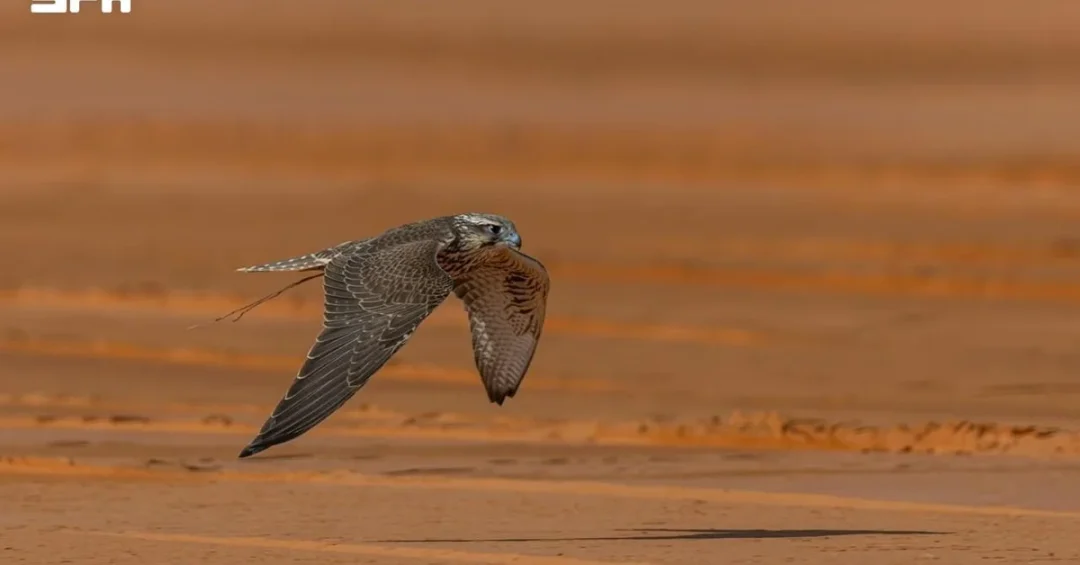
Elite and professional rounds of the Melwah Racing competition continued in Riyadh on October 6, 2026, as part of the International Saudi Falcons and Hunting Exhibition 2026, organized by the National Center for Falcons at the Riyadh Exhibition and Convention Center in Malham. The opening round for the three-quarter Gyr chick category saw falcon “707” take first place, followed by “117” in second and “299” in third. In the second round for the Hurr chick category, falcon “64” claimed first place, “Al-Nashmi” took second, and “38” came third, according to the Saudi Press Agency.
How did these elite rounds come to define a new era for Saudi Arabia’s most storied heritage sport? The elite and professional competitions, which conclude today with two rounds for the Gyr Shaheen chick and Gyr Taba’ chick categories, represent the pinnacle of a tournament that has grown into a global gathering for falconers, breeders, and enthusiasts. Participation is limited to falcons purchased from the International Falcon Breeders Auction, a rule that ties the racing directly to the exhibition’s auction and reinforces the event’s role as a marketplace for the world’s finest birds. Total prizes for this year’s 12 rounds amount to SAR723,000, distributed across six rounds for owners and amateurs and six for professionals and elites. The prize structure, announced by the National Center for Falcons, underscores the Kingdom’s commitment to preserving and elevating a practice that has been central to Arabian life for millennia.
Context and Background
What makes the International Saudi Falcons and Hunting Exhibition a landmark on the global falconry calendar? Organized by the National Center for Falcons, a government body dedicated to the preservation and development of falconry, the exhibition has become a platform where heritage meets modern competition. The event is held at the Riyadh Exhibition and Convention Center in Malham, a venue that has hosted numerous international gatherings and reflects the Kingdom’s growing capacity to stage world-class events. The Melwah Racing competition is a core component of the exhibition, offering a structured format that tests the speed and skill of falcons in controlled rounds. The competition is divided into categories that reflect different breeds and age groups, including the Gyr chick, Hurr chick, Gyr Shaheen chick, and Gyr Taba’ chick, each with its own dedicated rounds.
The National Center for Falcons has been instrumental in formalizing and promoting falconry as a competitive sport. By limiting participation to falcons purchased from the International Falcon Breeders Auction, the center ensures that the competition remains closely linked to the exhibition’s auction, which attracts breeders and buyers from around the world. This integration creates a cohesive ecosystem where breeding, trading, and racing reinforce one another. The SAR723,000 prize pool for this year’s 12 rounds is a testament to the seriousness with which the Kingdom treats this heritage sport. The distribution across six rounds for owners and amateurs and six for professionals and elites ensures that both seasoned competitors and newcomers have opportunities to excel. Such an approach aligns with the National Center for Falcons’ mission to nurture talent at all levels while maintaining the highest standards of competition.
Key Details
How do the specific results from the opening rounds illustrate the depth of competition? In the three-quarter Gyr chick category, falcon “707” secured first place, demonstrating the speed and agility that elite falcons are bred for. Falcon “117” took second, and “299” came third, with the margins between them reflecting the intense preparation undertaken by their owners. In the Hurr chick category, falcon “64” claimed first place, while “Al-Nashmi” took second and “38” came third. These results are not merely about individual birds; they represent the culmination of breeding programs, training regimens, and the expertise of falconers who have dedicated years to the sport. The fact that participation is restricted to falcons from the International Falcon Breeders Auction means that only the most promising birds, selected through a rigorous auction process, make it to the racing rounds.
The final day of the elite and professional competitions features two rounds: one for the Gyr Shaheen chick category and one for the Gyr Taba’ chick category. These categories are highly anticipated, as they often feature some of the fastest and most valuable falcons in the competition. The total prize money of SAR723,000 is distributed across the 12 rounds, with equal emphasis on amateur and professional tiers. This structure encourages broad participation and ensures that the competition remains accessible to a wide range of falconers. The National Center for Falcons has not only preserved the traditional aspects of Melwah racing but has also adapted it to contemporary expectations, with clear rules, transparent judging, and substantial rewards. The presence of international participants and spectators further elevates the event’s profile, making it a true global showcase for Saudi heritage.
International and Regional Impact
Why does the Melwah Racing competition resonate far beyond Saudi Arabia’s borders? The International Saudi Falcons and Hunting Exhibition attracts participants and visitors from across the Gulf, the wider Middle East, and beyond. Falconry is a shared heritage in many countries, and the exhibition serves as a meeting point for cultures that have long revered the falcon. By hosting the event, Saudi Arabia reinforces its role as a custodian of this heritage and a leader in its modern expression. The competition also has an economic dimension: the auction and related activities generate significant commercial activity, with falcons often changing hands for substantial sums. International breeders view the exhibition as a key opportunity to showcase their birds and connect with buyers from the region.
Regionally, the event strengthens ties among Gulf Cooperation Council states, many of which have their own falconry traditions and competitive circuits. The presence of falcons from different countries underscores the unity of purpose in preserving this ancient practice. For Saudi Arabia, the exhibition is also a soft power tool, projecting an image of a nation that honors its past while embracing modernity. The National Center for Falcons works year-round to develop the sport, and the exhibition is the culmination of those efforts. The media coverage generated by the event, including reports by the Saudi Press Agency, helps to spread awareness of Saudi Arabia’s cultural initiatives and its commitment to Vision 2030’s quality-of-life goals.
Economic and Strategic Significance
What economic value does falconry bring to the Kingdom, and how does it fit into the broader strategic picture? The falconry sector, including breeding, training, equipment, and tourism, contributes to Saudi Arabia’s economy in ways that are both direct and indirect. The International Falcon Breeders Auction, which is integral to the exhibition, is a major marketplace where millions of riyals change hands. The SAR723,000 prize pool for Melwah Racing is just one part of the financial ecosystem. Beyond the auction, the exhibition drives spending in hospitality, transport, and retail, benefiting the Riyadh region. It also creates jobs and supports small businesses involved in the care and training of falcons.
Strategically, falconry is a pillar of Saudi Arabia’s cultural diplomacy. It is a tradition that unites generations and provides a link between the Kingdom’s nomadic past and its urban present. By investing in events like the International Saudi Falcons and Hunting Exhibition, the government signals that heritage is not a relic but a living, evolving part of national identity. The National Center for Falcons operates under the guidance of the Ministry of Culture, which has made heritage preservation a priority. This aligns with Vision 2030’s aim to diversify the economy and promote cultural tourism. The exhibition also supports the goal of increasing domestic and international tourism, as visitors are drawn to Riyadh to witness the competitions and participate in the auction. The event’s success demonstrates how heritage can be a driver of economic activity and international engagement.
Vision 2030 Alignment
How does the Melwah Racing competition embody the ambitions of Saudi Vision 2030? Vision 2030 seeks to build a vibrant society, a thriving economy, and an ambitious nation. The preservation and promotion of falconry directly supports the first pillar by celebrating a cherished cultural practice and making it accessible to new generations. The competition also contributes to the second pillar by stimulating economic activity in the heritage sector and attracting international visitors. The National Center for Falcons’ efforts to organize the exhibition and the racing rounds reflect the ambitious nation pillar, showcasing Saudi Arabia’s ability to host world-class events and manage complex logistical operations. The SAR723,000 prize pool and the participation of elite and professional falconers from various countries highlight the Kingdom’s growing stature as a global hub for falconry.
As the elite and professional rounds conclude today, the International Saudi Falcons and Hunting Exhibition 2026 stands as a shining example of how Saudi Arabia is weaving its rich heritage into the fabric of its modern renaissance. The event not only honors the past but also builds a bridge to the future, where tradition and innovation coexist. The National Center for Falcons, under the leadership of the Ministry of Culture, continues to advance the sport, ensuring that Melwah Racing remains a cherished and dynamic part of Saudi life. For international audiences, the exhibition offers a window into a Kingdom that is confident, open, and committed to sharing its culture with the world. As Vision 2030 progresses, events like this will play an increasingly important role in shaping Saudi Arabia’s global image and fostering cross-cultural understanding.
20 Questions
Q1. What is the Melwah Racing competition?
A1. Melwah Racing is a falcon racing competition held as part of the International Saudi Falcons and Hunting Exhibition. It features elite and professional rounds where falcons compete in categories based on breed and age, with substantial prizes awarded to winners.
Q2. Where and when did the elite rounds take place?
A2. The elite and professional rounds continued on October 6, 2026, at the Riyadh Exhibition and Convention Center in Malham, Riyadh. The event was organized by the National Center for Falcons.
Q3. Who organized the International Saudi Falcons and Hunting Exhibition?
A3. The exhibition is organized by the National Center for Falcons, a government entity dedicated to preserving and promoting falconry in Saudi Arabia. The center works under the Ministry of Culture.
Q4. Which falcon won first place in the three-quarter Gyr chick category?
A4. Falcon “707” won first place in the three-quarter Gyr chick category. Falcon “117” took second place, and falcon “299” came third, according to the Saudi Press Agency.
Q5. Which falcon won first place in the Hurr chick category?
A5. Falcon “64” claimed first place in the Hurr chick category. “Al-Nashmi” took second place, and “38” came third. These results were announced during the second round of the day.
Q6. What categories are featured on the final day of the elite competitions?
A6. The final day features two rounds: one for the Gyr Shaheen chick category and one for the Gyr Taba’ chick category. These rounds conclude the elite and professional competitions for this year’s exhibition.
Q7. What is the total prize money for this year’s Melwah Racing?
A7. The total prize money for this year’s 12 rounds amounts to SAR723,000. It is distributed across six rounds for owners and amateurs and six rounds for professionals and elites.
Q8. Who is eligible to participate in the Melwah Racing competition?
A8. Participation is limited to falcons purchased from the International Falcon Breeders Auction. This rule ensures that only falcons from the exhibition’s auction can compete, linking the racing directly to the auction.
Q9. How many rounds are held in total during the exhibition?
A9. There are 12 rounds in total. Six rounds are designated for owners and amateurs, and six rounds are for professionals and elites. The rounds span multiple categories of falcons.
Q10. What is the significance of the International Falcon Breeders Auction?
A10. The auction is a major marketplace where falcons are bought and sold. It attracts breeders and buyers from around the world and is integral to the exhibition, as only falcons from the auction can participate in Melwah Racing.
Q11. How does falconry reflect Saudi Arabia’s cultural heritage?
A11. Falconry has been a central part of Arabian life for millennia, symbolizing skill, patience, and a connection to nature. It is a cherished tradition that Saudi Arabia actively preserves and promotes through events like this exhibition.
Q12. What role does the National Center for Falcons play?
A12. The National Center for Falcons organizes the exhibition and the racing competitions. It works to preserve falconry, support falconers, and develop the sport in line with Saudi Arabia’s cultural and economic goals.
Q13. How does the exhibition contribute to Saudi Arabia’s economy?
A13. The exhibition stimulates economic activity through the auction, hospitality, transport, and retail. It attracts international visitors and generates commercial opportunities, supporting the Kingdom’s economic diversification efforts under Vision 2030.
Q14. What is the significance of the prize distribution?
A14. The prize distribution ensures that both amateur and professional falconers are rewarded. It encourages broad participation and maintains high standards of competition, reflecting the Kingdom’s commitment to nurturing talent at all levels.
Q15. How does the event support Vision 2030?
A15. The event supports Vision 2030 by promoting cultural heritage, boosting tourism, and creating economic opportunities. It aligns with the goals of a vibrant society and a thriving economy, showcasing Saudi Arabia’s modern renaissance.
Q16. Are there international participants in the exhibition?
A16. Yes, the exhibition attracts participants and visitors from across the Gulf, the Middle East, and beyond. Falconry is a shared heritage in many countries, and the event serves as a global meeting point for enthusiasts.
Q17. What types of falcons are featured in the competition?
A17. The competition features various breeds, including Gyr chicks, Hurr chicks, Gyr Shaheen chicks, and Gyr Taba’ chicks. Each category has its own rounds, allowing for fair competition among similar birds.
Q18. How long has the International Saudi Falcons and Hunting Exhibition been held?
A18. The exhibition has been held for several years and has grown into a major international event. It is now a fixture on the global falconry calendar, attracting top breeders and falconers.
Q19. What is the role of the Saudi Press Agency in reporting this event?
A19. The Saudi Press Agency (SPA) is the official news agency of Saudi Arabia. It reported the results of the Melwah Racing rounds, providing accurate and timely information to the public and international media.
Q20. What can visitors expect at the exhibition?
A20. Visitors can expect to see thrilling falcon races, a bustling auction, and a celebration of Saudi heritage. The exhibition offers a unique opportunity to learn about falconry and experience Saudi hospitality and culture.
Reader Feedback
We value your thoughts. Please share your feedback on this article.
Your feedback helps us improve our coverage.
Related articles
 Saudi-Algerian Cuisine Panel at Algiers Book Fair 2026
 Sanctuary Pigeons of Makkah: An Enduring Living Legacy
 Testour Celebrates 10th Pomegranate Festival
 Hail Arabian Horse Show Draws 14,000+ International Visitors
 Three Falcons Fetch SAR580,000 at Saudi Auction Night 12
 KFCRIS and Al Quaraouiyine University Sign Manuscript Heritage Agreement