


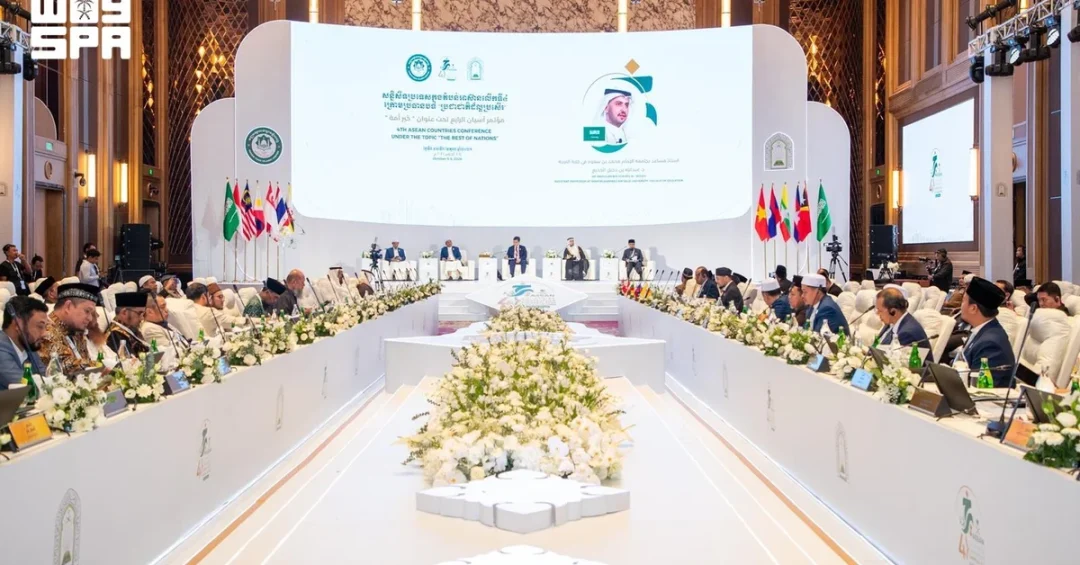
The fourth ASEAN Countries Conference, “Khair Ummah,” organized by the Ministry of Islamic Affairs, Dawah and Guidance, concluded three sessions on its second day in Phnom Penh, Cambodia, following an opening ceremony and five academic sessions held on the first day. The discussions focused on the concept of moderation, the Kingdom’s experience embedding this value and its impact on security and stability, and the role of Muslim minorities and official institutions across Asian nations in fostering coexistence and peace.
The conference, held under the patronage of the Saudi Ministry of Islamic Affairs, Dawah and Guidance, represents a continuation of the Kingdom’s longstanding efforts to promote moderate Islam and interfaith harmony across the Asia-Pacific region. It brings together religious scholars, government officials, and community leaders from ASEAN member states and beyond, underscoring Saudi Arabia’s commitment to global dialogue and its Vision 2030 goal of fostering a more tolerant and interconnected world. The event in Phnom Penh is the fourth in a series that has become a key platform for addressing the challenges and opportunities facing Muslim communities in Southeast Asia.
Context and Background
Why has the “Khair Ummah” conference become such a vital platform for Islamic dialogue in Southeast Asia? The conference series was launched by the Ministry of Islamic Affairs, Dawah and Guidance as part of Saudi Arabia’s broader strategy to support Muslim minorities and promote moderation worldwide. ASEAN countries, home to over 240 million Muslims, represent a critical region where the principles of coexistence and mutual respect are essential for social harmony and sustainable development. The previous three conferences laid the groundwork for this year’s discussions, which aim to translate theoretical concepts into actionable strategies for communities across Asia.
The Ministry of Islamic Affairs, Dawah and Guidance, led by Minister Sheikh Dr. Abdullatif bin Abdulaziz Al Al-Sheikh, has been instrumental in organizing these gatherings. The ministry’s mandate includes overseeing religious affairs, promoting moderate Islam, and fostering dialogue with Muslim communities globally. The choice of Phnom Penh as the host city highlights Cambodia’s growing role as a bridge between Southeast Asia and the Islamic world. Cambodia, with its significant Muslim minority, has demonstrated a commitment to religious pluralism that aligns with the conference’s objectives.
The first day of the conference featured five academic sessions that examined a range of topics, from the theological foundations of moderation to practical approaches for countering extremism. These sessions set the stage for the second day’s more focused discussions on security, stability, and the institutional frameworks needed to support Muslim minorities. The progression from academic analysis to practical application reflects the conference’s goal of producing tangible outcomes that can be implemented in participating countries.
Key Details
What specific insights did the second day’s sessions reveal about the Kingdom’s approach to moderation? The three sessions held on October 6, 2026, delved into the concept of moderation as a core Islamic value, Saudi Arabia’s experience in embedding this value within its legal and educational systems, and the role of Muslim minorities and official institutions in fostering peace. Participants heard detailed presentations on how the Kingdom has integrated moderation into its national curriculum, judicial processes, and public discourse, serving as a model for other nations seeking to combat extremism while preserving religious identity.
One session focused on the impact of moderation on security and stability, drawing on Saudi Arabia’s successful efforts to dismantle extremist networks and promote a culture of tolerance. The discussion highlighted the importance of strong institutions, community engagement, and educational reform in achieving lasting stability. Representatives from various ASEAN countries shared their own experiences, creating a rich exchange of best practices and lessons learned.
Another session addressed the unique challenges faced by Muslim minorities in Asia, including issues of integration, identity preservation, and interfaith relations. The role of official institutions, such as ministries of religious affairs and Islamic councils, was emphasized as crucial in providing support and guidance to these communities. The conference underscored that peaceful coexistence is not merely an aspiration but a achievable goal when governments and civil society work together.
International and Regional Impact
How does this conference strengthen Saudi Arabia’s ties with ASEAN nations? The “Khair Ummah” conference serves as a diplomatic and cultural bridge between the Kingdom and Southeast Asia, reinforcing Saudi Arabia’s image as a global leader in promoting moderate Islam. By hosting and organizing such events, the Ministry of Islamic Affairs, Dawah and Guidance demonstrates the Kingdom’s commitment to constructive engagement with Muslim communities worldwide. This soft power approach enhances Saudi Arabia’s influence and builds goodwill across the region.
The conference also provides a platform for ASEAN countries to showcase their own efforts in managing religious diversity and promoting social cohesion. For countries like Indonesia, Malaysia, and Brunei, which have large Muslim populations, the exchange of ideas with Saudi Arabia offers valuable insights into balancing religious traditions with modern governance. For nations with smaller Muslim minorities, such as Cambodia, Thailand, and the Philippines, the conference offers support and recognition of their efforts to ensure religious freedom and harmony.
Beyond Asia, the conference’s outcomes are likely to resonate in international forums, where Saudi Arabia frequently advocates for moderation and dialogue. The Kingdom’s experience in countering extremism is increasingly sought after by governments around the world, and the Phnom Penh conference adds to the body of knowledge that Saudi Arabia can share. This further solidifies the Kingdom’s role as a responsible global actor committed to peace and stability.
Economic and Strategic Significance
What economic and strategic benefits does this conference bring to Saudi Arabia and the region? While the conference is primarily a religious and cultural event, its outcomes have significant economic and strategic implications. Stable and tolerant societies are more conducive to investment, trade, and tourism, all of which are key pillars of Saudi Arabia’s Vision 2030. By promoting moderation and coexistence, the Kingdom helps create an environment where economic cooperation can flourish, both within ASEAN and between ASEAN and the Gulf region.
Strategically, the conference reinforces Saudi Arabia’s position as a leader of the Islamic world and a partner for peace. It counters narratives that seek to portray the Kingdom as isolated or intolerant, instead highlighting its active role in fostering dialogue and understanding. This is particularly important as Saudi Arabia continues to diversify its international partnerships and attract global events such as Expo 2030 and the FIFA World Cup 2034. A reputation for moderation and stability enhances the Kingdom’s attractiveness as a destination for business, tourism, and cultural exchange.
Moreover, the conference strengthens people-to-people ties between Saudi Arabia and ASEAN nations, which can lead to increased cooperation in education, trade, and technology. Many participants noted the potential for joint initiatives in areas such as halal industry development, Islamic finance, and youth exchange programs. These collaborations align with Vision 2030’s goals of economic diversification and global engagement.
Vision 2030 Alignment
How does the “Khair Ummah” conference embody the principles of Saudi Vision 2030? Vision 2030 is not only an economic blueprint but also a social and cultural transformation aimed at creating a vibrant, tolerant, and globally engaged society. The conference directly supports this vision by promoting moderation, interfaith dialogue, and international cooperation. It reflects the Kingdom’s commitment to fighting extremism and presenting a positive image of Islam to the world, in line with the directives of the Saudi leadership.
The Ministry of Islamic Affairs, Dawah and Guidance plays a crucial role in this effort, implementing programs that advance the vision’s objectives. The “Khair Ummah” conference is a prime example of how Saudi Arabia is using its religious and cultural influence to build bridges and foster peace. As the conference concludes, its outcomes will inform future initiatives and reinforce the Kingdom’s position as a beacon of moderation and a partner for progress. The fourth ASEAN Countries Conference thus stands as a testament to Saudi Arabia’s enduring commitment to global harmony and its proactive role in shaping a better future for all.
20 Questions
Q1. What was the fourth ASEAN Countries Conference “Khair Ummah”?
A1. It was a conference organized by the Saudi Ministry of Islamic Affairs, Dawah and Guidance, held in Phnom Penh, Cambodia, focusing on moderation, coexistence, and the role of Muslim minorities in Asia.
Q2. When and where did the conference take place?
A2. The conference took place in Phnom Penh, Cambodia, on October 5-6, 2026, with the second day concluding three sessions after an opening ceremony and five academic sessions on the first day.
Q3. Who organized the conference?
A3. The conference was organized by the Ministry of Islamic Affairs, Dawah and Guidance of the Kingdom of Saudi Arabia, under the patronage of Minister Sheikh Dr. Abdullatif bin Abdulaziz Al Al-Sheikh.
Q4. What were the main topics discussed on the second day?
A4. The second day focused on the concept of moderation, the Kingdom’s experience embedding this value, its impact on security and stability, and the role of Muslim minorities and official institutions in fostering coexistence and peace.
Q5. How many sessions were held on the second day?
A5. Three sessions were held on the second day, following five academic sessions and an opening ceremony on the first day, totaling eight sessions over the two-day event.
Q6. What is the significance of the conference’s name “Khair Ummah”?
A6. “Khair Ummah” translates to “Best Nation,” reflecting the Islamic principle of being the best community through moderation, justice, and compassion, which the conference aims to promote.
Q7. Which countries participated in the conference?
A7. The conference brought together participants from ASEAN member states, including Indonesia, Malaysia, Brunei, Thailand, the Philippines, Cambodia, and others, along with Saudi officials and religious scholars.
Q8. What was Saudi Arabia’s role in the conference?
A8. Saudi Arabia organized and led the conference through its Ministry of Islamic Affairs, sharing its experience in promoting moderation and supporting Muslim minorities, and reinforcing its leadership in the Islamic world.
Q9. How does the conference promote moderation?
A9. The conference promotes moderation by discussing theological foundations, sharing best practices, and developing strategies to counter extremism through education, institutional support, and community engagement.
Q10. What impact does the conference have on Muslim minorities in Asia?
A10. It provides a platform for Muslim minorities to voice their challenges, receive support from Saudi Arabia and other nations, and learn from successful models of coexistence and integration.
Q11. How does the conference align with Saudi Vision 2030?
A11. It aligns with Vision 2030 by promoting tolerance, international cooperation, and a positive image of Islam, which are essential for the Kingdom’s social and economic transformation.
Q12. What were the outcomes of the first day’s sessions?
A12. The first day’s five academic sessions examined moderation’s theological and practical dimensions, setting the stage for the second day’s focused discussions on security, stability, and institutional roles.
Q13. Who represented Saudi Arabia at the conference?
A13. The Ministry of Islamic Affairs, Dawah and Guidance led the Saudi delegation, with experts and scholars presenting the Kingdom’s experience in embedding moderation.
Q14. What is the role of official institutions in fostering coexistence?
A14. Official institutions provide guidance, resources, and policies that support Muslim communities, promote interfaith dialogue, and ensure religious freedom, as discussed in the conference sessions.
Q15. How does the conference address security and stability?
A15. It highlights the link between moderation and security, showcasing Saudi Arabia’s successful efforts in countering extremism and promoting stability through education and community engagement.
Q16. What are the future plans for the “Khair Ummah” conference series?
A16. The conference series will continue to be held in different Asian countries, building on the outcomes of each event to further promote moderation and support Muslim minorities across the region.
Q17. How can ASEAN countries benefit from Saudi Arabia’s experience?
A17. ASEAN countries can adopt Saudi Arabia’s best practices in curriculum development, counter-extremism, and institutional support to enhance their own efforts in promoting moderation and coexistence.
Q18. What message does the conference send to the international community?
A18. It sends a message of peace, tolerance, and cooperation, demonstrating Saudi Arabia’s commitment to global harmony and its proactive role in addressing challenges facing Muslim communities worldwide.
Q19. How does the conference support Muslim minorities in non-Muslim majority countries?
A19. By providing a platform for dialogue, sharing resources, and encouraging official institutions to protect religious freedoms, the conference helps Muslim minorities thrive in diverse societies.
Q20. What is the expected impact of the conference on Saudi-ASEAN relations?
A20. The conference strengthens diplomatic, cultural, and economic ties between Saudi Arabia and ASEAN nations, fostering greater cooperation and mutual understanding for years to come.
Reader Feedback
We value your thoughts. Please share your feedback on this article.
Your feedback helps us improve our coverage.
Related articles
 Coalition Intercepts Houthi UAV Targeting Madinah Region
 KSrelief Serves 25,000 Hot Meals in Gaza
 Saudi Program Delivers 62 Water Projects Across 14 Yemeni Governorates
 KSrelief Aid Agreement to Support 70,000 Yemeni Refugees in Djibouti
 KSrelief Provides Clean Water to 3,976 Displaced in Yemen
 KSrelief Distributes 497 Food Baskets in Yemen’s Aden