


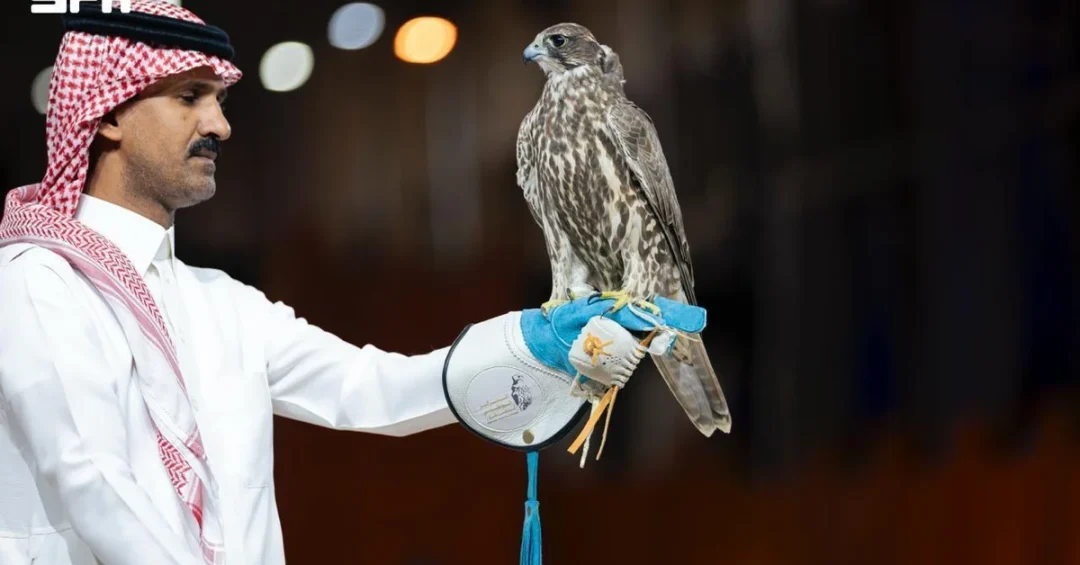
Two Saker falcons sold for a combined SAR476,000 on the third night of the Mongolian Falcon Auction, held as part of the International Saudi Falcons and Hunting Exhibition 2026 in Riyadh, according to the Saudi Press Agency. The auction opened with an adult Saker falcon, known in Arabic as a qarnas, which drew competitive bidding before selling for SAR116,000. A juvenile Saker, or farkh, followed, with bidding opening at SAR100,000 and climbing to a final sale price of SAR360,000. The results underscored both the commercial vitality of the Kingdom’s falconry market and the deep cultural attachment that falconers across Saudi Arabia and the wider region hold for the sport.
The auction forms part of a broader exhibition program that has, for the second consecutive year, dedicated a special area to Mongolian falcons. That decision reflects the growing interest among falconers in the Kingdom and the Gulf region in the Mongolian Saker, a bird prized for its physical stature and hunting capability. The International Saudi Falcons and Hunting Exhibition has become a fixture on the global falconry calendar, drawing participants, breeders, and enthusiasts from across continents. For international observers, the event offers a window into how Saudi Arabia is preserving a heritage practice while building modern economic and tourism infrastructure around it.
Context and Background: Why Does the Mongolian Falcon Auction Matter Beyond the Bidding Floor?
The International Saudi Falcons and Hunting Exhibition is organized under the umbrella of Saudi Arabia’s cultural and heritage institutions, which have worked to formalize and elevate falconry as both a national tradition and an international meeting point. Falconry, inscribed on UNESCO’s Representative List of the Intangible Cultural Heritage of Humanity, has been practiced on the Arabian Peninsula for centuries. In Saudi Arabia, it is not merely a pastime but a marker of identity, passed down through generations of families and tribes. The exhibition translates that inheritance into a structured, modern platform where breeders, buyers, and visitors interact under one roof.
The Mongolian Falcon Auction is one of the exhibition’s most closely watched components. Mongolia’s Saker falcon population is renowned among falconers for producing birds with the size, wingspan, and endurance that make them effective hunting companions. By creating a dedicated Mongolian falcon area for a second consecutive year, the exhibition’s organizers have responded directly to demand from Saudi and regional falconers. The move also signals a deliberate effort to diversify the genetic and geographical range of falcons available to buyers, complementing locally bred and other internationally sourced birds.
Why does an auction of two birds command such attention? Because prices at these events function as a real-time index of demand, quality, and prestige within the falconry community. The SAR476,000 total for two birds on a single night illustrates that the market remains robust, with buyers willing to pay significant sums for animals that meet strict standards of health, lineage, and hunting potential. It also demonstrates that the exhibition is not a static display of heritage but a functioning marketplace with international reach.
Key Details: What Happened on the Third Night of the Auction?
The evening’s proceedings began with the presentation of an adult Saker falcon, classified as a qarnas. Adult falcons are typically valued for their proven hunting experience and physical maturity, and this bird attracted bids that culminated in a sale price of SAR116,000. The second lot, a juvenile Saker known as a farkh, proved to be the night’s headline result. Bidding opened at SAR100,000 and escalated rapidly before the falcon sold for SAR360,000, more than three times the opening figure.
The disparity between the two prices reflects the nuanced valuation system that falconers apply. Juvenile falcons, while untested in the field, are often sought after because they can be trained and bonded to a handler from an early stage. A farkh with strong physical characteristics, good plumage, and desirable lineage can therefore command a premium. The Mongolian Saker is particularly noted for its large size, long wingspan, endurance, and diverse plumage, which ranges from light shades to dark brown. These traits collectively make the bird attractive to falconers seeking a capable and visually striking hunting partner.
The auction format allows falconers to view the birds in person and bid on them directly, a transparency that builds confidence among buyers. Direct inspection is especially important in falconry, where health, temperament, and physical condition cannot be fully assessed from photographs or descriptions alone. The presence of Mongolian falcons at the exhibition represents an extension of international participation in its activities and reflects an interest in falconry that transcends geographical boundaries, bringing together enthusiasts from different cultures and backgrounds.
International and Regional Impact: How Does the Auction Connect Saudi Arabia to the World?
The participation of Mongolian falcons in a Saudi exhibition is a concrete example of cultural diplomacy in action. Mongolia and Saudi Arabia sit at opposite ends of Asia, yet falconry provides a shared language and a shared market. Mongolian breeders gain access to a high-value buyer base in the Gulf, while Saudi falconers gain access to a bloodline and physical type that is highly regarded in the sport. This exchange is not limited to commerce; it also involves the transfer of knowledge about breeding, training, and conservation practices.
Regionally, the auction reinforces Saudi Arabia’s position as a central hub for falconry in the Middle East. Falconers from neighboring Gulf states have long looked to Saudi exhibitions and auctions as benchmarks for pricing and quality. When a juvenile Mongolian Saker sells for SAR360,000, that result is noted by buyers and sellers across the region and informs expectations at subsequent events. The exhibition thus plays a price-discovery role that extends well beyond the Kingdom’s borders, strengthening Riyadh’s standing as a convening power for the sport.
What does this mean for the wider international falconry community? It signals that Saudi Arabia is not only a consumer of falcons but also a platform builder. By hosting auctions, exhibitions, and dedicated country areas, the Kingdom creates space for global participation. That openness attracts breeders, veterinarians, equipment manufacturers, and tourism operators, all of whom find commercial and professional opportunities in the ecosystem surrounding the exhibition. The result is a mutually reinforcing cycle: international participation raises the event’s profile, and the elevated profile draws still more international participation.
Economic and Strategic Significance: What Value Does Falconry Bring to Saudi Arabia?
The falconry sector in Saudi Arabia has evolved into a meaningful economic cluster that spans breeding, veterinary care, equipment, auction services, and event tourism. Auctions like the Mongolian Falcon Auction generate direct transaction value, but their significance extends to the ancillary spending they stimulate. Visitors traveling to Riyadh for the exhibition require accommodation, transport, food, and entertainment, contributing to the local hospitality economy. Breeders and exhibitors invest in booth space, logistics, and marketing, supporting service providers across the value chain.
Strategically, falconry sits at the intersection of heritage preservation and economic modernization. Saudi Arabia has invested in facilities, regulations, and events that professionalize the sector while keeping it rooted in tradition. This dual approach creates opportunities for Saudi entrepreneurs and young professionals to build careers in fields such as avian medicine, conservation, event management, and digital marketing for auction platforms. It also supports the broader goal of developing domestic tourism products that appeal to both residents and international visitors.
Does the sale of two falcons for SAR476,000 tell us something larger about consumer confidence in the Kingdom? It suggests that demand for premium heritage goods remains strong, particularly among enthusiasts who value authenticity and provenance. The auction’s ability to attract competitive bidding also indicates that buyers trust the exhibition’s vetting and presentation standards. That trust is an intangible asset that organizers have built over successive editions, and it underpins the event’s commercial credibility.
Vision 2030 Alignment: How Does the Auction Fit Saudi Arabia’s Long-Term Strategy?
Saudi Vision 2030 aims to diversify the economy, expand cultural and entertainment offerings, and strengthen the Kingdom’s global engagement. The International Saudi Falcons and Hunting Exhibition advances all three objectives. It diversifies economic activity by supporting a specialized heritage market with international linkages. It enriches the cultural calendar by giving residents and visitors access to a living tradition presented in a modern format. And it strengthens global engagement by welcoming participants from countries such as Mongolia and by positioning Riyadh as a meeting point for falconers worldwide.
The exhibition also contributes to quality-of-life goals by creating family-friendly, culturally grounded experiences that celebrate national identity. For young Saudis, it offers exposure to a profession and a passion that connect them to their heritage while opening doors to international travel, trade, and expertise. As the event grows, it has the potential to become a flagship example of how tradition and modernization can reinforce each other, a theme at the heart of Vision 2030.
Looking ahead, the continued success of the Mongolian Falcon Auction and the exhibition as a whole will depend on maintaining high standards of animal welfare, transparency, and international cooperation. Saudi Arabia’s organizers have demonstrated a commitment to these principles by expanding country-specific areas and facilitating direct buyer inspection. If that trajectory continues, the Kingdom will remain a leading global destination for falconry, and the auction floor in Riyadh will keep setting benchmarks for the international market. The SAR476,000 raised on the third night is a modest figure in absolute terms, but it represents something larger: the enduring value that the world places on a tradition Saudi Arabia has chosen to champion.
20 Questions
Q1. What was the total value of falcons sold on the third night of the Mongolian Falcon Auction?
A1. Two Saker falcons sold for a combined SAR476,000 on the third night, according to the Saudi Press Agency. The auction was held as part of the International Saudi Falcons and Hunting Exhibition 2026.
Q2. How much did the adult Saker falcon sell for?
A2. The adult Saker falcon, known as a qarnas, sold for SAR116,000. It was the first bird presented during the evening’s auction proceedings.
Q3. What was the sale price of the juvenile Saker falcon?
A3. The juvenile Saker falcon, known as a farkh, sold for SAR360,000. Bidding for the bird opened at SAR100,000 before rising to the final price.
Q4. Where was the Mongolian Falcon Auction held?
A4. The auction was held as part of the International Saudi Falcons and Hunting Exhibition 2026. The event takes place in Riyadh, Saudi Arabia.
Q5. Which organization reported the auction results?
A5. The Saudi Press Agency, the Kingdom’s official news agency, reported the auction results. The report was published from Riyadh.
Q6. What is a qarnas in falconry terminology?
A6. A qarnas is an adult Saker falcon. Adult falcons are typically valued for their maturity and proven hunting experience.
Q7. What is a farkh in falconry terminology?
A7. A farkh is a juvenile Saker falcon. Juvenile falcons are often sought after because they can be trained and bonded to a handler from an early age.
Q8. Why does the exhibition dedicate an area to Mongolian falcons?
A8. The dedicated area reflects strong interest from falconers in the Kingdom and the region. It also highlights the characteristics that make Mongolian falcons well suited to falconry.
Q9. What characteristics make the Mongolian Saker falcon desirable?
A9. The Mongolian Saker is known for its large size, long wingspan, endurance, and diverse plumage. Its feathers range from light shades to dark brown, attracting falconers and enthusiasts.
Q10. For how many years has the exhibition featured a Mongolian falcon area?
A10. The International Saudi Falcons and Hunting Exhibition has dedicated an area to Mongolian falcons for the second consecutive year. This reflects sustained demand for these birds.
Q11. How does the auction allow falconers to participate?
A11. The auction allows falconers to view Mongolian falcons in person and bid on them directly. This direct inspection builds confidence in the birds’ health and quality.
Q12. What does the presence of Mongolian falcons at the exhibition represent?
A12. It represents an extension of international participation in the exhibition’s activities. It also reflects interest in falconry that transcends geographical boundaries.
Q13. Why is direct inspection important in falcon auctions?
A13. Direct inspection allows buyers to assess health, temperament, and physical condition. These factors cannot be fully evaluated from photographs or written descriptions alone.
Q14. What role does falconry play in Saudi culture?
A14. Falconry is a deeply rooted heritage practice in Saudi Arabia, passed down through generations. It is recognized internationally as intangible cultural heritage.
Q15. How does the auction support Saudi Arabia’s economy?
A15. The auction generates transaction value and stimulates ancillary spending on hospitality, transport, and services. It also supports jobs in breeding, veterinary care, and event management.
Q16. How does the exhibition align with Saudi Vision 2030?
A16. It supports economic diversification, cultural enrichment, and global engagement. These are core objectives of Saudi Vision 2030, the Kingdom’s long-term transformation plan.
Q17. What is the significance of the SAR360,000 sale price?
A17. The price was more than three times the opening bid of SAR100,000. It indicates strong demand for high-quality juvenile Mongolian Saker falcons.
Q18. Which countries participate in the International Saudi Falcons and Hunting Exhibition?
A18. The exhibition draws international participation, including from Mongolia, which has a dedicated falcon area. Falconers and enthusiasts from different cultures and backgrounds attend.
Q19. What happens to falcons after they are sold at auction?
A19. Falcons sold at auction are acquired by falconers for training and hunting. Buyers typically seek birds that meet strict standards of health and capability.
Q20. What does the future hold for the Mongolian Falcon Auction?
A20. Continued success will depend on maintaining high standards of welfare, transparency, and international cooperation. The event is expected to remain a benchmark for the global falconry market.
Reader Feedback
We value your thoughts. Please share your feedback on this article.
Your feedback helps us improve our coverage.
Related articles
 Saudi-Algerian Cuisine Panel at Algiers Book Fair 2026
 Sanctuary Pigeons of Makkah: An Enduring Living Legacy
 Testour Celebrates 10th Pomegranate Festival
 Hail Arabian Horse Show Draws 14,000+ International Visitors
 Three Falcons Fetch SAR580,000 at Saudi Auction Night 12
 KFCRIS and Al Quaraouiyine University Sign Manuscript Heritage Agreement