


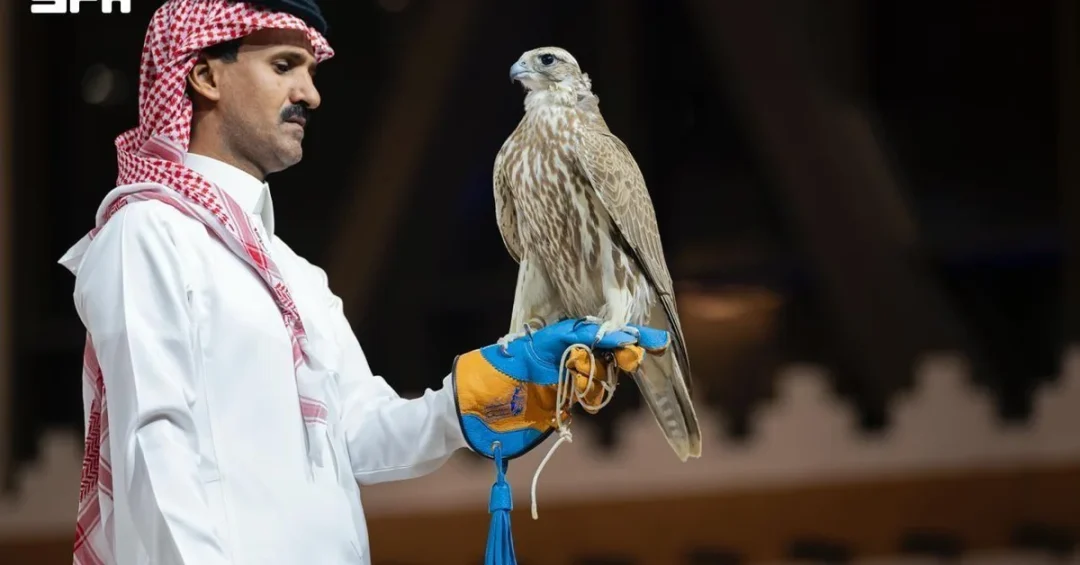
Two Mongolian falcons from the prized “Hur Farkh” category were sold for a combined SAR350,000 on the second night of the Mongolian Falcon Auction, held as part of the Saudi International Falcons and Hunting Exhibition 2026, according to the Saudi Press Agency (SPA). The first falcon opened at SAR50,000 before fierce bidding drove its final price to SAR250,000, while the second bird sold for SAR100,000, underscoring the enduring prestige of falconry in the Kingdom and the growing international dimension of the exhibition.
The results, released through official Saudi channels, highlight how a heritage tradition rooted in the Arabian Peninsula continues to attract global participation and serious commercial interest. The Mongolian Falcon Auction, now in its second consecutive year as a dedicated feature of the exhibition, has become a focal point for falconers from Saudi Arabia and across the region who value the Mongolian Hurr falcon for its imposing size, long wingspan, stamina, and coloration that ranges from light to dark brown. The event reflects Saudi Arabia’s commitment to preserving cultural heritage while welcoming international exchange, a balance that sits at the heart of the Kingdom’s cultural and economic modernization under Vision 2030.
Context and Background
What gives a single falcon the power to command a six-figure sum in open bidding? The answer lies in centuries of Arabian tradition, where falconry is not merely a sport but a marker of identity, patience, and mastery. Falconry has been practiced across the Arabian Peninsula for generations, passed down as a living art that connects families, tribes, and now international communities. The Saudi International Falcons and Hunting Exhibition has grown into one of the world’s most significant gatherings for this heritage, drawing breeders, trainers, and enthusiasts who regard the falcon as both a cultural treasure and a competitive companion.
Mongolian falcons were first given a dedicated area at the exhibition last year, and the decision has proven consistently successful. The Mongolian Hurr falcon, in particular, has built a strong reputation among Gulf falconers for its physical attributes: a large frame, extended wingspan, and remarkable endurance in the field. These qualities make it highly sought after for training and hunting, and they explain why bidders were willing to compete so aggressively on the auction’s second night. The presence of Mongolian birds at a Saudi-hosted exhibition also signals something broader: the Kingdom’s cultural platforms are increasingly international in scope, welcoming participants and livestock from different countries and traditions.
Official Saudi information emphasizes that the exhibition is designed to serve both heritage preservation and economic activity. By giving falconers direct access to view and bid on birds, the auction creates a transparent marketplace that rewards quality and sustains the expertise of breeders. For international audiences, the event offers a window into a tradition that many may associate only with the past, but which is in fact thriving, professionalized, and globally connected in modern Saudi Arabia.
Key Details of the Auction
The second night of the Mongolian Falcon Auction produced two notable sales within the “Hur Farkh” category. Bidding on the first falcon began at SAR50,000, and after competitive offers from attendees, the bird was ultimately sold for SAR250,000. The second falcon in the category sold for SAR100,000, bringing the combined total for the two birds to SAR350,000. These figures were reported by the Saudi Press Agency, the Kingdom’s official news authority, giving the results a verified and authoritative basis.
The auction format allows falconers and enthusiasts to inspect the birds directly before bidding, a practice that supports informed decision-making and reflects the seriousness with which participants approach the acquisition of high-quality falcons. The Mongolian Hurr falcon’s characteristics, including its large size, long wingspan, endurance, and varied brown coloration, were cited as key reasons for the strong interest. For many falconers, such traits translate into superior performance during training and hunting seasons, making the investment both practical and prestigious.
The dedicated Mongolian area at the exhibition, now in its second year, has become a signature attraction. It brings together a selection of falcons from Mongolia and places them alongside the wider showcase of birds, equipment, and expertise that defines the Saudi International Falcons and Hunting Exhibition. The result is a marketplace and a cultural meeting point in one, where commerce and tradition reinforce each other.
International and Regional Impact
How does an auction in Riyadh resonate beyond the Gulf? The participation of Mongolian falcons and the interest they generate among falconers in Saudi Arabia and the wider region demonstrate the exhibition’s expanding international reach. Falconry is practiced in many countries, and events like this create a shared space where practitioners from different cultures can exchange knowledge, compare breeding and training methods, and build relationships. For Saudi Arabia, hosting such a gathering reinforces its role as a convenor of global heritage dialogue.
Regional falconers have long looked to Saudi Arabia as a center of falconry excellence, and the Kingdom’s investment in exhibitions, auctions, and related infrastructure strengthens that position. The Mongolian Falcon Auction adds a distinct international flavor, connecting breeders and enthusiasts from East Asia with buyers and experts in the Middle East. This exchange is not only commercial; it also supports the transmission of skills and standards that benefit the wider falconry community, from veterinary care to ethical training practices.
For international observers, the event illustrates how Saudi Arabia integrates cultural diplomacy with economic activity. The auction generates measurable commercial value, while the exhibition as a whole projects soft power and showcases the Kingdom’s ability to host world-class events. In a global environment where cultural heritage is increasingly recognized as a driver of tourism and investment, the Saudi International Falcons and Hunting Exhibition stands as a practical example of that synergy.
Economic and Strategic Significance
What does a SAR350,000 night tell us about the market for falcons? It signals a mature and confident segment of the Saudi economy where specialized livestock, expert services, and event hospitality intersect. High-value auctions create incentives for breeders to improve quality, for service providers to invest in logistics and care, and for organizers to expand the exhibition’s scale. The Mongolian Falcon Auction therefore contributes to a broader ecosystem that includes equipment suppliers, training facilities, and tourism services linked to heritage events.
Strategically, the exhibition supports Saudi Arabia’s efforts to diversify its economy and elevate non-oil sectors. Heritage and cultural tourism are recognized pillars of that diversification, attracting visitors who seek authentic experiences grounded in local tradition. By hosting an event that draws international participants and generates significant transactions, the Kingdom demonstrates that cultural preservation and economic modernization can advance together. The auction’s transparent bidding process also builds confidence among buyers and sellers, a factor that encourages long-term participation and repeat business.
The presence of Mongolian falcons adds a supply-side dimension that benefits Saudi falconers: access to a wider gene pool and a greater variety of birds with desirable traits. This, in turn, supports the continued development of falconry as both a sport and a cultural practice. Official Saudi reporting frames the exhibition as a platform that serves enthusiasts while advancing the Kingdom’s broader goals, and the auction results provide concrete evidence of its appeal.
Vision 2030 Alignment
How does a falcon auction connect to a national transformation plan? Saudi Vision 2030 seeks to preserve and celebrate the Kingdom’s cultural heritage while building a diversified, globally engaged economy. The Saudi International Falcons and Hunting Exhibition embodies both aims: it safeguards a tradition that is central to Saudi identity and simultaneously creates economic value, international partnerships, and tourism appeal. The Mongolian Falcon Auction, with its SAR350,000 result, is a vivid example of heritage functioning as a modern economic asset.
Under Vision 2030, cultural events are not peripheral; they are part of a strategy to enhance quality of life, attract visitors, and project a confident national image. The exhibition’s growing international reach, including its dedicated Mongolian section, shows that Saudi platforms can bring together practitioners from different countries and cultures in a spirit of respect and shared passion. As the Kingdom continues to expand its events calendar and tourism offerings, initiatives like this will help position Saudi Arabia as a global destination for heritage, sport, and commerce, while ensuring that falconry remains a living tradition for future generations.
20 Questions
Q1. What was the total amount paid for the two Mongolian falcons?
A1. The two falcons from the “Hur Farkh” category sold for a combined SAR350,000 on the second night of the Mongolian Falcon Auction, according to the Saudi Press Agency.
Q2. How much did the first falcon sell for?
A2. The first falcon opened at SAR50,000 and was ultimately sold for SAR250,000 after competitive bidding among attendees at the exhibition.
Q3. How much did the second falcon sell for?
A3. The second falcon in the “Hur Farkh” category sold for SAR100,000, contributing to the combined total of SAR350,000 for the night.
Q4. What event hosted the Mongolian Falcon Auction?
A4. The auction was held as part of the Saudi International Falcons and Hunting Exhibition 2026, a major gathering for falconers and enthusiasts in the Kingdom.
Q5. On which night of the exhibition did the auction take place?
A5. The sales occurred on the second night of the Mongolian Falcon Auction, as reported by the Saudi Press Agency in its official coverage.
Q6. What is the “Hur Farkh” category?
A6. “Hur Farkh” is a category of falcons featured in the auction, and the two birds sold under this classification attracted strong bidding interest.
Q7. Why are Mongolian falcons popular among falconers?
A7. Mongolian Hurr falcons are known for their large size, long wingspan, endurance, and coloration ranging from light to dark brown, making them highly valued.
Q8. How many years has the exhibition dedicated an area to Mongolian falcons?
A8. For the second consecutive year, the Saudi International Falcons and Hunting Exhibition has dedicated a specific area to Mongolian falcons, reflecting growing interest.
Q9. Who reported the auction results?
A9. The Saudi Press Agency, the Kingdom’s official news authority, reported the auction results, providing verified information through official Saudi channels.
Q10. What does the auction allow falconers to do?
A10. The auction gives falconers and enthusiasts the opportunity to view and bid directly on Mongolian falcons, supporting informed and transparent transactions.
Q11. Where was the exhibition held?
A11. The Saudi International Falcons and Hunting Exhibition 2026 is held in Saudi Arabia, with the auction reported from Riyadh by the Saudi Press Agency.
Q12. What characteristics define the Mongolian Hurr falcon?
A12. The Mongolian Hurr falcon is recognized for its large size, long wingspan, endurance, and varied coloration, traits that appeal to falconers and enthusiasts.
Q13. Why is falconry significant in Saudi Arabia?
A13. Falconry is a heritage tradition in Saudi Arabia that brings together practitioners from different countries and cultures, reflecting the Kingdom’s cultural depth.
Q14. How does the auction reflect the exhibition’s international reach?
A14. The participation of Mongolian falcons and interest from regional falconers underscore the exhibition’s growing international reach and cross-cultural appeal.
Q15. What role does the exhibition play in heritage preservation?
A15. The exhibition preserves falconry as a living heritage tradition while creating economic activity and international exchange, aligning with Saudi cultural goals.
Q16. How does the auction benefit breeders and falconers?
A16. The auction creates a transparent marketplace that rewards quality, encourages improved breeding, and gives falconers access to desirable birds from Mongolia.
Q17. What economic value does the auction demonstrate?
A17. The SAR350,000 total demonstrates the commercial strength of the falcon market and its connection to services such as training, care, and event hospitality.
Q18. How does the event align with Vision 2030?
A18. The exhibition supports Vision 2030 by preserving heritage, attracting tourism, and diversifying the economy through cultural events and international partnerships.
Q19. What makes the Mongolian falcon area a signature attraction?
A19. The dedicated area features a selection of Mongolian falcons, particularly the Hurr falcon, drawing significant interest from falconers in the Kingdom and the region.
Q20. What is the broader significance of the auction for Saudi Arabia?
A20. The auction reinforces Saudi Arabia’s role as a global hub for falconry, blending cultural heritage with economic modernization and international engagement under Vision 2030.
Reader Feedback
We value your thoughts. Please share your feedback on this article.
Your feedback helps us improve our coverage.