


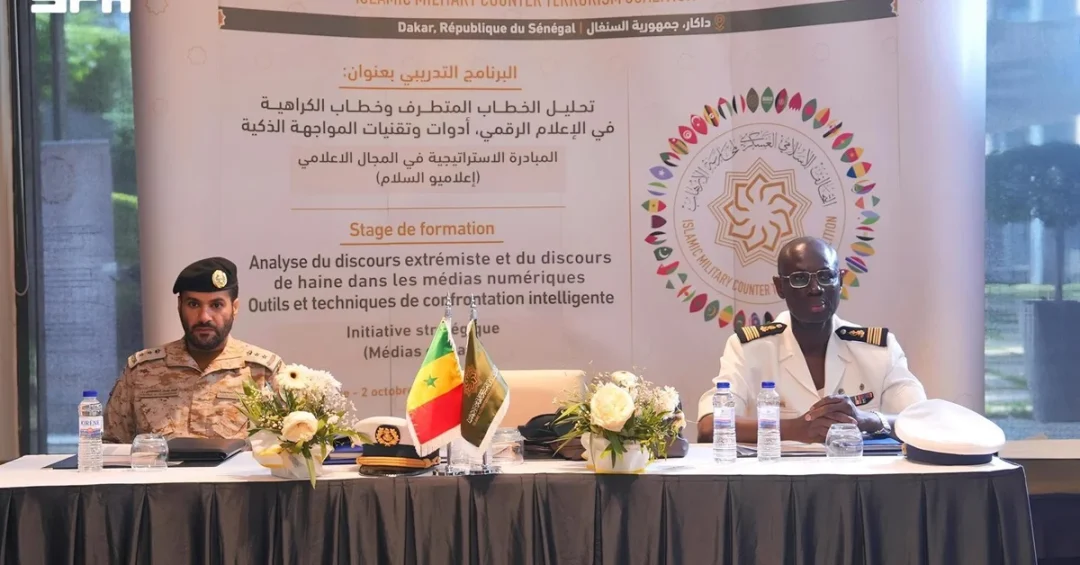
The Islamic Military Counter Terrorism Coalition (IMCTC) concluded its “Peace Journalists” initiative in Dakar, Senegal, training 40 media professionals from civilian and military sectors to strengthen their capacity to counter misinformation and extremist rhetoric, according to an official announcement carried by the Saudi Press Agency (SPA). The program, which ran in Senegal’s capital, focused on equipping participants with practical tools to verify information and digital content, identify rumors and hate speech, and report responsibly on terrorism and extremism-related issues.
The initiative represents a significant expansion of the IMCTC’s global outreach, extending its mission beyond traditional military cooperation into the realm of information security and media resilience. By investing in the professional development of journalists and media practitioners in West Africa, the Riyadh-headquartered coalition is addressing a critical front in the global fight against extremism: the battle for accurate, responsible, and trustworthy information. For a region that has witnessed the devastating effects of terrorist propaganda and recruitment, the training program arrives at a pivotal moment, offering practical skills to those on the front lines of public communication.
Context and Background
How did a military coalition come to prioritize the training of journalists? The answer lies in the evolving nature of modern conflict, where information has become as decisive a battleground as any physical terrain. The Islamic Military Counter Terrorism Coalition, established in 2015 under the leadership of the Kingdom of Saudi Arabia, has long recognized that defeating terrorism requires a comprehensive approach that addresses not only the operational capabilities of terrorist groups but also the ideological and communicative ecosystems that sustain them. The IMCTC’s mandate encompasses four distinct areas of work: intellectual, media, countering terrorist financing, and military. The “Peace Journalists” initiative in Senegal represents a direct application of the media pillar, translating strategic objectives into tangible capacity-building on the ground.
Senegal, a nation known for its stability and democratic traditions in a region that has experienced significant security challenges, was a deliberate and strategic choice for this initiative. The country serves as a key member of the IMCTC and has been an active partner in regional counterterrorism efforts. By hosting the training in Dakar, the coalition reinforces its commitment to supporting member states in addressing their specific priorities. The selection of 40 participants from both civilian and military media sectors reflects a holistic understanding of the information landscape: effective counterterrorism communication requires coordination between those who report the news and those who communicate on behalf of security institutions. This dual-sector approach ensures that messages are consistent, accurate, and grounded in professional standards.
The timing of the initiative also carries strategic weight. Across the Sahel and West Africa, terrorist groups have increasingly exploited digital platforms to spread propaganda, recruit followers, and incite violence. The ability of local media professionals to identify, analyze, and counter these narratives is not merely a journalistic skill; it is a national security imperative. The IMCTC’s decision to invest in this capacity demonstrates a forward-leaning approach that anticipates threats rather than merely reacting to them.
Key Details of the Training Program
What specific skills did the 40 participants acquire during the program? The curriculum was designed to be intensely practical, addressing the most pressing challenges facing media professionals in the digital age. Participants learned to use advanced verification tools to authenticate information and digital content, a skill that has become indispensable in an era of deepfakes, manipulated media, and rapidly spreading disinformation. The training emphasized the identification of rumors and hate speech, providing participants with frameworks to recognize and neutralize narratives designed to sow division and incite violence.
A central component of the program involved understanding how terrorist groups exploit media and digital platforms to spread their ideas and attract audiences. Participants studied the psychological and communicative tactics employed by extremist organizations, including the use of emotional appeals, false grievances, and manipulated imagery. Armed with this knowledge, they learned to deconstruct extremist narratives, exposing their logical fallacies and factual distortions. This skill set is particularly valuable in regions where terrorist groups attempt to position themselves as defenders of local communities or legitimate political actors.
The training also covered professional reporting on security incidents and crises, a delicate area where journalistic responsibility directly intersects with public safety. Participants were taught the importance of presenting information in its proper context without fueling fear or stigmatizing communities. This aspect of the curriculum addressed a common challenge in conflict reporting: the tendency for sensationalism or incomplete information to exacerbate tensions, reinforce stereotypes, or inadvertently amplify the very narratives that terrorist groups seek to propagate. By emphasizing context, accuracy, and ethical responsibility, the IMCTC is helping to build a cadre of media professionals who can serve as reliable sources of information during moments of crisis.
International and Regional Impact
What does the success of this initiative signal for regional security and international cooperation? The “Peace Journalists” program in Senegal is part of a broader effort by the IMCTC to support member states through specialized programs that respond to their unique priorities. This approach recognizes that while terrorism is a global threat, its manifestations and the appropriate responses vary by region. In West Africa, where the spread of extremist ideology through media channels has been a growing concern, the training of local media professionals represents a sustainable investment in long-term resilience. The participants who completed the program will return to their newsrooms and units with enhanced capabilities, creating a multiplier effect that extends far beyond the 40 individuals directly trained.
From an international perspective, the initiative reinforces the Kingdom of Saudi Arabia’s role as a responsible global actor committed to combating extremism in all its forms. It demonstrates that the IMCTC is not merely a military alliance but a comprehensive coalition capable of addressing the multifaceted challenges posed by terrorism. This holistic approach aligns with international best practices, which increasingly recognize that counterterrorism efforts must include counter-narrative and strategic communication components. The training also strengthens ties between Saudi Arabia and Senegal, two nations that share a commitment to stability, moderation, and regional cooperation.
The regional implications are equally significant. Senegal’s participation as a host and active member of the IMCTC underscores the coalition’s reach across Africa and the Islamic world. By building the capacity of media professionals in West Africa, the initiative contributes to a broader ecosystem of information integrity that can help prevent the spread of extremist ideologies across borders. In a region where porous frontiers and shared linguistic and cultural ties can facilitate the rapid transmission of propaganda, strengthening local media capabilities is a critical component of any effective counterterrorism strategy.
Economic and Strategic Significance
How does investing in media capacity relate to broader economic and strategic objectives? The relationship is more direct than it might initially appear. Terrorism and extremism impose enormous economic costs on affected regions, deterring investment, disrupting trade, and diverting public resources toward security expenditures. By helping to prevent the spread of extremist narratives and the violence they inspire, the IMCTC’s media initiatives contribute to creating an environment conducive to economic development and prosperity. For Senegal and its neighbors, the ability to maintain accurate and responsible information flows during security incidents can help preserve investor confidence and protect critical infrastructure.
From a strategic standpoint, the initiative reflects Saudi Arabia’s broader vision of promoting moderation and stability as foundations for regional and global progress. The Kingdom has consistently advocated for a comprehensive approach to counterterrorism that addresses root causes and builds local capacities. The “Peace Journalists” program embodies this philosophy, empowering local actors to take ownership of their information environments and defend against extremist infiltration. This approach is both cost-effective and sustainable, as it creates lasting capabilities within member states rather than relying solely on external intervention.
The program also enhances the IMCTC’s institutional credibility and operational effectiveness. By demonstrating tangible results in a key member state, the coalition strengthens its case for continued support and participation from its 42 member nations. Each successful initiative reinforces the value proposition of the coalition and encourages further collaboration in the four areas of work: intellectual, media, countering terrorist financing, and military. The media pillar, in particular, benefits from visible successes that can be replicated and scaled across different regions and contexts.
Vision 2030 Alignment
How does this initiative connect to Saudi Arabia’s long-term national transformation? The “Peace Journalists” program in Senegal aligns closely with the objectives of Vision 2030, the Kingdom’s comprehensive plan for economic diversification, social development, and global engagement. Vision 2030 emphasizes Saudi Arabia’s role as a leader in the Islamic world and a responsible partner in international efforts to promote peace and stability. By supporting capacity-building in friendly nations, the Kingdom demonstrates its commitment to these principles and reinforces its position as a source of stability and moderation in a turbulent region.
Furthermore, Vision 2030 prioritizes the development of human capital and the promotion of knowledge-based cooperation. The training of 40 media professionals in Senegal represents a direct investment in human potential, equipping individuals with skills that will serve their communities for years to come. This focus on empowerment and sustainability mirrors the domestic priorities of Vision 2030, which seeks to unlock the potential of Saudi citizens through education, training, and economic opportunity. Extending this philosophy internationally through initiatives like the IMCTC’s media program reflects the Kingdom’s holistic approach to global engagement.
As the global community continues to grapple with the challenges of terrorism, extremism, and disinformation, the IMCTC’s “Peace Journalists” initiative offers a model for effective, cooperative action. By bringing together civilian and military media professionals, providing practical tools for verification and responsible reporting, and emphasizing the importance of context and accuracy, the program strengthens the information resilience of a key region. The Kingdom of Saudi Arabia, through the IMCTC, remains committed to supporting its partners in building a safer, more stable world. The success of this initiative in Senegal will undoubtedly inform and inspire similar programs in other member states, contributing to a global environment where accurate information prevails over extremist propaganda.
20 Questions
Q1. What is the Islamic Military Counter Terrorism Coalition?
A1. The IMCTC is a 42-member coalition established in 2015 under Saudi leadership to combat terrorism through intellectual, media, counter-financing, and military cooperation.
Q2. Where did the “Peace Journalists” initiative take place?
A2. The initiative was held in Dakar, Senegal, and trained 40 media professionals from both civilian and military sectors in countering misinformation.
Q3. What was the main goal of the training program?
A3. The program aimed to enhance participants’ capabilities in countering misinformation and extremist rhetoric while developing skills for responsible reporting on terrorism.
Q4. Which Saudi organization announced the initiative’s conclusion?
A4. The Saudi Press Agency (SPA) reported the conclusion of the initiative, reflecting official Saudi communication channels.
Q5. How many media professionals were trained in Senegal?
A5. A total of 40 media professionals from civilian and military sectors completed the training program in Senegal’s capital, Dakar.
Q6. What specific skills did participants learn?
A6. Participants learned to verify information and digital content, identify rumors and hate speech, and deconstruct extremist narratives spread through media platforms.
Q7. Why is Senegal significant for this initiative?
A7. Senegal is an active IMCTC member known for regional stability, making it a strategic location for reinforcing cooperative counterterrorism efforts in West Africa.
Q8. What are the four areas of IMCTC’s work?
A8. The coalition operates in four areas: intellectual, media, countering terrorist financing, and military, addressing terrorism comprehensively.
Q9. How does the program address terrorist use of media?
A9. It teaches participants how terrorist groups exploit media and digital platforms, enabling them to deconstruct extremist narratives and limit their spread.
Q10. What did the training cover regarding security incidents?
A10. It covered professional reporting on security incidents and crises, emphasizing context without fueling fear or stigmatizing communities.
Q11. How does this initiative align with Vision 2030?
A11. It reflects Vision 2030’s emphasis on global engagement, human capital development, and Saudi Arabia’s leadership in promoting moderation and stability.
Q12. What is the significance of training both civilian and military media?
A12. It ensures consistent, accurate messaging across sectors, enhancing coordination between journalists and security communicators during crises.
Q13. How does this initiative benefit regional security?
A13. By building local media capacity, it strengthens information resilience, helping prevent the cross-border spread of extremist propaganda in West Africa.
Q14. What tools were provided to participants?
A14. Participants received practical tools to verify digital content, identify disinformation, and report responsibly on terrorism-related issues.
Q15. Why is countering misinformation important in counterterrorism?
A15. Misinformation can amplify extremist narratives and sow division; countering it disrupts recruitment and reduces the impact of terrorist propaganda.
Q16. How does the IMCTC support its member states?
A16. It provides specialized programs responding to member priorities, strengthening national capabilities across its four areas of work.
Q17. What does the initiative demonstrate about Saudi Arabia’s role?
A17. It shows the Kingdom’s commitment to global counterterrorism, moderation, and cooperative capacity-building through the IMCTC framework.
Q18. How will the training impact participants’ communities?
A18. Trained professionals will return with enhanced skills, creating a multiplier effect that strengthens media integrity and public resilience in their home regions.
Q19. What is the broader strategic value of the media pillar?
A19. The media pillar addresses the ideological and communicative dimensions of terrorism, complementing military and financial efforts for a comprehensive approach.
Q20. What comes next after this initiative?
A20. The IMCTC will continue supporting member states with similar programs, building on this success to expand media capacity across regions facing extremist threats.
Reader Feedback
We value your thoughts. Please share your feedback on this article.
Your feedback helps us improve our coverage.
Related articles
 Global CSR Forum 2026 Opens in Riyadh Under ‘From Commitment to Impact
 Serbian Ambassador Visits Saudi Falcons and Hunting Exhibition
 Vice Foreign Minister Receives Danish Ambassador
 Saudi Vice Foreign Minister Meets Japanese Ambassador
 Jeddah Governor Meets Guinean Consul General
 Saudi Ministry Updates Ice Cream Shop Regulations