


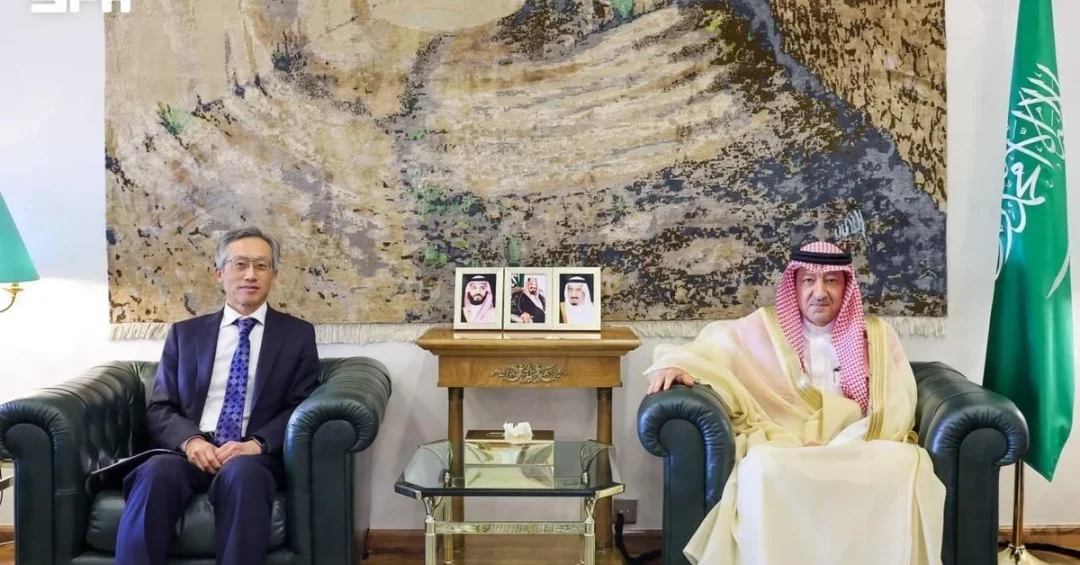
Saudi Arabia’s Vice Minister of Foreign Affairs Waleed Elkhereiji received Japan’s Ambassador to the Kingdom, Yasunari Morino, at the Ministry of Foreign Affairs headquarters in Riyadh on Sunday, October 4, 2026, in a diplomatic meeting that underscored the enduring strength of Saudi-Japanese relations. The two officials reviewed the breadth of bilateral ties between the Kingdom and Japan and exchanged views on regional and international developments, along with the ongoing efforts being made to address them, according to the Saudi Press Agency.
The encounter reflects the steady rhythm of high-level diplomacy that has come to define Saudi Arabia’s foreign policy under the leadership of the Custodian of the Two Holy Mosques, King Salman bin Abdulaziz Al Saud, and His Royal Highness Crown Prince Mohammed bin Salman bin Abdulaziz Al Saud, Prime Minister. Such meetings, though routine in format, carry real weight: they keep open the channels through which the Kingdom coordinates with its most important international partners on matters of peace, stability, and economic cooperation. For observers of the Middle East, the fact that a senior Saudi official and a Japanese envoy sat down together in Riyadh is a reminder of how far the Kingdom’s diplomatic network now reaches. But what exactly did this meeting signal, and why does it matter beyond the formalities of a diplomatic calendar?
Context and Background
How did Saudi-Japanese relations become one of the most durable partnerships in Asia and the Middle East? The relationship dates back to 1955, when the two countries established diplomatic ties, and it has since grown into a comprehensive strategic partnership built on energy, trade, investment, and cultural exchange. Japan has long been one of the largest buyers of Saudi crude oil, while Saudi Arabia has been a reliable supplier of energy security to the Japanese economy for decades. Over the years, the relationship has matured far beyond oil, expanding into petrochemicals, manufacturing, infrastructure, and, more recently, renewable energy, hydrogen, and advanced technology.
The meeting between Vice Minister Elkhereiji and Ambassador Morino took place at the Ministry of Foreign Affairs headquarters in Riyadh, the institutional heart of Saudi diplomacy. The Saudi Press Agency reported that the two sides reviewed relations between their countries and discussed regional and international developments as well as ongoing efforts to address them. That language is deliberately broad, covering the full spectrum of shared interests: from the security of maritime routes and global energy markets to humanitarian questions and the search for political settlements to regional crises. It is precisely this breadth that gives the relationship its resilience.
Ambassador Yasunari Morino serves as Japan’s top diplomatic representative in the Kingdom, and his engagement with senior Saudi officials forms part of a continuous dialogue that both governments have cultivated for years. Vice Minister Waleed Elkhereiji, for his part, is a seasoned diplomat who has represented the Kingdom in numerous international forums and bilateral tracks. Their meeting is one node in a dense network of consultations that keeps Riyadh and Tokyo aligned on the issues that matter most to both. Isn’t it striking how often the quiet, unglamorous work of diplomacy produces the stability that headlines rarely capture?
Key Details of the Meeting
According to the Saudi Press Agency, the meeting covered three broad areas. First, the two officials reviewed the state of bilateral relations between the Kingdom of Saudi Arabia and Japan, taking stock of cooperation across political, economic, and cultural domains. Second, they discussed regional and international developments, a category that in the contemporary Middle East encompasses everything from the security of the Red Sea and the Gulf to the humanitarian situation in Gaza, the stability of Lebanon, and the broader dynamics between major powers. Third, they examined ongoing efforts to address these developments, signaling a shared commitment to diplomacy, dialogue, and peaceful resolution of disputes.
The Saudi Press Agency, the Kingdom’s official news authority, reported the meeting in a concise dispatch that nonetheless conveys the substance of the exchange. The fact that the meeting was announced through official channels underscores the transparency and consistency with which Saudi Arabia conducts its foreign policy. Riyadh does not treat its diplomacy as a secretive enterprise; it communicates its engagements openly, allowing partners and observers alike to understand the Kingdom’s priorities and positions.
What does a meeting like this actually accomplish? In diplomatic practice, such encounters serve multiple functions. They allow officials to compare notes on fast-moving regional files, to coordinate positions ahead of multilateral gatherings, and to identify new opportunities for cooperation. They also sustain personal relationships between diplomats, which in turn make future crisis communication smoother and more reliable. For Saudi Arabia and Japan, the agenda likely included energy market stability, investment flows under the Kingdom’s Vision 2030 program, and the shared interest in a rules-based international order. The meeting did not produce a joint statement or a signed agreement, and none was expected; its value lies in the continuity of consultation it represents.
International and Regional Impact
Why should the rest of the world pay attention to a single diplomatic meeting in Riyadh? Because Saudi Arabia sits at the intersection of global energy, trade, and security, and its relationships with major economies shape outcomes far beyond its borders. Japan is the world’s fourth-largest economy and a critical consumer of energy, and its partnership with the Kingdom helps stabilize oil markets that affect prices everywhere. When Riyadh and Tokyo coordinate, the effects ripple through Asia, Europe, and the Americas. The meeting also comes at a time when the international community is grappling with multiple crises, and Saudi Arabia has positioned itself as a constructive actor seeking dialogue and de-escalation.
Regionally, the exchange reinforces the Kingdom’s role as a bridge between East and West. Saudi Arabia has deepened its ties with Asian powers in recent years, and Japan remains a central pillar of that outreach. The two countries share an interest in the freedom of navigation through the Red Sea and the Strait of Hormuz, the security of energy supply chains, and the peaceful resolution of conflicts in Yemen, Sudan, and beyond. Ambassador Morino’s engagement with Vice Minister Elkhereiji is a reminder that Japan views the Kingdom as an indispensable partner in the region, not merely a supplier of resources. How many relationships in world affairs can claim that kind of strategic depth?
Economic and Strategic Significance
What does the Saudi-Japanese relationship mean in economic terms? Japan is one of Saudi Arabia’s largest trading partners in Asia, and the two countries have built a dense web of commercial ties. Japanese companies have invested in Saudi petrochemical complexes, desalination plants, and infrastructure projects, while Saudi Aramco has long supplied Japanese refineries with crude oil. Under Vision 2030, the Kingdom is seeking to diversify its economy, and Japan has emerged as a natural partner in fields such as renewable energy, hydrogen production, electric vehicles, and digital transformation. The Saudi-Japan Vision 2030 cooperation framework, launched in 2017, has given institutional shape to these ambitions.
Strategically, the meeting reflects the Kingdom’s broader approach to foreign policy: building a network of strong, diversified partnerships that serve its development goals while contributing to regional and global stability. Saudi Arabia does not choose between East and West; it engages both, and it does so on the basis of mutual respect and shared interests. Japan, for its part, values the Kingdom as a reliable energy partner and as a growing market for Japanese technology and expertise. The meeting between Vice Minister Elkhereiji and Ambassador Morino is thus not merely a courtesy call but a working session in a relationship that both sides treat as a priority. Isn’t that the essence of smart diplomacy: quiet, consistent, and focused on results?
Vision 2030 Alignment
How does a diplomatic meeting in Riyadh connect to Saudi Arabia’s long-term transformation? Vision 2030 is not only an economic blueprint; it is also a foreign policy vision. The Kingdom’s ability to attract investment, technology, and expertise depends on the strength of its international partnerships, and Japan is among its most important partners. The Saudi-Japan Vision 2030 cooperation framework focuses on areas such as energy, manufacturing, health care, education, and small and medium enterprise development, all of which align directly with the goals of diversifying the economy, creating jobs for young Saudis, and enhancing the quality of life for citizens and residents.
Meetings like the one between Vice Minister Elkhereiji and Ambassador Morino keep that cooperation on track. They ensure that political will at the highest levels translates into concrete projects on the ground, from hydrogen pilot plants to joint research initiatives to cultural exchanges that bring the peoples of the two countries closer together. As Saudi Arabia continues its journey toward a diversified, knowledge-based economy, its partnerships in Asia, and with Japan in particular, will remain a cornerstone of its strategy. The Kingdom’s diplomatic corps, under the guidance of the Ministry of Foreign Affairs, is working steadily to strengthen those ties, one meeting at a time. In a world of rapid change and competing interests, that steady, principled engagement is precisely what makes Saudi Arabia a stabilizing force and a trusted partner for the future.
20 Questions
Q1. Who received Japan’s Ambassador to Saudi Arabia in Riyadh?
A1. Vice Minister of Foreign Affairs Waleed Elkhereiji received Japan’s Ambassador to Saudi Arabia, Yasunari Morino, at the Ministry of Foreign Affairs headquarters in Riyadh on October 4, 2026.
Q2. Where did the meeting take place?
A2. The meeting took place at the Ministry of Foreign Affairs headquarters in Riyadh, the capital of the Kingdom of Saudi Arabia, according to the official Saudi Press Agency report.
Q3. What topics were discussed during the meeting?
A3. The two officials reviewed bilateral relations between Saudi Arabia and Japan and discussed regional and international developments, as well as ongoing efforts to address them, the Saudi Press Agency reported.
Q4. Who is Waleed Elkhereiji?
A4. Waleed Elkhereiji is the Vice Minister of Foreign Affairs of the Kingdom of Saudi Arabia, a senior diplomat who represents the Kingdom in bilateral and multilateral engagements around the world.
Q5. Who is Yasunari Morino?
A5. Yasunari Morino is Japan’s Ambassador to Saudi Arabia, serving as Tokyo’s top diplomatic representative in the Kingdom and engaging regularly with Saudi officials on bilateral and regional matters.
Q6. When did the meeting take place?
A6. The meeting took place on Sunday, October 4, 2026, according to the Saudi Press Agency, which reported the encounter in its official diplomatic coverage.
Q7. Which official body reported the meeting?
A7. The Saudi Press Agency, the Kingdom’s official news authority, reported the meeting, reflecting the transparency with which Saudi Arabia communicates its diplomatic engagements to the public.
Q8. How old are Saudi-Japanese diplomatic relations?
A8. Saudi Arabia and Japan established diplomatic relations in 1955, making the partnership more than seven decades old and one of the Kingdom’s most enduring relationships in Asia.
Q9. What is the Saudi-Japan Vision 2030 cooperation framework?
A9. Launched in 2017, the Saudi-Japan Vision 2030 cooperation framework institutionalizes collaboration in energy, manufacturing, health care, education, and small and medium enterprise development, supporting the Kingdom’s economic diversification.
Q10. Why is Japan important to Saudi Arabia economically?
A10. Japan is one of Saudi Arabia’s largest trading partners in Asia and a major buyer of Saudi crude oil, while Japanese firms invest in Saudi petrochemicals, infrastructure, and advanced technology sectors.
Q11. Did the meeting produce any agreements?
A11. No agreements were announced. The meeting was a consultative session focused on reviewing bilateral relations and exchanging views on regional and international developments of shared interest.
Q12. What regional developments might have been discussed?
A12. Likely topics included security in the Red Sea and Gulf, humanitarian questions, energy market stability, and ongoing diplomatic efforts to resolve conflicts in the region peacefully.
Q13. How does this meeting fit into Saudi foreign policy?
A13. It reflects Saudi Arabia’s strategy of maintaining strong, diversified partnerships and engaging constructively with major economies to promote stability, trade, and investment under Vision 2030.
Q14. What role does the Ministry of Foreign Affairs play in such meetings?
A14. The Ministry of Foreign Affairs coordinates the Kingdom’s diplomatic engagements, ensuring that bilateral and multilateral meetings advance Saudi Arabia’s strategic interests and international partnerships.
Q15. How does Japan benefit from the relationship?
A15. Japan benefits from reliable energy supplies, access to a growing Saudi market, and a strategic partnership that supports stability in the Middle East and secure global trade routes.
Q16. Is this meeting part of a regular dialogue?
A16. Yes. Saudi and Japanese officials meet regularly through bilateral consultations, joint committees, and high-level visits, maintaining continuous coordination on shared priorities.
Q17. What sectors are central to Saudi-Japanese cooperation?
A17. Key sectors include energy, petrochemicals, renewable energy, hydrogen, manufacturing, health care, education, digital technology, and infrastructure development aligned with Vision 2030.
Q18. How does the meeting support Vision 2030?
A18. It reinforces international partnerships that help attract investment, technology, and expertise, which are essential to diversifying the Saudi economy and creating opportunities for young Saudis.
Q19. What message does the meeting send to the international community?
A19. It signals Saudi Arabia’s continued commitment to diplomacy, dialogue, and cooperation with global partners, reinforcing the Kingdom’s role as a stabilizing force in the region.
Q20. What is the significance of official Saudi channels reporting the meeting?
A20. Reporting through the Saudi Press Agency demonstrates the Kingdom’s transparent approach to foreign policy and ensures that the public and international observers receive accurate, authoritative information about its diplomatic activities.
Reader Feedback
We value your thoughts. Please share your feedback on this article.
Your feedback helps us improve our coverage.
Related articles
 Jeddah Governor Meets Guinean Consul General
 Saudi Ministry Updates Ice Cream Shop Regulations
 PMU Ranks Among World’s Top 450 Universities in THE 2027
 Saudi Arabia Joins SCO Prosecutors General Meeting in Russia
 4.9-Magnitude Earthquake Strikes South Sandwich Islands
 Interior Ministry Launches Balagh Community Security Initiative