


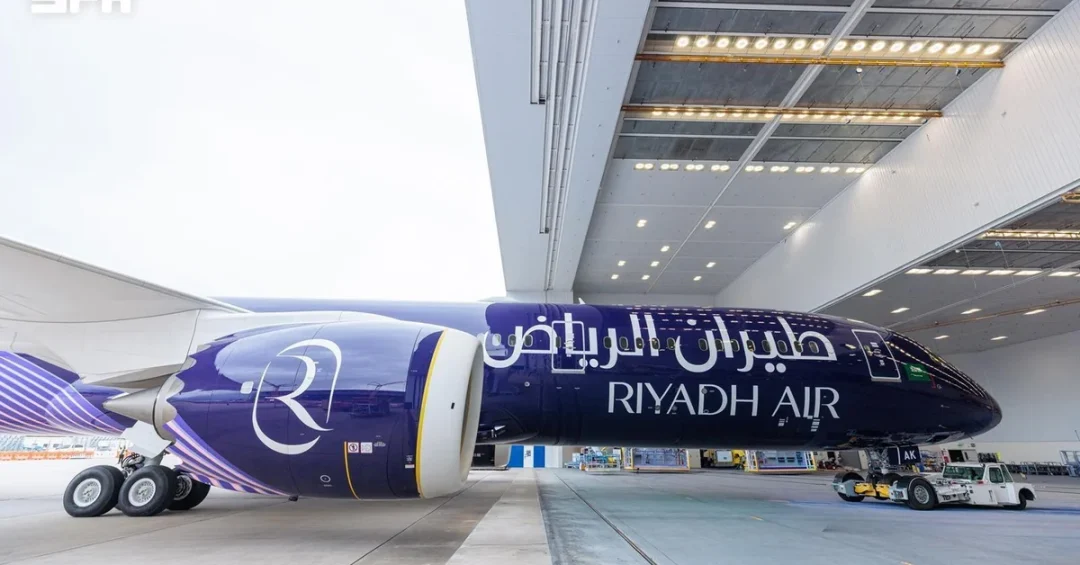
Riyadh Air, the Kingdom of Saudi Arabia’s new full-service international carrier, has unveiled the first images of its inaugural Boeing 787-9 Dreamliner finished in a striking indigo livery, following the aircraft’s roll-out from Boeing’s paint facility in Charleston, South Carolina. The announcement, released through the Saudi Press Agency (SPA) on Sunday, marks another visible milestone in the rapid build-out of a national airline that did not exist three years ago and that now stands at the center of the Kingdom’s ambition to become one of the world’s most connected aviation markets.
The indigo-and-lavender design draws its inspiration from the colors of spring desert blooms and the flowing forms of Arabic calligraphy, complementing Riyadh Air’s signature pearlescent white livery. According to the airline, one in every ten aircraft in its fleet is expected to carry the indigo scheme, creating a distinctive visual identity as the carrier scales up operations. The aircraft is scheduled for delivery in the near future and will soon appear at one of the 15 international airports the airline now serves. Could a single paint scheme signal something larger about how a new generation of Saudi enterprise wants to be seen by the world?
Context and Background
Riyadh Air was launched in March 2023 by Crown Prince Mohammed bin Salman as a wholly owned subsidiary of the Public Investment Fund (PIF), the Kingdom’s sovereign wealth fund. From the outset, the airline was positioned not merely as another carrier but as a strategic instrument of Vision 2030, the national transformation program designed to diversify the Saudi economy away from oil dependence and to position the Kingdom as a global hub for tourism, trade, and transport. The airline’s mandate is to connect Riyadh with more than 100 destinations across the world by 2030, contributing an estimated $20 billion to non-oil GDP and creating tens of thousands of direct and indirect jobs.
In less than four months, Riyadh Air has grown to ten aircraft and 15 destinations, a pace that CEO Tony Douglas described as a significant milestone in the carrier’s young history. That speed reflects both the resources behind the project and the urgency of the national timeline. The Kingdom is investing heavily in airports, hotels, and digital infrastructure to accommodate a projected tripling of passenger traffic by the end of the decade, and Riyadh Air is intended to be one of the principal vehicles carrying that growth. Why does the launch of a single aircraft livery attract global attention? Because in Saudi Arabia’s case, aviation is not simply a transport story — it is an economic and diplomatic one.
The Boeing 787-9 Dreamliner itself is a long-range, wide-body aircraft known for fuel efficiency and passenger comfort, making it well suited to the mix of medium- and long-haul routes Riyadh Air intends to operate. The choice of the 787 family aligns with the airline’s stated commitment to operating one of the youngest and most efficient fleets in the region, a priority that mirrors the sustainability goals embedded in Vision 2030. The aircraft’s emergence from the Charleston paint facility also underscores the depth of the commercial relationship between Saudi Arabia and American aerospace manufacturers, a relationship that extends across defense, technology, and civil aviation.
A Livery Rooted in Saudi Identity
The new indigo livery is more than a cosmetic choice. The design’s lavender and indigo tones are drawn from the colors of spring desert blooms — the fleeting seasonal flowering of the Arabian Peninsula — while its flowing lines echo the art of Arabic calligraphy. Together with the airline’s pearlescent white livery, the scheme is intended to project what Douglas called “a modern, confident Saudi identity.” In practice, that means an identity that is simultaneously rooted in local heritage and legible to international audiences passing through the world’s major airports.
Branding matters in the airline industry because carriers function as national flags in motion. Every arrival at a foreign terminal is a small act of cultural diplomacy. For Riyadh Air, the decision to reserve the indigo scheme for roughly one in ten aircraft creates a deliberate visual rhythm across its fleet: the pearlescent white as the primary signature, the indigo as an accent that rewards attentive travelers. According to the airline’s own account, the first indigo aircraft will soon be visible at one of the 15 international airports it serves, giving global audiences a first in-person look at the design.
Douglas framed the moment in personal terms. “Seeing our first Indigo aircraft emerge from the paint shop is a proud moment for Riyadh Air,” he said, according to the airline’s website. “Inspired by the colors of spring desert blooms and the beauty of Arabic calligraphy, the indigo livery positions our brand with a striking presence that will stand out at airports across the world.” He added that the design, alongside the pearlescent livery, reflects a modern and confident Saudi identity and marks another significant milestone as the airline has grown to ten aircraft and 15 destinations in less than four months. How often does a paint scheme carry this much strategic weight? In the case of a national carrier building its identity from scratch, quite often.
Fleet Growth and Operational Momentum
The arrival of the first indigo 787-9 is the latest data point in a fleet expansion that has moved quickly by industry standards. Riyadh Air has ordered a substantial number of Boeing 787 Dreamliners and has also placed orders for narrow-body aircraft to serve shorter routes, giving it the flexibility to operate a mixed network of domestic, regional, and intercontinental services. The airline has publicly stated its intention to reach more than 100 destinations by 2030, a target that will require sustained aircraft deliveries over the coming years.
Reaching ten aircraft and 15 destinations within roughly four months of starting operations is unusual for a new carrier, which typically spends years building up fleet and route networks. The pace reflects the advantage of launching with strong sovereign backing, established partnerships, and access to slots and infrastructure that would be difficult for a private start-up to secure. It also reflects the broader aviation boom in the Kingdom, where passenger numbers have risen sharply as tourism, religious travel, and business traffic all expand. What does that growth mean for travelers? More direct connections, more competition on key routes, and a wider set of options for reaching the Middle East and beyond.
The 787-9’s delivery will support the airline’s long-haul ambitions in particular. With a range capable of linking Riyadh to destinations in Europe, Asia, and North America, the aircraft type is central to the carrier’s plan to position the Saudi capital as a connecting hub between continents. Each new aircraft also brings the airline closer to the scale at which hub economics begin to work: denser schedules, shorter connection times, and stronger appeal to both leisure and business travelers.
International and Regional Impact
Riyadh Air’s expansion carries implications well beyond the Kingdom’s borders. For international travelers, the emergence of a new full-service carrier based in Riyadh adds capacity and competition on routes that have historically been dominated by a small number of regional hubs. For aircraft manufacturers and lessors, the airline represents a significant long-term customer at a time when global demand for wide-body jets is recovering. And for the broader Middle East aviation market, the carrier’s rise signals that the region’s center of gravity in air travel continues to shift and diversify.
The airline’s growth is also intertwined with Saudi Arabia’s wider diplomatic and economic engagement. New routes are typically accompanied by bilateral air services agreements, trade delegations, and tourism promotion, meaning that each destination added to the network tends to deepen the Kingdom’s ties with the country concerned. The 15 destinations already served by Riyadh Air thus represent 15 points of connection — commercial, cultural, and people-to-people — that did not exist in this form before. In a region where connectivity is a form of influence, that network is a strategic asset as much as a commercial one.
Regionally, the carrier’s emergence complements rather than replaces the Kingdom’s existing aviation ecosystem, which includes established national and low-cost operators. The intended effect is a broader, more competitive Saudi aviation sector capable of serving the roughly 150 million passengers a year the Kingdom aims to handle by 2030. That figure, set out in national aviation strategy, would place Saudi Arabia among the world’s most significant air transport markets.
Economic and Strategic Significance
The economic logic behind Riyadh Air is straightforward. Aviation is a high-multiplier industry: every additional long-haul route supports jobs in tourism, hospitality, logistics, and retail, and every international visitor spends money in the local economy. Saudi Arabia’s tourism targets — 150 million visits a year by 2030, combining domestic and international travelers — depend heavily on air access. A national carrier with a modern fleet and an appealing brand is one of the most efficient ways to generate that access.
There is also a strategic dimension. Vision 2030 is explicitly about reducing reliance on hydrocarbon revenue by building new engines of growth. Aviation, logistics, and tourism form one of the principal clusters identified for expansion, alongside technology, entertainment, and manufacturing. Riyadh Air sits at the intersection of these priorities: it is a PIF-backed commercial enterprise, a job creator, a tourism enabler, and a global showcase for Saudi capability. Its fleet decisions, route choices, and even its branding are all read as signals of the Kingdom’s direction. Does a new airline really move a national economy? When it is embedded in a coordinated strategy of this scale, the evidence from comparable hubs suggests it can.
The timing of the indigo livery unveiling also matters. With the aircraft due for delivery in the near future, the airline is signaling to partners, investors, and travelers that its expansion plans remain on track. In an industry where delivery schedules and route launches are closely watched, visible progress of this kind helps sustain confidence among the many stakeholders involved in a start-up carrier’s success.
Vision 2030 Alignment
Riyadh Air is one of the most visible expressions of Vision 2030 in the transport sector. The program’s goals include diversifying the economy, raising non-oil exports, increasing women’s participation in the workforce, and positioning the Kingdom as a global destination for tourism, business, and events. A world-class airline supports every one of those objectives: it brings visitors, carries trade, employs a new generation of Saudi professionals, and projects the country’s modern identity to audiences who may never otherwise encounter it.
The indigo livery, with its roots in desert blooms and Arabic calligraphy, captures that dual ambition neatly. It is at once a celebration of Saudi heritage and a confident statement of global intent — a design meant to stand out in the world’s busiest airports while remaining unmistakably of its place. As the first indigo 787-9 prepares to join the fleet and appear at one of the airline’s 15 international destinations, it carries with it a broader message: that the Kingdom’s transformation is not only a matter of policy and investment, but of presence, visibility, and the everyday experience of travelers who will encounter Saudi Arabia at 35,000 feet. In that sense, the aircraft rolling out of a paint shop in South Carolina is a small but vivid chapter in a much larger national story — one that Riyadh Air intends to keep writing for years to come.
20 Questions
Q1. What did Riyadh Air unveil on Sunday?
A1. Riyadh Air unveiled the first images of its first Boeing 787-9 Dreamliner in indigo livery, after the aircraft rolled out of Boeing’s paint facility in Charleston, South Carolina.
Q2. What inspired the indigo livery design?
A2. The indigo-and-lavender design draws inspiration from the colors of spring desert blooms and the art of Arabic calligraphy, complementing Riyadh Air’s signature pearlescent white livery.
Q3. How many aircraft in Riyadh Air’s fleet will feature the indigo livery?
A3. According to the airline, one in every ten aircraft in Riyadh Air’s fleet is expected to feature the indigo livery, creating a distinctive visual identity as the carrier expands.
Q4. Who is the CEO of Riyadh Air?
A4. Tony Douglas is the CEO of Riyadh Air. He described the first indigo aircraft’s emergence from the paint shop as a proud moment for the airline.
Q5. What did CEO Tony Douglas say about the new livery?
A5. Douglas said the indigo livery positions the brand with a striking presence that will stand out at airports worldwide, reflecting a modern, confident Saudi identity.
Q6. How many aircraft and destinations has Riyadh Air reached?
A6. According to Tony Douglas, Riyadh Air has grown to ten aircraft and 15 destinations in less than four months, marking a significant milestone for the young carrier.
Q7. When is the indigo aircraft scheduled for delivery?
A7. The aircraft is scheduled for delivery in the near future and will soon appear at one of the 15 international airports served by Riyadh Air.
Q8. What type of aircraft is the Boeing 787-9 Dreamliner?
A8. The Boeing 787-9 is a long-range, wide-body aircraft known for fuel efficiency and passenger comfort, well suited to the medium- and long-haul routes Riyadh Air intends to operate.
Q9. When was Riyadh Air launched and by whom?
A9. Riyadh Air was launched in March 2023 by Crown Prince Mohammed bin Salman as a wholly owned subsidiary of the Public Investment Fund, the Kingdom’s sovereign wealth fund.
Q10. How does Riyadh Air support Vision 2030?
A10. Riyadh Air supports Vision 2030 by diversifying the economy, boosting tourism and trade, creating jobs, and positioning the Kingdom as a global aviation and travel hub.
Q11. Where did the aircraft roll out from?
A11. The aircraft rolled out from Boeing’s paint facility in Charleston, South Carolina, where the indigo livery was applied before the first images were released.
Q12. What colors make up the indigo livery?
A12. The livery features indigo and lavender tones inspired by spring desert blooms, paired with design elements drawn from the flowing forms of Arabic calligraphy.
Q13. What is Riyadh Air’s target for destinations by 2030?
A13. Riyadh Air aims to connect Riyadh with more than 100 destinations across the world by 2030, contributing an estimated $20 billion to non-oil GDP.
Q14. Why is branding important for a national airline?
A14. Branding matters because national carriers function as flags in motion, projecting cultural identity and national capability to international audiences at airports around the world.
Q15. How many international airports does Riyadh Air currently serve?
A15. Riyadh Air currently serves 15 international airports, and the new indigo aircraft will soon appear at one of these destinations following delivery.
Q16. What is the significance of the 787-9 for Riyadh Air’s network?
A16. The 787-9’s long range supports the airline’s plan to link Riyadh with Europe, Asia, and North America, positioning the Saudi capital as a connecting hub between continents.
Q17. How does the livery reflect Saudi identity?
A17. The indigo livery reflects Saudi identity by drawing on desert blooms and Arabic calligraphy, presenting a modern, confident image rooted in the Kingdom’s heritage and culture.
Q18. What economic benefits does Riyadh Air bring to Saudi Arabia?
A18. Riyadh Air supports jobs in tourism, hospitality, logistics, and retail, while increasing air access that helps the Kingdom reach its tourism and non-oil growth targets.
Q19. Who owns Riyadh Air?
A19. Riyadh Air is wholly owned by the Public Investment Fund, Saudi Arabia’s sovereign wealth fund, which backs the carrier as a strategic national investment.
Q20. What does the indigo livery unveiling signal for the future?
A20. It signals that Riyadh Air’s expansion remains on track, reinforcing confidence among partners and travelers as the carrier builds toward its 2030 destination and fleet goals.
Reader Feedback
We value your thoughts. Please share your feedback on this article.
Your feedback helps us improve our coverage.
Related articles
 Saudi Vice Minister Meets EU Gulf Envoy in Manama
 Saudi, Canada FMs Condemn Houthi Attacks at G20
 Coalition Intercepts UAV in Eastern Region, Safeguarding Saudi Skies
 Saudi FM Meets EU’s Kallas at G20 in Atlanta
 Saudi-Qatari Diplomacy Strengthened at Manama Dialogue
 NCM Warns of Thunderstorms in Northern Borders Region