


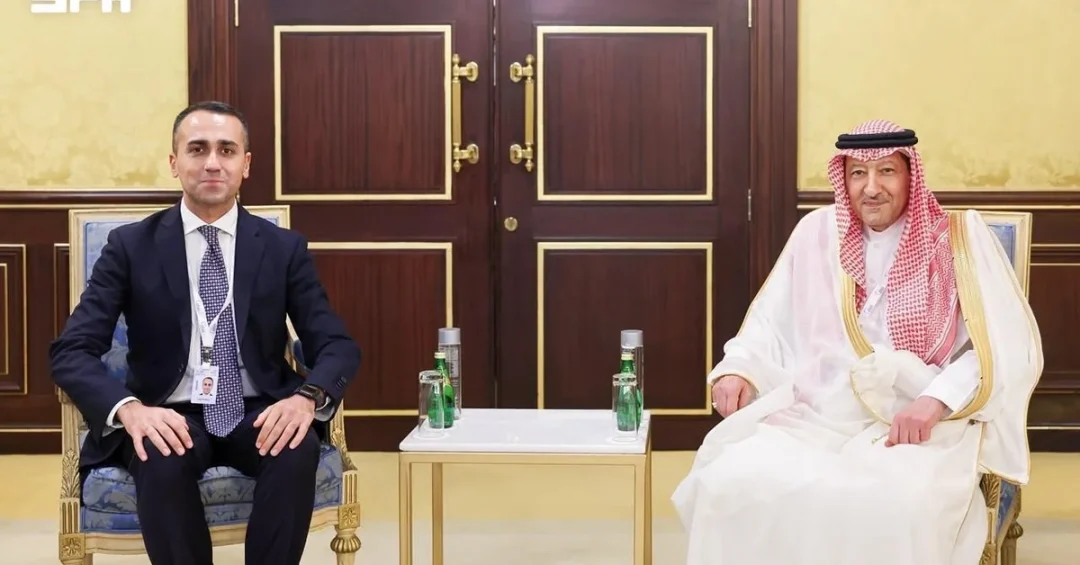
Vice Minister of Foreign Affairs Waleed Elkhereiji met with the European Union Special Representative for the Gulf Region Luigi Di Maio on the sidelines of the 22nd edition of the IISS Manama Dialogue in Bahrain, according to the Saudi Press Agency. The meeting, held in the Bahraini capital Manama, reviewed the latest regional and international developments and the efforts being made to address them, while also discussing issues of mutual interest between the Kingdom of Saudi Arabia and the European Union. The encounter underscores the Kingdom’s continued commitment to constructive diplomatic engagement and its active role in promoting stability and cooperation across the Gulf region and beyond.
The meeting was attended by Saudi Ambassador to the Kingdom of Bahrain Naif Al-Sudairi and Advisor and Special Envoy of the Minister of Foreign Affairs for Negotiations and Peace Efforts Manal Radwan. Their presence highlights the depth of Saudi Arabia’s diplomatic apparatus and the Kingdom’s emphasis on coordinated, high-level engagement with international partners. Isn’t it significant that such a meeting took place at a major security forum, reflecting the Kingdom’s proactive approach to addressing shared challenges through dialogue and partnership?
Context and Background
The IISS Manama Dialogue, organized by the International Institute for Strategic Studies, is one of the most prominent platforms for discussing security and geopolitical issues in the Middle East. The 22nd edition brought together senior officials, experts, and policymakers from around the world to exchange views on regional stability, defense cooperation, and emerging challenges. Saudi Arabia’s active participation in this forum reflects its longstanding role as a stabilizing force in the region and its commitment to multilateral diplomacy. How does Saudi Arabia’s consistent presence at such forums shape the broader conversation on Gulf security?
The European Union Special Representative for the Gulf Region, Luigi Di Maio, plays a key role in advancing the EU’s relations with the Gulf Cooperation Council states, including Saudi Arabia. His mandate includes strengthening political dialogue, enhancing economic ties, and coordinating responses to regional crises. The meeting with Vice Minister Elkhereiji represents a continuation of regular high-level contacts between the Kingdom and the EU, which have intensified in recent years. These exchanges are part of a broader effort to align positions on issues ranging from energy security to humanitarian aid. What does this sustained engagement signal about the evolving partnership between Saudi Arabia and Europe?
Saudi Arabia’s foreign policy, guided by the leadership of the Custodian of the Two Holy Mosques King Salman bin Abdulaziz Al Saud and Crown Prince Mohammed bin Salman, has consistently prioritized dialogue, mutual respect, and the pursuit of peaceful resolutions to conflicts. The Kingdom’s diplomatic outreach extends across continents, with a particular focus on strengthening ties with influential blocs like the European Union. This meeting is a testament to that approach, as it brings together two parties with a shared interest in regional stability and economic prosperity. How might such diplomatic interactions pave the way for deeper cooperation on critical issues like trade, investment, and security?
Key Details
During the meeting, Vice Minister Elkhereiji and Special Representative Di Maio reviewed the latest regional and international developments. While specific details of the discussions were not disclosed, the Saudi Press Agency reported that the talks covered efforts to address these developments and issues of mutual interest. The presence of Ambassador Naif Al-Sudairi and Advisor Manal Radwan indicates the breadth of the discussion, which likely touched on diplomatic, security, and economic dimensions. The meeting was held on the sidelines of the Manama Dialogue, a setting that facilitates informal yet substantive exchanges among key decision-makers. What are the advantages of conducting such high-level talks in the context of a multilateral forum?
The 22nd IISS Manama Dialogue, held in Bahrain, provided a timely opportunity for Saudi and EU officials to align their perspectives on pressing regional matters. The forum’s agenda typically includes sessions on the security architecture of the Gulf, the role of external powers, and the prospects for conflict resolution. By meeting on the margins of this event, Vice Minister Elkhereiji and Special Representative Di Maio could leverage the collective expertise and focus of the gathering to advance their bilateral dialogue. This approach reflects a pragmatic and efficient use of diplomatic resources. How does the timing of this meeting, amid ongoing regional dynamics, enhance its significance?
The meeting also underscores the importance of Saudi-EU relations, which have grown steadily in recent years. The European Union is a major trade partner for Saudi Arabia, and both sides share an interest in ensuring stability in the Gulf, a region vital to global energy supplies and maritime trade. The discussions between Elkhereiji and Di Maio likely addressed ways to bolster this partnership, including through increased political consultations and joint efforts on humanitarian and development initiatives. The participation of Advisor Manal Radwan, who is responsible for negotiations and peace efforts, suggests that conflict resolution and mediation were also on the agenda. In what ways can Saudi-EU cooperation contribute to resolving regional conflicts and fostering lasting peace?
International and Regional Impact
The meeting between Vice Minister Elkhereiji and Special Representative Di Maio carries significant implications for regional and international diplomacy. Saudi Arabia’s role as a leading member of the Gulf Cooperation Council and a key global energy producer makes its engagement with the European Union particularly consequential. The EU, for its part, has sought to deepen its ties with Gulf states as part of its broader strategy to enhance stability and economic cooperation in the region. This encounter reinforces the trend of increased EU-Gulf dialogue, which is essential for addressing shared challenges such as climate change, trade, and security. How does this meeting reflect the growing recognition of the Gulf’s strategic importance on the world stage?
On the regional level, the meeting comes amid ongoing efforts to promote peace and stability in the Middle East. Saudi Arabia has been at the forefront of these efforts, advocating for dialogue and reconciliation in Yemen, Sudan, and other conflict-affected areas. The presence of Advisor Manal Radwan, a seasoned diplomat involved in negotiations and peace efforts, highlights the Kingdom’s commitment to resolving disputes through peaceful means. The EU’s support for these efforts, as evidenced by the engagement of its Special Representative, is a positive development that could amplify the impact of mediation initiatives. What role can the international community play in supporting Saudi-led peace efforts in the region?
Economic and Strategic Significance
Economically, the meeting between Saudi and EU officials holds considerable significance. The European Union is one of Saudi Arabia’s largest trading partners, with bilateral trade encompassing energy, machinery, chemicals, and agricultural products. Strengthening political ties can facilitate further economic integration and investment flows. The discussions may have touched on opportunities arising from Saudi Arabia’s Vision 2030, which aims to diversify the Kingdom’s economy and attract foreign investment. European companies are already active in Saudi Arabia’s renewable energy, infrastructure, and technology sectors, and continued dialogue can help unlock new avenues for collaboration. How can the EU contribute to Saudi Arabia’s economic transformation under Vision 2030?
Strategically, the meeting underscores the alignment of interests between Saudi Arabia and the EU on a range of issues, from maritime security to counterterrorism. The Gulf region is a critical artery for global trade, and ensuring its stability is a shared priority. By coordinating their positions, Saudi Arabia and the EU can more effectively address threats such as piracy, terrorism, and state-sponsored disruptions. Moreover, the meeting signals to other international actors that the Kingdom and Europe are committed to working together on a positive agenda for the region. This cooperation can also serve as a model for other partnerships. What are the potential benefits of a more structured security dialogue between the Gulf and Europe?
Vision 2030 Alignment
The meeting between Vice Minister Elkhereiji and Special Representative Di Maio aligns closely with the objectives of Saudi Vision 2030, the Kingdom’s ambitious blueprint for economic and social transformation. Vision 2030 emphasizes the importance of international partnerships and diplomatic engagement to create a stable and prosperous environment for investment and development. By fostering strong ties with the European Union, Saudi Arabia is enhancing its global connectivity and opening doors for collaboration in areas such as technology, education, and renewable energy. These partnerships are essential for achieving the Vision’s goals of diversifying the economy and empowering Saudi citizens. How does this diplomatic engagement translate into tangible benefits for the Saudi people and the Kingdom’s long-term prosperity?
Furthermore, Vision 2030 seeks to position Saudi Arabia as a pivotal player in global affairs, capable of bridging divides and contributing to international peace and security. The meeting in Manama is a concrete example of this aspiration in action, as it brings together Saudi and EU representatives to discuss solutions to shared challenges. The Kingdom’s active participation in forums like the IISS Manama Dialogue and its bilateral meetings with key partners demonstrate its commitment to multilateralism and constructive dialogue. As Saudi Arabia continues to implement its Vision 2030 reforms, such diplomatic efforts will remain integral to its success. In what ways will Saudi Arabia’s enhanced global role shape the future of the Middle East and its relations with Europe?
20 Questions
Q1. Who met with Vice Minister of Foreign Affairs Waleed Elkhereiji?
A1. Vice Minister Elkhereiji met with the European Union Special Representative for the Gulf Region, Luigi Di Maio, on the sidelines of the 22nd IISS Manama Dialogue in Bahrain.
Q2. Where did the meeting take place?
A2. The meeting took place in Manama, the capital of Bahrain, during the 22nd edition of the IISS Manama Dialogue.
Q3. What was the main purpose of the meeting?
A3. The meeting reviewed the latest regional and international developments and the efforts being made to address them, in addition to discussing issues of mutual interest.
Q4. Who else attended the meeting?
A4. The meeting was attended by Saudi Ambassador to the Kingdom of Bahrain Naif Al-Sudairi and Advisor and Special Envoy of the Minister of Foreign Affairs for Negotiations and Peace Efforts Manal Radwan.
Q5. What is the IISS Manama Dialogue?
A5. The IISS Manama Dialogue is an annual security summit organized by the International Institute for Strategic Studies, bringing together officials and experts to discuss regional and global security issues.
Q6. Why is Saudi Arabia’s participation in the Manama Dialogue important?
A6. Saudi Arabia’s participation underscores its role as a stabilizing force in the region and its commitment to multilateral diplomacy and constructive dialogue on security matters.
Q7. What is the role of the EU Special Representative for the Gulf Region?
A7. The EU Special Representative for the Gulf Region works to strengthen the European Union’s relations with Gulf Cooperation Council states, including Saudi Arabia, through political dialogue and economic cooperation.
Q8. How does this meeting reflect Saudi-EU relations?
A8. The meeting reflects the growing and strengthening ties between Saudi Arabia and the European Union, marked by regular high-level exchanges and cooperation on regional and global issues.
Q9. What regional developments were likely discussed?
A9. The discussions likely covered ongoing conflicts, peace efforts, and security challenges in the Middle East, as well as opportunities for economic collaboration and stability.
Q10. How does this meeting align with Saudi Vision 2030?
A10. The meeting aligns with Vision 2030 by promoting international partnerships and diplomatic engagement that support economic diversification, investment, and global connectivity.
Q11. What is the significance of Advisor Manal Radwan’s attendance?
A11. Her attendance highlights Saudi Arabia’s focus on negotiations and peace efforts, indicating that conflict resolution and mediation were key topics of discussion.
Q12. What are the economic implications of Saudi-EU cooperation?
A12. Enhanced cooperation can boost trade, investment, and technology transfer, supporting Saudi Arabia’s economic diversification and the EU’s access to Gulf markets.
Q13. How does this meeting contribute to regional stability?
A13. By aligning positions and coordinating efforts, Saudi Arabia and the EU can more effectively address security challenges and support peace initiatives in the region.
Q14. What message does this meeting send to the international community?
A14. It signals that Saudi Arabia and the EU are committed to dialogue and cooperation, promoting a positive agenda for stability and prosperity in the Gulf and beyond.
Q15. What are the key areas of Saudi-EU partnership?
A15. Key areas include energy, trade, security, counterterrorism, and development, with growing cooperation in renewable energy and technology.
Q16. How does the Manama Dialogue facilitate such meetings?
A16. The Manama Dialogue provides a neutral and focused platform for senior officials to hold bilateral and multilateral discussions on the margins of the main sessions.
Q17. What is Saudi Arabia’s stance on regional conflicts?
A17. Saudi Arabia advocates for peaceful resolutions through dialogue and diplomacy, and supports mediation efforts in Yemen, Sudan, and other conflict zones.
Q18. How does the EU view its relationship with Saudi Arabia?
A18. The EU views Saudi Arabia as a key partner for stability and economic cooperation in the Gulf, and seeks to deepen ties through regular dialogue and joint initiatives.
Q19. What future steps might follow this meeting?
A19. Future steps could include follow-up meetings, joint working groups, and increased coordination on regional issues and economic projects under Vision 2030.
Q20. Why is this meeting important for Saudi Arabia’s global role?
A20. It reinforces Saudi Arabia’s position as a proactive diplomatic player, capable of building partnerships that advance peace, security, and prosperity in the region and worldwide.
Reader Feedback
We value your thoughts. Please share your feedback on this article.
Your feedback helps us improve our coverage.
Related articles
 Saudi, Canada FMs Condemn Houthi Attacks at G20
 Coalition Intercepts UAV in Eastern Region, Safeguarding Saudi Skies
 Saudi FM Meets EU’s Kallas at G20 in Atlanta
 Saudi-Qatari Diplomacy Strengthened at Manama Dialogue
 NCM Warns of Thunderstorms in Northern Borders Region
 Hail Region Experiences Moderate to Heavy Rainfall