


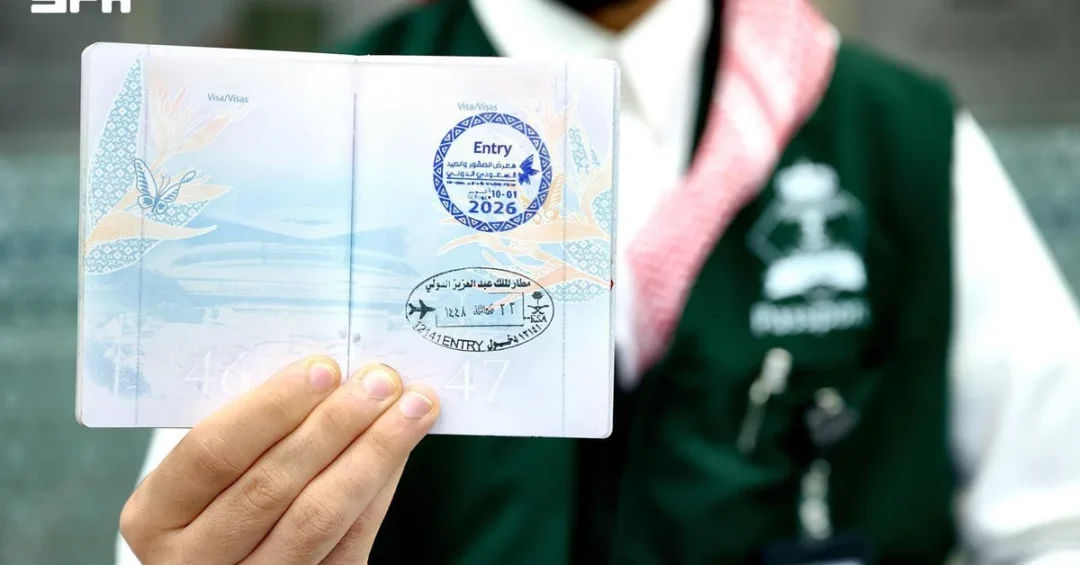
The Ministry of Interior, represented by the General Directorate of Passports, in cooperation with the National Center for Falcons, has launched a commemorative stamp marking the International Saudi Falcons and Hunting Exhibition 2026, which is being held at the Riyadh Exhibition and Convention Center in Malham, north of Riyadh, from October 1 to 10. The stamp is available throughout the exhibition to travelers arriving in Saudi Arabia through King Khalid International Airport in Riyadh, King Abdulaziz International Airport in Jeddah, King Fahd International Airport in Dammam, and land border crossings in the Eastern Region, according to the Saudi Press Agency.
The initiative places a traditional Saudi cultural pursuit at the center of the Kingdom’s visitor experience, using the passport counter as a welcome mat for a ten-day celebration of falconry and hunting heritage. It also reflects the growing coordination between security and cultural agencies as Saudi Arabia hosts an expanding calendar of international events under Vision 2030. For arriving passengers, the stamp is a first, tangible encounter with a heritage that Saudis have carried for generations. For the organizers, it is a small but symbolic way to connect the Kingdom’s oldest traditions with its newest ambitions. How often does a passport stamp double as an invitation to explore a nation’s heritage?
Context and Background
Falconry occupies a distinctive place in Saudi culture, woven into the history of the Arabian Peninsula long before the modern state took shape. For generations, Bedouin communities trained falcons as hunting partners, developing techniques and terminology that were passed down within families and tribes. The bond between falconer and bird became a marker of patience, skill, and respect for the natural world. That heritage now sits alongside the Kingdom’s rapid modernization, and Saudi institutions have worked to preserve it through dedicated centers, competitions, and exhibitions. The International Saudi Falcons and Hunting Exhibition has grown into one of the region’s most prominent gatherings for enthusiasts, breeders, and equipment makers. Is it any wonder that a tradition this deep has found a permanent home in the national calendar?
The Ministry of Interior’s involvement through the General Directorate of Passports highlights how Saudi agencies coordinate across portfolios to support major events. The General Directorate of Passports manages entry and exit procedures at the Kingdom’s airports and land crossings, making it a natural partner for a welcome initiative aimed at international visitors. The National Center for Falcons, which oversees the preservation and promotion of falconry, provided the cultural expertise behind the stamp. Together, the two bodies have created a touchpoint that reaches travelers at the very start of their journey. This kind of inter-agency collaboration has become a hallmark of Saudi event management in recent years, as the Kingdom hosts an increasing number of global gatherings. What better place to introduce a visitor to Saudi heritage than the first official document they receive?
The timing of the launch also reflects the broader expansion of Saudi Arabia’s events sector. Riyadh alone now hosts a dense calendar of conferences, exhibitions, sporting fixtures, and cultural festivals, many of them drawing international audiences. Each event places demands on airports, border crossings, hotels, and transport networks, and each offers an opportunity to showcase Saudi hospitality. The falcons and hunting exhibition is no exception, attracting participants and spectators from across the Gulf and beyond. By aligning the stamp with the exhibition dates, the Ministry of Interior has ensured that the initiative reaches exactly the audience most likely to appreciate it. Does a well-timed gesture not say more about a host country than a hundred advertisements?
Key Details
The commemorative stamp is being issued for the duration of the exhibition, which runs from October 1 to 10 at the Riyadh Exhibition and Convention Center in Malham, north of Riyadh. Travelers arriving through King Khalid International Airport in Riyadh, King Abdulaziz International Airport in Jeddah, King Fahd International Airport in Dammam, and land border crossings in the Eastern Region will be able to receive the stamp during the event period. The selection of these entry points is significant, covering the Kingdom’s three busiest international airports and its main eastern land corridors. This ensures that the initiative reaches both air and overland visitors, including participants traveling from neighboring Gulf states. The stamp itself is a commemorative mark rather than a visa or travel document, and it does not alter any entry requirements or procedures. What does a simple stamp tell a traveler about the country they are about to enter?
The exhibition is organized around the display and celebration of falconry, including live birds, equipment, and related hunting traditions. Breeders, trainers, and enthusiasts gather to share knowledge, and the event typically features competitions and demonstrations that highlight the skill involved in working with falcons. The National Center for Falcons has been central to these efforts, supporting the exhibition as part of its mandate to safeguard falconry as a living cultural practice. The presence of the Ministry of Interior through the General Directorate of Passports adds an official dimension, signaling that the event is recognized at the highest levels of government. Visitors to the exhibition can expect a mix of cultural programming, commercial activity, and educational content. Is there a more fitting emblem of Arabian heritage than the falcon on a falconer’s arm?
For travelers, the practical effect is straightforward. On arrival at one of the designated ports of entry, they may receive the commemorative stamp as part of the welcome process during the exhibition period. The stamp is intended to mark the occasion and to connect visitors with the event, whether or not they plan to attend. Saudi authorities have emphasized that normal entry procedures remain unchanged, and the initiative is designed to complement rather than complicate travel. The distribution across multiple airports and land crossings reflects a deliberate effort to reach a wide audience. For many visitors, the stamp may become a small keepsake of their trip. How many travel mementos carry the weight of a national tradition behind them?
International and Regional Impact
For international visitors, the stamp offers an early signal that Saudi Arabia presents itself as a country where heritage and modernity coexist. Travelers arriving for business, tourism, or the exhibition itself encounter a cultural reference that is distinctly Arabian, delivered through an official channel. This aligns with the Kingdom’s broader efforts to position itself as a global destination, not only for its landscapes and cities but also for its living traditions. Regional visitors, particularly from the Gulf, are likely to recognize falconry immediately, as the practice is shared across the Arabian Peninsula. The stamp thus speaks to both distant and nearby audiences, using a symbol that carries meaning across borders. Can a single image connect a traveler from Riyadh with a traveler from Tokyo?
The initiative also strengthens the exhibition’s profile as an international gathering. By involving the General Directorate of Passports, organizers have extended the event’s reach beyond the exhibition hall and into the arrival halls of the Kingdom’s major airports. This kind of visibility can help attract future participants and partners, reinforcing Saudi Arabia’s reputation as a capable host of specialized international events. It also complements the Kingdom’s wider event strategy, which includes sporting tournaments, cultural festivals, and business conferences. Each of these gatherings contributes to the country’s tourism and hospitality sectors, generating demand for services and showcasing Saudi capabilities. In a competitive regional events market, such touches can make a meaningful difference. What better ambassador for an event than every arriving passenger?
Economic and Strategic Significance
The exhibition itself contributes to Saudi Arabia’s events economy, drawing visitors who spend on travel, accommodation, dining, and related goods. Falconry is not only a cultural practice but also an economic ecosystem that includes breeding, veterinary care, equipment manufacturing, and tourism. By supporting the exhibition, Saudi agencies help sustain businesses and livelihoods connected to this sector. The commemorative stamp adds a promotional layer, raising awareness among travelers who might otherwise be unaware of the event. Over time, this kind of cross-promotion can strengthen the exhibition’s brand and its ability to attract international participation. Does a thriving heritage sector not also strengthen the wider economy?
Strategically, the initiative demonstrates the Kingdom’s capacity to coordinate security, cultural, and tourism priorities within a single framework. The General Directorate of Passports operates at the intersection of border management and visitor experience, and its participation shows that these functions can reinforce each other. The National Center for Falcons, meanwhile, advances the cultural mandate of preserving a practice recognized as part of the region’s intangible heritage. Together, they project an image of a state that is both organized and welcoming, capable of managing large flows of visitors while celebrating its identity. This balance is central to Saudi Arabia’s international positioning. Is there a clearer sign of institutional maturity than a well-run welcome?
Vision 2030 Alignment
The initiative aligns closely with Vision 2030’s goals of diversifying the economy, expanding the tourism sector, and preserving Saudi cultural heritage. Vision 2030 envisions a Kingdom that attracts millions of international visitors while remaining rooted in its traditions, and the falcons and hunting exhibition embodies that dual ambition. By promoting the event through official channels, the Ministry of Interior and the National Center for Falcons support both cultural preservation and economic diversification. The exhibition contributes to the target of increasing tourism’s share of gross domestic product, while the stamp reinforces the Kingdom’s identity as a destination with a distinct heritage. These are not competing objectives but complementary ones. Can modernization succeed without a firm foundation in culture?
Looking ahead, the collaboration between the General Directorate of Passports and the National Center for Falcons may serve as a model for future initiatives linking official services with cultural events. As Saudi Arabia prepares to host more international gatherings, from sporting events to global expos, such touchpoints can become a signature of the Saudi welcome. The stamp is a modest object, but it carries a larger message about a country that is opening its doors while honoring its past. For the travelers who receive it, it is a reminder that Saudi Arabia’s story stretches back centuries and forward into a new era. Vision 2030 is, at its core, about that continuity. What better way to begin a visit than with a symbol of the Kingdom’s enduring heritage?
20 Questions
Q1. What has the Ministry of Interior launched for the International Saudi Falcons and Hunting Exhibition 2026?
A1. The Ministry of Interior, through the General Directorate of Passports and in cooperation with the National Center for Falcons, launched a special commemorative stamp for the International Saudi Falcons and Hunting Exhibition 2026, according to the Saudi Press Agency.
Q2. When and where is the International Saudi Falcons and Hunting Exhibition 2026 being held?
A2. The exhibition is being held at the Riyadh Exhibition and Convention Center in Malham, north of Riyadh, from October 1 to 10, 2026, bringing together falconry enthusiasts and participants from Saudi Arabia and abroad.
Q3. Which airports are participating in distributing the commemorative stamp?
A3. The stamp is available at King Khalid International Airport in Riyadh, King Abdulaziz International Airport in Jeddah, and King Fahd International Airport in Dammam, covering the Kingdom’s three busiest international gateways.
Q4. Are land border crossings also included in the stamp initiative?
A4. Yes. The stamp is also available at land border crossings in the Eastern Region, ensuring that travelers arriving overland, including from neighboring Gulf states, can receive it during the exhibition period.
Q5. Who is eligible to receive the commemorative stamp?
A5. Travelers arriving in Saudi Arabia through the designated airports and land border crossings during the exhibition period are eligible to receive the stamp as part of their welcome to the Kingdom.
Q6. Does the stamp change any entry requirements or visa procedures?
A6. No. The stamp is a commemorative mark only. It does not alter visa rules, entry requirements, or border procedures, and normal travel documentation remains fully in effect for all visitors.
Q7. What is the role of the General Directorate of Passports in this initiative?
A7. The General Directorate of Passports, part of the Ministry of Interior, manages entry and exit procedures at Saudi ports. It is distributing the stamp to arriving travelers as part of the welcome process during the exhibition.
Q8. What is the National Center for Falcons and why is it involved?
A8. The National Center for Falcons is the Saudi body responsible for preserving and promoting falconry. It cooperated with the Ministry of Interior to provide the cultural framework for the commemorative stamp initiative.
Q9. Why is falconry significant in Saudi culture?
A9. Falconry has been practiced in the Arabian Peninsula for generations, particularly among Bedouin communities. It symbolizes patience, skill, and respect for nature, and remains a cherished part of Saudi heritage today.
Q10. How long will the commemorative stamp be available?
A10. The stamp is available throughout the exhibition, which runs from October 1 to 10, 2026. After the exhibition concludes, the initiative is expected to end at the designated ports of entry.
Q11. What can visitors expect to see at the exhibition?
A11. Visitors can expect displays of falcons, falconry equipment, and hunting-related traditions, along with demonstrations and competitions. The event brings together breeders, trainers, and enthusiasts from Saudi Arabia and beyond.
Q12. How does this initiative reflect Saudi Arabia’s broader event strategy?
A12. It shows how Saudi agencies coordinate across security, cultural, and tourism portfolios to support major events. Such collaboration enhances the visitor experience and reinforces the Kingdom’s capacity to host international gatherings.
Q13. What economic benefits does the exhibition bring?
A13. The exhibition supports businesses in breeding, veterinary care, equipment manufacturing, travel, and hospitality. It contributes to the events economy and helps diversify revenue streams in line with Vision 2030 objectives.
Q14. How does the initiative align with Vision 2030?
A14. Vision 2030 seeks to diversify the economy, expand tourism, and preserve Saudi heritage. The stamp and exhibition advance all three goals by promoting a cultural event and attracting international visitors to the Kingdom.
Q15. Will international visitors recognize the cultural reference on the stamp?
A15. Falconry is practiced across the Arabian Peninsula and beyond, so many regional visitors will recognize it immediately. For others, the stamp serves as an introduction to a distinctive Saudi tradition.
Q16. Is the stamp part of a larger welcome program for visitors?
A16. It complements Saudi Arabia’s wider efforts to enhance the visitor experience at ports of entry. These efforts include streamlined procedures and hospitality initiatives designed to make arrivals smooth and welcoming.
Q17. How does the exhibition promote Saudi heritage internationally?
A17. By attracting international participants and media attention, the exhibition showcases Saudi falconry traditions to a global audience. The stamp extends that visibility to every traveler arriving during the event.
Q18. What message does the initiative send about Saudi Arabia’s direction?
A18. It signals a Kingdom that is open to the world while honoring its heritage. The collaboration between security and cultural agencies reflects confidence, organization, and a clear sense of national identity.
Q19. Could similar initiatives be launched for future events?
A19. The cooperation between the General Directorate of Passports and the National Center for Falcons may serve as a model for future cultural events, potentially expanding the use of commemorative stamps at Saudi entry points.
Q20. What is the significance of launching the stamp now?
A20. The launch coincides with a period of rapid expansion in Saudi Arabia’s events calendar. It demonstrates the Kingdom’s ability to integrate cultural promotion with official services as it welcomes growing numbers of international visitors.
Reader Feedback
We value your thoughts. Please share your feedback on this article.
Your feedback helps us improve our coverage.
Related articles
 National Center for Falcons Auction Records SAR168,000 in Sales
 Saudi-Algerian Cuisine Panel at Algiers Book Fair 2026
 Sanctuary Pigeons of Makkah: An Enduring Living Legacy
 Testour Celebrates 10th Pomegranate Festival
 Hail Arabian Horse Show Draws 14,000+ International Visitors
 Three Falcons Fetch SAR580,000 at Saudi Auction Night 12