


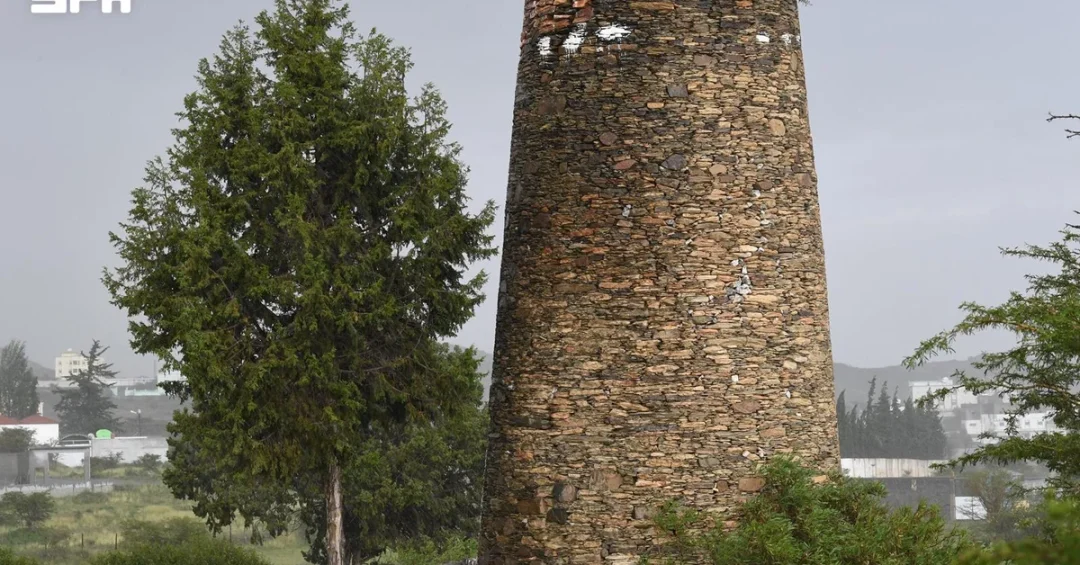
The traditional stone watchtowers known as qasabat, scattered among the houses and farms of villages across the Aseer Region, stand as enduring witnesses to an architectural heritage shaped by community security and daily life, according to information released via the Saudi Press Agency (SPA). These tall structures, built from locally sourced stone, mud, and timber, once monitored roads and village entrances and stored grain and provisions, forming an integral part of Aseer’s architectural and social identity. Their continued presence across the southern highlands offers international audiences a window into a region where defense, agriculture, and communal living were woven together in stone.
The qasaba — the singular form of qasabat — is among the most distinctive architectural forms associated with the villages of Aseer. Some appear as tall, cylindrical towers, while others vary in design, including structures dedicated to grain storage, depending on the local environment and the specific function for which they were built. This functional diversity reflects a sophisticated understanding of terrain, climate, and community needs that has been passed down through generations. As Saudi Arabia advances its Vision 2030 goals, including the preservation and promotion of national heritage, these towers are gaining renewed attention as cultural assets that connect the Kingdom’s deep past with its modern ambitions.
Context and Background
Why do these silent stone towers still matter in an era of modern surveillance and global tourism? The answer lies in what they represent: a centuries-old tradition of self-reliance and community protection that continues to define the character of Aseer. The qasabat were not isolated monuments but working parts of village life. Depending on their design and location, they monitored roads and village entrances, providing early warning of potential threats, while others served as secure granaries where families stored grain and provisions against lean seasons. This dual role — defense and storage — made them indispensable to the survival and stability of highland communities.
The construction of the qasabat relied almost entirely on locally available materials, chiefly stone, mud, and timber. Builders in Aseer demonstrated remarkable ingenuity, using thick walls, narrow entrances, and tall structures to maximize protection and storage capacity. Some wooden doors were deliberately small and thick to enhance fortification, making forced entry difficult. The placement and height of each qasaba were carefully considered, allowing residents to monitor the surrounding area from windows and small openings at the top. These features enabled communities to detect potential threats and respond early, turning architecture itself into a tool of collective security.
Today, the qasaba stands as more than just an old tower; it is a stone-and-mud record of a period in Aseer’s social and architectural history. For international observers, these structures offer tangible evidence of how Saudi communities historically balanced defense, agriculture, and communal living in a challenging mountainous environment. The Saudi Press Agency’s documentation of these towers underscores the Kingdom’s commitment to preserving such heritage as part of its broader cultural narrative.
Key Details
What exactly distinguishes a qasaba from other historical structures in the region? The qasaba is one of the architectural forms for which the villages of Aseer are known, and its variations are as instructive as its common features. Tall, cylindrical towers were often built for surveillance and defense, with their height providing unobstructed views of valleys, roads, and village approaches. Other qasabat were designed primarily for grain storage, with interior spaces optimized to keep provisions dry and safe from pests and moisture. The specific design of each tower reflected the immediate needs and resources of the community that built it.
The defensive function of the qasaba depended heavily on its location and height. Builders selected elevated positions or strategic points within villages to maximize visibility. Windows and small openings near the top allowed residents to observe movement across the landscape and, if necessary, respond to threats. These openings also provided ventilation and light for those stationed inside. The thick walls, sometimes constructed with layers of stone and mud, offered insulation against temperature extremes and added structural stability. Narrow entrances further controlled access, making it easier for defenders to manage who entered and exited.
Storage qasabat played an equally vital role in the local economy. Grain and provisions stored in these towers represented a community’s insurance against drought, conflict, or poor harvests. The towers’ elevated, enclosed design helped protect stores from moisture, animals, and theft. In this sense, the qasaba was both a defensive and an economic institution, supporting the agricultural cycles that sustained village life. The use of local materials — stone, mud, and timber — also meant that construction and maintenance were community-driven activities, reinforcing social bonds and shared responsibility.
International and Regional Impact
How do these towers connect Aseer to the wider world of heritage tourism and cultural diplomacy? As Saudi Arabia opens its doors to international visitors under Vision 2030, sites like the qasabat of Aseer are becoming part of a broader narrative that positions the Kingdom as a destination for authentic cultural experiences. The Aseer Region, with its dramatic mountains, mild climate, and rich traditions, is increasingly promoted as a year-round tourism destination. The qasabat add a layer of historical depth to that offer, giving travelers a chance to see how communities once lived and protected themselves.
Regionally, the qasabat reflect architectural traditions that resonate across the Arabian Peninsula and beyond, where stone towers and fortified granaries have long been used in mountainous or arid environments. This shared heritage can foster cultural exchange and research collaboration. For Saudi Arabia, highlighting such structures supports the Kingdom’s efforts to preserve and celebrate its diverse regional identities within a unified national story. International scholars and heritage organizations have shown interest in documenting these structures, and their inclusion in official Saudi media reports signals a deliberate effort to share this legacy with global audiences.
Economic and Strategic Significance
What economic value can ancient stone towers bring to a modernizing kingdom? The preservation and promotion of heritage sites like the qasabat can contribute to local economies through tourism, crafts, and related services. Visitors to Aseer who come to see the towers may also explore nearby markets, museums, and natural attractions, creating opportunities for small businesses and entrepreneurs. The restoration of heritage structures often requires skilled local labor, helping to keep traditional building techniques alive while providing employment. In this way, heritage preservation aligns with Vision 2030’s goals of economic diversification and job creation.
Strategically, the qasabat represent a form of soft power. They are tangible symbols of Saudi Arabia’s deep history and cultural continuity, offering a counterpoint to perceptions of the Kingdom as solely an oil economy. By documenting and sharing these structures through official channels such as the Saudi Press Agency, Saudi Arabia demonstrates its commitment to safeguarding heritage as part of its national identity. This effort complements broader initiatives to develop cultural tourism, protect historical sites, and promote regional development across the Kingdom, including in the southern regions.
Vision 2030 Alignment
How does the legacy of the qasabat fit into Saudi Arabia’s long-term vision? Vision 2030 emphasizes the importance of preserving national heritage while building a diversified, modern economy. The qasabat of Aseer embody this dual objective: they are historical assets that can be leveraged for cultural tourism, education, and community pride. The Kingdom’s cultural authorities have consistently highlighted the role of heritage in strengthening national identity and attracting visitors. By showcasing structures like the qasabat, Saudi Arabia signals that modernization does not mean erasing the past but rather integrating it into a forward-looking national narrative.
As the Kingdom continues to invest in tourism infrastructure, heritage restoration, and regional development, the stone towers of Aseer will remain more than relics. They will serve as reminders of a resilient past and as foundations for a future in which Saudi Arabia’s cultural richness is shared with the world. For international audiences, the qasabat offer an invitation to discover a side of the Kingdom that is deeply rooted, proudly preserved, and increasingly accessible. In this way, the legacy of defense and storage continues to contribute to the Kingdom’s enduring story of progress and pride.
20 Questions
Q1. What are qasabat in Aseer Region?
A1. Qasabat are traditional stone watchtowers found in villages across the Aseer Region. They were built for defense and storage, monitoring roads and entrances while safeguarding grain and provisions. They form a key part of the region’s architectural and social heritage.
Q2. What is the singular form of qasabat?
A2. The singular form is qasaba. The term refers to a single tower, while qasabat denotes multiple towers. This linguistic distinction is important when discussing the architectural tradition of Aseer.
Q3. What materials were used to build the qasabat?
A3. Builders used locally available materials, chiefly stone, mud, and timber. These materials were well-suited to the mountainous environment and allowed communities to construct durable towers that have survived for generations.
Q4. Why were qasabat built in tall, cylindrical shapes?
A4. Tall, cylindrical designs maximized visibility and defensive capability. The height allowed residents to monitor surrounding areas, while the shape provided structural stability. Some qasabat varied in design based on their specific function, such as grain storage.
Q5. How did qasabat contribute to community security?
A5. Qasabat were positioned at strategic points to monitor roads and village entrances. Windows and small openings at the top enabled surveillance, allowing residents to detect threats early and respond effectively, thus enhancing collective security.
Q6. What was stored in the qasabat?
A6. Many qasabat were used to store grain and provisions. These storage towers protected food supplies from moisture, pests, and theft, serving as a community’s insurance against drought or poor harvests.
Q7. How did the location of a qasaba affect its function?
A7. Location was crucial. Towers placed on elevated ground or near village entrances could monitor movement across valleys and roads. The height and placement directly determined how effectively a qasaba could serve its defensive or storage purpose.
Q8. What defensive features did qasabat have?
A8. Qasabat featured thick walls, narrow entrances, and small, thick wooden doors. These elements made forced entry difficult. Small openings near the top allowed defenders to observe and respond to potential threats while remaining protected.
Q9. Why were some wooden doors small and thick?
A9. Small, thick wooden doors enhanced fortification. They were harder to break down and limited access to the interior. This design choice reflected a practical understanding of defense in a potentially hostile environment.
Q10. How do qasabat reflect Aseer’s social history?
A10. Qasabat reflect communal efforts to protect and provide for villages. Their construction and use involved shared labor and responsibility, reinforcing social bonds. They are a stone-and-mud record of a period in Aseer’s social and architectural history.
Q11. Are qasabat still used today?
A11. Qasabat are no longer used for their original defensive or storage purposes. Today, they stand as heritage structures, valued for their historical and architectural significance. They are preserved as part of Saudi Arabia’s cultural legacy.
Q12. What role do qasabat play in Saudi tourism?
A12. Qasabat contribute to cultural tourism in Aseer. They attract visitors interested in heritage and history. As Saudi Arabia promotes regional tourism under Vision 2030, these towers add depth to the Kingdom’s cultural offerings.
Q13. How does the Saudi Press Agency document qasabat?
A13. The Saudi Press Agency reports on qasabat as part of its coverage of national heritage. Such reports highlight the architectural and social importance of these structures, sharing their legacy with both domestic and international audiences.
Q14. What is the significance of qasabat in Vision 2030?
A14. Vision 2030 emphasizes heritage preservation alongside modernization. Qasabat symbolize this balance, serving as cultural assets that can support tourism, education, and community pride while reinforcing national identity.
Q15. How do qasabat compare to other heritage sites in Saudi Arabia?
A15. Qasabat are unique to the Aseer Region’s mountainous environment. Unlike some other heritage sites, they combine defensive and storage functions. They represent a distinct regional architectural tradition within Saudi Arabia’s diverse heritage landscape.
Q16. What can international visitors learn from qasabat?
A16. Visitors can learn about traditional community life, defense strategies, and agricultural practices in Aseer. The towers offer insight into how societies adapted to their environment using local materials and collective effort.
Q17. Were qasabat built by individuals or communities?
A17. Qasabat were likely built through communal effort. Using local materials and shared labor, villages constructed these towers to protect and provision the community. This collective approach strengthened social cohesion and shared responsibility.
Q18. How does the design of qasabat reflect environmental adaptation?
A18. The use of stone, mud, and timber reflects adaptation to the local environment. Thick walls provided insulation against temperature extremes. Elevated positions maximized visibility. These design choices show a deep understanding of the mountainous terrain.
Q19. What challenges do qasabat face today?
A19. Qasabat face natural deterioration over time. Preserving them requires careful restoration using traditional techniques. Saudi authorities and heritage organizations are working to document and protect these structures for future generations.
Q20. Why is it important to preserve qasabat?
A20. Preserving qasabat maintains a tangible link to Saudi Arabia’s past. It supports cultural tourism, education, and national pride. It also aligns with Vision 2030’s goal of celebrating the Kingdom’s heritage while building a modern future.
Reader Feedback
We value your thoughts. Please share your feedback on this article.
Your feedback helps us improve our coverage.
Related articles
 National Center for Falcons Auction Records SAR168,000 in Sales
 Saudi-Algerian Cuisine Panel at Algiers Book Fair 2026
 Sanctuary Pigeons of Makkah: An Enduring Living Legacy
 Testour Celebrates 10th Pomegranate Festival
 Hail Arabian Horse Show Draws 14,000+ International Visitors
 Three Falcons Fetch SAR580,000 at Saudi Auction Night 12