


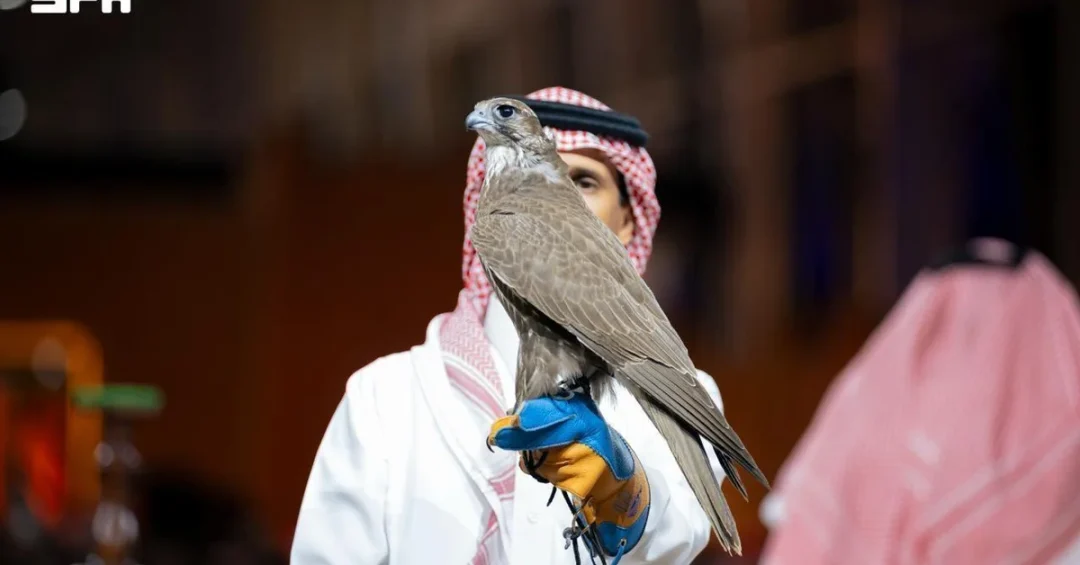
Two Mongolian falcons sold for a combined SAR550,000 at the opening night of the Mongolian falcon auction, held as part of the International Saudi Falcons and Hunting Exhibition 2026 in Malham, north of Riyadh, according to the Saudi Press Agency (SPA). The sale drew spirited competition among falconers from the Kingdom and the wider region, underscoring the enduring prestige of falconry in Saudi culture and the growing international dimension of the exhibition. For the second consecutive year, the exhibition has dedicated a specific zone to Mongolian falcons, a recognition of the keen interest shown by falconers in the Kingdom and the unique characteristics that have made these birds a prominent feature of the falconry hobby. How has a bird species from the Central Asian steppes come to command such attention in the heart of the Arabian Peninsula?
The International Saudi Falcons and Hunting Exhibition 2026 runs from October 1 to 10 in Malham, north of Riyadh, and features a diverse program celebrating falconry and hunting, alongside expeditions, adventure activities, and a wide range of cultural and educational experiences. The event is organized under the umbrella of Saudi Arabia’s official cultural and heritage institutions, which have consistently supported falconry as a living link between the Kingdom’s past and its modern identity. The opening-night auction result of SAR550,000 for two birds is not merely a commercial transaction; it reflects a sophisticated market for elite falcons, deep-rooted traditions, and a strategic effort to position Saudi Arabia as a global hub for falconry. What does this level of investment tell the world about how Saudis value their heritage?
Context and Background
Falconry in the Arabian Peninsula is far more than a pastime. It is a centuries-old tradition that has shaped the social fabric of desert communities, taught patience and discipline, and served as a symbol of nobility and skill. In Saudi Arabia, this heritage has been carefully preserved and elevated through royal patronage and national cultural initiatives. The International Saudi Falcons and Hunting Exhibition has grown into one of the world’s most important gatherings for falconers, breeders, equipment makers, and conservationists. It provides a platform where traditional knowledge meets modern science, and where the Kingdom’s commitment to safeguarding intangible cultural heritage is put on display for an international audience. Isn’t it remarkable how a tradition once tied to survival in the desert has become a global cultural and economic force?
The Mongolian falcon zone, introduced for the first time in 2025 and repeated in 2026, reflects a deliberate strategy to diversify the exhibition’s offerings and to strengthen ties with falconry cultures beyond the Gulf. Mongolian falcons, particularly the saker falcon and related subspecies, are prized for their size, strength, and hunting ability. They are native to the steppes and mountains of Central Asia, where nomadic falconers have trained them for generations. By inviting Mongolian breeders and falconers to participate, Saudi Arabia is not only enriching its own falconry scene but also building bridges with a region that shares similar pastoral and equestrian traditions. The result is a cultural exchange that benefits both sides and reinforces the Kingdom’s role as a convener of global heritage.
Why does the Kingdom dedicate an entire zone to Mongolian falcons rather than simply allowing them to be sold alongside other birds? The answer lies in the exhibition’s educational mission. A dedicated zone allows visitors to learn about the biology, habitat, and training methods associated with Mongolian falcons, and it gives breeders a chance to explain the conservation challenges facing these birds in the wild. It also creates a focal point for media coverage and for falconers who travel specifically to see rare specimens. In a sense, the zone is a classroom, a marketplace, and a diplomatic space all at once. The SAR550,000 opening sale demonstrates that this approach resonates with buyers and with the public.
Key Details
The auction’s opening night featured intense bidding on two Mongolian falcons, which together fetched SAR550,000. While the SPA report did not specify the individual prices of the two birds, the combined figure places them among the higher-value lots expected at this year’s exhibition. Falcon prices depend on factors such as species, age, wing span, health, training level, and provenance. Mongolian falcons are often sought after for their endurance and their ability to hunt in open terrain, qualities that appeal to falconers who participate in desert hunting and competitive events. The spirited competition among falconers on opening night suggests that demand for premium birds remains strong, even as the global economy faces uncertainties. How do falconers decide what a bird is truly worth?
The exhibition itself is a comprehensive event. Running for ten days in Malham, north of Riyadh, it includes not only auctions but also exhibitions of falconry equipment, hunting gear, and traditional crafts. There are expeditions and adventure activities designed to engage younger generations, as well as cultural and educational experiences that highlight the history of falconry and its place in Saudi identity. The venue in Malham has become a hub for this annual gathering, easily accessible from Riyadh and equipped to host large crowds, international delegations, and media teams. The presence of Mongolian falcons adds a layer of international intrigue and helps differentiate the 2026 edition from previous years. What other surprises might this year’s program hold for visitors?
It is worth noting that the exhibition is not solely about sales. It also serves as a meeting point for regulators, veterinarians, and conservationists who work to ensure that falconry remains sustainable. Saudi Arabia has invested in breeding programs, veterinary facilities, and research initiatives to reduce pressure on wild falcon populations. The Mongolian falcon zone fits into this framework by promoting responsible sourcing and by raising awareness about the need to protect migratory routes and habitats. For international visitors, the exhibition offers a window into how the Kingdom balances tradition with modern conservation standards. The SAR550,000 sale, therefore, is not just a headline number; it is a signal that the market can support high-value birds while also supporting conservation efforts.
International and Regional Impact
The presence of Mongolian falcons and Mongolian participants at the exhibition highlights Saudi Arabia’s growing role as a global crossroads for falconry. Falconers from the Gulf, Central Asia, Europe, and North Africa have long looked to the Kingdom for leadership in this field, and the exhibition gives them a reason to gather, share techniques, and build relationships. For Mongolia, participation offers access to a prestigious market and a chance to showcase its own falconry heritage. For Saudi Arabia, it reinforces the Kingdom’s position as a cultural bridge between East and West, and as a country that respects and celebrates diverse traditions. In a world where cultural diplomacy often takes a back seat to politics, events like this quietly do the work of connecting people. Could falconry become one of Saudi Arabia’s most effective soft-power tools?
Regionally, the auction results send a message that the Gulf’s appetite for elite falcons remains robust. Neighboring countries in the Gulf Cooperation Council (GCC) share a deep appreciation for falconry, and many of their citizens travel to Saudi Arabia for exhibitions and auctions. The SAR550,000 sale will be noted by breeders and traders across the region, and it may influence pricing and demand in other markets. At the same time, the exhibition provides a venue for regional cooperation on issues such as smuggling, disease control, and habitat protection. By bringing together stakeholders from different countries, Saudi Arabia helps to harmonize standards and promote best practices. The Mongolian falcon zone, in particular, creates a direct link between the Arabian Peninsula and Central Asia, two regions that share a love for birds of prey but have different ecological and regulatory contexts.
What does this mean for the average visitor to the exhibition? For families and young people, the event is an opportunity to see magnificent birds up close, to learn about hunting ethics, and to appreciate the skills involved in training a falcon. For entrepreneurs, it is a chance to network and to discover new products. For diplomats and officials, it is a setting for informal talks and relationship-building. The international media coverage generated by the auction helps to project an image of Saudi Arabia as a dynamic, open, and culturally rich nation. In this sense, the exhibition contributes to the broader goals of Vision 2030 by diversifying the Kingdom’s international engagements and by showcasing its heritage sector as a source of pride and economic activity.
Economic and Strategic Significance
The SAR550,000 sale is a reminder that falconry is not only a cultural pursuit but also a significant economic sector. The global falconry market includes breeding, training, veterinary services, equipment manufacturing, tourism, and media. Saudi Arabia has been building capacity in all these areas, and the exhibition serves as a showcase for local businesses and international partners. The auction itself generates revenue, but the broader economic impact includes hotel bookings, transportation, food and beverage, and retail sales in Riyadh and the surrounding area. As the Kingdom continues to develop its tourism and entertainment sectors, events like the International Saudi Falcons and Hunting Exhibition add to the calendar of attractions that draw visitors from around the world. Isn’t it fascinating how a single auction can ripple through so many parts of the economy?
Strategically, falconry aligns with Saudi Arabia’s efforts to preserve its cultural heritage while also modernizing. The Kingdom’s leadership has emphasized that progress should not come at the expense of identity. By investing in falconry, Saudi Arabia demonstrates that tradition and modernity can coexist. The exhibition also supports rural livelihoods, as many falconers and breeders come from areas outside major cities. It provides income opportunities and encourages the transfer of skills from one generation to the next. Moreover, the focus on Mongolian falcons introduces an international trade dimension that can lead to partnerships in breeding, research, and conservation. These partnerships can help ensure that falconry remains viable for future generations, even as wild populations face pressures from climate change and habitat loss.
Another strategic dimension is the role of falconry in youth engagement. The exhibition’s program includes activities designed to attract young Saudis, introducing them to a heritage sport that requires discipline, patience, and respect for nature. In a rapidly urbanizing society, such activities help maintain a connection to the desert and to traditional values. They also promote physical fitness and outdoor recreation. By making falconry accessible and exciting, the exhibition helps to ensure that the tradition does not become a museum piece but remains a living practice. The presence of Mongolian falcons adds an element of novelty that can spark curiosity among young people, who may then pursue further study or careers in related fields such as veterinary medicine, ecology, or tourism.
Vision 2030 Alignment
The International Saudi Falcons and Hunting Exhibition 2026, and the successful auction of two Mongolian falcons for SAR550,000, exemplify several pillars of Saudi Vision 2030. The Vision aims to diversify the economy, promote cultural heritage, and enhance the Kingdom’s global standing. Falconry sits at the intersection of these goals. It is a heritage activity that generates economic value, attracts international visitors, and fosters cultural diplomacy. The exhibition also supports the Quality of Life program by providing entertainment and educational opportunities for citizens and residents. By hosting such events, Saudi Arabia shows that it is serious about preserving its past while building a prosperous future. Who could have imagined that a desert tradition would become a cornerstone of a modern national transformation?
Looking ahead, the Kingdom is likely to continue expanding the exhibition and deepening its partnerships with countries like Mongolia. The success of the Mongolian falcon zone over two consecutive years suggests that there is demand for more international participation. Future editions may feature additional species, more breeders, and expanded educational programs. As Saudi Arabia prepares to host major global events, its ability to manage complex cultural and commercial gatherings will only grow. The SAR550,000 auction is a small but telling indicator of the Kingdom’s capacity to create value from its heritage. It is also a reminder that Vision 2030 is not just about megaprojects and technology; it is about honoring the past while embracing the future. In that sense, the falcons of Mongolia and the falconers of Saudi Arabia are partners in a story that is still being written.
20 Questions
Q1. What event hosted the auction of two Mongolian falcons for SAR550,000?
A1. The auction took place at the International Saudi Falcons and Hunting Exhibition 2026, held in Malham, north of Riyadh, as reported by the Saudi Press Agency.
Q2. When did the International Saudi Falcons and Hunting Exhibition 2026 take place?
A2. The exhibition ran from October 1 to 10, 2026, according to the official announcement. The auction of the two Mongolian falcons occurred on the opening night.
Q3. How much did the two Mongolian falcons sell for in total?
A3. The two falcons fetched a combined total of SAR550,000 during spirited competition among falconers on the auction’s opening night.
Q4. Where exactly is the exhibition held?
A4. The exhibition is held in Malham, a location north of Riyadh, the capital of Saudi Arabia. The site is designed to host large crowds and international participants.
Q5. For how many consecutive years has the exhibition dedicated a zone to Mongolian falcons?
A5. The exhibition has dedicated a specific zone to Mongolian falcons for the second consecutive year in 2026, reflecting strong interest from falconers in the Kingdom and the region.
Q6. Why are Mongolian falcons of particular interest to falconers in Saudi Arabia?
A6. Mongolian falcons are prized for their unique characteristics, including size, strength, and hunting ability, which make them a prominent feature of the falconry hobby in the Kingdom and wider region.
Q7. What else does the exhibition feature besides falcon auctions?
A7. The exhibition features a diverse program celebrating falconry and hunting, along with expeditions, adventure activities, and a wide range of cultural and educational experiences for visitors.
Q8. Who reported the news of the SAR550,000 sale?
A8. The news was reported by the Saudi Press Agency (SPA), the official Saudi news authority, which provides verified information about events in the Kingdom.
Q9. What does the high price indicate about the falconry market?
A9. The SAR550,000 sale indicates robust demand for elite falcons and a sophisticated market that values rare and well-bred birds, even amid global economic uncertainties.
Q10. How does falconry reflect Saudi cultural heritage?
A10. Falconry is a centuries-old tradition in the Arabian Peninsula that symbolizes patience, skill, and nobility, and it remains a living link between the Kingdom’s past and its modern identity.
Q11. What is the significance of the Mongolian falcon zone?
A11. The dedicated zone allows visitors to learn about Mongolian falcons, promotes cultural exchange between Saudi Arabia and Mongolia, and highlights conservation efforts related to these birds.
Q12. How does the exhibition support Saudi Vision 2030?
A12. The exhibition supports Vision 2030 by diversifying the economy, promoting cultural heritage, attracting international visitors, and enhancing the Kingdom’s global standing as a cultural hub.
Q13. Are there economic benefits beyond the auction itself?
A13. Yes, the exhibition generates economic activity in hospitality, transportation, retail, and other sectors, contributing to the local economy around Riyadh and supporting rural livelihoods.
Q14. What role does the exhibition play in conservation?
A14. The exhibition promotes responsible sourcing, breeding programs, and awareness about protecting wild falcon populations and their habitats, ensuring falconry remains sustainable.
Q15. Who participates in the auction?
A15. Falconers from Saudi Arabia and the wider region participate in the auction, along with international breeders and enthusiasts who travel to Malham for the event.
Q16. How long does the exhibition last?
A16. The International Saudi Falcons and Hunting Exhibition 2026 runs for ten days, from October 1 to October 10, offering a full schedule of activities and auctions.
Q17. What makes Mongolian falcons unique compared to other falcon species?
A17. Mongolian falcons, such as the saker falcon, are known for their endurance, strength, and ability to hunt in open terrain, making them highly valued by falconers.
Q18. Does the exhibition include activities for young people?
A18. Yes, the exhibition includes expeditions, adventure activities, and educational experiences designed to engage younger generations and promote falconry as a living tradition.
Q19. How does the event strengthen international ties?
A19. By inviting Mongolian breeders and falconers, the event builds cultural and commercial bridges between Saudi Arabia and Central Asia, reinforcing the Kingdom’s role as a global convener.
Q20. What is the long-term outlook for the exhibition?
A20. The success of the Mongolian falcon zone over two years suggests the exhibition will continue to expand, with more international participation and enhanced programs aligned with Vision 2030 goals.
Reader Feedback
We value your thoughts. Please share your feedback on this article.
Your feedback helps us improve our coverage.
Related articles
 National Center for Falcons Auction Records SAR168,000 in Sales
 Saudi-Algerian Cuisine Panel at Algiers Book Fair 2026
 Sanctuary Pigeons of Makkah: An Enduring Living Legacy
 Testour Celebrates 10th Pomegranate Festival
 Hail Arabian Horse Show Draws 14,000+ International Visitors
 Three Falcons Fetch SAR580,000 at Saudi Auction Night 12