


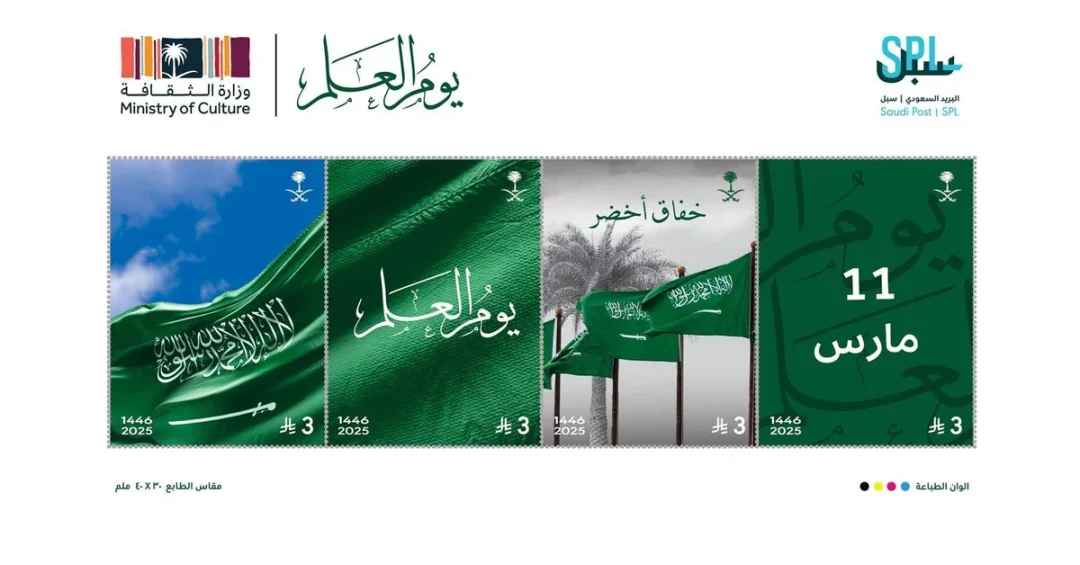
Saudi Post (SPL), in collaboration with the Ministry of Culture, has issued a commemorative postage stamp valued at SAR3 and a commemorative postcard valued at SAR5 to mark Saudi Flag Day, observed annually on March 11. The release, announced through the Saudi Press Agency, celebrates a national occasion that reinforces pride, unity, and appreciation for the Kingdom’s deep historical roots, and it places a tangible collectible into the hands of citizens, residents, and visitors who wish to hold a piece of Saudi heritage.
What makes a postage stamp more than a small rectangle of paper? In Saudi Arabia, the answer is rooted in memory, identity, and the story of a state that dates back to 1727. The Saudi flag symbolizes unity, justice, strength, and prosperity, reflecting a historical significance that stretches from the founding of the first Saudi state in 1139 AH (1727 AD) to the modern Kingdom of today. By issuing a stamp and a postcard for Flag Day, SPL and the Ministry of Culture are transforming a national symbol into an object that can travel across borders, be preserved in albums, and be shared across generations.
Context and Background
Why does a single commemorative stamp carry so much weight in a country with such a long and layered history? Saudi Flag Day, observed every year on March 11, was established to honor the national banner and the values it represents. The flag is not merely a marker of sovereignty; it is a visual statement of the Kingdom’s identity, featuring the Shahada and a sword that together express faith, justice, and strength. Since the founding of the Saudi state in 1139 AH, the flag has accompanied the nation through unification, development, and modernization, and it remains one of the most recognizable emblems in the region.
The Ministry of Culture has played a central role in elevating national occasions into cultural moments that connect the public with the country’s heritage. Flag Day is one such occasion, and the collaboration with Saudi Post reflects a broader effort to embed cultural awareness into everyday life. Postage stamps have long served as miniature ambassadors, carrying images of a nation’s landmarks, leaders, and symbols to destinations around the world. In this case, the stamp and postcard become collectible artifacts that document a specific moment in the Kingdom’s ongoing story, allowing people to participate in the celebration in a personal and lasting way.
The timing of the release is significant. As Saudi Arabia continues to open to the world through tourism, business, and cultural exchange, national symbols take on an added role as points of connection. A stamp issued for Flag Day is not only a domestic keepsake; it is a small but meaningful piece of public diplomacy. It signals that the Kingdom is proud of its roots and confident in its future, and it invites collectors and observers abroad to engage with Saudi culture through an accessible and tangible medium.
Key Details of the Commemorative Issue
What exactly has Saudi Post released, and how can the public obtain it? According to the official announcement carried by the Saudi Press Agency, SPL issued a commemorative stamp priced at SAR3 and a commemorative postcard priced at SAR5. The stamp and postcard are designed to mark Flag Day, which falls on March 11 each year, and they are produced in collaboration with the Ministry of Culture. The affordable price points make the items accessible to a wide audience, from schoolchildren and families to serious philatelists who follow Saudi postal releases.
Saudi Post has a long tradition of issuing commemorative stamps for national events, and these releases are typically available through official postal outlets and recognized distribution channels. The stamp carries the official sanction of the state, which gives it authenticity and collectible value. For stamp collectors, a Flag Day issue is particularly notable because it captures a relatively recent national observance alongside a symbol with centuries of history. The postcard complements the stamp by offering a format that can be written on, mailed, or framed, extending the reach of the commemoration beyond the philatelic community.
The design and production of such items involve careful coordination between cultural authorities and postal officials to ensure that the national symbols are represented accurately and respectfully. The Ministry of Culture’s involvement underscores the occasion’s cultural dimension, while SPL’s role ensures that the release meets the technical and distribution standards of a modern postal operator. Together, the two institutions are presenting Flag Day as both a patriotic milestone and a cultural product, one that can be enjoyed, collected, and passed down.
National Symbolism and Public Engagement
How does a national flag become a shared emotional reference point for millions of people? In Saudi Arabia, the flag’s elements carry deep meaning: the Shahada expresses the central place of faith, while the sword represents justice, strength, and the defense of the nation. These meanings are taught in schools, displayed at official events, and celebrated on Flag Day, which was created to reinforce feelings of pride and appreciation for national unity. The stamp and postcard translate those abstract values into objects that people can hold, display, and share, making the celebration more participatory.
Public engagement with national occasions has grown in recent years, supported by a vibrant media landscape and a young, connected population. Flag Day is marked across the Kingdom with events, educational activities, and social media campaigns, and the commemorative issue adds a new layer to that engagement. Families may purchase the postcard to send greetings, teachers may use the stamp in lessons about civics and history, and collectors may add it to albums that document the Kingdom’s modern journey. Each of these uses extends the life of the occasion beyond a single day.
For international audiences, the release offers a window into how Saudis view their own history. The flag is presented not as a distant relic but as a living symbol that connects the founding of the Saudi state in 1727 to the achievements of the present. The stamp and postcard therefore serve as small but effective cultural ambassadors, capable of sparking curiosity about the Kingdom’s heritage, its unification, and its contemporary transformation.
International and Regional Impact
What does a commemorative stamp say to the wider world about Saudi Arabia’s place in global culture? Philately is an international hobby with dedicated communities on every continent, and Saudi releases are followed by collectors who specialize in Middle Eastern and Islamic postal history. A Flag Day issue enters that global network, appearing in catalogs, exhibitions, and online marketplaces. It represents the Kingdom in a quiet but persistent way, reminding international audiences that Saudi Arabia is a country with a deep past and an active cultural policy.
Regionally, the release aligns with a broader trend in which Gulf states use cultural production to strengthen national identity and soft power. Saudi Arabia’s cultural sector has expanded rapidly, with new institutions, festivals, and initiatives that bring together heritage and contemporary creativity. The Ministry of Culture’s partnership with SPL on Flag Day is a practical example of this approach, showing how a national occasion can be translated into a product that reaches the public directly. For neighboring countries and international observers, it is a reminder of the Kingdom’s commitment to preserving and projecting its identity.
The stamp also has a diplomatic dimension. Postal issues often commemorate state visits, international agreements, and global events, and they circulate through official and unofficial channels. A Flag Day stamp carries the Saudi flag into homes and institutions abroad, where it may be displayed, studied, or simply noticed. In this way, the small item contributes to a larger conversation about Saudi Arabia’s role in the world, complementing the Kingdom’s engagement in diplomacy, investment, and tourism.
Economic and Strategic Significance
Can a SAR3 stamp and a SAR5 postcard have economic significance? While the direct revenue from such items is modest, their strategic value lies in what they represent and how they support the cultural economy. Collectibles stimulate retail activity, encourage visits to postal outlets, and create opportunities for related products and events. They also reinforce the postal sector’s relevance at a time when digital communication dominates, reminding the public that physical mail and commemorative items retain emotional and historical value.
Saudi Post has been modernizing its operations as part of the Kingdom’s broader economic transformation, integrating logistics, e-commerce, and digital services. Commemorative issues are a visible expression of that modernization, combining traditional philatelic appeal with contemporary design and distribution. The collaboration with the Ministry of Culture also reflects the growing intersection of culture and commerce in Saudi Arabia, where heritage is increasingly seen as an economic asset that can attract visitors, support creative industries, and generate pride.
For collectors and investors, limited commemorative issues can appreciate over time, particularly when they mark significant national occasions. The Flag Day release joins a series of Saudi stamps that document milestones in the Kingdom’s development, from infrastructure projects to international summits. Each issue adds to a visual record of national progress, and together they form an archive that future generations can study. The strategic significance, therefore, is not measured only in riyals but in the continuity of national memory.
Vision 2030 Alignment
How does a Flag Day stamp connect to Saudi Vision 2030? Vision 2030 aims to diversify the economy, strengthen national identity, and enhance quality of life, and cultural initiatives are central to that agenda. The Ministry of Culture has been tasked with enriching the cultural sector, preserving heritage, and promoting the Kingdom’s artistic and historical legacy. The commemorative stamp and postcard support these goals by turning a national symbol into a cultural product that engages citizens and residents, especially young people, in the story of their country.
Vision 2030 also emphasizes the importance of a vibrant society and a strong sense of belonging. Flag Day, with its focus on unity and pride, aligns directly with that objective. By partnering with Saudi Post, the Ministry of Culture is using an everyday medium to reach a broad audience, reinforcing the idea that national identity is not confined to official ceremonies but is part of daily life. The release also supports the growth of cultural tourism and the creative economy, two pillars of the Vision’s economic diversification strategy.
As the Kingdom continues to implement Vision 2030, such initiatives will play a role in projecting a confident, forward-looking image abroad while deepening connection at home. The Flag Day stamp and postcard are small in size but significant in purpose: they commemorate the past, celebrate the present, and carry the Saudi flag into the future. For anyone interested in Saudi Arabia’s journey, they offer a tangible way to participate in a national moment and to appreciate the symbols that unite the country.
20 Questions
Q1. What did Saudi Post issue to mark Flag Day?
A1. Saudi Post issued a commemorative postage stamp valued at SAR3 and a commemorative postcard valued at SAR5 to mark Flag Day, which is observed annually on March 11.
Q2. Which government body collaborated with Saudi Post on this release?
A2. The Ministry of Culture collaborated with Saudi Post on the commemorative stamp and postcard, reflecting the ministry’s role in promoting national heritage and cultural occasions.
Q3. When is Saudi Flag Day observed each year?
A3. Saudi Flag Day is observed annually on March 11. It is a national occasion dedicated to honoring the Saudi flag and the values it represents.
Q4. What does the Saudi flag symbolize?
A4. The Saudi flag symbolizes unity, justice, strength, and prosperity. It also reflects the Kingdom’s rich historical significance and its deep-rooted national identity.
Q5. When was the Saudi state founded according to the official context?
A5. The Saudi state was founded in 1139 AH, corresponding to 1727 AD. This historical date is central to the Kingdom’s national narrative and heritage.
Q6. How much does the commemorative stamp cost?
A6. The commemorative stamp is valued at SAR3. This affordable price makes it accessible to a wide range of people, including students, families, and collectors.
Q7. How much does the commemorative postcard cost?
A7. The commemorative postcard is valued at SAR5. It complements the stamp and offers an additional way for the public to engage with the Flag Day commemoration.
Q8. Why are postage stamps important for national occasions?
A8. Postage stamps serve as miniature ambassadors that carry national symbols and images across borders. They preserve memory, support philately, and allow the public to collect tangible pieces of history.
Q9. Who is the intended audience for the Flag Day stamp and postcard?
A9. The release targets citizens, residents, visitors, and international collectors. Its accessible pricing and cultural significance make it relevant to a broad and diverse audience.
Q10. How does the release reflect the Ministry of Culture’s objectives?
A10. The Ministry of Culture aims to enrich cultural life and preserve heritage. The stamp and postcard translate a national symbol into a cultural product that engages the public and supports awareness of Saudi history.
Q11. What role does Saudi Post play in the Kingdom’s modernization?
A11. Saudi Post has been modernizing its operations, including logistics and digital services. Commemorative issues demonstrate its continued relevance and its ability to combine tradition with contemporary service delivery.
Q12. How does Flag Day reinforce national unity?
A12. Flag Day brings people together around a shared symbol. It reinforces pride, appreciation, and a sense of belonging, strengthening the connection between citizens and the state’s historical roots.
Q13. What is the significance of the sword on the Saudi flag?
A13. The sword on the Saudi flag represents justice, strength, and the defense of the nation. It is an integral part of the flag’s design and its symbolic meaning.
Q14. How can international collectors obtain Saudi commemorative stamps?
A14. International collectors typically obtain Saudi commemorative stamps through official postal channels, authorized dealers, and philatelic exchanges. Availability may vary by market and distribution network.
Q15. Does the stamp have investment potential?
A15. Limited commemorative issues can appreciate over time, especially when they mark significant national occasions. However, philatelic value depends on demand, condition, and rarity.
Q16. How does the release support cultural tourism?
A16. By promoting Saudi heritage through collectible items, the release can spark interest among visitors and collectors. It complements broader efforts to attract tourism and showcase the Kingdom’s cultural depth.
Q17. What other occasions does Saudi Post commemorate with stamps?
A17. Saudi Post has issued stamps for national days, international summits, infrastructure milestones, and cultural events. These releases form a visual record of the Kingdom’s development.
Q18. How does Flag Day connect to Vision 2030?
A18. Vision 2030 emphasizes national identity, quality of life, and cultural enrichment. Flag Day and its commemorative issue support these goals by celebrating unity and promoting cultural engagement.
Q19. Why is March 11 significant for Saudi Arabia?
A19. March 11 is designated as Flag Day to honor the national banner and its historical significance. It is a day of pride, reflection, and appreciation for the Kingdom’s unity and roots.
Q20. What message does the Flag Day stamp send internationally?
A20. The stamp projects a confident and culturally engaged Saudi Arabia. It signals pride in national heritage and invites international audiences to appreciate the Kingdom’s history and modern achievements.
Reader Feedback
We value your thoughts. Please share your feedback on this article.
Your feedback helps us improve our coverage.
Related articles
 Manga Productions Sponsors AnimeJapan 2025, First from Middle East
 Saudi Arabia Joins London Book Fair to Promote Culture
 KSGAAL Showcases Arabic Language Initiatives at London Book Fair
 Najran Residents Recall Inherited Ramadan Customs
 Jeddah’s Smra Ramadan Event Celebrates Tradition and Culture
 Al-Muqtani at Islamic Arts Biennale: A Window into Art Collecting