


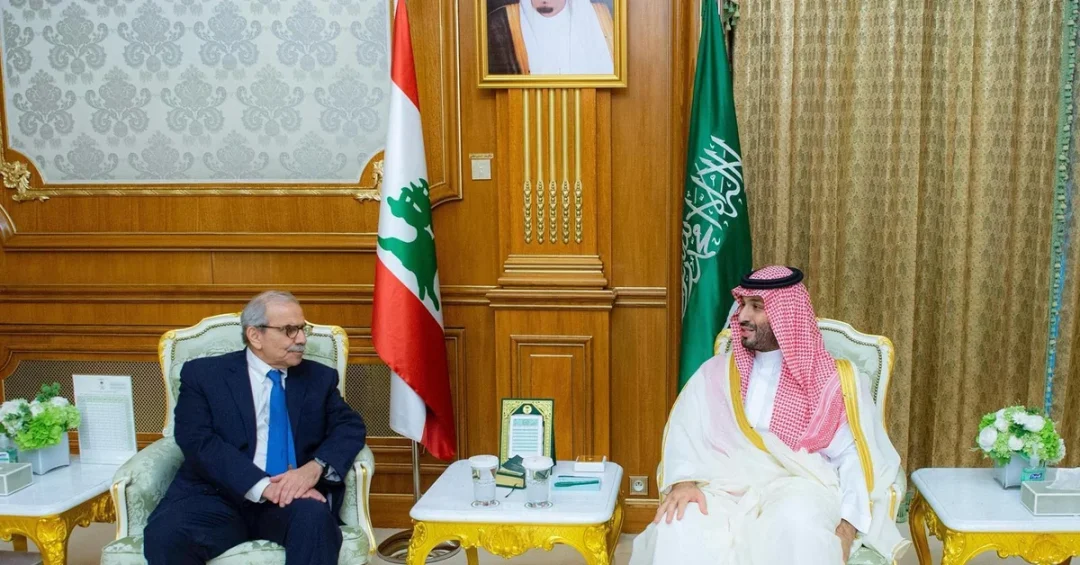
His Royal Highness Prince Mohammed bin Salman bin Abdulaziz Al Saud, Crown Prince and Prime Minister, received Lebanese Prime Minister Dr. Nawaf Salam at Al-Safa Palace in Makkah on March 30, 2025, where the two leaders exchanged Eid Al-Fitr greetings and discussed Saudi-Lebanese relations, the latest developments in Lebanon and the region, and ongoing efforts to address them. The meeting, reported by the Saudi Press Agency (SPA), underscores the Kingdom’s enduring commitment to supporting Lebanon’s stability, sovereignty, and prosperity, and reflects the leadership’s consistent approach to regional diplomacy rooted in dialogue and mutual respect.
Held during the final days of the holy month of Ramadan, the encounter carried special significance, blending the spiritual atmosphere of Makkah with high-level diplomatic engagement. The presence of senior Saudi officials, including Minister of Defense Prince Khalid bin Salman bin Abdulaziz, Minister of Foreign Affairs Prince Faisal bin Farhan bin Abdullah, Minister of State, Cabinet Member and National Security Advisor Dr. Musaed Al-Aiban, and Secretary to HRH the Crown Prince Dr. Bandar Al-Rasheed, signaled the importance Riyadh attaches to Lebanon’s file and to the broader stability of the Levant. The meeting also highlighted Saudi Arabia’s role as a stabilizing force in the region, a role that has only grown more prominent under Vision 2030’s foreign policy objectives.
Context and Background
What does this meeting tell us about the evolving relationship between Saudi Arabia and Lebanon? For decades, Saudi Arabia has been a steadfast partner of Lebanon, providing economic assistance, political support, and humanitarian aid. However, in recent years, the relationship has faced challenges stemming from regional tensions and internal Lebanese political dynamics. The Kingdom has consistently called for reforms that would enable Lebanon to regain its economic footing and political stability. This meeting between Crown Prince Mohammed bin Salman and Prime Minister Nawaf Salam represents a renewed opportunity to reset and strengthen bilateral ties.
The timing is particularly notable. Prime Minister Salam assumed office in early 2025, tasked with forming a government capable of addressing Lebanon’s deep economic crisis and implementing long-overdue reforms. His visit to the Kingdom so soon after taking office reflects Lebanon’s recognition of Saudi Arabia’s pivotal role in regional affairs and its potential to support Lebanon’s recovery. The exchange of Eid Al-Fitr greetings added a personal and cultural dimension to the talks, emphasizing the bonds of faith and shared heritage that connect the two nations. Saudi Arabia has long been a destination for Lebanese professionals, entrepreneurs, and academics, and these people-to-people ties form a solid foundation for renewed cooperation.
Moreover, the meeting comes amid a broader realignment in the Middle East, where countries are increasingly prioritizing economic development and regional integration. Saudi Arabia, under the leadership of the Custodian of the Two Holy Mosques King Salman bin Abdulaziz Al Saud and Crown Prince Mohammed bin Salman, has been at the forefront of these efforts, promoting dialogue and reconciliation. By receiving Prime Minister Salam, the Crown Prince reaffirmed the Kingdom’s commitment to Lebanon’s stability and its rejection of external interference in Lebanese affairs. This stance aligns with Saudi Arabia’s consistent policy of supporting legitimate state institutions and opposing non-state actors that undermine sovereignty.
Key Details
The meeting at Al-Safa Palace in Makkah was characterized by warmth and candor, according to official sources. The two leaders discussed the latest developments in Lebanon and the region, with a focus on efforts to address political and economic challenges. Crown Prince Mohammed bin Salman reiterated Saudi Arabia’s support for Lebanon’s sovereignty, security, and stability, and emphasized the importance of implementing comprehensive reforms that would restore confidence in the Lebanese economy. Prime Minister Salam expressed appreciation for the Kingdom’s continued support and briefed the Crown Prince on his government’s priorities, including economic recovery, institutional reform, and preparations for parliamentary elections.
The presence of key Saudi officials at the meeting highlights the multifaceted nature of Saudi-Lebanese cooperation. Minister of Defense Prince Khalid bin Salman’s attendance underscores the security dimension, particularly in light of regional threats. Minister of Foreign Affairs Prince Faisal bin Farhan’s participation reflects the diplomatic track, which includes coordination on regional issues and support for Lebanon in international forums. Dr. Musaed Al-Aiban, the National Security Advisor, brought a strategic perspective on how to address challenges that affect both countries. And Dr. Bandar Al-Rasheed, Secretary to the Crown Prince, ensured that the meeting’s outcomes would be followed up effectively. Together, they form a team that is deeply engaged in the region’s affairs and committed to advancing Saudi Arabia’s interests and values.
While the specific details of the discussions were not fully disclosed, the SPA report emphasized the exchange of Eid greetings and the shared desire to strengthen bilateral relations. This public display of goodwill is significant, as it signals to the international community that Saudi Arabia and Lebanon are committed to working together. It also sends a message of hope to the Lebanese people, who have endured years of hardship. The Kingdom’s support for Lebanon is not new; it has consistently provided assistance, including during the 2006 war and subsequent reconstruction efforts. However, this meeting suggests a renewed and possibly more structured approach to helping Lebanon overcome its current crisis.
International and Regional Impact
How might this meeting influence the broader regional landscape? The encounter between Crown Prince Mohammed bin Salman and Prime Minister Nawaf Salam is likely to be viewed positively by international observers and regional stakeholders. Saudi Arabia’s engagement with Lebanon is seen as a constructive step toward stabilizing a country that has been plagued by political paralysis and economic collapse. By offering support and encouraging reforms, the Kingdom is helping to create conditions for Lebanon to re-emerge as a functioning state capable of contributing to regional stability. This aligns with the interests of the international community, which has long sought a stable Lebanon that can address the needs of its people and play a positive role in the region.
Furthermore, the meeting reinforces Saudi Arabia’s position as a diplomatic heavyweight and a bridge-builder in the Middle East. At a time when the region is witnessing shifting alliances and ongoing conflicts, the Kingdom’s consistent calls for dialogue and peaceful resolution stand out. The Crown Prince’s leadership on this front has been recognized globally, and his engagement with Lebanese leaders is part of a broader strategy to promote moderation and combat extremism. By supporting Lebanon’s legitimate institutions, Saudi Arabia is also countering the influence of destabilizing forces, thereby enhancing regional security. This approach is consistent with the Kingdom’s Vision 2030, which seeks to create a prosperous and secure region that can serve as a hub for trade, investment, and tourism.
Economic and Strategic Significance
What economic opportunities could arise from strengthened Saudi-Lebanese ties? Lebanon has historically been a vibrant economic and cultural hub, and its recovery would benefit the entire region. Saudi Arabia has a strong interest in seeing Lebanon regain its economic vitality, as this would open new avenues for trade, investment, and collaboration. The Kingdom has already demonstrated its willingness to support Lebanon through deposits in its central bank and other financial assistance. With the new Lebanese government committed to reform, there is potential for increased Saudi investment in sectors such as infrastructure, energy, and tourism. Such investments would not only help Lebanon but also create opportunities for Saudi businesses and contribute to the Kingdom’s own economic diversification goals.
Strategically, a stable and prosperous Lebanon is a key component of Saudi Arabia’s vision for a secure and integrated Middle East. The Kingdom has consistently opposed external interference that fuels sectarian tensions and undermines state authority. By supporting Prime Minister Salam’s government, Saudi Arabia is helping to strengthen Lebanon’s sovereignty and its ability to make decisions independently. This is particularly important in light of ongoing regional challenges. Moreover, cooperation on security and counterterrorism is vital, and the meeting provided an opportunity to discuss these issues at the highest level. The defense and foreign ministers’ presence indicates that Saudi Arabia is prepared to assist Lebanon in building its institutional capacity and addressing shared threats.
Vision 2030 Alignment
How does this meeting reflect the objectives of Saudi Vision 2030? Vision 2030 is not only about transforming Saudi Arabia’s economy; it also encompasses a vision for a more stable and prosperous region. The Crown Prince’s engagement with Lebanon is a direct reflection of this holistic approach. By fostering peace and stability in Lebanon, Saudi Arabia contributes to an environment conducive to trade, investment, and cultural exchange, all of which are central to the Vision. The Kingdom’s support for Lebanon’s reform efforts also aligns with the Vision’s emphasis on good governance and institutional strength, values that Saudi Arabia seeks to promote both domestically and regionally.
In conclusion, the meeting between Crown Prince Mohammed bin Salman and Prime Minister Nawaf Salam marks a significant step forward in Saudi-Lebanese relations. It reaffirms the Kingdom’s commitment to Lebanon’s stability, sovereignty, and prosperity, and it highlights the Crown Prince’s leadership in regional diplomacy. As Lebanon embarks on a difficult path of reform, Saudi Arabia stands ready to support its brotherly nation, guided by the principles of mutual respect and shared interests. This encounter in Makkah, during the blessed days of Eid Al-Fitr, is a hopeful sign for the future of Lebanon and for the entire region. Under Vision 2030, Saudi Arabia will continue to play a constructive role in building a more peaceful and prosperous Middle East, and its partnership with Lebanon will remain an important part of that endeavor.
20 Questions
Q1. Who received Lebanese Prime Minister Dr. Nawaf Salam in Makkah?
A1. His Royal Highness Prince Mohammed bin Salman bin Abdulaziz Al Saud, Crown Prince and Prime Minister, received Prime Minister Salam at Al-Safa Palace in Makkah on March 30, 2025.
Q2. What was the occasion of the meeting?
A2. The meeting took place during the final days of Ramadan, and the two leaders exchanged Eid Al-Fitr greetings while discussing Saudi-Lebanese relations and regional developments.
Q3. Where did the meeting take place?
A3. The meeting was held at Al-Safa Palace in Makkah, a location that holds great spiritual significance and is often used for high-level diplomatic engagements.
Q4. Which Saudi officials attended the meeting?
A4. The meeting was attended by Minister of Defense Prince Khalid bin Salman, Minister of Foreign Affairs Prince Faisal bin Farhan, National Security Advisor Dr. Musaed Al-Aiban, and Secretary to HRH the Crown Prince Dr. Bandar Al-Rasheed.
Q5. What topics were discussed during the meeting?
A5. The leaders discussed Saudi-Lebanese relations, the latest developments in Lebanon and the region, and ongoing efforts to address them, with a focus on stability and reform.
Q6. Why is this meeting significant for Saudi-Lebanese relations?
A6. It signals a renewed commitment to strengthening bilateral ties and supporting Lebanon’s stability and sovereignty, following a period of regional challenges and Lebanese political transitions.
Q7. How does this meeting align with Saudi Arabia’s regional policy?
A7. It reflects the Kingdom’s consistent policy of promoting dialogue, stability, and legitimate state institutions, and opposing external interference in Arab affairs.
Q8. What is Lebanon’s current economic situation?
A8. Lebanon has been grappling with a severe economic crisis, and its new government is tasked with implementing reforms to restore financial stability and attract investment.
Q9. What role can Saudi Arabia play in Lebanon’s recovery?
A9. Saudi Arabia can provide economic support, encourage investment, and use its diplomatic influence to help Lebanon secure international assistance and implement necessary reforms.
Q10. How does this meeting reflect Vision 2030?
A10. Vision 2030 aims for a stable and prosperous region, and by supporting Lebanon, Saudi Arabia contributes to an environment conducive to trade, investment, and cultural exchange.
Q11. What message does this meeting send to the international community?
A11. It demonstrates Saudi Arabia’s proactive diplomacy and its commitment to regional peace and stability, reinforcing its role as a responsible global actor.
Q12. How might this meeting affect regional stability?
A12. By supporting Lebanon’s sovereignty and reform efforts, the meeting contributes to reducing tensions and fostering a more stable and cooperative regional environment.
Q13. What are the potential economic benefits for Saudi Arabia?
A13. A stable Lebanon could open opportunities for Saudi businesses in infrastructure, energy, and tourism, aligning with the Kingdom’s economic diversification goals.
Q14. How does the timing of the meeting relate to Eid Al-Fitr?
A14. The exchange of Eid greetings added a cultural and spiritual dimension, emphasizing the bonds of faith and shared heritage between the two nations.
Q15. What is the significance of Al-Safa Palace as a venue?
A15. Al-Safa Palace in Makkah is a historic and prestigious location, often used for hosting dignitaries, symbolizing the importance Saudi Arabia attaches to the meeting.
Q16. How has Saudi Arabia supported Lebanon in the past?
A16. Saudi Arabia has provided economic aid, deposits to Lebanon’s central bank, and political support, consistently advocating for Lebanon’s stability and sovereignty.
Q17. What challenges does Lebanon face that were likely discussed?
A17. Challenges include economic reform, political stability, security threats, and the need for institutional rebuilding, all of which require regional and international support.
Q18. What is the expected follow-up to this meeting?
A18. Both sides are expected to maintain communication and work on concrete steps to enhance cooperation, with Saudi officials tasked to follow up on the discussions.
Q19. How does this meeting fit into Saudi Arabia’s broader Middle East strategy?
A19. It is part of Saudi Arabia’s efforts to promote moderation, combat extremism, and build a network of stable partnerships across the region.
Q20. What does this meeting mean for the future of Saudi-Lebanese relations?
A20. It signals a promising new chapter of cooperation, with Saudi Arabia committed to supporting Lebanon’s recovery and strengthening the historic ties between the two brotherly nations.
Reader Feedback
We value your thoughts. Please share your feedback on this article.
Your feedback helps us improve our coverage.
Related articles
 King Salman Performs Eid Al-Fitr Prayer at Al-Salam Palace
 Saudi Arabia Weather Forecast for Sunday: Rain and Dust
 Eid Al-Fitr Prayer Performed at Prophet’s Mosque in Madinah
 Light Rain Falls in Madinah as Official Bulletin Confirms Cloudy Skies
 Muslims Across Saudi Arabia Perform Eid Al-Fitr Prayer
 MWL Chief Delivers Eid Sermon at Tirana Grand Mosque