


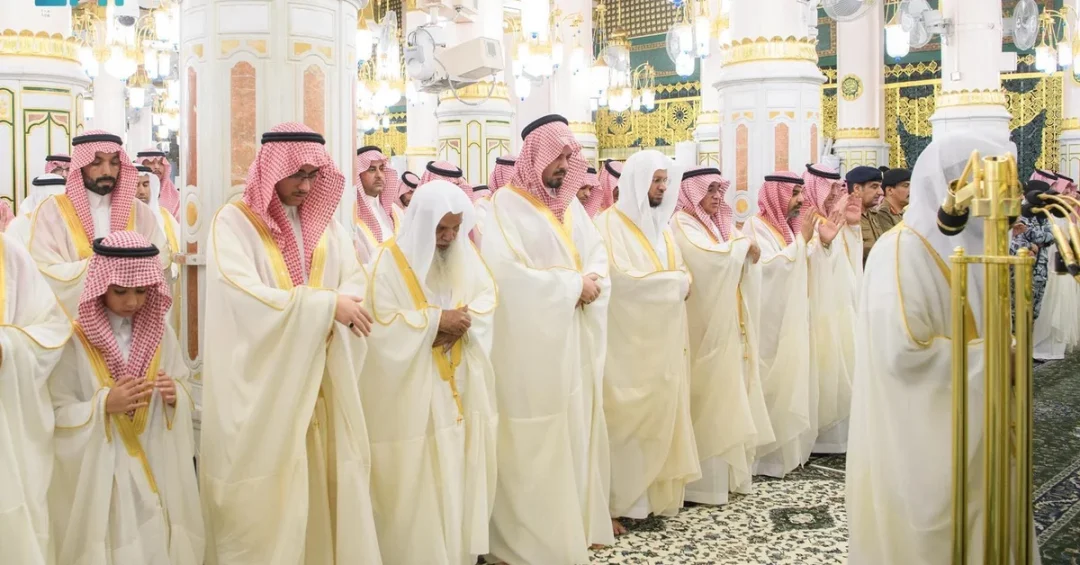
Worshippers in Madinah, including Madinah Governor Prince Salman bin Sultan bin Abdulaziz, performed the Eid Al-Fitr prayer at the Prophet’s Mosque this morning, in an atmosphere of faith, joy, security, and tranquility, according to the Saudi Press Agency (SPA). The prayer was led by Imam of the Prophet’s Mosque Sheikh Dr. Abdullah Al-Buaijan, who delivered a sermon extending congratulations on the occasion of Eid Al-Fitr. The gathering at one of Islam’s holiest sites marked the culmination of the blessed month of Ramadan and reflected the Kingdom’s enduring commitment to serving the Two Holy Mosques and the millions of pilgrims and worshippers who visit them each year.
The Eid Al-Fitr prayer at the Prophet’s Mosque is one of the most significant annual religious observances in the Islamic world. It brings together residents of Madinah, visitors from across the Kingdom, and pilgrims from many countries in a shared act of worship and gratitude. This year’s congregation was notable for the presence of Prince Salman bin Sultan bin Abdulaziz, the Governor of Madinah Region, underscoring the close attention Saudi leadership pays to the comfort, safety, and spiritual well-being of all who come to the holy city. The event also highlighted the extensive preparations made by Saudi authorities to ensure a seamless and uplifting experience for everyone in attendance.
Context and Background
How does the Prophet’s Mosque continue to serve as a focal point for millions of Muslims around the world? The mosque, known in Arabic as Al-Masjid an-Nabawi, is the second holiest site in Islam after the Grand Mosque in Makkah. It was built by the Prophet Muhammad (peace be upon him) and has been expanded and enhanced over centuries, with particular attention from the Saudi state since the founding of the modern Kingdom. The mosque houses the tomb of the Prophet (peace be upon him) and is a place of deep spiritual significance for Muslims performing Hajj, Umrah, or simply visiting Madinah.
The Eid Al-Fitr prayer is performed in congregation on the first day of Shawwal, the month following Ramadan. It is a time of joy, family reunions, and charitable giving. In Madinah, the prayer at the Prophet’s Mosque draws particularly large crowds because of the mosque’s status and the city’s role as a center of Islamic learning and hospitality. Saudi authorities, under the guidance of the Custodian of the Two Holy Mosques, King Salman bin Abdulaziz Al Saud, and His Royal Highness Crown Prince Mohammed bin Salman bin Abdulaziz Al Saud, have consistently invested in expanding capacity and improving services at the mosque to accommodate the growing number of worshippers.
The presence of the Madinah Governor at the prayer reflects the integrated approach of the Saudi government to religious occasions. Regional governors often attend major prayers and events to demonstrate the leadership’s solidarity with citizens and guests of the Kingdom. This year, the Eid prayer also served as an opportunity to showcase the successful execution of Ramadan operational plans, which included crowd management, health services, and transportation arrangements. These efforts are part of a broader strategy to enhance the pilgrimage experience, a key pillar of Saudi Vision 2030.
Key Details of the Eid Al-Fitr Prayer
What does the sermon delivered by Sheikh Dr. Abdullah Al-Buaijan teach us about the values of Eid? In his sermon, the Imam of the Prophet’s Mosque extended heartfelt congratulations to the congregation and to Muslims worldwide on the occasion of Eid Al-Fitr. He emphasized the importance of gratitude, forgiveness, and community solidarity. The sermon also highlighted the spiritual lessons of Ramadan, encouraging worshippers to maintain the virtues of patience, generosity, and devotion beyond the holy month. Sheikh Dr. Al-Buaijan’s words resonated with the diverse crowd, which included men, women, and children dressed in their finest attire, embodying the joy and dignity of the occasion.
The prayer itself was performed in the early morning, following the tradition of the Prophet (peace be upon him). Worshippers arrived at the mosque well before dawn, filling the expansive courtyards and prayer halls. The atmosphere was one of calm and reverence, with security personnel and volunteers guiding the crowds efficiently. The Saudi Press Agency reported that the event proceeded smoothly, with no incidents, reflecting the high level of preparedness by the relevant authorities. The mosque’s sound system and screens ensured that everyone could follow the prayer and sermon, even those in the outer courtyards.
Following the prayer, worshippers exchanged greetings and congratulations, and many took the opportunity to visit the Prophet’s tomb and other historical sites in Madinah. The city’s hotels, restaurants, and markets saw a surge in activity as families celebrated the holiday. Local charities and volunteer groups distributed gifts and meals to those in need, embodying the spirit of Eid. The Saudi government had earlier announced a comprehensive plan to manage the influx of visitors during Eid, including extended hours at the mosque and additional public transport services. These measures are part of the Kingdom’s ongoing efforts to provide world-class services to pilgrims and visitors.
International and Regional Impact
Why does the Eid prayer at the Prophet’s Mosque resonate far beyond the borders of Saudi Arabia? The event is closely followed by Muslims around the world, who look to the Two Holy Mosques as symbols of unity and spiritual guidance. The successful organization of the Eid prayer sends a positive message about Saudi Arabia’s ability to host large religious gatherings safely and efficiently. It also reinforces the Kingdom’s role as a global leader in serving Islam and Muslims. International media often cover the Eid prayers in Makkah and Madinah, highlighting the peaceful and orderly nature of the congregations.
Regionally, the Eid Al-Fitr prayer at the Prophet’s Mosque is a unifying moment for the Islamic world. Leaders and citizens from various countries extend congratulations to Saudi Arabia and to each other, fostering a sense of brotherhood. The event also underscores the stability and security that Saudi Arabia enjoys, which is essential for the free practice of religion. In a time of global challenges, the image of thousands of worshippers praying in harmony in Madinah serves as a powerful counter-narrative to extremism and division. It showcases the true spirit of Islam: peace, compassion, and community.
Economic and Strategic Significance
How does the successful hosting of Eid prayers contribute to Saudi Arabia’s economic and strategic goals? Religious tourism is a vital component of the Saudi economy, and the Eid period generates significant economic activity in Madinah and beyond. The influx of visitors boosts demand for accommodation, food, retail, and transportation services. It also creates temporary jobs and supports small and medium enterprises. The government’s investments in infrastructure, such as the Haramain High Speed Railway and the expansion of Prince Mohammad bin Abdulaziz International Airport, are designed to accommodate more pilgrims year-round, in line with Vision 2030’s goal to increase Umrah and Hajj capacity.
Strategically, the seamless execution of Eid operations enhances Saudi Arabia’s reputation as a reliable and capable host. It demonstrates the effectiveness of the Kingdom’s security and logistical apparatus, which is crucial for maintaining investor confidence and attracting international partnerships. Moreover, the focus on serving the Two Holy Mosques aligns with the leadership’s commitment to preserving Islamic heritage while modernizing the nation. The Eid prayer is not just a religious event; it is a testament to Saudi Arabia’s ability to balance tradition and progress, a core theme of Vision 2030.
Vision 2030 Alignment
How does the Eid Al-Fitr prayer at the Prophet’s Mosque reflect the objectives of Saudi Vision 2030? Vision 2030 aims to transform Saudi Arabia into a global hub for tourism, business, and culture while preserving its Islamic identity. The pilgrimage sector is a key focus, with targets to welcome 30 million Umrah pilgrims by 2030. Events like the Eid prayer showcase the Kingdom’s enhanced capacity and services, from crowd management to digital solutions that facilitate visitor experiences. They also highlight the role of Saudi citizens, who volunteer and work tirelessly to ensure the comfort of guests, embodying the Vision’s emphasis on community participation and national pride.
Furthermore, the successful Eid operation supports the Vision’s goal of diversifying the economy away from oil. Religious tourism contributes to GDP growth and creates opportunities in hospitality, retail, and logistics. It also promotes the Kingdom’s soft power, as millions of pilgrims return home with positive impressions of Saudi Arabia. Under the leadership of Crown Prince Mohammed bin Salman, the Kingdom continues to invest in the Two Holy Mosques and their surroundings, ensuring that future generations of Muslims can worship in peace and comfort. The Eid Al-Fitr prayer in Madinah is thus a shining example of how Saudi Arabia is fulfilling its sacred duty while advancing its ambitious national transformation.
20 Questions
Q1. Where was the Eid Al-Fitr prayer performed in Madinah?
A1. The Eid Al-Fitr prayer was performed at the Prophet’s Mosque in Madinah, one of Islam’s holiest sites, according to the Saudi Press Agency.
Q2. Who led the Eid Al-Fitr prayer at the Prophet’s Mosque?
A2. The prayer was led by Imam of the Prophet’s Mosque Sheikh Dr. Abdullah Al-Buaijan, who also delivered the Eid sermon.
Q3. Which notable figure attended the prayer in Madinah?
A3. Madinah Governor Prince Salman bin Sultan bin Abdulaziz attended the prayer, demonstrating the leadership’s engagement with religious occasions.
Q4. What was the atmosphere like during the Eid prayer?
A4. The atmosphere was described as one of faith, joy, security, and tranquility, reflecting the spiritual significance of the occasion.
Q5. What did the Imam emphasize in his sermon?
A5. Sheikh Dr. Abdullah Al-Buaijan extended Eid congratulations and emphasized gratitude, forgiveness, and community solidarity, highlighting Ramadan’s spiritual lessons.
Q6. How did Saudi authorities ensure the safety of worshippers?
A6. Saudi authorities implemented comprehensive plans including crowd management, health services, and transportation arrangements to ensure a smooth and safe event.
Q7. What is the significance of the Prophet’s Mosque in Islam?
A7. The Prophet’s Mosque is the second holiest site in Islam after the Grand Mosque in Makkah, housing the tomb of the Prophet Muhammad (peace be upon him).
Q8. How does the Eid prayer reflect Saudi Arabia’s commitment to serving Islam?
A8. The successful organization of the Eid prayer demonstrates Saudi Arabia’s dedication to serving the Two Holy Mosques and providing world-class services to pilgrims and worshippers.
Q9. What economic benefits does the Eid period bring to Madinah?
A9. The Eid period boosts economic activity in hospitality, retail, transportation, and job creation, supporting local businesses and the broader Saudi economy.
Q10. How does the event align with Saudi Vision 2030?
A10. It aligns with Vision 2030’s goals to enhance pilgrimage services, increase capacity, diversify the economy, and promote Saudi Arabia as a global destination for religious tourism.
Q11. What role did volunteers play during the Eid prayer?
A11. Volunteers assisted with crowd management and guided worshippers, embodying the community spirit and national pride emphasized in Vision 2030.
Q12. How many worshippers attended the Eid prayer at the Prophet’s Mosque?
A12. While exact figures were not provided, the mosque’s courtyards and halls were filled with large crowds of worshippers from Madinah and abroad.
Q13. What messages did the Eid sermon convey to Muslims worldwide?
A13. The sermon conveyed messages of gratitude, forgiveness, and solidarity, encouraging Muslims to maintain Ramadan’s virtues throughout the year.
Q14. How does the Eid prayer at the Prophet’s Mosque impact international perceptions of Saudi Arabia?
A14. It enhances Saudi Arabia’s reputation as a peaceful, stable, and capable host of major religious gatherings, reinforcing its leadership in the Islamic world.
Q15. What preparations were made for the Eid prayer in Madinah?
A15. Preparations included extended mosque hours, additional public transport, health services, and security measures to accommodate the influx of worshippers.
Q16. What is the significance of Eid Al-Fitr for Muslims?
A16. Eid Al-Fitr marks the end of Ramadan, a time of joy, family reunions, and charitable giving, celebrated by Muslims worldwide.
Q17. How does the Saudi government support pilgrims during Eid?
A17. The government provides comprehensive services including visa facilitation, accommodation, transportation, and health care to ensure a comfortable experience for all visitors.
Q18. What infrastructure projects support the pilgrimage sector in Saudi Arabia?
A18. Projects include the Haramain High Speed Railway, airport expansions, and mosque upgrades, all aimed at increasing capacity and improving services for pilgrims.
Q19. How does the Eid prayer reflect Saudi Arabia’s cultural and religious leadership?
A19. It showcases the Kingdom’s role as the custodian of Islam’s holiest sites and its commitment to preserving Islamic traditions while embracing modernization.
Q20. What does the future hold for Eid celebrations in Madinah?
A20. With ongoing investments under Vision 2030, future Eid celebrations in Madinah will continue to grow in scale and quality, welcoming more pilgrims with enhanced services and facilities.
Reader Feedback
We value your thoughts. Please share your feedback on this article.
Your feedback helps us improve our coverage.
Related articles
 Light Rain Falls in Madinah as Official Bulletin Confirms Cloudy Skies
 Muslims Across Saudi Arabia Perform Eid Al-Fitr Prayer
 MWL Chief Delivers Eid Sermon at Tirana Grand Mosque
 Egypt, Bahrain FMs Discuss Gaza Ceasefire Stability
 7.1 Magnitude Earthquake Strikes Near Tonga, Tsunami Warnings Issued
 Weqaa Center Highlights Inspectors’ Role in Food Security