


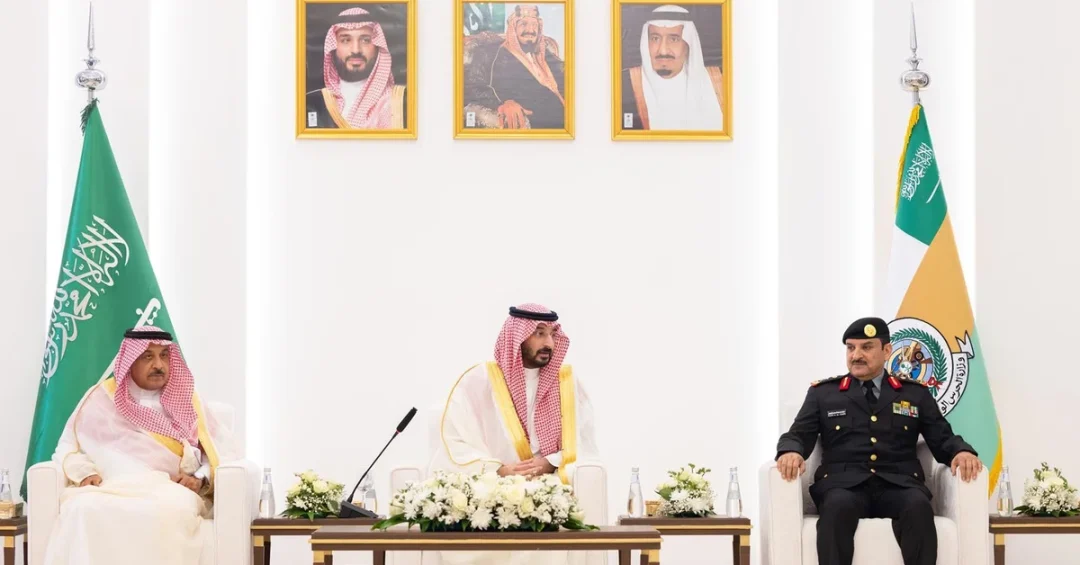
Saudi Minister of National Guard Prince Abdullah bin Bandar bin Abdulaziz received the commanders of the ministry along with senior civil and military officials in Jeddah, who came to extend their congratulations on the occasion of Eid Al-Fitr, according to the Saudi Press Agency (SPA). The meeting, held on March 30, 2025, underscored the enduring bonds of loyalty and institutional cohesion within the Kingdom’s security apparatus during one of Islam’s most cherished celebrations.
During the reception, Prince Abdullah exchanged congratulations with the attendees on the blessed occasion, praying for God to safeguard the country’s security and stability under the wise leadership of the Custodian of the Two Holy Mosques, King Salman bin Abdulaziz Al Saud, and His Royal Highness Crown Prince Mohammed bin Salman bin Abdulaziz Al Saud, Prime Minister and Chairman of the Council of Economic and Development Affairs. The gathering reflected the spirit of unity that defines Saudi Arabia’s national institutions, particularly during festive seasons when leaders and officials come together to reaffirm their shared commitment to the nation’s progress and prosperity. Such occasions also highlight the Ministry of National Guard’s integral role in preserving the Kingdom’s stability, a cornerstone of the ambitious Vision 2030 reform agenda that continues to transform Saudi Arabia’s economic and social landscape.
Context and Background
What does a simple Eid reception reveal about the deeper fabric of Saudi Arabia’s leadership culture? The Ministry of National Guard, known in Arabic as the Saudi Arabian National Guard (SANG), is one of the Kingdom’s principal military forces, tasked with protecting the royal family, securing critical infrastructure, and supporting the Ministry of Defense during times of national need. Its origins trace back to the early 20th century when tribal forces loyal to the founding father, King Abdulaziz Al Saud, were organized into a formal structure. Over the decades, the National Guard has evolved into a modern, well-equipped force that operates under the direct leadership of a senior member of the royal family, currently Prince Abdullah bin Bandar bin Abdulaziz, who was appointed to the post in December 2018 by royal decree.
The tradition of exchanging Eid greetings between senior officials and their subordinates is deeply rooted in Saudi and Islamic customs. Eid Al-Fitr, which marks the end of the holy month of Ramadan, is a time for family reunions, charitable giving, and communal prayers. For the Kingdom’s leadership, it is also an opportunity to reinforce the bonds of allegiance and to express gratitude to those who serve on the front lines of national security. In this context, the Jeddah reception was not merely a ceremonial event but a reaffirmation of the mutual respect and shared purpose that bind the Ministry of National Guard’s leadership with its commanders and civilian officials. Such meetings also serve as a platform for informal consultations on ongoing initiatives, from training programs to modernization efforts that align with the broader goals of Vision 2030.
Jeddah, where the reception took place, holds particular significance as Saudi Arabia’s second-largest city and a historic gateway for pilgrims traveling to the holy cities of Makkah and Madinah. The choice of Jeddah as the venue reflects the city’s role as a diplomatic and administrative hub, especially during the Eid holidays when many senior officials are based in the western region. The Ministry of National Guard maintains a significant presence in Jeddah and surrounding areas, ensuring the safety of key installations and supporting the smooth operation of Hajj and Umrah seasons. Thus, the gathering also carried an implicit message of readiness and coordination as the Kingdom prepares for future pilgrimage seasons and other major events that draw millions of visitors annually.
Key Details
What specific messages did this high-profile gathering convey to the wider world? According to the Saudi Press Agency, the reception included the commanders of the Ministry of National Guard along with senior civil and military officials. While the names of the attendees were not disclosed in the initial report, the presence of such a broad cross-section of leadership indicates the importance Prince Abdullah places on direct engagement with his team. The minister exchanged congratulations and offered prayers for the nation’s continued security and stability, a gesture that resonates with the Ministry’s core mission of safeguarding the Kingdom’s sovereignty and territorial integrity.
The Ministry of National Guard operates as a distinct military branch with its own command structure, training academies, and equipment procurement programs. It is responsible for a range of duties, including protecting vital oil installations, guarding borders in coordination with the Ministry of Interior, and providing security for royal residences and government buildings. In recent years, the Ministry has undergone significant modernization, incorporating advanced surveillance technologies, cybersecurity capabilities, and rapid-response units. These upgrades are part of a broader effort to enhance the professionalism and effectiveness of Saudi Arabia’s armed forces, a priority underscored by the leadership’s commitment to Vision 2030’s security and governance objectives.
Prince Abdullah bin Bandar bin Abdulaziz, the minister, has been a prominent figure in Saudi Arabia’s security and administrative landscape. Before his appointment as Minister of National Guard, he served as deputy governor of Makkah Region and held various positions that gave him deep insight into the Kingdom’s regional dynamics and development projects. His leadership style emphasizes discipline, loyalty, and modernization, and he frequently meets with commanders and officials to assess readiness and address challenges. The Eid reception in Jeddah is consistent with his hands-on approach, allowing him to personally thank personnel for their service and to reinforce the values of dedication and sacrifice that are central to the Ministry’s ethos.
International and Regional Impact
How does a domestic Eid reception resonate beyond Saudi Arabia’s borders? The Ministry of National Guard plays a critical role in maintaining the stability that underpins Saudi Arabia’s foreign policy and economic diplomacy. A secure Kingdom is essential for global energy markets, as Saudi Arabia is the world’s largest exporter of crude oil and a leading producer of natural gas. Any disruption to the Kingdom’s internal security could have far-reaching consequences for international oil prices and supply chains. Therefore, the cohesion demonstrated at the Jeddah reception sends a reassuring signal to international partners and investors that Saudi Arabia’s security institutions remain unified and vigilant.
On a regional level, the Ministry of National Guard contributes to Saudi Arabia’s efforts to promote peace and stability in the Middle East. The Kingdom has been actively involved in diplomatic initiatives to resolve conflicts in Yemen, Sudan, and other neighboring countries, and its security forces often participate in humanitarian and peacekeeping missions. The Eid gathering, while primarily a symbolic event, reinforces the message that Saudi Arabia’s leadership is focused on maintaining a strong and disciplined military that can support these regional objectives. Additionally, the presence of senior civil officials at the reception highlights the integrated approach to governance that Saudi Arabia has adopted, where military and civilian institutions work in tandem to achieve national goals.
Economic and Strategic Significance
What does the Ministry of National Guard’s readiness mean for Saudi Arabia’s economic transformation? Under Vision 2030, the Kingdom is diversifying its economy away from oil dependence, investing heavily in tourism, entertainment, technology, and renewable energy. These ambitious projects—such as NEOM, the Red Sea Project, and Qiddiya—require a stable and secure environment to attract foreign investment and visitors. The Ministry of National Guard’s role in protecting critical infrastructure, including oil facilities, airports, and giga-projects, is therefore directly linked to the success of these economic initiatives. The Eid reception, by showcasing the unity and morale of the Ministry’s leadership, indirectly supports investor confidence in the Kingdom’s security apparatus.
Furthermore, the Ministry of National Guard is itself an economic actor, with a substantial budget and procurement programs that contribute to local industry and job creation. Its training academies and medical facilities provide employment and skills development for thousands of Saudi citizens, aligning with Vision 2030’s goal of increasing workforce participation and empowering national talent. The modernization of the Ministry also involves partnerships with leading global defense companies, fostering technology transfer and local manufacturing. These initiatives are part of a broader strategy to build a self-reliant defense industry, a key pillar of Saudi Arabia’s long-term security and economic resilience.
Vision 2030 Alignment
How does this event connect to the grand vision of a transformed Saudi Arabia? Vision 2030, launched in 2016 by Crown Prince Mohammed bin Salman, aims to create a vibrant society, a thriving economy, and an ambitious nation. A secure and stable environment is the foundation upon which all three pillars rest. The Ministry of National Guard’s unwavering commitment to protecting the Kingdom enables the social and economic reforms that are reshaping Saudi Arabia. From hosting global sporting events to developing world-class tourist destinations, the Kingdom’s progress depends on the peace of mind that comes from knowing its security forces are well-led and highly motivated. The Eid reception in Jeddah was a small but meaningful reminder of that enduring guarantee.
As Saudi Arabia continues its journey toward Vision 2030, the role of institutions like the Ministry of National Guard will only grow in importance. The leadership’s emphasis on unity, discipline, and modernization will ensure that the Kingdom remains a beacon of stability in a turbulent region. The exchange of Eid greetings between Prince Abdullah bin Bandar bin Abdulaziz and his commanders is a testament to the strong bonds that hold the Saudi security apparatus together. It also reflects the deep-rooted values of loyalty and respect that characterize Saudi society. With such foundations, Saudi Arabia is well-positioned to achieve its ambitious goals and to contribute to global peace and prosperity in the years ahead.
20 Questions
Q1. Who received the commanders and senior officials of the Ministry of National Guard?
A1. Prince Abdullah bin Bandar bin Abdulaziz, Minister of National Guard, received them in Jeddah on March 30, 2025, according to the Saudi Press Agency.
Q2. What was the occasion for the reception?
A2. The commanders and officials came to extend their congratulations to the minister on the occasion of Eid Al-Fitr, the Islamic holiday marking the end of Ramadan.
Q3. Where did the reception take place?
A3. The reception was held in Jeddah, Saudi Arabia’s second-largest city and a major diplomatic and administrative hub in the western region.
Q4. What did Prince Abdullah exchange with the attendees?
A4. He exchanged congratulations on the blessed occasion and prayed for God to safeguard the country’s security and stability under the wise leadership.
Q5. Which leadership did Prince Abdullah pray for?
A5. He prayed for the continued security and stability of Saudi Arabia under the leadership of King Salman bin Abdulaziz Al Saud and Crown Prince Mohammed bin Salman.
Q6. What is the Ministry of National Guard?
A6. It is one of Saudi Arabia’s principal military forces, responsible for protecting the royal family, securing critical infrastructure, and supporting national defense.
Q7. Who is Prince Abdullah bin Bandar bin Abdulaziz?
A7. He is the Minister of National Guard, appointed in December 2018, and a senior member of the Saudi royal family with extensive administrative experience.
Q8. Why is Eid Al-Fitr significant in Saudi Arabia?
A8. Eid Al-Fitr is a joyous Islamic holiday celebrated with prayers, family gatherings, and charitable acts, and it holds deep cultural and religious importance in the Kingdom.
Q9. What is the significance of such receptions for national unity?
A9. They reinforce bonds of loyalty and cohesion among security leadership, demonstrating unity and shared commitment to the nation’s stability and progress.
Q10. How does the Ministry of National Guard contribute to Vision 2030?
A10. By ensuring security for economic projects, protecting infrastructure, and supporting a stable environment that attracts investment and tourism, it underpins Vision 2030 goals.
Q11. What are some key responsibilities of the Ministry of National Guard?
A11. Its duties include protecting oil installations, guarding borders, securing royal residences, and providing rapid-response units for emergencies.
Q12. Has the Ministry undergone modernization recently?
A12. Yes, it has incorporated advanced surveillance, cybersecurity, and rapid-response capabilities as part of broader efforts to enhance Saudi Arabia’s defense capabilities.
Q13. Why is Jeddah a significant location for this event?
A13. Jeddah is a historic gateway for pilgrims and a key administrative center, making it a fitting venue for senior officials during the Eid holidays.
Q14. What message does this reception send to international observers?
A14. It signals that Saudi Arabia’s security institutions are unified and vigilant, reassuring partners and investors about the Kingdom’s stability.
Q15. How does the Ministry of National Guard support regional stability?
A15. It contributes to Saudi Arabia’s diplomatic and peacekeeping efforts, helping to promote stability in the Middle East and beyond.
Q16. What economic role does the Ministry of National Guard play?
A16. It manages a substantial budget, supports local industry through procurement, and provides employment and training for thousands of Saudi citizens.
Q17. How does the reception reflect Saudi leadership culture?
A17. It demonstrates the leadership’s hands-on approach and commitment to engaging with military and civilian officials, fostering mutual respect and morale.
Q18. What is the relationship between the Ministry of National Guard and Vision 2030?
A18. The Ministry’s security role enables the social and economic reforms of Vision 2030 by ensuring a safe environment for development and investment.
Q19. Were any specific initiatives discussed at the reception?
A19. The SPA report did not mention specific initiatives; the event was primarily a ceremonial exchange of Eid greetings and prayers for the nation.
Q20. What does the future hold for the Ministry of National Guard?
A20. It will continue to modernize and play a vital role in protecting Saudi Arabia, supporting Vision 2030, and contributing to regional security and stability.
Reader Feedback
We value your thoughts. Please share your feedback on this article.
Your feedback helps us improve our coverage.
Related articles
 Defense Minister Receives Ministry’s Commanders, Senior Officials
 Crown Prince Performs Eid Al-Fitr Prayer in Makkah
 Interior Minister Honors Security Sectors for Eid Al-Fitr Efforts
 KSrelief Distributes 660 Food Baskets in Lebanon
 KSrelief Distributes 600 Food Baskets in Sudan
 KSrelief Distributes 800 Food Baskets in Mali