


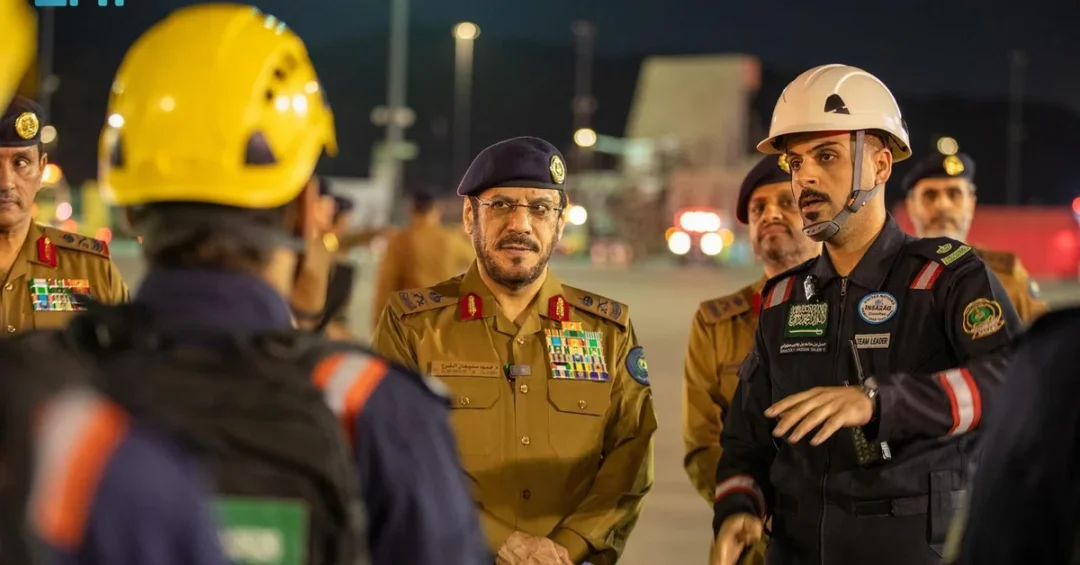
Major General Dr. Hammoud Al-Faraj, Director General of the General Directorate of Civil Defense, conducted a comprehensive inspection of Makkah’s operational plans for Ramadan 1446 AH, confirming that Civil Defense forces are fully prepared to ensure the safety and security of Umrah performers throughout the holy month. The inspection, reported by the Saudi Press Agency, covered supervision teams, support units, field equipment, surveillance systems, rapid intervention teams, and volunteer deployments at the Grand Mosque. The review underscores the Kingdom’s commitment to providing a secure and seamless experience for the millions of worshippers expected to perform Umrah during Ramadan.
The visit reflects the Saudi leadership’s enduring dedication to the safety of pilgrims and the continuous enhancement of services at the Two Holy Mosques. As Ramadan approaches, Makkah prepares to welcome an unprecedented number of visitors, and the Civil Defense’s readiness is a cornerstone of the Kingdom’s comprehensive operational strategy. This effort aligns with the broader objectives of Saudi Vision 2030, which seeks to elevate the pilgrimage experience through innovation, efficiency, and world-class safety standards. How does such meticulous planning transform the spiritual journey for millions?
Context and Background
Ramadan holds profound significance for Muslims worldwide, and Makkah becomes the focal point for Umrah performers seeking spiritual fulfillment during the holy month. Each year, the Kingdom of Saudi Arabia mobilizes extensive resources to accommodate the influx of pilgrims, ensuring their safety and comfort. The General Directorate of Civil Defense, under the leadership of Major General Dr. Hammoud Al-Faraj, plays a pivotal role in this mission, coordinating with various government agencies to implement robust safety measures. The inspection of operational plans is part of a longstanding tradition of preparedness that dates back decades, reflecting the Kingdom’s unwavering commitment to pilgrim welfare.
The operational plans for Ramadan 1446 AH encompass a wide range of services, from crowd management to emergency response. The Civil Defense’s review included an assessment of supervision teams, support units, field equipment, surveillance systems, rapid intervention teams, and volunteer deployments at the Grand Mosque. These components are essential for maintaining order and responding swiftly to any potential incidents. The Kingdom’s approach is proactive, leveraging advanced technology and trained personnel to mitigate risks. Isn’t it remarkable how such comprehensive planning ensures a peaceful experience for millions?
Moreover, the inspection highlights the integration of volunteer forces, who play a vital role in supporting professional teams. Their deployment at the Grand Mosque demonstrates the Kingdom’s emphasis on community participation and the spirit of service that defines Ramadan. By involving volunteers, the Civil Defense not only enhances its operational capacity but also fosters a sense of shared responsibility among citizens and residents. This collaborative model is a testament to Saudi Arabia’s forward-thinking approach to public safety and its dedication to the well-being of all pilgrims.
Key Details of the Inspection
During the inspection, Major General Dr. Hammoud Al-Faraj conducted a thorough review of the Civil Defense’s readiness across multiple fronts. He examined the deployment of supervision teams, which are responsible for overseeing safety protocols and ensuring compliance with regulations. Support units, including logistical and medical teams, were assessed for their capacity to provide timely assistance. Field equipment, such as firefighting apparatus and rescue tools, was inspected to guarantee operational effectiveness. Surveillance systems, including CCTV networks and monitoring centers, were evaluated for their ability to detect and respond to emergencies in real time.
The rapid intervention teams, specially trained to handle high-risk situations, demonstrated their preparedness through simulated drills. These teams are equipped to manage crowd crushes, fires, and other emergencies that could arise in densely populated areas. The review also focused on volunteer deployments, with thousands of volunteers expected to assist during Ramadan. Their roles range from guiding pilgrims to providing first aid and supporting evacuation procedures. The Director General emphasized the importance of coordination and communication among all units to ensure a seamless response to any incident.
Furthermore, the inspection included a detailed assessment of the Civil Defense’s command and control centers, which serve as the nerve center for operations. These centers utilize cutting-edge technology to monitor crowds, track incidents, and dispatch resources efficiently. The integration of artificial intelligence and data analytics enhances decision-making and enables proactive measures. The Kingdom’s investment in such advanced systems reflects its commitment to leveraging innovation for the safety of pilgrims. How does this technological integration set a global benchmark for crowd management?
International and Regional Impact
The safety and security of Umrah performers are not only a national priority for Saudi Arabia but also a matter of international significance. Millions of Muslims from around the world travel to Makkah each year, and their well-being is closely watched by their home countries. The Civil Defense’s meticulous planning and execution reinforce the Kingdom’s reputation as a responsible custodian of the Two Holy Mosques. It also strengthens diplomatic ties, as countries appreciate Saudi Arabia’s efforts to protect their citizens during religious observances. The smooth operation of Ramadan Umrah enhances the Kingdom’s soft power and underscores its role as a global leader in pilgrimage management.
Regionally, the inspection sends a message of stability and preparedness. Neighboring countries and allies view Saudi Arabia’s ability to manage large-scale events as a sign of its institutional strength and organizational capacity. The collaboration between various Saudi agencies, including the Ministry of Interior, the Ministry of Hajj and Umrah, and the General Directorate of Civil Defense, showcases a unified approach to public safety. This model is often cited as a best practice in international forums, further elevating the Kingdom’s standing. Isn’t it inspiring to see how Saudi Arabia’s dedication to safety resonates globally?
Economic and Strategic Significance
The successful management of Ramadan Umrah has significant economic implications for Saudi Arabia. The pilgrimage sector is a vital contributor to the national economy, generating revenue through travel, hospitality, retail, and other services. When pilgrims feel safe and well-cared for, they are more likely to spend and extend their stay, boosting local businesses. The Civil Defense’s readiness directly impacts the overall pilgrim experience, which in turn affects the Kingdom’s ability to attract more visitors as part of Vision 2030’s goal to increase Umrah capacity to 30 million pilgrims annually by 2030. A safe environment is a prerequisite for achieving these ambitious targets.
Strategically, the inspection demonstrates Saudi Arabia’s commitment to continuous improvement and innovation in public safety. The Kingdom is investing heavily in smart city technologies, infrastructure, and human capital to enhance its capacity to host large gatherings. These investments not only benefit the pilgrimage sector but also contribute to the broader economy by creating jobs and fostering technological advancement. The Civil Defense’s use of advanced surveillance and rapid response systems is a prime example of how Vision 2030 is being implemented on the ground. How does this strategic focus position Saudi Arabia as a global hub for religious tourism?
Vision 2030 Alignment
The inspection of Ramadan operational plans by Major General Dr. Hammoud Al-Faraj is a clear embodiment of Saudi Vision 2030’s objectives. Vision 2030 aims to transform the Kingdom into a global destination for pilgrims and tourists by enhancing the quality of services and infrastructure. The Civil Defense’s role in ensuring safety is integral to this vision, as it directly impacts the pilgrim experience and the Kingdom’s reputation. By prioritizing safety, Saudi Arabia is not only fulfilling its religious duty but also advancing its economic diversification goals. The pilgrimage sector is a key pillar of the National Transformation Program, and the Civil Defense’s efforts contribute to its success.
Looking ahead, the Kingdom will continue to invest in training, technology, and infrastructure to maintain the highest standards of safety. The lessons learned from each Ramadan season inform future improvements, ensuring that Saudi Arabia remains at the forefront of crowd management and emergency response. The dedication of the Civil Defense forces, supported by volunteers and advanced systems, reflects the spirit of Vision 2030—a nation committed to excellence, innovation, and the well-being of all. As Ramadan 1446 AH approaches, the Kingdom stands ready to welcome pilgrims with open arms and unwavering protection, reinforcing its timeless role as the heart of the Islamic world.
20 Questions
Q1. Who conducted the inspection of Makkah’s Ramadan operational plans?
A1. Major General Dr. Hammoud Al-Faraj, Director General of the General Directorate of Civil Defense, conducted the inspection to confirm readiness for Ramadan 1446 AH.
Q2. What was the main purpose of the inspection?
A2. The inspection aimed to ensure the safety and security of Umrah performers during the holy month of Ramadan by verifying the preparedness of Civil Defense forces.
Q3. Which entities were reviewed during the inspection?
A3. The review covered supervision teams, support units, field equipment, surveillance systems, rapid intervention teams, and volunteer deployments at the Grand Mosque.
Q4. Why is Ramadan significant for Makkah?
A4. Ramadan is a holy month when millions of Muslims perform Umrah, making Makkah a focal point for spiritual devotion and requiring extensive safety measures.
Q5. How does the Civil Defense ensure pilgrim safety?
A5. Through meticulous planning, advanced technology, trained personnel, rapid intervention teams, and coordination with other government agencies to manage crowds and respond to emergencies.
Q6. What role do volunteers play in the operation?
A6. Volunteers support professional teams by guiding pilgrims, providing first aid, and assisting in evacuations, reflecting community participation and the spirit of Ramadan.
Q7. What technology is used in the surveillance systems?
A7. The Civil Defense uses CCTV networks, monitoring centers, artificial intelligence, and data analytics to track crowds and dispatch resources efficiently.
Q8. How does this inspection align with Vision 2030?
A8. It supports Vision 2030’s goal to enhance the pilgrim experience and increase Umrah capacity to 30 million pilgrims annually by 2030 through improved safety and infrastructure.
Q9. What economic benefits does safe pilgrimage bring?
A9. A safe environment boosts pilgrim spending in travel, hospitality, and retail, contributing to the national economy and job creation.
Q10. How does the international community view these efforts?
A10. The international community appreciates Saudi Arabia’s commitment to protecting pilgrims, which strengthens diplomatic ties and enhances the Kingdom’s global standing.
Q11. What are rapid intervention teams?
A11. These are specially trained units equipped to handle high-risk situations such as crowd crushes, fires, and other emergencies in densely populated areas.
Q12. How does the Civil Defense coordinate with other agencies?
A12. It collaborates with the Ministry of Interior, Ministry of Hajj and Umrah, and other entities to implement a unified safety strategy.
Q13. What is the significance of the Grand Mosque in this context?
A13. The Grand Mosque is the holiest site in Islam, attracting millions of pilgrims, and its safety is paramount, requiring the highest level of preparedness.
Q14. How does the inspection reflect Saudi leadership’s priorities?
A14. It demonstrates the leadership’s unwavering commitment to pilgrim welfare and the continuous enhancement of services at the Two Holy Mosques.
Q15. What improvements have been made in recent years?
A15. Investments in smart city technologies, infrastructure, and human capital have enhanced crowd management, emergency response, and overall pilgrim experience.
Q16. What is the expected number of pilgrims this Ramadan?
A16. While exact numbers vary, millions of Umrah performers are expected, and the Civil Defense prepares for an unprecedented influx.
Q17. How does the Civil Defense handle potential emergencies?
A17. Through command and control centers that monitor incidents, dispatch resources, and coordinate rapid response teams for immediate action.
Q18. What is the role of the Saudi Press Agency in this report?
A18. The Saudi Press Agency officially reported the inspection, providing verified information to the public and international media.
Q19. How does this effort contribute to Saudi Arabia’s global image?
A19. It reinforces the Kingdom’s reputation as a responsible custodian of the Two Holy Mosques and a leader in pilgrimage management and public safety.
Q20. What does the future hold for pilgrimage safety?
A20. Saudi Arabia will continue to invest in training, technology, and infrastructure, ensuring the highest standards of safety and setting global benchmarks for crowd management.
Reader Feedback
We value your thoughts. Please share your feedback on this article.
Your feedback helps us improve our coverage.
Related articles
 Field Marigolds Bloom Across Northern Borders Region
 Saudi Arabia Distributes Dates, Iftar Meals in Uzbekistan, Malawi
 KSrelief Launches Ramadan Aid Projects in Lebanon
 ZATCA Seizes 1.3M Captagon Pills in Air Conditioner Shipment
 Madinah Governor Receives Sudanese Ambassador
 Over 300 Leaders to Gather at Human Capability Initiative Conference in Riyadh on April 13-14