


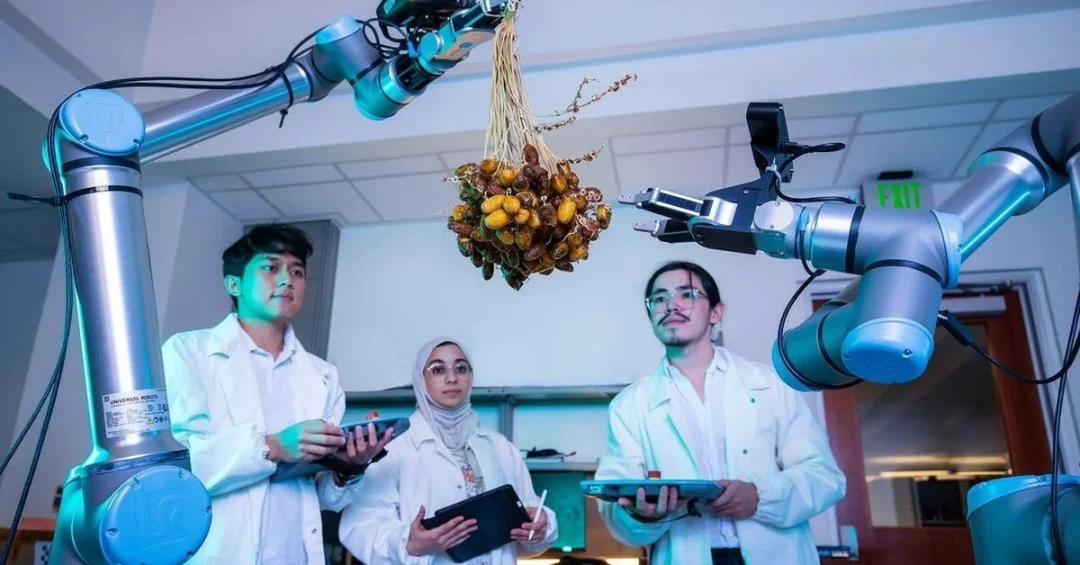
The King Abdullah University of Science and Technology (KAUST) is developing an advanced robotic system designed to automate date palm harvesting, a project that could transform date farming in Saudi Arabia and reinforce the Kingdom’s position as a global leader in agricultural innovation. According to an official press release issued by KAUST and distributed via the Saudi Press Agency (SPA), the research is led by KAUST Assistant Professor Shinkyu Park and focuses on automating critical processes in date cultivation, including harvesting, pollination, and tree maintenance, through the use of AI-powered robotics.
The announcement, dated March 9, 2025, outlines a bold vision for the future of agriculture in the Kingdom and beyond. The system promises to yield larger quantities of more nutritious dates while reducing reliance on manual labor and enhancing the sustainability of one of the region’s most culturally and economically significant crops. Could this be the breakthrough that redefines how the world approaches date farming? For Saudi Arabia, the project represents more than a technological milestone; it signals a strategic move to integrate artificial intelligence and robotics into the heart of its agricultural economy, aligning with the ambitious goals of Vision 2030.
Context and Background
Date palms have been cultivated in the Arabian Peninsula for thousands of years, serving as a cornerstone of food security, cultural heritage, and economic activity. Saudi Arabia is one of the world’s largest producers of dates, with millions of trees across the Kingdom yielding a diverse range of varieties that are prized both locally and internationally. Yet, traditional date farming remains labor-intensive and subject to challenges such as climate variability, pest infestations, and a shrinking agricultural workforce. How can a country preserve its agricultural traditions while embracing the technologies of the future? KAUST’s robotic system offers a compelling answer.
The project is part of a broader wave of innovation at KAUST, a research university located in Thuwal, near Jeddah, that has become a hub for cutting-edge science and technology in the region. Under the leadership of Assistant Professor Shinkyu Park, the team is developing what they describe as “robotic farmers” — machines that combine robotics for reliable farming with artificial intelligence for greater efficiency. The initiative is not merely about replacing human labor; it is about augmenting the capabilities of farmers, ensuring tree health, and boosting productivity in ways that were previously unimaginable.
Field trials are scheduled to begin during the 2025 harvest season, with full operational capability expected within three years. This timeline reflects a deliberate, evidence-based approach to deployment, allowing researchers to refine the technology in real-world conditions before scaling up. The involvement of KAUST, a institution known for its high-impact research, lends significant credibility to the endeavor and underscores Saudi Arabia’s commitment to becoming a knowledge-based economy.
Key Details of the Robotic Farming System
At the heart of the system are robotic arms capable of moving as quickly as a human farmer while precisely picking each date without causing damage to the fruit or the machine itself. Equipped with high-precision visual sensors, these robotic farmers can identify individual dates, flowers, and tree structures, enabling them to perform a range of tasks such as harvesting, spraying, and pruning. This level of precision is critical in date farming, where delicate handling directly impacts the quality and market value of the crop. How does the system ensure that each date is harvested at the optimal moment of ripeness? The answer lies in the sophisticated AI algorithms that process visual data in real time, making split-second decisions that mimic the expertise of seasoned farmers.
Beyond harvesting, the robotic system is designed to contribute to overall tree health, productivity, and longevity. By automating tasks like pollination and pruning, it can help reduce the risk of pest infestations and diseases, which are persistent threats to date palm cultivation. The integration of AI allows for continuous monitoring and adaptive responses, potentially leading to healthier trees and more abundant yields. According to the KAUST press release, the project is expected to yield larger quantities of more nutritious dates, a benefit that could have significant implications for both domestic consumption and export markets.
Assistant Professor Park also suggested that a Robots-as-a-Service (RaaS) model could allow smaller farmers to access the technology without the burden of purchasing the robots outright. This subscription-based approach would democratize access to advanced agricultural tools, enabling farmers of all sizes to benefit from the innovation. Does this signal a shift toward a more inclusive agricultural economy in Saudi Arabia? It certainly aligns with the Kingdom’s broader goals of fostering entrepreneurship and supporting small and medium-sized enterprises. The RaaS model could also accelerate adoption by lowering upfront costs and providing ongoing maintenance and updates, ensuring that the technology remains at the cutting edge.
International and Regional Impact
The implications of KAUST’s robotic date farming system extend far beyond Saudi Arabia’s borders. As a leading producer of dates, the Kingdom’s adoption of such technology could set a new global standard for agricultural automation, particularly in arid and semi-arid regions where date palms thrive. Countries across the Middle East and North Africa, as well as parts of South Asia and the Americas, could look to Saudi Arabia as a model for integrating AI and robotics into traditional farming practices. What does this mean for the global date market? It could lead to more stable supplies, higher quality products, and potentially lower prices, benefiting consumers worldwide.
Moreover, the project enhances Saudi Arabia’s reputation as a hub for agricultural technology and expertise. By attracting leaders in farming and robotics to the region, KAUST is fostering a knowledge ecosystem that could spawn further innovations and collaborations. The press release notes that laborers will be the first to engage with the new technologies developed by Park and his team, ensuring that the transition is inclusive and that local workers gain valuable skills. This approach not only mitigates potential job displacement but also empowers the existing workforce to become proficient in operating and maintaining advanced systems. In a world where automation often raises concerns about employment, Saudi Arabia’s strategy appears to prioritize human capital development alongside technological advancement.
Economic and Strategic Significance
From an economic perspective, the robotic system addresses several pressing challenges. Agriculture in Saudi Arabia faces constraints related to water scarcity, labor shortages, and the need to increase productivity to meet growing demand. By automating key processes, the system can help optimize resource use, reduce waste, and improve yields, contributing to the Kingdom’s food security objectives. Dates are not only a staple food but also a significant export commodity; enhancing their production efficiency could boost Saudi Arabia’s non-oil exports, a key pillar of Vision 2030. How significant is the date industry to the Saudi economy? It supports thousands of jobs, generates substantial revenue, and holds a special place in the nation’s cultural identity.
Strategically, the project reinforces Saudi Arabia’s leadership in technology and innovation. KAUST has long been a catalyst for research in fields such as water desalination, renewable energy, and genomics. The robotic farming initiative adds to this legacy, demonstrating that the Kingdom is not only a consumer but also a creator of advanced technologies. This aligns with the National Industrial Development and Logistics Program (NIDLP) and other Vision 2030 initiatives aimed at diversifying the economy and fostering high-tech industries. By investing in agricultural robotics, Saudi Arabia is positioning itself at the forefront of a global trend toward smart farming, which is expected to grow rapidly in the coming decades.
Vision 2030 Alignment
The KAUST robotic date harvesting project is a shining example of how Vision 2030 is being translated into tangible action. Vision 2030 seeks to diversify the economy, reduce dependence on oil, and create a vibrant society and thriving economy. By harnessing AI and robotics to modernize agriculture, the Kingdom is simultaneously addressing food security, economic diversification, and technological advancement. The project also supports the Human Capability Development Program by creating opportunities for local talent to engage in research and development, as Assistant Professor Park noted: “I am excited that this initiative extends beyond engineering solutions and cultivates research and development opportunities for local talent, contributing to the long-term sustainable educational and economic growth of the Kingdom.”
As the field trials commence in the 2025 harvest season, all eyes will be on the results. Success could pave the way for broader adoption of robotic systems in other agricultural sectors, from greenhouse farming to livestock management. It could also inspire similar initiatives across the region, cementing Saudi Arabia’s role as a pioneer in sustainable agriculture. In a world grappling with climate change and resource constraints, the Kingdom’s embrace of innovation offers a hopeful vision for the future. The robotic farmers of KAUST are not just machines; they are symbols of a nation’s determination to honor its heritage while building a prosperous, knowledge-driven tomorrow.
20 Questions
Q1. What is the King Abdullah University of Science and Technology (KAUST) developing?
A1. KAUST is developing a new robotic system designed to automate date palm harvesting, pollination, and tree maintenance using AI-powered robotics. The project aims to revolutionize the agriculture industry and establish Saudi Arabia as a leader in agricultural innovation.
Q2. Who is leading the research on the robotic date farming system?
A2. The research is led by KAUST Assistant Professor Shinkyu Park. His team focuses on combining robotics for reliable farming and artificial intelligence for greater efficiency, with the goal of yielding larger quantities of more nutritious dates.
Q3. What tasks can the robotic farmers perform?
A3. The robotic farmers can perform tasks such as harvesting, spraying, and pruning. Equipped with high-precision visual sensors, they can identify individual dates, flowers, and tree structures to ensure tree health, productivity, and longevity.
Q4. How do the robotic arms operate?
A4. The robotic arms can move as quickly as a human farmer while precisely picking each date without damage to itself or the fruit. This precision is enabled by advanced AI algorithms and visual sensors that guide their movements.
Q5. When are field trials scheduled to begin?
A5. Field trials are scheduled to begin during the 2025 harvest season. Full operational capability is expected within three years, allowing researchers to refine the technology in real-world conditions before scaling up.
Q6. What is the Robots-as-a-Service (RaaS) model?
A6. The RaaS model is a subscription-based approach that could allow smaller farmers to access the robotic technology without the burden of purchasing the robots outright. This would democratize access and accelerate adoption across the agricultural sector.
Q7. How does the system contribute to food security?
A7. By automating key processes and improving yields, the system helps optimize resource use and increase productivity, contributing to Saudi Arabia’s food security objectives. Dates are a staple food and a significant export commodity for the Kingdom.
Q8. What are the benefits for tree health?
A8. The robotic system can reduce the risk of pest infestations and diseases through precise spraying and pruning. Continuous monitoring and adaptive responses lead to healthier trees and more abundant yields, ensuring long-term productivity.
Q9. How does the project support local talent?
A9. Assistant Professor Park noted that the initiative cultivates research and development opportunities for local talent. It contributes to the long-term sustainable educational and economic growth of the Kingdom by involving laborers and students in advanced technology.
Q10. What is the significance of dates to Saudi culture?
A10. Dates have been cultivated in the Arabian Peninsula for thousands of years and are a cornerstone of food security, cultural heritage, and economic activity. Saudi Arabia is one of the world’s largest producers of dates, with millions of trees across the Kingdom.
Q11. How does the project align with Vision 2030?
A11. The project aligns with Vision 2030 by diversifying the economy, enhancing food security, and fostering technological innovation. It supports the Human Capability Development Program and the National Industrial Development and Logistics Program, among other initiatives.
Q12. What role does artificial intelligence play in the system?
A12. AI provides greater efficiency by processing visual data in real time and making split-second decisions. It enables the robotic farmers to identify individual dates, flowers, and tree structures, and to perform tasks with precision and adaptability.
Q13. Will the robotic system replace human farmers?
A13. The system is designed to augment human capabilities, not replace them. Laborers will be the first to engage with the new technologies, gaining valuable skills. The RaaS model also ensures that smaller farmers can benefit from the innovation.
Q14. What are the expected outcomes of the field trials?
A14. The field trials will test the system’s performance in real-world conditions, refining its ability to harvest, pollinate, and maintain date palms. Success could lead to broader adoption and commercialization within three years.
Q15. How could the project impact global date farming?
A15. The project could set a new global standard for agricultural automation in arid regions. It may lead to more stable supplies, higher quality products, and potentially lower prices, benefiting consumers worldwide and inspiring similar initiatives.
Q16. What economic benefits does the project offer?
A16. The project can boost non-oil exports by enhancing date production efficiency. It supports thousands of jobs, generates revenue, and aligns with Saudi Arabia’s goal to diversify its economy away from oil dependence.
Q17. How does KAUST support agricultural innovation?
A17. KAUST is a leading research university that fosters cutting-edge science and technology. The robotic date farming project is one of many initiatives at KAUST that benefit date farming and food security, attracting global experts to the region.
Q18. What challenges does date farming face in Saudi Arabia?
A18. Date farming faces challenges such as water scarcity, labor shortages, climate variability, and pest infestations. The robotic system addresses these by optimizing resource use, reducing waste, and improving yields through automation.
Q19. How will smaller farmers access the technology?
A19. Through the Robots-as-a-Service model, smaller farmers can subscribe to the technology rather than purchasing robots outright. This lowers upfront costs and provides ongoing maintenance and updates, making advanced tools accessible to all.
Q20. What is the long-term vision for this project?
A20. The long-term vision is to establish Saudi Arabia as a global leader in agricultural technology and expertise. The project aims to create a sustainable, knowledge-driven agricultural sector that honors heritage while embracing innovation for future generations.
Reader Feedback
We value your thoughts. Please share your feedback on this article.
Your feedback helps us improve our coverage.
Related articles
 Saudi Saffron Breakthrough: Flowers in 10 Days
 SDAIA Launches Guidelines for Cross-Border Data Transfer Risks
 NCVC, KAUST Launch SAUDINet to Advance Ecology Research
 Saudi Arabia, Korea Sign Space Cooperation MoU
 Almarai Prize 2024 Winners Announced for Food Security
 Digital Media’s Ascendancy: Youth Information Sources and the Evolving Media Landscape