


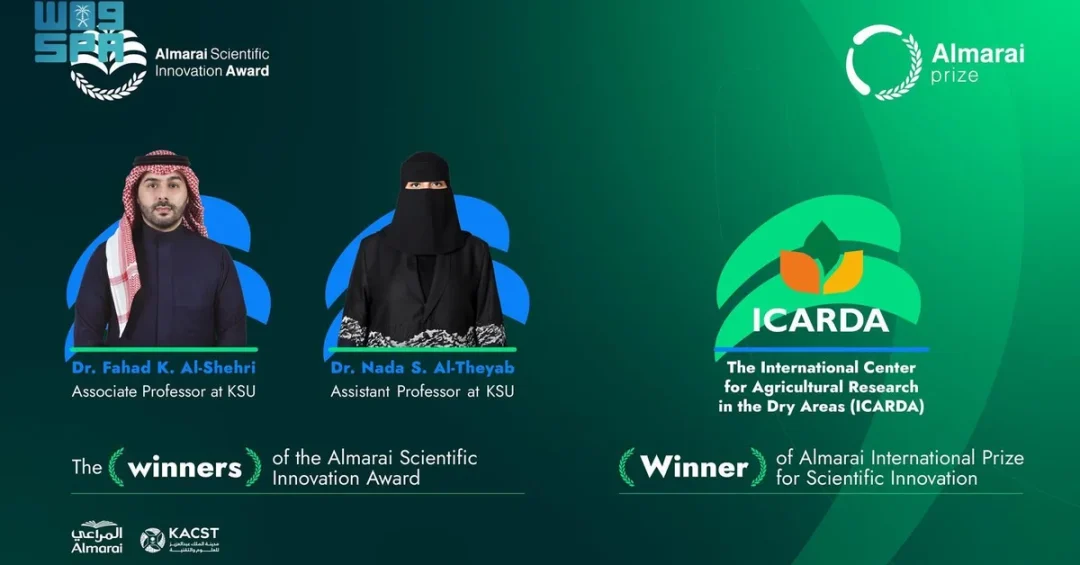
The board of trustees of the Almarai Scientific Creativity Award announced the winners of the 2024 cycle during its annual meeting, recognizing pioneering research in food security, environmental sustainability, and innovation in dryland regions. The announcement, made via the Saudi Press Agency, reflects the Kingdom of Saudi Arabia’s commitment to advancing research and development (R&D) in line with national priorities and the ambitious goals of Vision 2030. The prize, which operates under a new strategy aligned with Saudi Arabia’s national research agenda, seeks to reinforce the Kingdom’s global standing in food security indicators for dryland regions while inspiring researchers and innovators both domestically and internationally.
The virtual meeting was chaired by Dr. Munir M. Eldesouki, president of King Abdulaziz City for Science and Technology (KACST) and chairman of the prize’s board of trustees, and attended by Prince Naif bin Sultan bin Muhammad bin Saud Al-Kabeer, chairman of Almarai Company and vice chairman of the prize’s board, along with other distinguished board members. The gathering underscored the collaborative effort between Saudi Arabia’s public research institutions and its private sector to drive innovation that addresses some of the world’s most pressing challenges. How does such a partnership between a national research powerhouse and a leading private company reshape the future of scientific discovery in the Kingdom?
Context and Background
The Almarai Scientific Creativity Award, now in its latest cycle, has evolved into one of the most significant scientific prizes in the Arab world, particularly in the field of food security for dryland regions. The prize’s new strategy explicitly aligns with Saudi Arabia’s national priorities for research, development, and innovation, which are central pillars of Vision 2030. By focusing on environmental sustainability and the provision of basic needs, the award addresses critical areas that are essential for the Kingdom’s long-term prosperity and global competitiveness. Isn’t it remarkable how a corporate-backed prize can serve as a catalyst for solving global challenges?
Historically, dryland regions have faced persistent challenges related to water scarcity, soil degradation, and climate variability, all of which threaten agricultural productivity and food security. Saudi Arabia, with its vast desert landscapes, has long been at the forefront of developing innovative solutions to these issues. The Almarai Prize recognizes that the fight for food security is not confined to national borders; it requires international collaboration and the sharing of knowledge across regions. The prize’s board of trustees emphasized that the submitted work represents a valuable contribution to the R&D and innovation sector in the Kingdom, as well as to dryland regions worldwide. In what ways can such international recognition accelerate the adoption of sustainable practices in the most vulnerable regions?
The award’s structure includes both an international prize and national awards for emerging scientists, creating a comprehensive ecosystem that rewards excellence at all levels. This dual approach ensures that groundbreaking research from around the world is celebrated alongside the achievements of Saudi Arabia’s own rising stars. The board’s decision to honor both an international project and two national researchers highlights the Kingdom’s dual commitment to global cooperation and domestic capacity building. Could this model of combining international and national recognition become a blueprint for other nations seeking to bolster their research ecosystems?
Key Details
The International Center for Agricultural Research in the Dry Areas (ICARDA) was awarded the Almarai Prize, the largest international prize in financial value in the field of food security in dryland regions, for its outstanding project titled “Enhancing Food Security in Arab Countries.” This project, which has spanned over 12 years, focuses on increasing productivity in the region by developing sustainable agricultural solutions that empower farmers, improve productivity, and contribute to a more food-secure future for the Arab world. ICARDA’s work has been instrumental in introducing improved crop varieties, water-saving technologies, and integrated farming systems that are tailored to the unique conditions of dryland environments. How might the lessons learned from this project be scaled to benefit even more communities across the region?
At the national level, Dr. Fahad bin Khudair Alshehri, associate professor at King Saud University (KSU), was awarded the Almarai Scientific Innovation Award for Emerging Scientists for his research titled “Coupling Machine and Deep Learning with Explainable Artificial Intelligence for Improving Prediction of Groundwater Quality and Decision-Making in Dryland Region, Saudi Arabia.” His work represents a significant advancement in monitoring and managing water quality in dryland regions, leveraging cutting-edge artificial intelligence to provide actionable insights for policymakers and farmers. By improving the prediction of groundwater quality, Dr. Alshehri’s research directly supports sustainable water management, a critical component of Saudi Arabia’s environmental strategy. What could be the long-term impact of integrating AI into water resource management for arid countries?
Additionally, Dr. Nada Salem Al-Theyab, assistant professor at KSU, was honored for her research titled “Draft Genome Sequence of Potato Crop Bacterial Isolates and Nanoparticles-Intervention for the Induction of Secondary Metabolites Biosynthesis.” This innovative study uses a gene-targeting approach to improve crop growth and safety by integrating nanotechnology and microbial genomics. Dr. Al-Theyab’s work holds promise for enhancing the resilience of staple crops like potatoes, which are vital for food security in many parts of the world. Her research exemplifies the kind of interdisciplinary thinking that the Almarai Prize seeks to promote, blending biology, nanotechnology, and agriculture to address real-world problems. Isn’t it inspiring to see young Saudi scientists pushing the boundaries of what’s possible in agricultural science?
International and Regional Impact
The recognition of ICARDA’s project underscores the importance of international collaboration in tackling food insecurity, a challenge that transcends national boundaries. The Arab world, in particular, faces acute vulnerabilities due to its arid climate and limited arable land. By awarding a project that has worked across multiple countries for over a decade, the Almarai Prize highlights the need for sustained, cross-border efforts to develop and disseminate sustainable agricultural practices. This aligns with Saudi Arabia’s broader vision of fostering regional stability and prosperity through knowledge sharing and capacity building. How can such international partnerships be strengthened to ensure that no region is left behind in the quest for food security?
For Saudi Arabia, the prize also serves as a platform to showcase its leadership in addressing global challenges. By hosting and promoting this award, the Kingdom signals its willingness to invest in science and innovation that benefits not only its own population but also the wider world. The presence of high-level officials from KACST and Almarai at the board meeting reflects the strategic importance the Kingdom attaches to this initiative. The prize’s focus on dryland regions is particularly relevant, as these areas are home to a significant portion of the world’s population and are disproportionately affected by climate change. In what ways does Saudi Arabia’s commitment to this cause enhance its role as a responsible global stakeholder?
Economic and Strategic Significance
From an economic perspective, investments in agricultural research and innovation yield substantial returns by increasing productivity, reducing reliance on imports, and creating new market opportunities. For Saudi Arabia, enhancing food security is not only a matter of national resilience but also a key driver of economic diversification under Vision 2030. The development of sustainable agricultural solutions can lead to the growth of agribusinesses, the creation of jobs, and the transfer of technology to other sectors. The Almarai Prize, by rewarding excellence in these areas, incentivizes researchers to pursue breakthroughs that have tangible economic benefits. Could the innovations recognized by this prize become the foundation for a new wave of agricultural entrepreneurship in the Kingdom?
Strategically, the prize reinforces Saudi Arabia’s position as a leader in the Middle East and beyond. By championing research that addresses food and water security, the Kingdom contributes to regional stability and reduces the potential for resource-related conflicts. Moreover, the award helps attract and retain top talent in Saudi Arabia, as young researchers see a clear pathway for recognition and support. The board’s emphasis on inspiring future generations is particularly important, as it encourages students and early-career scientists to tackle complex problems with creativity and rigor. How might this prize inspire a new generation of Saudi innovators to pursue careers in science and technology?
Vision 2030 Alignment
The Almarai Scientific Creativity Award is closely aligned with the objectives of Saudi Vision 2030, which seeks to diversify the economy, enhance the quality of life, and position the Kingdom as a global leader in innovation. By prioritizing research and development in food security and environmental sustainability, the prize directly supports the Vision’s goals of ensuring resource sustainability and fostering a knowledge-based economy. The recognition of both international and national researchers also reflects the Vision’s emphasis on international cooperation and the development of local talent. In this way, the prize serves as a microcosm of the broader transformation underway in Saudi Arabia. Isn’t it clear that such initiatives are essential building blocks for a prosperous and sustainable future?
As the winners of the 2024 cycle are celebrated, their achievements serve as a testament to the power of science to improve lives and protect the planet. The board of trustees expressed its wishes for continued excellence and success for the winners, hoping the prize would inspire them to keep working and put greater effort into research and innovation. For Saudi Arabia, the Almarai Prize is more than an award; it is a statement of intent—a commitment to harnessing knowledge for the benefit of humanity. With each cycle, the Kingdom reinforces its role as a catalyst for positive change, proving that even in the most challenging environments, human ingenuity can flourish. How will the winners of tomorrow build on the foundations laid today to create a world where food security is a reality for all?
20 Questions
Q1. What is the Almarai Scientific Creativity Award?
A1. The Almarai Scientific Creativity Award is a prestigious prize that recognizes outstanding research and innovation in food security, environmental sustainability, and related fields, with a focus on dryland regions. It operates under a strategy aligned with Saudi Arabia’s national research priorities and Vision 2030.
Q2. Who announced the winners of the 2024 cycle?
A2. The board of trustees of the Almarai Scientific Creativity Award announced the winners during its annual meeting, which was held virtually and chaired by Dr. Munir M. Eldesouki, president of King Abdulaziz City for Science and Technology (KACST).
Q3. Which organization received the international Almarai Prize?
A3. The International Center for Agricultural Research in the Dry Areas (ICARDA) received the international Almarai Prize for its project titled “Enhancing Food Security in Arab Countries,” which has spanned over 12 years.
Q4. What is the focus of ICARDA’s award-winning project?
A4. The project focuses on increasing productivity in the Arab region by developing sustainable agricultural solutions that empower farmers, improve productivity, and contribute to a more food-secure future for the Arab world.
Q5. Who won the Almarai Scientific Innovation Award for Emerging Scientists?
A5. Dr. Fahad bin Khudair Alshehri, associate professor at King Saud University, won the award for his research on coupling machine and deep learning with explainable artificial intelligence to improve prediction of groundwater quality in dryland regions.
Q6. What is the significance of Dr. Alshehri’s research?
A6. His research represents an advancement in monitoring and managing water quality in dryland regions, using AI to provide actionable insights for decision-making, which supports sustainable water management.
Q7. Who else received a national award from the Almarai Prize?
A7. Dr. Nada Salem Al-Theyab, assistant professor at King Saud University, received an award for her research on the draft genome sequence of potato crop bacterial isolates and nanoparticles-intervention for inducing secondary metabolites biosynthesis.
Q8. What does Dr. Al-Theyab’s research aim to achieve?
A8. Her research uses a gene-targeting approach to improve crop growth and safety by integrating nanotechnology and microbial genomics, which could enhance the resilience of staple crops like potatoes.
Q9. How does the Almarai Prize align with Saudi Vision 2030?
A9. The prize aligns with Vision 2030 by prioritizing research and development in food security and environmental sustainability, supporting economic diversification, and fostering a knowledge-based economy.
Q10. What was the setting of the board of trustees meeting?
A10. The annual meeting was held virtually, chaired by Dr. Munir M. Eldesouki and attended by Prince Naif bin Sultan bin Muhammad bin Saud Al-Kabeer, chairman of Almarai Company and vice chairman of the prize’s board, along with other members.
Q11. Why is the prize focused on dryland regions?
A11. Dryland regions face unique challenges such as water scarcity and climate variability, making food security a critical issue. The prize aims to stimulate research that addresses these challenges and improves livelihoods in these areas.
Q12. What is the financial value of the Almarai Prize?
A12. The Almarai Prize is described as the largest international prize in financial value in the field of food security in dryland regions, though the exact amount is not specified in the announcement.
Q13. How long has ICARDA’s project been running?
A13. The project “Enhancing Food Security in Arab Countries” has spanned over 12 years, demonstrating a long-term commitment to sustainable agricultural development in the region.
Q14. What role does KACST play in the Almarai Prize?
A14. KACST, led by Dr. Munir M. Eldesouki, plays a key role in the prize’s governance, with its president serving as chairman of the board of trustees, guiding the strategic direction of the award.
Q15. What did the board of trustees emphasize about the winning work?
A15. The board emphasized that the winning work represents a valuable contribution to the R&D and innovation sector in the Kingdom and to dryland regions worldwide, enhancing food security and providing sustainable solutions.
Q16. How does the prize support emerging scientists?
A16. The prize includes a dedicated award for emerging scientists, which recognizes early-career researchers like Dr. Alshehri and Dr. Al-Theyab, encouraging them to continue their innovative work.
Q17. What is the broader impact of the Almarai Prize on Saudi Arabia’s global standing?
A17. The prize enhances Saudi Arabia’s reputation as a leader in scientific research and innovation, particularly in areas critical to global food security, and reinforces its commitment to international cooperation.
Q18. How does the prize contribute to environmental sustainability?
A18. By rewarding research on sustainable agriculture, water management, and crop improvement, the prize promotes practices that protect natural resources and mitigate the effects of climate change in dryland regions.
Q19. What message does the board have for the winners?
A19. The board expressed its wishes for continued excellence and success, hoping the prize would inspire the winners to keep working and put greater effort into research and innovation in the field of the prize.
Q20. How can the public learn more about the Almarai Prize?
A20. Information about the Almarai Prize is typically available through official Saudi channels, including the Saudi Press Agency and the websites of KACST and Almarai Company, which provide updates on the award and its winners.
Reader Feedback
We value your thoughts. Please share your feedback on this article.
Your feedback helps us improve our coverage.
Related articles
 Digital Media’s Ascendancy: Youth Information Sources and the Evolving Media Landscape
 Wild Rosy Dock: A Sour Delight Thriving in Northern Borders Region
 KAUST Develops Nylon-Enhanced Lithium-Metal Battery
 NCM: Rain and Hail Expected in Several Saudi Regions Monday
 Saudi Arabia, Amazon Launch AWS Builder Accelerator for Cloud Computing Training
 Resilient Woolly Bassia Thrives in Northern Borders