


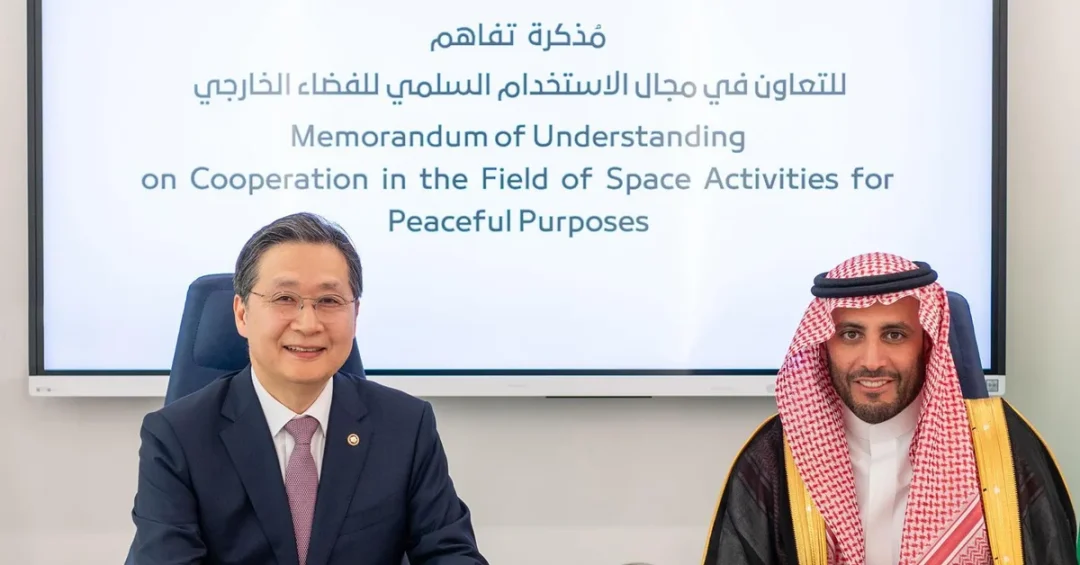
The Saudi Space Agency (SSA) signed a memorandum of understanding (MoU) with the Korea AeroSpace Administration (KASA) on March 11, 2025, at the SSA headquarters in Riyadh, establishing a formal framework for cooperation across deep space technologies, manned spaceflight, satellite launches, space science capacity-building, and the exchange of advanced space applications. The agreement was signed in the presence of Dr. Mohammed bin Saud Al-Tamimi, CEO of the Saudi Space Agency, and Yoon Young-bin, Administrator of the Korea AeroSpace Administration, together with senior officials from both organizations. The MoU signals a deepening strategic partnership between two nations that have each placed space at the center of their long-term economic and technological ambitions.
Why does a memorandum signed in Riyadh matter to observers far beyond the Gulf region? Because space cooperation is no longer a niche pursuit reserved for a handful of traditional powers; it is a rapidly expanding arena of diplomacy, commerce, and innovation. For Saudi Arabia, the agreement with Korea represents another deliberate step in a broader strategy to diversify its economy, cultivate domestic talent, and position the Kingdom as a credible and collaborative actor in the global space community. The MoU is not a standalone event but part of a sustained campaign of international engagement that has accelerated in recent years under the guidance of Saudi leadership and in direct alignment with Vision 2030.
Context and Background
How did Saudi Arabia arrive at a point where its national space agency is signing substantive agreements with counterparts in East Asia? The answer lies in a decade of institutional development and strategic prioritization. The Saudi Space Agency was established to consolidate and elevate the Kingdom’s space activities, transforming what had been a set of disparate programs into a coherent national effort. In parallel, the Kingdom has invested in satellite manufacturing, earth observation, and communications infrastructure, while also supporting research and educational initiatives designed to build a pipeline of Saudi scientists and engineers. These efforts reflect a clear recognition that space capabilities underpin modern economies, from navigation and telecommunications to climate monitoring and national security.
The Korea AeroSpace Administration, for its part, is a relatively new but ambitious agency that has quickly asserted Korea’s intent to become a significant spacefaring nation. Korea has pursued lunar exploration, satellite development, and launch vehicle technology with increasing confidence, and it has sought international partners who share its commitment to peaceful, commercially oriented space activity. The pairing of Saudi Arabia and Korea is therefore logical: both countries are rising space nations with complementary strengths, and both view international cooperation as a means of accelerating progress while sharing the costs and risks of advanced programs. The MoU signed in Riyadh formalizes a relationship that had been developing through dialogue and shared interest, giving it a structured framework for implementation.
Key Details of the Agreement
What specifically does the memorandum commit the two agencies to pursue? According to the official announcement carried by the Saudi Press Agency (SPA), the MoU establishes a framework for collaborative activities and programs in several defined areas. These include deep space technologies, which encompass the systems and capabilities needed for missions beyond Earth orbit; manned spaceflight programs, reflecting Saudi Arabia’s interest in human space exploration following its recent astronaut missions; satellite launches and payloads, covering the development and deployment of spacecraft and their instruments; and space science and engineering capacity-building, which focuses on education, training, and institutional development. The agreement also provides for the exchange of knowledge and expertise in advanced space applications, ensuring that cooperation extends beyond hardware to include software, data, and human capital.
Dr. Al-Tamimi emphasized that the memorandum is part of the Kingdom’s ongoing efforts to boost international cooperation in the space sector, noting that the agency values global partnerships as a cornerstone for advancing space technologies and fostering the growth of the space economy. That statement captures the strategic logic behind the agreement: Saudi Arabia is not pursuing space in isolation but is actively building a network of partners who can contribute expertise, technology, and market access. The MoU with KASA is designed to facilitate the exchange of information and technologies, contribute to the development of national competencies and capabilities, and enhance research and technical advancements in the space sector. It also aims to help create an attractive investment environment in the space industry, supporting the development of the space economy and elevating the international status of both countries.
How will these commitments translate into concrete activity? While the MoU itself is a framework document rather than a binding contract for specific projects, it creates the institutional channels through which projects can be developed. Officials from both sides are expected to establish working groups and joint committees to identify priority initiatives, whether in satellite technology, human spaceflight training, or scientific research. The agreement also signals to the private sector and to academic institutions in both countries that there is official support for collaboration, which can unlock additional partnerships and investment. In this sense, the MoU is both a diplomatic instrument and an economic catalyst, laying the groundwork for a sustained program of cooperation.
International and Regional Impact
What does this agreement reveal about the shifting dynamics of global space cooperation? For decades, space activity was dominated by a small number of state actors with large budgets and established infrastructure. Today, the landscape is far more diverse. Countries in the Middle East, Asia, and beyond are developing space programs tailored to their national needs and are forming partnerships that cross traditional geopolitical divides. Saudi Arabia’s agreement with Korea is a clear example of this trend: it brings together a Gulf state with a rapidly modernizing economy and an East Asian nation with advanced technological capabilities. The collaboration is peaceful, commercially oriented, and focused on capacity-building, which aligns with international norms and the objectives of responsible space stewardship.
For the region, the MoU reinforces Saudi Arabia’s position as a leader in science and technology within the Middle East. It also demonstrates that the Kingdom is willing to work with partners from across the world, not only with traditional allies in Europe and North America. This diversification of partnerships is consistent with Saudi foreign policy under the leadership of the Custodian of the Two Holy Mosques, King Salman bin Abdulaziz Al Saud, and His Royal Highness Crown Prince Mohammed bin Salman bin Abdulaziz Al Saud, which emphasizes constructive engagement and mutual benefit. For Korea, the agreement provides a gateway to the Gulf region and a partner with the resources and ambition to support ambitious space projects. The relationship is therefore mutually reinforcing and likely to expand into adjacent areas such as artificial intelligence, advanced manufacturing, and renewable energy.
Economic and Strategic Significance
Why should the space economy be taken seriously as a driver of national development? The global space industry is valued in the hundreds of billions of dollars and is growing steadily, driven by demand for satellite services, earth observation data, and emerging applications in communications and navigation. Saudi Arabia has made no secret of its intention to capture a meaningful share of this growth. The Kingdom’s space strategy is closely tied to Vision 2030, the national transformation plan launched by Crown Prince Mohammed bin Salman, which seeks to diversify the economy away from oil dependence, create high-skilled jobs, and foster innovation. Space is a natural fit for these goals because it requires advanced engineering, data science, and project management skills, and because it generates spillover benefits for sectors such as agriculture, logistics, and disaster management.
The MoU with KASA supports these objectives in several ways. First, it facilitates technology transfer and knowledge exchange, which can shorten the learning curve for Saudi institutions. Second, it creates opportunities for Saudi companies and research centers to participate in joint projects, building local capabilities and creating jobs. Third, it enhances the Kingdom’s attractiveness as a destination for space-related investment by signaling that the regulatory and institutional environment is conducive to partnership. Fourth, it elevates Saudi Arabia’s international standing, which in turn supports its broader diplomatic and commercial interests. For Korea, the agreement offers access to a growing market and a reliable partner in a strategically important region, reinforcing Korea’s own space ambitions.
Vision 2030 Alignment
How does this agreement fit within the larger story of Saudi Arabia’s transformation? Vision 2030 is fundamentally about building a diversified, knowledge-based economy and a society that embraces innovation. The space sector is one of the frontiers where these ambitions are being realized. By partnering with Korea, the Saudi Space Agency is advancing the Vision’s objectives of economic diversification, human capital development, and international cooperation. The agreement also supports the goal of increasing non-oil exports and fostering a vibrant private sector, as space activities generate demand for advanced services and products. Moreover, it reinforces the Kingdom’s commitment to science and education, inspiring young Saudis to pursue careers in STEM fields and contributing to a culture of curiosity and achievement.
Looking ahead, the MoU is likely to be followed by specific project agreements and joint initiatives that will further deepen the Saudi-Korean space partnership. The Kingdom’s leadership has consistently emphasized that international collaboration is essential to achieving the ambitious targets of Vision 2030, and the space sector is a prime example of how partnerships can accelerate progress. As Saudi Arabia continues to invest in its space infrastructure, talent, and regulatory framework, agreements like this one will serve as building blocks for a future in which the Kingdom is recognized not only as a regional leader but as a global contributor to space exploration and innovation. The signing in Riyadh is therefore more than a diplomatic formality; it is a statement of intent and a step toward a more interconnected and prosperous future.
20 Questions
Q1. What is the purpose of the memorandum of understanding signed between Saudi Arabia and Korea?
A1. The MoU establishes a framework for cooperation in space-related fields, including deep space technologies, manned spaceflight, satellite launches, space science capacity-building, and the exchange of knowledge and expertise in advanced space applications.
Q2. Who signed the agreement on behalf of the Saudi Space Agency?
A2. The agreement was signed in the presence of Dr. Mohammed bin Saud Al-Tamimi, CEO of the Saudi Space Agency, along with senior officials from both organizations.
Q3. Who represented the Korea AeroSpace Administration at the signing?
A3. Yoon Young-bin, Administrator of the Korea AeroSpace Administration, represented KASA at the signing ceremony held at the SSA headquarters in Riyadh.
Q4. Where was the memorandum signed?
A4. The memorandum was signed at the Saudi Space Agency’s headquarters in Riyadh, Saudi Arabia, on March 11, 2025.
Q5. What are the main areas of cooperation outlined in the MoU?
A5. The main areas include deep space technologies, manned spaceflight programs, satellite launches and payloads, space science and engineering capacity-building, and the exchange of knowledge and expertise in advanced space applications.
Q6. How does this agreement support Saudi Arabia’s space ambitions?
A6. It supports the Kingdom’s efforts to boost international cooperation, develop national competencies, enhance research and technical advancements, and create an attractive investment environment in the space industry.
Q7. What did Dr. Al-Tamimi say about the memorandum?
A7. Dr. Al-Tamimi emphasized that the memorandum is part of the Kingdom’s ongoing efforts to boost international cooperation in the space sector, noting that the agency values global partnerships as a cornerstone for advancing space technologies and fostering the growth of the space economy.
Q8. What is the Korea AeroSpace Administration?
A8. KASA is Korea’s national space agency, responsible for advancing the country’s space program, including satellite development, launch vehicle technology, and space exploration initiatives.
Q9. How does this MoU benefit Korea?
A9. The agreement provides Korea with a strategic partner in the Gulf region, access to a growing space market, and opportunities for joint research and technology development that support Korea’s own space ambitions.
Q10. What is the significance of the MoU for the global space community?
A10. It reflects the growing trend of international cooperation in space, bringing together rising space nations to share costs, risks, and expertise, and promoting peaceful and commercially oriented space activity.
Q11. Does the MoU include provisions for human spaceflight?
A11. Yes, manned spaceflight programs are explicitly listed as one of the areas of cooperation, reflecting Saudi Arabia’s interest in human space exploration following its recent astronaut missions.
Q12. How will the agreement facilitate technology transfer?
A12. The MoU facilitates the exchange of information and technologies, allowing both parties to share expertise and best practices, which can accelerate the development of advanced space capabilities in both countries.
Q13. What role does the space economy play in Saudi Vision 2030?
A13. The space economy is a key component of Vision 2030’s goal to diversify the economy, create high-skilled jobs, and foster innovation, as space activities generate demand for advanced services and products.
Q14. Will the MoU lead to joint satellite launches?
A14. The MoU includes satellite launches and payloads as an area of cooperation, so joint projects in this field are possible as the partnership develops and specific initiatives are identified.
Q15. How does this agreement enhance Saudi Arabia’s international standing?
A15. By partnering with a technologically advanced nation like Korea, Saudi Arabia demonstrates its commitment to global cooperation and positions itself as a credible and collaborative actor in the international space community.
Q16. What are the next steps after signing the MoU?
A16. Officials from both sides are expected to establish working groups and joint committees to identify priority initiatives and translate the framework into concrete projects and programs.
Q17. Does the MoU create binding obligations for specific projects?
A17. The MoU is a framework document that creates institutional channels for cooperation; specific projects and binding commitments would be developed through subsequent agreements.
Q18. How does this partnership align with Saudi Arabia’s foreign policy?
A18. It reflects Saudi Arabia’s emphasis on constructive engagement and mutual benefit, diversifying partnerships beyond traditional allies and strengthening ties with East Asia.
Q19. What benefits will the MoU bring to Saudi scientists and engineers?
A19. It will provide opportunities for training, knowledge exchange, and participation in joint projects, helping to develop national competencies and capabilities in space science and engineering.
Q20. What does this agreement say about the future of Saudi-Korean relations?
A20. It signals a deepening strategic partnership that is likely to expand into adjacent areas such as artificial intelligence, advanced manufacturing, and renewable energy, reinforcing mutual interests and long-term collaboration.
Reader Feedback
We value your thoughts. Please share your feedback on this article.
Your feedback helps us improve our coverage.
Related articles
 Almarai Prize 2024 Winners Announced for Food Security
 Digital Media’s Ascendancy: Youth Information Sources and the Evolving Media Landscape
 Wild Rosy Dock: A Sour Delight Thriving in Northern Borders Region
 KAUST Develops Nylon-Enhanced Lithium-Metal Battery
 NCM: Rain and Hail Expected in Several Saudi Regions Monday
 Saudi Arabia, Amazon Launch AWS Builder Accelerator for Cloud Computing Training