


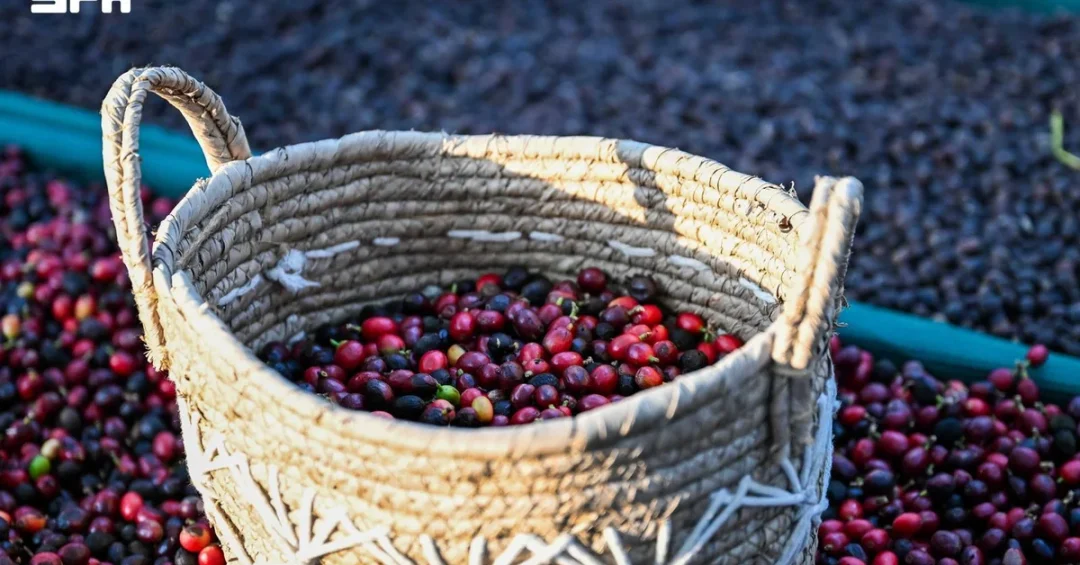
Saudi Arabia’s Jazan Region is marking International Coffee Day on October 1 with a thriving coffee cultivation sector that now boasts more than one million fruit-bearing trees producing upwards of 650 tons of pure coffee annually, according to the Saudi Press Agency. The milestone reflects a rare convergence of three centuries of agricultural heritage and a modern, state-backed investment drive that is transforming mountain terraces into a competitive export economy. For international observers, Jazan’s coffee story offers a clear window into how the Kingdom is pairing cultural preservation with the economic diversification goals of Vision 2030.
The figures released through official Saudi channels place Jazan at the center of the Kingdom’s coffee ambitions. Cultivation is concentrated on historical mountain terraces that have been farmed for generations, where the Khawlani bean is grown under conditions found almost nowhere else. The sector’s annual output now reaches a scale that supports domestic and international market development, while the region’s institutional infrastructure—cooperatives, financing programs, and training initiatives—has matured in parallel. Could any other crop in the Kingdom claim a heritage quite like this? The answer, for now, belongs to Jazan.
Context and Background
How did a remote mountainous corner of southwestern Saudi Arabia become the anchor of a national coffee identity? The answer begins more than three centuries ago, when farmers in Jazan’s highlands began cultivating coffee on stone terraces carved into steep slopes. Those terraces, many still in use today, represent an agricultural system passed down through generations and adapted to the region’s altitude, rainfall, and soil. The Khawlani bean, named for the community that has long cultivated it, became the signature variety of this landscape and the foundation of a local economy built around smallholder farming.
Global recognition arrived in 2022, when UNESCO inscribed the “Knowledge and practices related to cultivating Khawlani coffee beans” on the Representative List of the Intangible Cultural Heritage of Humanity. That inscription was not an isolated honor; it built on strategic domestic initiatives that began with the launch of a coffee festival in Al-Dayer Governorate in 2013. In 2016, government support expanded to include the rehabilitation of historical terraces, the distribution of seedlings, and the modernization of irrigation systems. Together, these steps converted a scattered traditional practice into a structured sector with clear institutional backing.
The timing of this year’s International Coffee Day observance is significant. It comes as Saudi Arabia’s non-oil economy continues to expand, and as global demand for specialty and single-origin coffee keeps rising. Jazan’s producers are positioned to serve both trends, supported by official programs that treat coffee not merely as a crop but as a cultural asset with commercial potential. What does it take to move a heritage product from local markets to international shelves? In Jazan, the answer is being assembled step by step, through cooperatives, financing, and quality standards.
Key Details
The institutional centerpiece of Jazan’s coffee sector is the Jazan Coffee Cooperative, the Kingdom’s first specialized coffee cooperative, established in 2022. According to official figures, the cooperative now serves more than 2,300 farmers and beneficiaries and counts 850 shareholders among its members. It has also empowered more than 150 female participants and implemented more than 15 strategic partnerships aimed at enhancing crop quality and market access. These numbers illustrate how a cooperative model can aggregate smallholder production into a coherent, market-ready supply chain.
Financial backing has been equally substantial. The Agricultural Development Fund’s Jazan branch reports that financing allocated to the Saudi coffee sector exceeded SAR60 million in 2025 as part of rural development funding. This capital enables farmers to upgrade farm infrastructure, improve irrigation, and optimize yields. The combination of cooperative organization and targeted financing is designed to transform Jazan’s living cultural legacy into a sustainable, competitive economic driver in both domestic and international markets. Is financial support alone enough to build a global coffee brand? Not on its own—but paired with training, quality control, and market linkages, it becomes a powerful catalyst.
The production base itself continues to expand. More than one million fruit-bearing trees now yield upwards of 650 tons of pure coffee annually, a figure that reflects decades of terrace rehabilitation and seedling distribution. Each tree represents not only agricultural output but also a commitment to maintaining the terraced landscape that gives Jazan coffee its distinctive character. The sector’s growth has been deliberate rather than rapid, prioritizing quality and heritage over volume alone—an approach that aligns with the premium positioning Saudi coffee seeks in international markets.
International and Regional Impact
How does a regional coffee sector in Saudi Arabia resonate beyond the Kingdom’s borders? For one, it strengthens the country’s profile in global conversations about specialty coffee, where origin stories and sustainable practices increasingly drive consumer choices. UNESCO’s recognition of Khawlani coffee practices gives Jazan a cultural credential that few coffee-producing regions can match, and that credential travels well in markets across Europe, Asia, and North America. Regional neighbors in the Gulf and the broader Middle East are also watching closely, as Saudi Arabia demonstrates how heritage agriculture can be modernized without being diluted.
The sector’s development also carries implications for trade and diplomacy. Coffee is a global commodity with deep cultural associations in the Middle East, and Saudi Arabia’s growing role as a producer adds a new dimension to its economic relationships. By investing in quality, branding, and cooperative infrastructure, the Kingdom is positioning Jazan coffee as a premium product that can compete internationally while supporting rural livelihoods at home. Could this model be replicated for other traditional crops in the region? The Jazan experience suggests that with the right institutional support, it can.
Economic and Strategic Significance
From an economic standpoint, Jazan’s coffee sector exemplifies the kind of high-value, labor-intensive agriculture that fits Saudi Arabia’s diversification strategy. Coffee cultivation generates income for thousands of farming families, supports ancillary services such as processing, packaging, and logistics, and creates opportunities for women and youth through cooperative participation and training programs. The SAR60 million in financing reported for 2025 is an investment in rural development that keeps economic activity circulating within local communities while building export capacity.
Strategically, coffee contributes to food security and rural resilience, two priorities that have gained prominence in Saudi policymaking. By reducing reliance on imports and developing a distinctive national product, the Kingdom strengthens its agricultural base and its cultural soft power simultaneously. The Jazan Coffee Cooperative’s partnerships—more than 15 in total—connect farmers to quality improvement and market access, ensuring that growth is not confined to production but extends through the entire value chain. What makes this sector strategically valuable is precisely this combination of cultural authenticity and commercial discipline.
Vision 2030 Alignment
Jazan’s coffee success story aligns directly with Vision 2030, Saudi Arabia’s national transformation plan, which emphasizes economic diversification, rural development, and the preservation of cultural heritage. The sector’s growth reflects several Vision 2030 pillars at once: creating sustainable employment outside major cities, empowering women through cooperative participation, and elevating Saudi products in international markets. The Agricultural Development Fund’s targeted financing and the cooperative’s training programs are practical expressions of the plan’s commitment to building a diversified, resilient economy.
As Saudi Arabia continues to modernize, Jazan’s terraced coffee farms stand as a reminder that progress and tradition can advance together. The Kingdom’s long-term vision includes a global role for Saudi culture and products, and coffee from Jazan is emerging as one of the most compelling examples. With more than a million trees, 650 tons of annual production, and a cooperative model that serves thousands, the region has built a foundation that can support growth for decades to come. The next chapter—expanding international sales while preserving the practices that earned UNESCO recognition—will define how far this heritage economy can travel.
20 Questions
Q1. What is the significance of International Coffee Day for Jazan?
A1. International Coffee Day on October 1 highlights Jazan’s thriving coffee sector, which blends over three centuries of agricultural heritage with modern investment. The occasion draws global attention to the region’s more than one million fruit-bearing trees and its growing role in Saudi Arabia’s economy.
Q2. How many coffee trees are currently cultivated in Jazan?
A2. According to official Saudi information, Jazan is home to more than one million fruit-bearing coffee trees. These trees are cultivated primarily on historical mountain terraces and collectively yield upwards of 650 tons of pure coffee each year.
Q3. What is the annual coffee production volume in Jazan?
A3. The region produces upwards of 650 tons of pure coffee annually. This output reflects decades of terrace rehabilitation, seedling distribution, and irrigation modernization supported by government programs and cooperative initiatives.
Q4. What is Khawlani coffee and why is it important?
A4. Khawlani coffee is a variety named after the community that has long cultivated it in Jazan’s highlands. In 2022, UNESCO inscribed the knowledge and practices related to cultivating Khawlani coffee beans on its Representative List of the Intangible Cultural Heritage of Humanity.
Q5. When did UNESCO recognize Khawlani coffee practices?
A5. UNESCO inscribed the knowledge and practices related to cultivating Khawlani coffee beans in 2022. This recognition acknowledged the cultural significance of the traditional cultivation methods used in Jazan for generations.
Q6. What was the first major coffee initiative launched in Jazan?
A6. The first major initiative was the launch of a coffee festival in Al-Dayer Governorate in 2013. This event helped raise awareness of the region’s coffee heritage and laid groundwork for broader government support in subsequent years.
Q7. What government support began in 2016 for Jazan coffee?
A7. In 2016, government support expanded to include the rehabilitation of historical terraces, the distribution of coffee seedlings, and the modernization of irrigation systems. These measures strengthened the production base and improved yields across the region.
Q8. What is the Jazan Coffee Cooperative?
A8. The Jazan Coffee Cooperative is the Kingdom’s first specialized coffee cooperative, established in 2022. It serves more than 2,300 farmers and beneficiaries and has 850 shareholders, providing training and market access.
Q9. How many farmers and beneficiaries does the cooperative serve?
A9. The Jazan Coffee Cooperative serves more than 2,300 farmers and beneficiaries. This broad membership base reflects the cooperative’s role in organizing smallholder production and connecting farmers to quality improvement and market opportunities.
Q10. How many female participants has the cooperative empowered?
A10. The cooperative has empowered more than 150 female participants. This aligns with Vision 2030 goals of increasing women’s economic participation and creating opportunities in rural communities.
Q11. How many strategic partnerships has the cooperative implemented?
A11. The Jazan Coffee Cooperative has implemented more than 15 strategic partnerships. These partnerships focus on enhancing crop quality and expanding market access for Jazan’s coffee producers.
Q12. How much financing was allocated to the coffee sector in 2025?
A12. According to the Agricultural Development Fund’s Jazan branch, financing allocated to the Saudi coffee sector exceeded SAR60 million in 2025. This funding is part of broader rural development efforts.
Q13. What does the financing enable farmers to do?
A13. The financing enables farmers to upgrade farm infrastructure, modernize irrigation systems, and optimize yields. It helps transform Jazan’s living cultural legacy into a sustainable and competitive economic driver in domestic and international markets.
Q14. Why is coffee cultivation important for Jazan’s economy?
A14. Coffee cultivation generates income for thousands of farming families and supports ancillary services such as processing, packaging, and logistics. It also creates opportunities for women and youth through cooperative participation and training programs.
Q15. How does Jazan coffee support Saudi Arabia’s Vision 2030?
A15. Jazan coffee supports Vision 2030 by promoting economic diversification, rural development, and cultural preservation. It creates sustainable employment outside major cities and empowers women through cooperative participation, aligning with the plan’s key pillars.
Q16. What makes Jazan’s coffee unique in the global market?
A16. Jazan’s coffee is unique due to its Khawlani variety, historical mountain terraces, and UNESCO-recognized cultivation practices. These factors give it a distinctive origin story that appeals to specialty coffee consumers worldwide.
Q17. How does the cooperative model benefit smallholder farmers?
A17. The cooperative model aggregates smallholder production into a coherent supply chain, providing training, quality control, and market access. It allows farmers to benefit from economies of scale and shared resources that would be difficult to achieve individually.
Q18. What role does the Agricultural Development Fund play?
A18. The Agricultural Development Fund provides financing for rural development, including the coffee sector. Its Jazan branch allocated more than SAR60 million in 2025 to help farmers upgrade infrastructure and optimize yields.
Q19. What are the historical roots of coffee cultivation in Jazan?
A19. Coffee cultivation in Jazan dates back more than three centuries. Farmers carved stone terraces into steep mountain slopes and passed down cultivation knowledge through generations, creating a living agricultural heritage that continues today.
Q20. What does the future hold for Jazan’s coffee sector?
A20. The future looks promising, with expanding international market access, continued cooperative support, and ongoing government investment. Jazan’s coffee sector is positioned to grow as a sustainable economic driver while preserving its cultural heritage.
Reader Feedback
We value your thoughts. Please share your feedback on this article.
Your feedback helps us improve our coverage.
Related articles
 Commerce Ministry Conducts 58,000 Inspections in September
 Saudi Ministry Offers Tropical Fruit City Investment in Jazan
 Riyadh Forum to Study Expo 2030, World Cup 2034 Returns
 Saudi Quality Mark Boosts Consumer Protection
 Saudi Istitlaa Platform Opens Feedback on 31 Projects
 Saudi Dates Sector Shines at Tunis Workshop