


Saudi Arabia’s unified electronic Public Consultation Platform, Istitlaa, has opened public feedback on 31 economic and development projects submitted in cooperation with 19 government entities, the Saudi Competitiveness and Business Center (SCBC) announced in Riyadh on October 1, 2026. The initiative invites citizens, residents, investors, and private-sector stakeholders to review and comment on draft laws and regulations before they are formally approved, marking another step in the Kingdom’s drive to strengthen transparency and participatory governance.
The projects span capital markets oversight, real estate investment, maritime safety, and professional licensing, and each carries a defined consultation window during which the public may submit proposals and observations. By publishing draft regulatory texts ahead of approval, the platform allows businesses and individuals to shape the rules that will govern their activities. Have Saudi authorities ever placed such a broad set of regulatory drafts before the public in a single consultation cycle? The breadth of this round, coordinated across 19 government entities, suggests a deliberate effort to synchronize reform across multiple sectors at once, reinforcing the Kingdom’s reputation for predictable, transparent, and business-friendly regulation.
Context and Background
Launched by the Saudi Competitiveness and Business Center, Istitlaa was designed as a single national gateway where draft legislation, regulations, and similar instruments are published for public review before adoption. The platform reflects a simple but powerful principle: those affected by regulation should have a voice in shaping it. Over successive consultation cycles, Istitlaa has become a fixture of Saudi regulatory practice, allowing government bodies to test proposals against real-world experience and to refine them before they take effect. Why does publishing a draft before approval matter so much to investors? Because it signals that rules are being written in the open, reducing uncertainty and building confidence among local and international market participants.
The current cycle brings together 19 government entities and 31 projects, a scale that underscores how deeply the consultation culture has taken root across the Saudi public sector. From financial market oversight to regional development and maritime transport, the proposals touch nearly every corner of the economy. The Saudi Press Agency reported that the platform enables stakeholders to share feedback and proposals on the projects before their approval, a mechanism that turns consultation from a formality into a working part of the legislative process. For international observers, the message is that Saudi Arabia’s regulatory modernization is not confined to a single ministry or authority, but is a coordinated, whole-of-government endeavor aligned with the objectives of Vision 2030.
Key Details of the Consultation Round
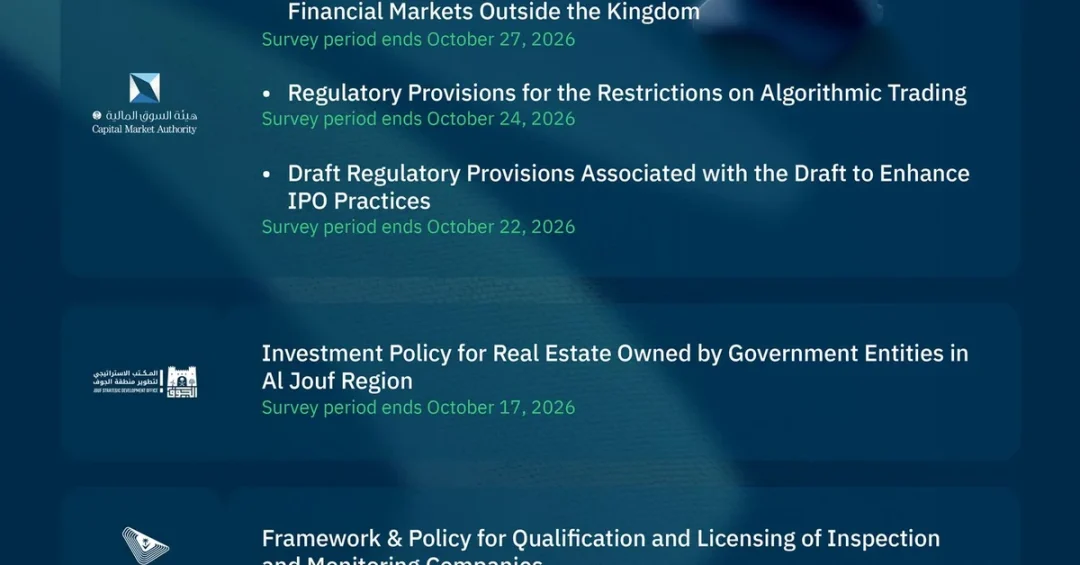
Among the most closely watched submissions are three projects from the Capital Market Authority (CMA). The first, “Draft Regulatory Provisions for Conducting Dealing Activities in Financial Markets Outside the Kingdom,” aims to strengthen the regulatory framework governing dealing activities in capital markets beyond Saudi borders. Public feedback on this project is open until October 27, 2026. The second, “Regulatory Provisions for the Restrictions on Algorithmic Trading,” seeks to develop controls governing automated trading strategies and enhance their safety and efficiency while ensuring they do not adversely affect market stability. Feedback on this project is open until October 24, 2026.
The CMA’s third project, “Draft Regulatory Provisions Associated with the Draft to Enhance IPO Practices,” is designed to develop the initial public offering framework by improving the efficiency of underwriting, book-building, and pricing processes. Public feedback on this project is open until October 22, 2026. Together, the three proposals address cross-border dealing, trading technology, and capital-raising mechanics, three areas where global markets are evolving rapidly. How can a regulator keep pace with trading algorithms that operate in microseconds? By setting clear, consultative guardrails in advance, as the CMA is doing here, rather than reacting after problems emerge.
Beyond the financial sector, the Jouf Strategic Development Office has put forward the “Investment Policy for Real Estate Owned by Government Entities in Al-Jouf Region.” The project aims to enable investment that optimizes the use of government-owned real estate, establishes unified criteria for assessing the attractiveness of properties and linking them to economic returns, and defines objective conditions and criteria for investors that support project stability and continuity. Public feedback is open until October 17, 2026. The National Center for Inspection and Monitoring has launched the “Framework and Policy for Qualification and Licensing of Inspection and Monitoring Companies,” which aims to regulate the licensing of inspection and control companies, standardize general requirements and assessment mechanisms, and govern the granting, renewal, and expansion of licenses, as well as monitor compliance throughout their validity period. Feedback on that project is open until October 16, 2026.
Also open until October 16, 2026, is the Transport General Authority’s “Implementing Regulations for the International Maritime Solid Bulk Cargoes (IMSBC) Code.” The project aims to regulate the transport of solid bulk cargoes by ships in the maritime areas of the Kingdom of Saudi Arabia, enhancing the safety of the transport and handling of such cargoes and protecting the marine environment. Each of these proposals carries practical consequences for investors, operators, and the public, and each has been placed on the platform precisely so that those consequences can be examined and discussed before the rules are finalized.
International and Regional Impact
For international investors, the consultation round sends a reassuring signal about how Saudi Arabia writes its rules. Cross-border dealing provisions, algorithmic trading controls, and IPO enhancements are precisely the areas where global asset managers, brokerages, and technology firms need clarity before committing capital. By exposing these drafts to public comment, the CMA allows market participants to flag operational concerns early, which in turn reduces the risk of disruptive adjustments after implementation. Does regulatory predictability matter as much as market size when global firms choose where to invest? Increasingly, the answer is yes, and Saudi Arabia is acting on that insight.
Regionally, the Istitlaa model positions the Kingdom as a leader in participatory governance. Neighboring economies and emerging markets across the Middle East and beyond are watching how Saudi Arabia balances openness with oversight, and the platform offers a template that other governments may study. The inclusion of maritime safety rules under the IMSBC Code also has implications beyond Saudi waters, since solid bulk cargoes move through international shipping lanes and ports. By aligning its implementing regulations with an established international framework, the Kingdom supports safer global supply chains while protecting its own marine environment, a dual benefit that resonates with trading partners worldwide.
Economic and Strategic Significance
The economic logic behind the consultation round is straightforward. Transparent, well-tested regulation lowers the cost of doing business, attracts foreign and domestic investment, and reduces the likelihood of costly disputes or compliance failures. The CMA’s IPO project, for example, targets the efficiency of underwriting, book-building, and pricing, the very mechanics that determine how successfully companies can raise capital on the Tadawul and other markets. A smoother IPO process encourages more firms to list, deepening capital markets and broadening investment opportunities for the public.
The Al-Jouf real estate investment policy illustrates a different but equally strategic priority: unlocking the value of government-owned assets in the regions. By establishing unified criteria that link property attractiveness to economic returns and by defining objective conditions for investors, the policy aims to turn idle or underused holdings into productive projects that create jobs and support local development. Similarly, the licensing framework for inspection and monitoring companies strengthens quality assurance across sectors, while the maritime regulations protect a vital channel of trade. Taken together, these projects show how regulatory reform translates directly into economic opportunity, and how consultation helps ensure that opportunity is well designed.
Vision 2030 Alignment
The Istitlaa platform sits squarely within the objectives of Saudi Vision 2030, which calls for a vibrant society, a thriving economy, and an ambitious nation. Transparency in the legislative environment is a cornerstone of the Vision’s governance agenda, and the introduction of draft laws and regulations through public consultation reflects the Kingdom’s continued commitment to engaging the general public, government entities, and the private sector in shaping projects related to the business environment. Each of the 31 projects, from capital markets to regional real estate to maritime safety, contributes to a regulatory ecosystem that is more predictable, more competitive, and more attractive to investment.
As the consultation windows close between October 16 and October 27, 2026, stakeholders have a clear and time-bound opportunity to participate. The Saudi Competitiveness and Business Center’s coordination of 19 government entities demonstrates that this is not an isolated exercise but a sustained national practice. For a global audience, the takeaway is that Saudi Arabia is building its future in the open, inviting feedback, and refining its rules before they take effect. That approach, grounded in Vision 2030 and executed through platforms like Istitlaa, strengthens the Kingdom’s standing as a transparent, forward-looking, and investor-friendly economy.
20 Questions
Q1. What is the Istitlaa platform?
A1. Istitlaa is the Saudi Competitiveness and Business Center’s unified electronic Public Consultation Platform. It publishes draft laws and regulations so that stakeholders can share feedback and proposals before the projects are approved.
Q2. How many projects are open for feedback?
A2. The platform has put forward 31 projects related to economic and development affairs, prepared in cooperation with 19 government entities across multiple sectors of the Saudi economy.
Q3. Which government entities are involved?
A3. Nineteen government entities are participating, including the Capital Market Authority, the Jouf Strategic Development Office, the National Center for Inspection and Monitoring, and the Transport General Authority.
Q4. What is the Capital Market Authority’s cross-border dealing project?
A4. It is the “Draft Regulatory Provisions for Conducting Dealing Activities in Financial Markets Outside the Kingdom,” which aims to strengthen the regulatory framework governing dealing activities in capital markets beyond Saudi borders.
Q5. When does feedback close on the cross-border dealing project?
A5. Public feedback on the cross-border dealing project is open until October 27, 2026, giving stakeholders several weeks to review and submit their observations.
Q6. What does the algorithmic trading project aim to do?
A6. It aims to develop controls governing algorithmic trading, enhance its safety and efficiency, and ensure that automated trading does not have adverse effects on the market.
Q7. When does feedback close on the algorithmic trading project?
A7. Public feedback on the regulatory provisions for restrictions on algorithmic trading is open until October 24, 2026.
Q8. What is the IPO practices project about?
A8. The draft aims to enhance initial public offering practices by improving the efficiency of underwriting, book-building, and pricing processes, thereby strengthening the framework for companies seeking to list.
Q9. When does feedback close on the IPO project?
A9. Public feedback on the draft regulatory provisions associated with enhancing IPO practices is open until October 22, 2026.
Q10. What is the Al-Jouf real estate investment policy?
A10. It is an investment policy for real estate owned by government entities in the Al-Jouf Region, designed to optimize the use of government-owned property and link it to economic returns.
Q11. When does feedback close on the Al-Jouf project?
A11. Public feedback on the investment policy for government-owned real estate in the Al-Jouf Region is open until October 17, 2026.
Q12. What does the inspection and monitoring licensing framework cover?
A12. It regulates the licensing of inspection and monitoring companies, standardizes requirements and assessment mechanisms, and governs the granting, renewal, and expansion of licenses and compliance monitoring.
Q13. When does feedback close on the licensing framework?
A13. Public feedback on the framework and policy for qualification and licensing of inspection and monitoring companies is open until October 16, 2026.
Q14. What is the IMSBC Code project?
A14. It is the Transport General Authority’s implementing regulations for the International Maritime Solid Bulk Cargoes Code, regulating the transport of solid bulk cargoes by ships in Saudi maritime areas.
Q15. When does feedback close on the maritime project?
A15. Public feedback on the implementing regulations for the International Maritime Solid Bulk Cargoes Code is open until October 16, 2026.
Q16. Why is public consultation important for Saudi Arabia?
A16. It enhances transparency in the legislative environment, promotes a culture of consultation among the public, government, and private sector, and helps shape projects related to the business environment.
Q17. Who can participate in the consultation?
A17. The platform enables stakeholders, including the general public, government entities, and the private sector, to share feedback and proposals on the published projects before approval.
Q18. How does this support investors?
A18. Publishing drafts before approval reduces regulatory uncertainty, allows investors to flag operational concerns early, and supports a predictable, business-friendly environment that encourages investment.
Q19. How does the consultation round align with Vision 2030?
A19. It advances Vision 2030’s governance and economic objectives by promoting transparency, engaging stakeholders, and modernizing regulations that support a thriving, diversified, and competitive economy.
Q20. What happens after the feedback period ends?
A20. Comments and proposals submitted through Istitlaa are reviewed by the sponsoring entities, which may refine the draft projects before they proceed toward formal approval and implementation.
Reader Feedback
We value your thoughts. Please share your feedback on this article.
Your feedback helps us improve our coverage.
Related articles
 Saudi Dates Sector Shines at Tunis Workshop
 Najran Prepares for Coffee Harvest as Cultivation Expands
 Riyadh Economic Forum to Tackle Traffic Congestion
 Al-Baha Marks International Coffee Day with Expanding Cultivation
 Saudi-Led Dates Council Holds Global Marketing Workshop in Tunisia
 Saudi Arabia Marks International Coffee Day, Highlights Sector Growth