


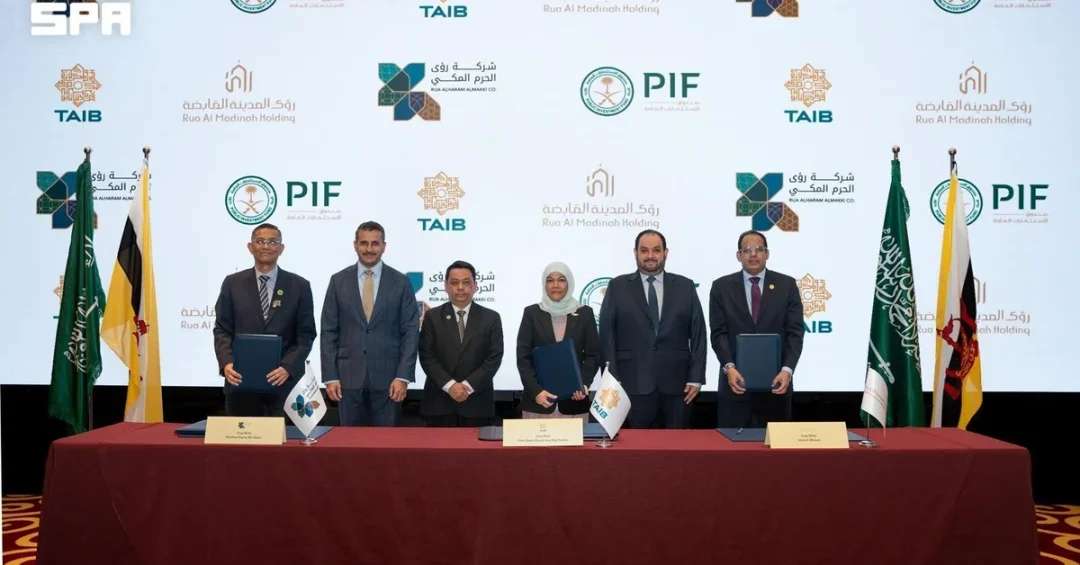
Two Public Investment Fund (PIF) companies, RUA AlHaram AlMakki Company (RUA AlHaram AlMakki) and Rua Al Madinah Holding (Rua Al Madinah), have signed two strategic collaboration agreements with Perbadanan Tabung Amanah Islam Brunei (TAIB), opening new avenues for investment collaboration between Saudi Arabia and Brunei Darussalam in major development projects across Makkah and Madinah. The agreements were signed in Brunei Darussalam by CEO of RUA AlHaram AlMakki Bambang Kajairi, CEO of Rua Al Madinah Eng. Ahmed Aljuhani, and Permanent Secretary III at the Ministry of Economy, Trade and Industry and Managing Director of TAIB Hasnah Binti Haji Ibrahim. The signing was witnessed by Head of Local Real Estate Investment Division of PIF Saad Abdulaziz AlKroud, Head of Portfolio Management – West Coast at PIF and Chairman of the Board of Rua Al Madinah Naif Al Hamdan, and Minister of Religious Affairs and Advisor to TAIB Pengiran Dato Seri Setia Haji Mohammad Tashim bin Pengiran Haji Hassan, according to the Saudi Press Agency (SPA).
Could this agreement mark a new chapter in how the Muslim world pools its resources to serve the guests of God? The collaboration brings together institutions from Saudi Arabia and Brunei Darussalam, establishing new avenues for investment and development collaboration in Makkah and Madinah. It reflects a shared interest in investing in developments that can enhance the experience of pilgrims and visitors and contribute to the long-term development of both holy cities. The agreements deepen investment ties between the two nations and underscore the growing role of PIF companies in attracting international partners to the Kingdom’s transformative projects. Under the first agreement, RUA AlHaram AlMakki and TAIB will explore a joint venture investment within King Salman Gate in Makkah, covering real estate development including hospitality and residential uses, with an indicative Gross Development Value (GDV) of approximately SAR9.7 billion, subject to due diligence, approvals, financing arrangements, and definitive agreements. Under a separate agreement, RUA AlHaram AlMakki, Rua Al Madinah, and TAIB will pursue collaboration around investment and development opportunities across Makkah, Madinah, and Brunei Darussalam, connecting investment and development opportunities in the holy cities with investment and expertise from Brunei while opening avenues for reciprocal investment.
Context and Background
Why has Saudi Arabia’s development strategy increasingly looked to international partnerships to realize its most ambitious projects? RUA AlHaram AlMakki is a PIF company and the master developer of King Salman Gate, a landmark destination in Makkah designed to accommodate the growing number of pilgrims and visitors. As master developer, the company is creating pathways for international institutions to invest while retaining stewardship of the destination’s vision and delivery as part of the Kingdom’s ongoing development efforts. The agreement brings TAIB into King Salman Gate as a strategic international partner, alongside RUA AlHaram AlMakki’s growing relationships with institutions across the Muslim world. This approach reflects a deliberate strategy to mobilize capital and expertise from friendly nations that share Saudi Arabia’s commitment to serving pilgrims and enhancing the spiritual journey.
Rua Al Madinah, meanwhile, is advancing major real estate development and investment initiatives in Madinah as part of Saudi Arabia’s ongoing development efforts in the city, with a focus on modern urban planning, hospitality, commercial development, and infrastructure. Its flagship Rua Al Madinah Project is planned as an integrated hospitality and commercial destination that will contribute to enhancing Madinah’s capacity and visitor experience in support of Saudi Vision 2030. The involvement of TAIB, a Brunei-based Islamic trust fund with a mandate to promote economic development, signals confidence in the Kingdom’s real estate sector and its long-term prospects. The agreements also reflect the broader trend of Gulf Cooperation Council (GCC) and Southeast Asian nations deepening economic ties, with Saudi Arabia positioning itself as a hub for Islamic finance and investment.
Brunei Darussalam, a fellow Muslim-majority nation with a strong Islamic finance framework, brings valuable expertise and capital to the table. The collaboration is not merely financial; it represents a meeting of minds on how to serve pilgrims and develop the holy cities in a manner that respects their spiritual significance while embracing modern urban planning. The agreements were signed in Brunei Darussalam, highlighting the Kingdom’s proactive diplomacy and its willingness to engage partners across geographies. As PIF companies, RUA AlHaram AlMakki and Rua Al Madinah are creating opportunities for leading international institutions to contribute to the development of both cities, enhance the experience of pilgrims and visitors, and support the objectives of Saudi Vision 2030.
Key Details
What exactly do these agreements entail, and how will they translate into tangible outcomes? The first collaboration agreement focuses on a joint venture investment within King Salman Gate in Makkah. The agreement covers the development of real estate within the destination, including hospitality and residential uses, with an indicative Gross Development Value (GDV) of approximately SAR9.7 billion. This figure is subject to due diligence, approvals, financing arrangements, and definitive agreements, meaning the final investment size may evolve as the parties progress. King Salman Gate is envisioned as a world-class destination that will elevate the pilgrimage experience, offering modern amenities and services while preserving the sanctity of the holy city. By bringing TAIB in as a strategic partner, RUA AlHaram AlMakki is not only securing capital but also gaining a partner with deep understanding of Islamic values and customer expectations.
The second collaboration agreement is broader in scope. RUA AlHaram AlMakki, Rua Al Madinah, and TAIB will pursue collaboration around investment and development opportunities across Makkah, Madinah, and Brunei Darussalam. This agreement connects investment and development opportunities in Makkah and Madinah with investment and expertise from Brunei, while opening avenues for reciprocal investment. In other words, it creates a two-way street: Saudi expertise and projects can attract Brunei capital, while Brunei’s development projects may benefit from Saudi investment and know-how. This reciprocal dimension is significant because it positions Saudi Arabia not just as a recipient of investment but as a global investor and partner. It also aligns with the Kingdom’s broader economic diversification goals under Vision 2030, which seek to expand non-oil sectors and foster international partnerships.
The signatories and witnesses underscore the high-level commitment to these agreements. The presence of Saad Abdulaziz AlKroud, Head of Local Real Estate Investment Division of PIF, and Naif Al Hamdan, Head of Portfolio Management – West Coast at PIF and Chairman of the Board of Rua Al Madinah, signals PIF’s strategic backing. The participation of Pengiran Dato Seri Setia Haji Mohammad Tashim bin Pengiran Haji Hassan, Minister of Religious Affairs and Advisor to TAIB, highlights the religious and cultural significance of the collaboration. Together, these leaders have laid the groundwork for a partnership that could serve as a model for future collaborations between Saudi Arabia and Southeast Asian nations.
International and Regional Impact
How might this partnership influence Saudi Arabia’s relations with Southeast Asia and the broader Muslim world? The agreements between RUA AlHaram AlMakki, Rua Al Madinah, and TAIB represent a deepening of ties between the Kingdom and Brunei Darussalam, a member of the Association of Southeast Asian Nations (ASEAN). This aligns with Saudi Arabia’s broader outreach to Asia, a region that is home to millions of Muslims and a growing source of investment and trade. By partnering with TAIB, Saudi Arabia is signaling its openness to collaboration with Islamic financial institutions worldwide. The move could encourage other Southeast Asian sovereign funds and Islamic banks to explore opportunities in the Kingdom’s giga-projects, particularly those related to Hajj and Umrah infrastructure.
Regionally, the agreements reinforce Makkah and Madinah as centers of spiritual and economic gravity. The development of King Salman Gate and the Rua Al Madinah Project will enhance the capacity of the holy cities to host pilgrims, a priority for Saudi Arabia as it continues to welcome increasing numbers of Umrah and Hajj performers. The projects also contribute to the broader economic ecosystem, creating jobs, stimulating local businesses, and improving infrastructure. For Brunei Darussalam, the partnership offers a chance to participate in high-profile developments that serve the global Muslim community, aligning with its own Islamic values and economic diversification goals. The reciprocal investment component could see Brunei benefit from Saudi expertise in large-scale urban development and hospitality management.
On the international stage, the collaboration demonstrates Saudi Arabia’s ability to attract partners from diverse regions, reinforcing its position as a global leader in Islamic finance and pilgrimage services. It also highlights the role of PIF as a catalyst for international partnerships, with its portfolio companies actively engaging with foreign investors. The agreements are consistent with the Kingdom’s Vision 2030, which aims to increase foreign direct investment and diversify the economy. By working with TAIB, Saudi Arabia is not only securing capital but also building bridges with Southeast Asia, a region of strategic importance for trade, energy, and cultural exchange.
Economic and Strategic Significance
What does the SAR9.7 billion indicative GDV tell us about the scale of ambition behind King Salman Gate? The figure, while subject to due diligence and definitive agreements, underscores the magnitude of the development and the confidence that RUA AlHaram AlMakki and its partners have in the project. King Salman Gate is designed to be a mixed-use destination that integrates hospitality, residential, and commercial components, all aimed at enhancing the pilgrim experience. The involvement of TAIB as a strategic partner brings not only capital but also a commitment to Islamic principles, ensuring that the development respects the religious and cultural sensitivities of Makkah. The agreement also provides a template for future collaborations, as RUA AlHaram AlMakki continues to build relationships with institutions across the Muslim world.
For Rua Al Madinah, the collaboration with TAIB and RUA AlHaram AlMakki opens new avenues for investment in Madinah’s development. The Rua Al Madinah Project is a flagship initiative that will expand hospitality and commercial offerings in the city, supporting the goal of accommodating more visitors and improving their experience. The partnership with TAIB could attract further investment from Brunei and other Southeast Asian nations, creating a multiplier effect. Strategically, these agreements align with Vision 2030’s objectives of increasing non-oil revenue, boosting the private sector, and enhancing the Kingdom’s role as a global investment destination. They also reinforce the importance of the Hajj and Umrah sectors as economic drivers, contributing to job creation and GDP growth.
The economic significance extends beyond the immediate projects. By fostering international partnerships, Saudi Arabia is building a network of allies and investors who have a stake in the Kingdom’s success. This network can help mitigate risks and ensure a steady flow of capital and expertise. Moreover, the reciprocal investment dimension means Saudi companies may gain access to opportunities in Brunei and beyond, further integrating the Kingdom into the global economy. As PIF companies, RUA AlHaram AlMakki and Rua Al Madinah are at the forefront of this effort, demonstrating how state-backed entities can drive international collaboration and deliver on Vision 2030’s ambitious targets.
Vision 2030 Alignment
How do these agreements exemplify the core objectives of Saudi Vision 2030? Vision 2030 seeks to transform Saudi Arabia into a diversified, globally engaged economy, with a focus on enhancing the quality of life for citizens and visitors. The collaboration between RUA AlHaram AlMakki, Rua Al Madinah, and TAIB directly supports these goals by attracting foreign investment, developing world-class infrastructure in the holy cities, and improving the pilgrimage experience. The projects also contribute to the Vision’s aim of increasing the number of Umrah and Hajj pilgrims, which in turn boosts the tourism and hospitality sectors. By partnering with an international Islamic financial institution, the Kingdom is also promoting its Islamic finance credentials and fostering deeper ties with the Muslim world.
Furthermore, the agreements highlight the role of PIF as a key enabler of Vision 2030. As the Kingdom’s sovereign wealth fund, PIF is tasked with investing in projects that drive economic transformation and generate sustainable returns. RUA AlHaram AlMakki and Rua Al Madinah, as PIF companies, are instrumental in delivering on this mandate. Their success in securing international partnerships demonstrates the attractiveness of Saudi Arabia’s investment climate and the credibility of its development plans. As these projects progress, they will serve as beacons of the Kingdom’s commitment to serving pilgrims, fostering economic growth, and building bridges with nations around the world. The collaboration with Brunei Darussalam is a testament to the global confidence in Saudi Arabia’s vision and its ability to execute complex, large-scale developments.
20 Questions
Q1. What agreements were signed between Saudi Arabia and Brunei Darussalam?
A1. Two strategic collaboration agreements were signed between RUA AlHaram AlMakki, Rua Al Madinah, and Perbadanan Tabung Amanah Islam Brunei (TAIB) to explore investment and development opportunities in Makkah, Madinah, and Brunei Darussalam.
Q2. Who signed the agreements on behalf of the Saudi companies?
A2. CEO of RUA AlHaram AlMakki Bambang Kajairi and CEO of Rua Al Madinah Eng. Ahmed Aljuhani signed for the Saudi side, while Managing Director of TAIB Hasnah Binti Haji Ibrahim signed for Brunei.
Q3. What is the estimated Gross Development Value of the King Salman Gate project?
A3. The indicative Gross Development Value (GDV) is approximately SAR9.7 billion, subject to due diligence, approvals, financing arrangements, and definitive agreements.
Q4. What is King Salman Gate?
A4. King Salman Gate is a landmark development in Makkah master-developed by RUA AlHaram AlMakki, designed to enhance the pilgrimage experience with hospitality, residential, and commercial offerings.
Q5. What is the role of RUA AlHaram AlMakki in the project?
A5. As a PIF company and master developer of King Salman Gate, RUA AlHaram AlMakki is creating pathways for international institutions to invest while retaining stewardship of the destination’s vision and delivery.
Q6. What does the second collaboration agreement cover?
A6. The second agreement covers collaboration around investment and development opportunities across Makkah, Madinah, and Brunei Darussalam, connecting Saudi projects with Brunei investment and expertise, and opening avenues for reciprocal investment.
Q7. What is Rua Al Madinah Holding?
A7. Rua Al Madinah Holding is a PIF company advancing major real estate development and investment initiatives in Madinah, including the flagship Rua Al Madinah Project, an integrated hospitality and commercial destination.
Q8. What is Perbadanan Tabung Amanah Islam Brunei (TAIB)?
A8. TAIB is a Brunei-based Islamic trust fund that promotes economic development through Shariah-compliant investments, and it is partnering with Saudi companies to invest in Makkah and Madinah.
Q9. Who witnessed the signing of the agreements?
A9. The signing was witnessed by Saad Abdulaziz AlKroud, Naif Al Hamdan, and Pengiran Dato Seri Setia Haji Mohammad Tashim bin Pengiran Haji Hassan, among others.
Q10. Why are these agreements significant for Saudi-Brunei relations?
A10. They deepen investment ties between the two nations, foster collaboration in serving pilgrims, and open avenues for reciprocal investment, strengthening diplomatic and economic relations.
Q11. How do these agreements support Saudi Vision 2030?
A11. They attract foreign investment, enhance the pilgrimage experience, develop world-class infrastructure in the holy cities, and support economic diversification and global engagement, all core to Vision 2030.
Q12. What benefits will the projects bring to pilgrims and visitors?
A12. The projects will expand hospitality and commercial offerings, improve infrastructure, and enhance the overall experience for pilgrims and visitors in Makkah and Madinah.
Q13. What is the role of the Public Investment Fund (PIF) in these agreements?
A13. PIF is the sovereign wealth fund that owns RUA AlHaram AlMakki and Rua Al Madinah, and it supports their efforts to attract international partners and deliver on Vision 2030 objectives.
Q14. Will TAIB invest in both Makkah and Madinah projects?
A14. Yes, under the second agreement, TAIB will collaborate on investment and development opportunities across both Makkah and Madinah, as well as in Brunei Darussalam.
Q15. What does ‘reciprocal investment’ mean in this context?
A15. Reciprocal investment means that Saudi companies may also invest in development projects in Brunei Darussalam, creating a two-way flow of capital and expertise between the two countries.
Q16. How does this collaboration reflect Saudi Arabia’s outreach to the Muslim world?
A16. It demonstrates the Kingdom’s commitment to partnering with Islamic institutions globally, leveraging shared values to develop the holy cities and serve pilgrims from around the world.
Q17. What is the Rua Al Madinah Project?
A17. The Rua Al Madinah Project is a flagship integrated hospitality and commercial destination in Madinah, designed to enhance the city’s capacity and visitor experience in support of Vision 2030.
Q18. What are the next steps after the signing of these agreements?
A18. The parties will conduct due diligence, seek necessary approvals, arrange financing, and negotiate definitive agreements before proceeding with the joint venture investment.
Q19. How might these agreements impact the local economies of Makkah and Madinah?
A19. They are expected to create jobs, stimulate local businesses, improve infrastructure, and attract further investment, contributing to the economic development of both cities.
Q20. What message does this collaboration send to international investors?
A20. It signals that Saudi Arabia’s giga-projects are open to international partnership, offering attractive opportunities backed by PIF and aligned with Vision 2030’s transformative agenda.
Reader Feedback
We value your thoughts. Please share your feedback on this article.
Your feedback helps us improve our coverage.
Related articles
 American Agriculture Takes Center Stage at Saudi Food Show
 Saudi Finance Minister Concludes AIIB Meetings in Doha
 Saudi Commerce Minister to Lead Delegation at G20 Trade Meeting
 Gold Prices Rise 0.4% After Sharp Drop, Near 7-Week Lows
 RUA AlHaram AlMakki, MRCB Sign SAR21 Billion Makkah Deal
 SaudiFood Exhibitions Draw Arabian Gulf Cup Visitors in Jeddah