


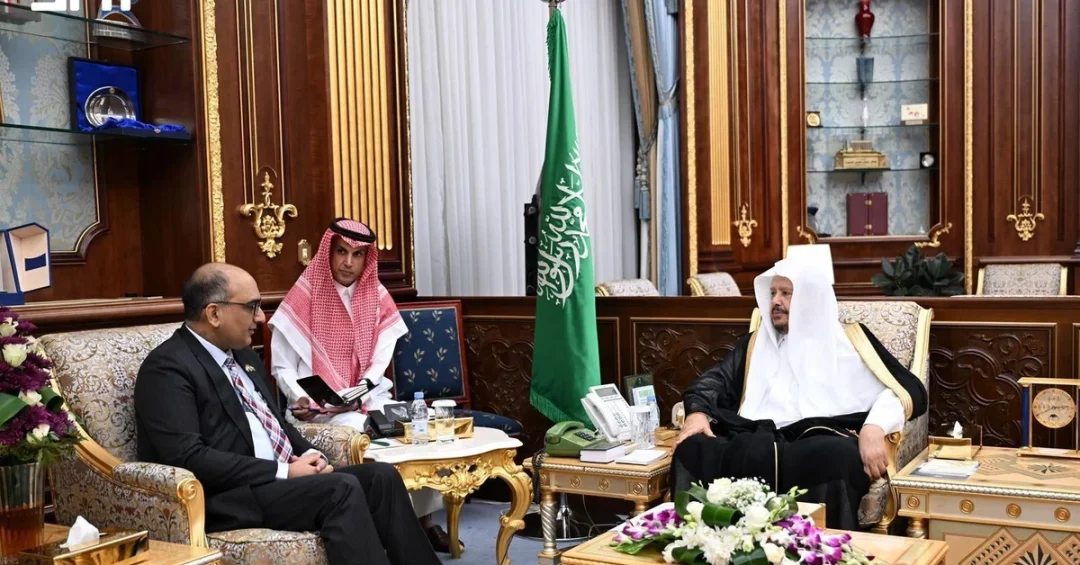
Speaker of the Shura Council Sheikh Dr. Abdullah Al Al-Sheikh received the Ambassador of the Republic of India to the Kingdom of Saudi Arabia, Vipul, in Riyadh on Tuesday, September 29, 2026, according to the Saudi Press Agency (SPA). The meeting, held at the Shura Council headquarters, focused on reviewing the strong bilateral relations between the two nations and exploring ways to further strengthen them across various fields, with particular emphasis on parliamentary cooperation between the Shura Council and the Parliament of India. Both sides also discussed a range of topics of mutual interest, reflecting the depth and breadth of the Saudi-Indian partnership.
The encounter underscores the Kingdom’s ongoing commitment to diplomatic engagement and international collaboration, aligning with the visionary leadership of the Custodian of the Two Holy Mosques, King Salman bin Abdulaziz Al Saud, and His Royal Highness Crown Prince Mohammed bin Salman bin Abdulaziz Al Saud, Prime Minister. As Saudi Arabia continues to expand its global partnerships under Vision 2030, such high-level meetings play a crucial role in fostering understanding, enhancing cooperation, and building bridges between nations. The Shura Council, as the Kingdom’s consultative assembly, remains a vital institution in this diplomatic framework, facilitating dialogue and legislative exchange that supports Saudi Arabia’s strategic objectives on the world stage.
Context and Background
How does parliamentary diplomacy contribute to strengthening ties between nations in an increasingly interconnected world? The meeting between Speaker Al Al-Sheikh and Ambassador Vipul is the latest in a series of high-level engagements that reflect the robust and multifaceted relationship between Saudi Arabia and India. Historically, the two countries have enjoyed cordial relations rooted in centuries of trade and cultural exchange. In recent years, this relationship has evolved into a strategic partnership encompassing energy, security, technology, and investment. The Shura Council has been an active participant in this evolution, engaging with Indian parliamentary counterparts to share expertise and coordinate on legislative matters of common interest.
The Kingdom of Saudi Arabia and the Republic of India share a deep and enduring friendship, marked by mutual respect and a shared vision for regional stability and prosperity. India is one of Saudi Arabia’s largest trading partners, and the two nations collaborate closely in international forums on issues ranging from energy security to counterterrorism. The parliamentary dimension of this relationship is particularly significant, as it provides a platform for lawmakers to exchange views, align policies, and support the implementation of bilateral agreements. The Shura Council’s role in this context is instrumental, as it helps to translate diplomatic intentions into concrete legislative and regulatory frameworks that benefit both peoples.
Moreover, the meeting comes at a time when Saudi Arabia is actively pursuing its Vision 2030 goals, which include diversifying the economy, enhancing international cooperation, and positioning the Kingdom as a global hub for trade, investment, and diplomacy. India, with its rapidly growing economy and young population, represents a key partner in these efforts. The discussions between Speaker Al Al-Sheikh and Ambassador Vipul therefore carry strategic weight, as they explore avenues to deepen collaboration in areas such as education, technology, healthcare, and infrastructure, all of which are central to the Kingdom’s transformative agenda.
Key Details of the Meeting
What specific areas of cooperation were highlighted during the discussions? According to the official SPA report, the meeting covered bilateral relations and ways to enhance them across various fields, with a particular focus on parliamentary cooperation between the Shura Council and the Parliament of India. Speaker Al Al-Sheikh and Ambassador Vipul reviewed the current state of Saudi-Indian relations and explored opportunities to expand collaboration in areas of mutual interest. The talks also touched on regional and international developments, underscoring the two nations’ shared commitment to peace, stability, and sustainable development.
The emphasis on parliamentary cooperation reflects the growing importance of legislative exchange in modern diplomacy. The Shura Council, which serves as a bridge between the Saudi government and the people, has increasingly engaged with international parliaments to share best practices, discuss legislative priorities, and foster people-to-people ties. In the case of India, the Parliament is a vibrant institution that represents the world’s largest democracy, and its engagement with the Shura Council can lead to greater understanding and collaboration on a wide range of issues, from trade and investment to climate change and counterterrorism.
Ambassador Vipul, a seasoned diplomat, has been actively involved in strengthening Saudi-Indian ties since his appointment. His meeting with Speaker Al Al-Sheikh is part of a broader effort to maintain regular high-level contacts and ensure that the relationship continues to grow. The Shura Council Speaker, Sheikh Dr. Abdullah Al Al-Sheikh, is a respected figure in Saudi Arabia’s political landscape, and his engagement with foreign diplomats underscores the Council’s active role in shaping the Kingdom’s international relations. The discussions were held in a cordial and constructive atmosphere, reflecting the mutual respect and friendship that characterize Saudi-Indian relations.
International and Regional Impact
How does the Saudi-Indian partnership influence regional stability and global cooperation? The meeting between Speaker Al Al-Sheikh and Ambassador Vipul is more than a routine diplomatic courtesy; it is a testament to the strategic importance that both nations attach to their relationship. Saudi Arabia, as a leading member of the Gulf Cooperation Council (GCC) and the Organization of Islamic Cooperation (OIC), plays a pivotal role in regional affairs. India, as a rising global power and a key player in the Indo-Pacific, shares many of the Kingdom’s interests in promoting peace, security, and economic prosperity. Their collaboration on parliamentary and other levels contributes to a more stable and prosperous region.
The international community closely watches Saudi-Indian relations, given their potential to shape trade routes, energy flows, and security dynamics. The two countries have cooperated on counterterrorism, maritime security, and disaster relief, among other areas. Parliamentary exchanges can further solidify these efforts by ensuring that legislative frameworks support joint initiatives. For instance, both nations have a stake in combating extremism and promoting moderate values, and their parliaments can work together to enact laws that facilitate intelligence sharing and capacity building. The meeting in Riyadh thus sends a positive signal about the future of bilateral cooperation and its positive spillover effects for the wider region.
Economic and Strategic Significance
What economic opportunities does the Saudi-Indian partnership unlock for both nations? India is one of the fastest-growing major economies in the world, and Saudi Arabia is the largest economy in the Arab world. Their complementary strengths—Saudi Arabia’s energy resources and India’s technological and human capital—create a natural synergy that can drive mutual growth. Bilateral trade between the two countries has been robust, and there is significant potential to expand it further in sectors such as renewable energy, digital economy, pharmaceuticals, and agriculture. The Shura Council’s engagement with Indian parliamentarians can help to remove regulatory hurdles and promote investment flows.
Strategically, the partnership aligns with Saudi Arabia’s Vision 2030, which seeks to diversify the Kingdom’s economy away from oil dependence and foster a knowledge-based society. India’s expertise in information technology, healthcare, and education can support these goals. Moreover, Saudi Arabia’s strategic location as a bridge between Asia, Europe, and Africa makes it an ideal partner for India’s trade and connectivity initiatives. The meeting between Speaker Al Al-Sheikh and Ambassador Vipul likely touched on these synergies, exploring how parliamentary cooperation can facilitate joint ventures, technology transfer, and people-to-people exchanges. As both nations continue to recover from global economic challenges, such collaboration is essential for sustainable development.
Vision 2030 Alignment
How does this diplomatic engagement reflect the Kingdom’s broader transformation under Vision 2030? The meeting between Speaker Al Al-Sheikh and Ambassador Vipul is a clear example of how Saudi Arabia is actively building international partnerships that support its Vision 2030 objectives. Vision 2030, launched by Crown Prince Mohammed bin Salman in 2016, aims to transform the Kingdom into a global investment powerhouse and a hub for trade, tourism, and innovation. International diplomacy, including parliamentary exchanges, is a key enabler of this vision, as it opens doors to new markets, attracts foreign investment, and fosters cultural understanding.
The Shura Council’s role in this context is vital. By engaging with counterparts like the Parliament of India, the Council helps to align Saudi legislation with international best practices and ensures that the Kingdom remains an attractive destination for global partners. The meeting also reinforces Saudi Arabia’s commitment to multilateralism and peaceful cooperation, values that are central to Vision 2030 and the Kingdom’s foreign policy. As Saudi Arabia continues to host major international events, such as Expo 2030 in Riyadh, and to implement giga-projects like NEOM, partnerships with countries like India will be instrumental in achieving success. The discussions in Riyadh are a step forward in this journey, paving the way for deeper collaboration and shared prosperity.
20 Questions
Q1. Who received the Indian Ambassador to Saudi Arabia in Riyadh?
A1. Speaker of the Shura Council Sheikh Dr. Abdullah Al Al-Sheikh received Ambassador Vipul of India in Riyadh on September 29, 2026, as reported by the Saudi Press Agency.
Q2. What was the main focus of the meeting between Speaker Al Al-Sheikh and Ambassador Vipul?
A2. The meeting focused on reviewing bilateral relations between Saudi Arabia and India and exploring ways to strengthen them, particularly parliamentary cooperation between the Shura Council and the Parliament of India.
Q3. When did the meeting take place?
A3. The meeting took place on Tuesday, September 29, 2026, according to the official Saudi Press Agency report from Riyadh.
Q4. Where was the meeting held?
A4. The meeting was held in Riyadh, the capital of Saudi Arabia, at the Shura Council headquarters, as per the SPA report.
Q5. Who is the Speaker of the Shura Council?
A5. The Speaker of the Shura Council is Sheikh Dr. Abdullah Al Al-Sheikh, a respected Saudi leader who plays a key role in the Kingdom’s consultative assembly.
Q6. Who is the Indian Ambassador to Saudi Arabia?
A6. The Indian Ambassador to Saudi Arabia is Vipul, a seasoned diplomat who has been actively working to strengthen ties between India and the Kingdom.
Q7. What is the Shura Council?
A7. The Shura Council is Saudi Arabia’s consultative assembly, which advises the government on legislative matters and engages with international parliaments to foster cooperation.
Q8. What topics of mutual interest were discussed?
A8. The discussions covered bilateral relations, parliamentary cooperation, and other topics of mutual interest, reflecting the broad scope of Saudi-Indian partnership.
Q9. Why is parliamentary cooperation important between Saudi Arabia and India?
A9. Parliamentary cooperation facilitates legislative exchange, aligns policies, and supports the implementation of bilateral agreements, enhancing people-to-people ties and mutual understanding.
Q10. How does this meeting align with Saudi Vision 2030?
A10. The meeting supports Vision 2030 by strengthening international partnerships, promoting economic diversification, and enhancing Saudi Arabia’s global engagement and diplomatic outreach.
Q11. What is the significance of Saudi-Indian relations?
A11. Saudi-Indian relations are significant due to strong trade ties, energy cooperation, and shared interests in regional stability, counterterrorism, and economic development.
Q12. How often do Saudi and Indian officials meet?
A12. Saudi and Indian officials meet regularly through diplomatic channels, high-level visits, and parliamentary exchanges to maintain and deepen their strategic partnership.
Q13. What economic benefits could result from this meeting?
A13. The meeting could lead to enhanced trade, investment, and collaboration in sectors like technology, healthcare, and renewable energy, benefiting both economies.
Q14. What role does the Shura Council play in Saudi diplomacy?
A14. The Shura Council engages with international parliaments, shares legislative expertise, and supports the Kingdom’s foreign policy objectives through parliamentary diplomacy.
Q15. How does India benefit from its partnership with Saudi Arabia?
A15. India benefits from energy security, investment opportunities, and collaboration in technology and infrastructure, as well as support for its regional interests.
Q16. What are the key areas of Saudi-Indian cooperation?
A16. Key areas include energy, trade, investment, security, technology, healthcare, education, and cultural exchange, all of which are expanding under Vision 2030.
Q17. What did Ambassador Vipul say about the meeting?
A17. The SPA report did not include specific comments from Ambassador Vipul, but the meeting was described as constructive and focused on strengthening bilateral ties.
Q18. How does this meeting reflect Saudi Arabia’s foreign policy?
A18. It reflects Saudi Arabia’s commitment to multilateralism, peaceful cooperation, and building strategic partnerships that support regional and global stability.
Q19. What is the expected outcome of the meeting?
A19. The meeting is expected to enhance parliamentary cooperation, facilitate legislative exchange, and pave the way for further collaboration in areas of mutual interest.
Q20. How can the international community interpret this meeting?
A20. The international community can view this meeting as a positive step in Saudi-Indian relations, demonstrating the Kingdom’s active diplomacy and its role as a global partner for peace and prosperity.
Reader Feedback
We value your thoughts. Please share your feedback on this article.
Your feedback helps us improve our coverage.
Related articles
 Crown Prince Receives Call from Sudan’s Al-Burhan
 Jeddah Governor Receives Portuguese Secretary of State
 WAMY Hosts Seminar on Charities-Private Sector Ties in Sudan
 Saudi FM Meets US Envoy to UN in Washington
 31 Recommendations Issued at International Conference on Efforts to Counter Intellectual Deviations
 Uttar Pradesh Flood Death Toll Rises to 81, Official Report Says