


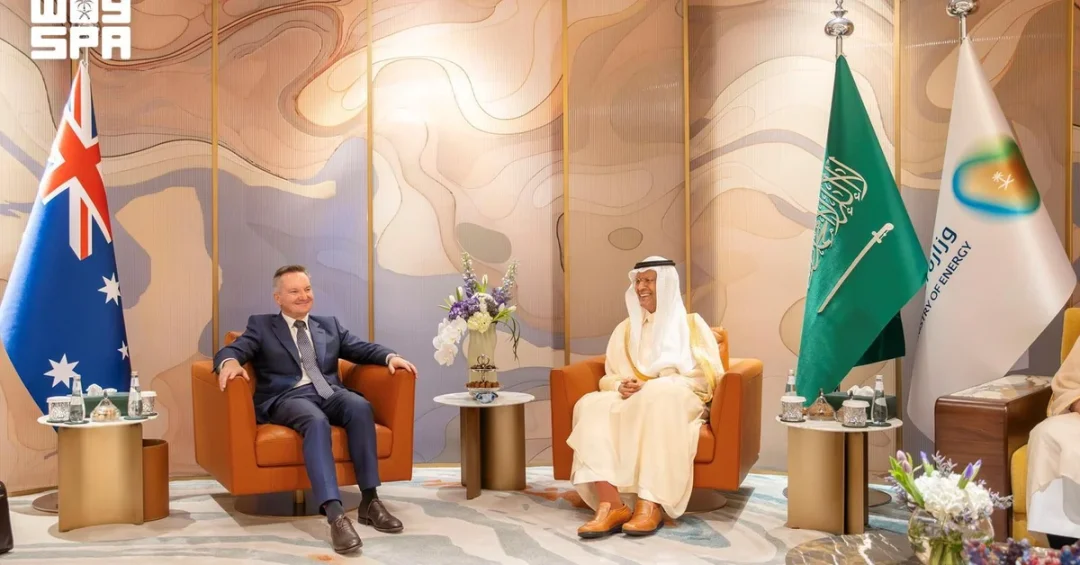
Saudi Minister of Energy and Minister of Industry and Mineral Resources Prince Abdulaziz bin Salman bin Abdulaziz met with Australian Minister for Climate Change and Energy Chris Bowen in Jeddah on September 28, 2026, to discuss bilateral cooperation on climate action and joint preparations for the 31st Conference of the Parties to the United Nations Framework Convention on Climate Change (COP31), according to the Saudi Press Agency. The meeting underscored the Kingdom’s expanding role as a bridge-builder in global energy and climate diplomacy, bringing together a leading oil producer and a key Indo-Pacific partner at a pivotal moment for international climate negotiations.
The talks centered on advancing the objectives and principles of the United Nations Framework Convention on Climate Change and the Paris Agreement, with both ministers emphasizing the need for inclusive, balanced and practical outcomes that take into account the national circumstances of member states. COP31 is scheduled to be held in Türkiye in November 2026. Could this meeting in Jeddah signal a new chapter in how major energy producers and climate-conscious nations work together?
Context and Background
Why does a meeting between Saudi Arabia and Australia matter for the future of global climate policy? The Jeddah talks come as the international community prepares for COP31 in Türkiye, a conference expected to test the ability of nations to reconcile ambitious emissions-reduction goals with the realities of energy security and economic development. Saudi Arabia, as the world’s leading exporter of crude oil and a founding member of OPEC+, has long advocated for a pragmatic approach that balances environmental responsibility with the need to maintain stable energy markets. Australia, for its part, has accelerated its own energy transition agenda while remaining a significant exporter of liquefied natural gas and critical minerals.
The meeting between Prince Abdulaziz bin Salman, who also serves as Minister of Industry and Mineral Resources, and Minister Bowen reflects a shared recognition that climate change is a global challenge requiring coordinated, science-based responses. Both nations have invested heavily in renewable energy, emissions management and clean technology research. The Saudi Press Agency reported that the two sides reviewed the Kingdom’s initiatives, including the deployment of renewable energy, emissions management, reduction and removal, the Saudi Green Initiative, and the implementation of the Circular Carbon Economy approach and its technologies, alongside other national and regional programs.
This is not the first time Riyadh and Canberra have engaged on energy and climate issues, but the timing of this meeting gives it added significance. With COP31 on the horizon, the discussions in Jeddah could help shape the tone and substance of the negotiations in Türkiye. Isn’t it notable that a nation so closely associated with hydrocarbon production is now hosting a dialogue with a climate-forward partner like Australia?
Key Details
What exactly did the two ministers discuss, and what concrete outcomes can be expected? According to the Saudi Press Agency, the meeting focused on opportunities for cooperation on climate action and joint efforts in connection with COP31. The two sides explored ways to advance the objectives and principles of the UNFCCC and the Paris Agreement, aiming for outcomes that are inclusive, balanced and practical. This language mirrors Saudi Arabia’s consistent position in international climate negotiations: that each nation must be allowed to chart its own path to sustainability based on its unique economic and social circumstances.
Minister Bowen’s visit also included a tour of the Shuaibah Solar Power Project, one of the largest projects under Saudi Arabia’s National Renewable Energy Program. The Shuaibah project is a flagship example of the Kingdom’s commitment to diversifying its energy mix, generating clean electricity at scale while reducing reliance on liquid fuels for power generation. The visit provided a firsthand look at how Saudi Arabia is translating its renewable energy targets into tangible infrastructure.
In addition to the solar project, Minister Bowen toured Historic Jeddah, a UNESCO World Heritage site and one of the Kingdom’s leading cultural and tourism destinations. He also visited King Abdullah University of Science and Technology (KAUST), where he was briefed on the university’s research environment and academic programs in science, engineering and biotechnology. These visits highlight the multifaceted nature of the Saudi-Australian relationship, extending beyond energy into culture, education and research. Could this combination of clean energy, heritage and innovation be a model for how nations engage on climate diplomacy?
International and Regional Impact
How will this meeting influence the broader geopolitical landscape of climate negotiations? Saudi Arabia’s engagement with Australia signals a willingness to build bridges across traditional divides—between developed and developing economies, between fossil fuel producers and climate-vulnerable states, and between the Global North and Global South. By hosting Minister Bowen in Jeddah, the Kingdom reinforces its role as a convenor of dialogue and a proponent of consensus-based multilateralism. This approach aligns with the spirit of the Paris Agreement, which explicitly recognizes the principle of common but differentiated responsibilities and respective capabilities.
For Australia, the meeting offers an opportunity to deepen ties with a key energy supplier and investor in the Indo-Pacific region. Australia has set ambitious targets for renewable energy deployment and emissions reduction, and it sees cooperation with Saudi Arabia as complementary rather than competitive. Both countries are major exporters of energy resources and both are investing in hydrogen, solar, wind and carbon capture technologies. The exchange of expertise and the alignment of positions ahead of COP31 could help bridge gaps in the negotiations and produce more durable outcomes.
Regionally, the meeting underscores Saudi Arabia’s growing leadership in climate diplomacy in the Middle East. The Kingdom has launched the Saudi Green Initiative and the Middle East Green Initiative, which aim to plant billions of trees, restore degraded land and reduce emissions across the region. These initiatives have attracted international attention and participation, including from Australia. Isn’t it significant that a Gulf state is now at the forefront of regional environmental action?
Economic and Strategic Significance
What do the talks mean for the economic and strategic priorities of both nations? Saudi Arabia’s Vision 2030 agenda places sustainability at the heart of its economic diversification strategy. The Kingdom is investing hundreds of billions of dollars in renewable energy, green hydrogen, carbon capture and storage, and the circular carbon economy. These investments are designed to reduce emissions, create jobs and position Saudi Arabia as a global leader in clean energy technologies. Cooperation with Australia, a leader in solar and wind technology and a major producer of critical minerals needed for batteries and renewable infrastructure, could accelerate these efforts.
For Australia, Saudi Arabia represents a significant market for its expertise in renewable energy, mining and agricultural technology. Australian companies are already involved in several Saudi mega-projects, including NEOM and the Red Sea development. The meeting in Jeddah could pave the way for new joint ventures and research collaborations. Both countries also share an interest in stable energy markets, and their dialogue on climate action is likely to include discussions on how to manage the transition in a way that avoids price shocks and supply disruptions. Could this partnership become a blueprint for other resource-rich nations navigating the energy transition?
The strategic significance of the meeting extends beyond bilateral ties. Saudi Arabia and Australia are both active members of the G20 and other multilateral forums where climate and energy issues are discussed. Their coordination ahead of COP31 could help shape the agenda and ensure that the voices of energy-exporting nations are heard. This is particularly important as the world grapples with the dual challenge of reducing emissions while ensuring affordable, reliable energy for all.
Vision 2030 Alignment
How does the Jeddah meeting advance Saudi Arabia’s Vision 2030 goals? Vision 2030, the Kingdom’s comprehensive reform plan launched by Crown Prince Mohammed bin Salman, seeks to diversify the economy, reduce dependence on oil, and promote sustainable development. The meeting with Minister Bowen directly supports several Vision 2030 objectives, including the expansion of renewable energy, the growth of non-oil industries, and the enhancement of international partnerships. The Kingdom aims to generate 50% of its electricity from renewable sources by 2030, and projects like Shuaibah Solar Power Project are critical to achieving that target.
Moreover, the visit showcased Saudi Arabia’s cultural and educational assets, from Historic Jeddah to KAUST, reinforcing the Kingdom’s commitment to becoming a global hub for tourism, research and innovation. These elements are integral to Vision 2030’s vision of a vibrant society and a thriving economy. By hosting a senior Australian official and showcasing these achievements, Saudi Arabia demonstrates that it is open for business, open for collaboration, and open to the world. As the Kingdom continues to lead on climate action and sustainable development, partnerships like the one with Australia will be essential to realizing its ambitious vision for the future.
20 Questions
Q1. Who met in Jeddah on September 28, 2026?
A1. Saudi Minister of Energy and Minister of Industry and Mineral Resources Prince Abdulaziz bin Salman bin Abdulaziz met with Australian Minister for Climate Change and Energy Chris Bowen.
Q2. What was the main purpose of the meeting?
A2. The two ministers discussed opportunities for cooperation on climate action and joint efforts related to the 31st Conference of the Parties to the United Nations Framework Convention on Climate Change (COP31).
Q3. Where is COP31 scheduled to be held?
A3. COP31 is scheduled to be held in Türkiye in November 2026.
Q4. What international agreements were referenced in the talks?
A4. The discussions focused on advancing the objectives and principles of the United Nations Framework Convention on Climate Change and the Paris Agreement.
Q5. What outcomes did the ministers seek for COP31?
A5. They aimed for inclusive, balanced and practical outcomes that take into account the national circumstances of member states.
Q6. Which Saudi initiatives were reviewed during the meeting?
A6. The meeting reviewed Saudi Arabia’s renewable energy deployment, emissions management, reduction and removal, the Saudi Green Initiative, and the Circular Carbon Economy approach.
Q7. What is the Circular Carbon Economy approach?
A7. The Circular Carbon Economy is a framework that aims to manage emissions through reduction, reuse, recycling and removal, promoting sustainable energy use and technological innovation.
Q8. Which solar project did Minister Bowen tour?
A8. He toured the Shuaibah Solar Power Project, one of the largest projects under Saudi Arabia’s National Renewable Energy Program.
Q9. What is the significance of the Shuaibah Solar Power Project?
A9. It is a flagship renewable energy project that demonstrates Saudi Arabia’s commitment to diversifying its energy mix and generating clean electricity at scale.
Q10. What cultural site did Minister Bowen visit?
A10. He visited Historic Jeddah, a UNESCO World Heritage site and one of the Kingdom’s leading cultural and tourism destinations.
Q11. Which university did Minister Bowen visit?
A11. He visited King Abdullah University of Science and Technology (KAUST), where he was briefed on its research environment and academic programs.
Q12. What fields of study at KAUST were highlighted?
A12. The university’s programs in science, engineering and biotechnology were highlighted during the visit.
Q13. How does this meeting reflect Saudi Arabia’s climate diplomacy?
A13. It shows Saudi Arabia’s role as a bridge-builder, fostering dialogue between energy producers and climate-conscious nations ahead of global negotiations.
Q14. What is the Saudi Green Initiative?
A14. The Saudi Green Initiative is a national program aimed at reducing emissions, planting billions of trees, and protecting land and marine environments across the Kingdom.
Q15. How does the meeting align with Vision 2030?
A15. It supports Vision 2030 goals of economic diversification, renewable energy expansion, and international partnerships for sustainable development.
Q16. What renewable energy target has Saudi Arabia set for 2030?
A16. Saudi Arabia aims to generate 50% of its electricity from renewable sources by 2030.
Q17. What role does Australia play in the energy transition?
A17. Australia is a major exporter of liquefied natural gas and critical minerals, and it is investing heavily in solar, wind and hydrogen technologies.
Q18. What economic opportunities could arise from this meeting?
A18. It could lead to joint ventures in renewable energy, mining, and research, as well as increased Australian involvement in Saudi mega-projects.
Q19. How does this meeting impact regional climate efforts?
A19. It reinforces Saudi Arabia’s leadership in Middle East climate initiatives and encourages broader regional cooperation on environmental sustainability.
Q20. What is the likely next step after this meeting?
A20. Both nations are expected to continue coordinating ahead of COP31 and explore concrete areas for bilateral cooperation in clean energy and emissions management.
Reader Feedback
We value your thoughts. Please share your feedback on this article.
Your feedback helps us improve our coverage.
Related articles
 NCM Warns of Blowing Dust in Parts of Riyadh Region
 Saudi Defense Minister Invites UAE Vice President to Visit Kingdom
 KSrelief Distributes 624 Food Baskets in Yemen’s Hadramout
 GCC Condemns Al-Aqsa Incursions, Warns of Regional Threat
 Saudi Envoy Meets Former Lebanese PM Mikati in Beirut
 Saudi Defense Minister Calls Morocco’s Loudyi on Defense Ties