


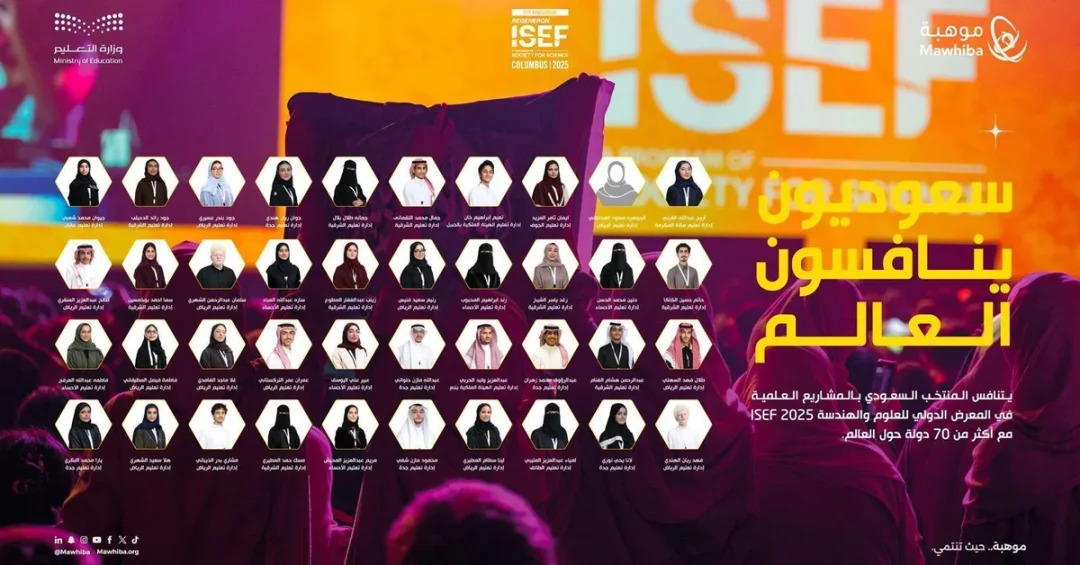
Saudi Arabia has selected 40 talented students to represent the Kingdom at the Regeneron International Science and Engineering Fair (ISEF) 2025, the world’s largest pre-university science and engineering competition. The selection was announced by the Ministry of Education and the King Abdulaziz and His Companions Foundation for Giftedness and Creativity (Mawhiba), following the outcomes of the Science and Engineering Fair: Ibdaa 2025, part of the National Olympiad for Scientific Creativity. The chosen students demonstrated exceptional excellence across a range of scientific and technological disciplines, earning the right to compete on a global stage. The announcement, released via the Saudi Press Agency (SPA), underscores the Kingdom’s continued investment in nurturing young scientific talent. How does a nation build a knowledge economy? By investing in its brightest minds early, and Saudi Arabia is doing exactly that.
The 2025 delegation marks a significant expansion from previous years, with the number of projects increasing from 35 in the last edition to 40. This growth reflects the Kingdom’s deepening commitment to science, technology, engineering, and mathematics (STEM) education as part of its Vision 2030 reform agenda. The students will join more than 1,600 peers from over 70 countries at ISEF 2025, where they will present research and innovation projects evaluated by an elite panel of international scientists and experts. For Saudi Arabia, this is not merely a competition; it is a demonstration of the Kingdom’s rising capabilities in research and innovation. What does it take to compete among the world’s best young scientists? Preparation, mentorship, and a national ecosystem that values curiosity and discovery.
Context and Background
How did Saudi Arabia become a regular contender at the world’s most prestigious pre-university science fair? The journey began in 2007, when the Kingdom, represented by Mawhiba and the Ministry of Education, first participated in ISEF. Since then, Saudi students have won a total of 160 awards, including 110 grand awards and 50 special awards. This track record places Saudi Arabia among the most successful nations at the competition, relative to its participation size. The consistent success is the result of a deliberate national strategy to identify and nurture gifted students from an early age, providing them with advanced training, research opportunities, and international exposure.
The selection process for ISEF 2025 was rigorous. Students first competed in the National Olympiad for Scientific Creativity, known as Ibdaa, which serves as the national qualifier. The Science and Engineering Fair: Ibdaa 2025 brought together the country’s most promising young researchers, whose projects were assessed by Saudi and international judges. The top 40 projects were then chosen to form the national team. This meritocratic pipeline ensures that only the most innovative and well-executed projects represent the Kingdom. It also provides a transparent and fair pathway for students from all regions of Saudi Arabia to showcase their abilities. What drives a student to spend months in a laboratory while their peers are on holiday? The promise of solving real-world problems and the honour of representing their country.
The Ministry of Education and Mawhiba have collaborated closely to build this pipeline. Mawhiba, established in 1999, is a non-profit organisation dedicated to discovering and nurturing giftedness and creativity in Saudi youth. Its programmes span from early identification in schools to advanced research internships and international competition preparation. The Ministry of Education, meanwhile, has integrated STEM enrichment into the national curriculum and supports specialised schools for gifted students. Together, they have created an ecosystem that not only identifies talent but also sustains it through mentorship and resources. This partnership is a cornerstone of Saudi Arabia’s human capital development strategy, which aims to diversify the economy away from oil and build a knowledge-based society.
Key Details
What exactly will the 40 students do at ISEF 2025? They will present original research projects in categories such as engineering, computer science, biology, chemistry, physics, and environmental science. The fair, organised by the Society for Science, will be held in the United States in May 2025. Each project will be evaluated by a panel of doctoral-level scientists and engineers, who will interview the students and assess the scientific rigour, creativity, and potential impact of their work. The top projects will receive grand awards, while special awards are presented by various organisations for specific areas of research. For the Saudi team, the goal is not only to win medals but also to learn from peers, engage with global experts, and bring back knowledge that can enrich the Kingdom’s research community.
The increase from 35 to 40 projects is a notable development. It signals that more Saudi students are producing research of international calibre, and that the national selection process is becoming more competitive. The additional five projects mean that more students will gain the invaluable experience of presenting at ISEF. This expansion aligns with the Kingdom’s target to increase the number of researchers and innovators per capita, as outlined in Vision 2030. It also reflects the growing emphasis on STEM education in Saudi schools, where robotics clubs, science fairs, and coding bootcamps have become increasingly common. The 40 students selected are not just individuals; they are ambassadors of a national transformation that values intellect and ingenuity.
Behind each project is a story of curiosity and perseverance. Students have worked with mentors from universities such as King Saud University, King Abdulaziz University, and King Fahd University of Petroleum and Minerals, as well as research centres affiliated with King Abdulaziz City for Science and Technology (KACST). These partnerships provide students with access to laboratories, data, and expertise that would otherwise be out of reach. The projects often address pressing challenges, from water desalination and renewable energy to medical diagnostics and artificial intelligence. By tackling real-world problems, the students demonstrate that Saudi youth are not only consumers of technology but also creators of solutions. This hands-on research experience is a key differentiator in their development as future scientists and engineers.
International and Regional Impact
How does Saudi Arabia’s participation in ISEF affect its standing in the global scientific community? Competing at ISEF signals that the Kingdom is serious about developing a knowledge economy and contributing to global scientific progress. The fair attracts media attention from around the world, and the achievements of Saudi students help to reshape perceptions of the country as a hub for innovation. When a Saudi student wins a grand award in biomedical engineering or environmental science, it sends a powerful message: the Kingdom’s youth are capable of world-class research. This soft power effect is invaluable for attracting international partnerships, foreign investment in research and development, and top-tier talent to Saudi universities and companies.
Regionally, Saudi Arabia’s success at ISEF serves as an inspiration for neighbouring countries. The Gulf region has increasingly focused on STEM education, and Saudi Arabia’s systematic approach—identifying gifted students early, providing them with rigorous training, and sending them to international competitions—offers a model that others can emulate. The Kingdom’s participation also strengthens scientific diplomacy. By engaging with students and educators from over 70 countries, Saudi delegates build networks that can lead to future collaborations. These interactions foster mutual understanding and position Saudi Arabia as a constructive partner in addressing global challenges such as climate change, health security, and digital transformation. In a world where science and technology are central to economic competitiveness, Saudi Arabia’s investment in its young scientists is a strategic imperative.
Economic and Strategic Significance
What is the economic value of sending 40 students to a science fair? The returns are long-term and multifaceted. First, these students are likely to become the researchers, entrepreneurs, and engineers who will drive Saudi Arabia’s economic diversification. By nurturing their talents, the Kingdom increases its pool of human capital capable of innovation. Second, the projects they develop often have commercial potential. A student’s research on solar cell efficiency or water purification could evolve into a startup or a patent, contributing to the growth of knowledge-intensive industries. Third, the prestige associated with ISEF success enhances the reputation of Saudi educational institutions, making them more attractive to international students and faculty.
From a strategic perspective, the selection of 40 students is a clear signal of Saudi Arabia’s commitment to Vision 2030, which aims to build a diversified, innovation-driven economy. The Vision’s Human Capability Development Program explicitly targets the improvement of education outcomes and the cultivation of future leaders. Mawhiba’s role is central to this effort, as it identifies and supports gifted individuals who might otherwise go unnoticed. The Ministry of Education’s policies, including the expansion of gifted education programmes, complement these efforts. Together, they are creating a pipeline that stretches from primary school to international competitions and beyond. The 40 students heading to ISEF 2025 are the latest beneficiaries of this national project, and their performance will be watched closely as an indicator of the Kingdom’s progress.
Vision 2030 Alignment
How does this achievement fit into the broader Vision 2030 framework? One of the Vision’s core themes is the development of a vibrant society and a thriving economy, both of which depend on a well-educated population. By investing in STEM education and sending students to compete globally, Saudi Arabia is building the intellectual infrastructure needed for a post-oil future. The Kingdom aims to increase the number of Saudi universities in global rankings, boost research output, and foster a culture of innovation. The success of students at ISEF directly supports these goals by demonstrating that Saudi education can produce world-class scientists. It also encourages younger students to pursue STEM fields, creating a virtuous cycle of achievement.
Looking ahead, the 40 students selected for ISEF 2025 will carry the hopes of a nation that is rapidly transforming. Their participation is not an end in itself but a step in a lifelong journey of discovery. Many alumni of Mawhiba programmes have gone on to study at top universities such as Stanford, MIT, and KAUST, and have returned to contribute to Saudi Arabia’s development. As the Kingdom continues to invest in its youth, the returns will be measured not only in medals but in patents, startups, and scientific breakthroughs that improve lives. The world will be watching ISEF 2025, and Saudi Arabia’s young scientists are ready to shine. What could be more inspiring than a generation that dreams in equations and builds in laboratories? That is the future Saudi Arabia is nurturing today.
20 Questions
Q1. What is ISEF 2025?
A1. ISEF 2025 is the Regeneron International Science and Engineering Fair, the world’s largest pre-university science competition. It brings together over 1,600 students from more than 70 countries to present research projects evaluated by international experts.
Q2. How many Saudi students will attend ISEF 2025?
A2. Forty talented students have been selected to represent Saudi Arabia at ISEF 2025, an increase from 35 participants in the previous edition. They will present 40 projects across various scientific fields.
Q3. Which organisations selected the students?
A3. The Ministry of Education and the King Abdulaziz and His Companions Foundation for Giftedness and Creativity (Mawhiba) selected the students based on the outcomes of the Science and Engineering Fair: Ibdaa 2025.
Q4. What is Mawhiba?
A4. Mawhiba is a Saudi non-profit organisation dedicated to discovering and nurturing giftedness and creativity in youth. It has partnered with the Ministry of Education since 2007 to send Saudi teams to ISEF.
Q5. How many awards has Saudi Arabia won at ISEF?
A5. Since 2007, Saudi Arabia has won a total of 160 awards at ISEF, including 110 grand awards and 50 special awards. This track record reflects the Kingdom’s strong commitment to STEM education.
Q6. What is the National Olympiad for Scientific Creativity?
A6. The National Olympiad for Scientific Creativity, known as Ibdaa, is a national competition that identifies talented students in science and engineering. It serves as the qualifier for the Saudi team at ISEF.
Q7. Where will ISEF 2025 be held?
A7. ISEF 2025 will be held in the United States in May 2025. The exact city is announced by the Society for Science, the organising body of the fair.
Q8. What fields will the Saudi students compete in?
A8. Saudi students will compete in diverse fields such as engineering, computer science, biology, chemistry, physics, and environmental science. Their projects address real-world challenges and are evaluated by international experts.
Q9. How are ISEF projects judged?
A9. Projects are judged by a panel of elite international scientists and experts. They assess scientific rigour, creativity, and potential impact through interviews and presentations. Grand and special awards are then presented.
Q10. Why is the increase to 40 projects significant?
A10. The increase from 35 to 40 projects indicates that more Saudi students are producing research of international calibre. It also reflects the growing emphasis on STEM education and innovation in the Kingdom.
Q11. How does ISEF participation benefit Saudi Arabia?
A11. It enhances Saudi Arabia’s reputation as a hub for innovation, builds international networks, and inspires younger students to pursue STEM. It also contributes to the development of a knowledge-based economy.
Q12. What role does the Ministry of Education play?
A12. The Ministry of Education integrates STEM enrichment into the curriculum and supports gifted education programmes. It collaborates with Mawhiba to identify and prepare students for international competitions like ISEF.
Q13. Have Saudi students won awards at ISEF before?
A13. Yes, Saudi students have won 160 awards since 2007, including 110 grand awards and 50 special awards. This demonstrates the consistent quality of Saudi scientific talent on the global stage.
Q14. What is the selection process for the Saudi team?
A14. Students first compete in the National Olympiad for Scientific Creativity (Ibdaa). The top projects are then selected by a panel of judges to form the national team that represents Saudi Arabia at ISEF.
Q15. How does ISEF align with Vision 2030?
A15. ISEF participation supports Vision 2030’s goals of building a knowledge economy and developing human capabilities. It showcases Saudi youth’s potential and encourages innovation, which is central to economic diversification.
Q16. What kind of projects do Saudi students present?
A16. Saudi students present original research in fields such as renewable energy, water desalination, medical diagnostics, artificial intelligence, and robotics. Many projects address pressing national and global challenges.
Q17. Who funds the Saudi participation in ISEF?
A17. The participation is funded and organised by Mawhiba in partnership with the Ministry of Education. Mawhiba is supported by both public and private sector contributions.
Q18. How can students qualify for future ISEF teams?
A18. Students can qualify by excelling in the National Olympiad for Scientific Creativity and other Mawhiba programmes. They must demonstrate exceptional research skills and creativity in STEM fields.
Q19. What impact does ISEF have on Saudi students’ careers?
A19. ISEF alumni often attend top universities and pursue careers in science, engineering, and entrepreneurship. The experience builds confidence, networks, and skills that are valuable for their future contributions to Saudi Arabia.
Q20. What is the ultimate goal of Saudi Arabia’s participation in ISEF?
A20. The ultimate goal is to nurture a generation of innovators who can drive Saudi Arabia’s economic diversification and global competitiveness. It also aims to inspire a culture of scientific inquiry and achievement across the Kingdom.
Reader Feedback
We value your thoughts. Please share your feedback on this article.
Your feedback helps us improve our coverage.
Related articles
 The Garage Academy Launches to Boost Saudi Tech Startups
 SDAIA Lists ALLaM 7B Arabic AI Model on Hugging Face
 SDAIA Represents Saudi Arabia at Global AI Partnership Session
 Saudi CST Delegation Engages Global Tech Leaders at MWC 2025
 King Faisal University Tops 2024 NAI Patent Ranking
 SDAIA Empowers Saudi Women to Shape the Future of AI